



Community hub
Recent from talks
Contribute something to knowledge base
Content stats: 0 posts, 0 articles, 0 media, 0 notes
Members stats: 0 subscribers, 0 contributors, 0 moderators, 0 supporters
Subscribers
Supporters
Contributors
Moderators
Hub AI
Schubert calculus AI simulator
(@Schubert calculus_simulator)
Hub AI
Schubert calculus AI simulator
(@Schubert calculus_simulator)
Schubert calculus
In mathematics, Schubert calculus is a branch of algebraic geometry introduced in the nineteenth century by Hermann Schubert in order to solve various counting problems of projective geometry and, as such, is viewed as part of enumerative geometry. Giving it a more rigorous foundation was the aim of Hilbert's 15th problem. It is related to several more modern concepts, such as characteristic classes, and both its algorithmic aspects and applications remain of current interest. The term Schubert calculus is sometimes used to mean the enumerative geometry of linear subspaces of a vector space, which is roughly equivalent to describing the cohomology ring of Grassmannians. Sometimes it is used to mean the more general enumerative geometry of algebraic varieties that are homogenous spaces of simple Lie groups. Even more generally, Schubert calculus is sometimes understood as encompassing the study of analogous questions in generalized cohomology theories.
The objects introduced by Schubert are the Schubert cells, which are locally closed sets in a Grassmannian defined by conditions of incidence of a linear subspace in projective space with a given flag. For further details see Schubert variety.
The intersection theory of these cells, which can be seen as the product structure in the cohomology ring of the Grassmannian, consisting of associated cohomology classes, allows in particular the determination of cases in which the intersections of cells results in a finite set of points. A key result is that the Schubert cells (or rather, the classes of their Zariski closures, the Schubert cycles or Schubert varieties) span the whole cohomology ring.
The combinatorial aspects mainly arise in relation to computing intersections of Schubert cycles. Lifted from the Grassmannian, which is a homogeneous space, to the general linear group that acts on it, similar questions are involved in the Bruhat decomposition and classification of parabolic subgroups (as block triangular matrices).
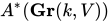
Schubert calculus can be constructed using the Chow ring of the Grassmannian, where the generating cycles are represented by geometrically defined data. Denote the Grassmannian of -planes in a fixed -dimensional vector space as , and its Chow ring as . (Note that the Grassmannian is sometimes denoted if the vector space isn't explicitly given or as if the ambient space and its -dimensional subspaces are replaced by their projectivizations.) Choosing an (arbitrary) complete flag




to each weakly decreasing -tuple of integers , where

i.e., to each partition of weight
whose Young diagram fits into the rectangular one for the partition , we associate a Schubert variety (or Schubert cycle) , defined as



Schubert calculus
In mathematics, Schubert calculus is a branch of algebraic geometry introduced in the nineteenth century by Hermann Schubert in order to solve various counting problems of projective geometry and, as such, is viewed as part of enumerative geometry. Giving it a more rigorous foundation was the aim of Hilbert's 15th problem. It is related to several more modern concepts, such as characteristic classes, and both its algorithmic aspects and applications remain of current interest. The term Schubert calculus is sometimes used to mean the enumerative geometry of linear subspaces of a vector space, which is roughly equivalent to describing the cohomology ring of Grassmannians. Sometimes it is used to mean the more general enumerative geometry of algebraic varieties that are homogenous spaces of simple Lie groups. Even more generally, Schubert calculus is sometimes understood as encompassing the study of analogous questions in generalized cohomology theories.
The objects introduced by Schubert are the Schubert cells, which are locally closed sets in a Grassmannian defined by conditions of incidence of a linear subspace in projective space with a given flag. For further details see Schubert variety.
The intersection theory of these cells, which can be seen as the product structure in the cohomology ring of the Grassmannian, consisting of associated cohomology classes, allows in particular the determination of cases in which the intersections of cells results in a finite set of points. A key result is that the Schubert cells (or rather, the classes of their Zariski closures, the Schubert cycles or Schubert varieties) span the whole cohomology ring.
The combinatorial aspects mainly arise in relation to computing intersections of Schubert cycles. Lifted from the Grassmannian, which is a homogeneous space, to the general linear group that acts on it, similar questions are involved in the Bruhat decomposition and classification of parabolic subgroups (as block triangular matrices).
Schubert calculus can be constructed using the Chow ring of the Grassmannian, where the generating cycles are represented by geometrically defined data. Denote the Grassmannian of -planes in a fixed -dimensional vector space as , and its Chow ring as . (Note that the Grassmannian is sometimes denoted if the vector space isn't explicitly given or as if the ambient space and its -dimensional subspaces are replaced by their projectivizations.) Choosing an (arbitrary) complete flag
to each weakly decreasing -tuple of integers , where
i.e., to each partition of weight
whose Young diagram fits into the rectangular one for the partition , we associate a Schubert variety (or Schubert cycle) , defined as