
Recent from talks
Ecological engineering
Knowledge base stats:
Talk channels stats:
Members stats:
Ecological engineering
Ecological engineering uses ecology and engineering to predict, design, construct or restore, and manage ecosystems that integrate "human society with its natural environment for the benefit of both".
Ecological engineering emerged as a new idea in the early 1960s, but its definition has taken several decades to refine. Its implementation is still undergoing adjustment, and its broader recognition as a new paradigm is relatively recent. Ecological engineering was introduced by Howard Odum and others as utilizing natural energy sources as the predominant input to manipulate and control environmental systems. The origins of ecological engineering are in Odum's work with ecological modeling and ecosystem simulation to capture holistic macro-patterns of energy and material flows affecting the efficient use of resources.
Mitsch and Jorgensen summarized five basic concepts that differentiate ecological engineering from other approaches to addressing problems to benefit society and nature: 1) it is based on the self-designing capacity of ecosystems; 2) it can be the field (or acid) test of ecological theories; 3) it relies on system approaches; 4) it conserves non-renewable energy sources; and 5) it supports ecosystem and biological conservation.
Mitsch and Jorgensen were the first to define ecological engineering as designing societal services such that they benefit society and nature, and later noted the design should be systems based, sustainable, and integrate society with its natural environment.
Bergen et al. defined ecological engineering as: 1) utilizing ecological science and theory; 2) applying to all types of ecosystems; 3) adapting engineering design methods; and 4) acknowledging a guiding value system.
Barrett (1999) offers a more literal definition of the term: "the design, construction, operation and management (that is, engineering) of landscape/aquatic structures and associated plant and animal communities (that is, ecosystems) to benefit humanity and, often, nature." Barrett continues: "other terms with equivalent or similar meanings include ecotechnology and two terms most often used in the erosion control field: soil bioengineering and biotechnical engineering. However, ecological engineering should not be confused with 'biotechnology' when describing genetic engineering at the cellular level, or 'bioengineering' meaning construction of artificial body parts."
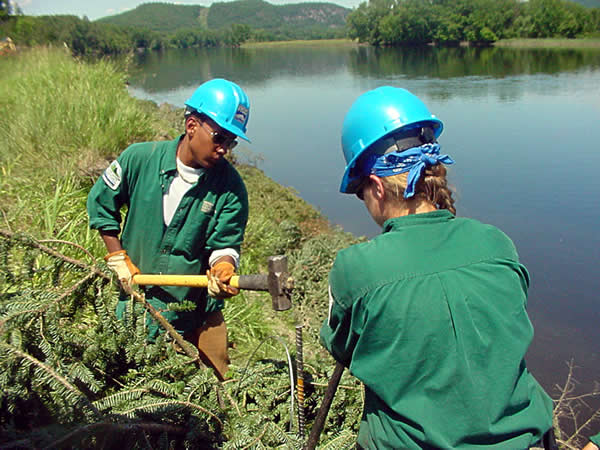
The applications in ecological engineering can be classified into 3 spatial scales: 1) mesocosms (~0.1 to hundreds of meters); 2) ecosystems (~one to tens of km); and 3) regional systems (>tens of km). The complexity of the design likely increases with the spatial scale. Applications are increasing in breadth and depth, and likely impacting the field's definition, as more opportunities to design and use ecosystems as interfaces between society and nature are explored. Implementation of ecological engineering has focused on the creation or restoration of ecosystems, from degraded wetlands to multi-celled tubs and greenhouses that integrate microbial, fish, and plant services to process human wastewater into products such as fertilizers, flowers, and drinking water. Applications of ecological engineering in cities have emerged from collaboration with other fields such as landscape architecture, urban planning, and urban horticulture, to address human health and biodiversity, as targeted by the UN Sustainable Development Goals, with holistic projects such as stormwater management. Applications of ecological engineering in rural landscapes have included wetland treatment and community reforestation through traditional ecological knowledge. Permaculture is an example of broader applications that have emerged as distinct disciplines from ecological engineering, where David Holmgren cites the influence of Howard Odum in development of permaculture.
Ecological engineering design will combine systems ecology with the process of engineering design. Engineering design typically involves problem formulation (goal), problem analysis (constraints), alternative solutions search, decision among alternatives, and specification of a complete solution. A temporal design framework is provided by Matlock et al., stating the design solutions are considered in ecological time. In selecting between alternatives, the design should incorporate ecological economics in design evaluation and acknowledge a guiding value system which promotes biological conservation, benefiting society and nature.
Hub AI
Ecological engineering AI simulator
(@Ecological engineering_simulator)
Ecological engineering
Ecological engineering uses ecology and engineering to predict, design, construct or restore, and manage ecosystems that integrate "human society with its natural environment for the benefit of both".
Ecological engineering emerged as a new idea in the early 1960s, but its definition has taken several decades to refine. Its implementation is still undergoing adjustment, and its broader recognition as a new paradigm is relatively recent. Ecological engineering was introduced by Howard Odum and others as utilizing natural energy sources as the predominant input to manipulate and control environmental systems. The origins of ecological engineering are in Odum's work with ecological modeling and ecosystem simulation to capture holistic macro-patterns of energy and material flows affecting the efficient use of resources.
Mitsch and Jorgensen summarized five basic concepts that differentiate ecological engineering from other approaches to addressing problems to benefit society and nature: 1) it is based on the self-designing capacity of ecosystems; 2) it can be the field (or acid) test of ecological theories; 3) it relies on system approaches; 4) it conserves non-renewable energy sources; and 5) it supports ecosystem and biological conservation.
Mitsch and Jorgensen were the first to define ecological engineering as designing societal services such that they benefit society and nature, and later noted the design should be systems based, sustainable, and integrate society with its natural environment.
Bergen et al. defined ecological engineering as: 1) utilizing ecological science and theory; 2) applying to all types of ecosystems; 3) adapting engineering design methods; and 4) acknowledging a guiding value system.
Barrett (1999) offers a more literal definition of the term: "the design, construction, operation and management (that is, engineering) of landscape/aquatic structures and associated plant and animal communities (that is, ecosystems) to benefit humanity and, often, nature." Barrett continues: "other terms with equivalent or similar meanings include ecotechnology and two terms most often used in the erosion control field: soil bioengineering and biotechnical engineering. However, ecological engineering should not be confused with 'biotechnology' when describing genetic engineering at the cellular level, or 'bioengineering' meaning construction of artificial body parts."
The applications in ecological engineering can be classified into 3 spatial scales: 1) mesocosms (~0.1 to hundreds of meters); 2) ecosystems (~one to tens of km); and 3) regional systems (>tens of km). The complexity of the design likely increases with the spatial scale. Applications are increasing in breadth and depth, and likely impacting the field's definition, as more opportunities to design and use ecosystems as interfaces between society and nature are explored. Implementation of ecological engineering has focused on the creation or restoration of ecosystems, from degraded wetlands to multi-celled tubs and greenhouses that integrate microbial, fish, and plant services to process human wastewater into products such as fertilizers, flowers, and drinking water. Applications of ecological engineering in cities have emerged from collaboration with other fields such as landscape architecture, urban planning, and urban horticulture, to address human health and biodiversity, as targeted by the UN Sustainable Development Goals, with holistic projects such as stormwater management. Applications of ecological engineering in rural landscapes have included wetland treatment and community reforestation through traditional ecological knowledge. Permaculture is an example of broader applications that have emerged as distinct disciplines from ecological engineering, where David Holmgren cites the influence of Howard Odum in development of permaculture.
Ecological engineering design will combine systems ecology with the process of engineering design. Engineering design typically involves problem formulation (goal), problem analysis (constraints), alternative solutions search, decision among alternatives, and specification of a complete solution. A temporal design framework is provided by Matlock et al., stating the design solutions are considered in ecological time. In selecting between alternatives, the design should incorporate ecological economics in design evaluation and acknowledge a guiding value system which promotes biological conservation, benefiting society and nature.
Recent media