Hubbry Logo
Ed BaileyEd BaileyMain
Open search
Ed Bailey
Community hub
Ed Bailey
logo
8 pages, 0 posts
0 subscribers
Be the first to start a discussion here.
Ed Bailey
Ed Bailey
from Wikipedia

Lonas Edgar Bailey, Jr. (April 15, 1931 – March 23, 2007) was an American professional baseball player and later served on the Knoxville, Tennessee city council.[1][2] He played as a catcher in Major League Baseball from 1953 through 1966.[1] A six-time All-Star, Bailey was one of the top catchers in the National League in the late 1950s and early 1960s.[3]

Key Information

Born in Strawberry Plains in Jefferson County, Tennessee, Bailey batted left-handed, threw right-handed and was listed as 6 feet 2 inches (1.88 m) tall and 205 pounds (93 kg). A younger brother, Jim, was a left-handed pitcher who had a brief big-league trial as Ed's teammate on the 1959 Cincinnati Reds.

Major League career

[edit]

Ed Bailey signed with the Reds in 1950 as an amateur free agent. He reached the Majors in 1953 and in 1955 he was given a chance as the Redlegs' (the Cincinnati team's nickname from 1953 to 1958) starting catcher, replacing Andy Seminick. When his offensive production floundered, the Redlegs traded Seminick for catcher Smoky Burgess and Bailey was sent down to the San Diego Padres of the Pacific Coast League.[3] With the help of some batting advice from Redlegs manager and former catcher Birdie Tebbetts, his hitting improved in the minor leagues and continued to improve in the Venezuelan Winter League.[3]

Bailey began the 1956 season as the backup catcher to Burgess, but when the team faltered early in the season, Tebbetts decided to shake things up and named Bailey as the Redlegs' starting catcher.[3] By mid-season, he was the leading hitter in the National League with a .335 batting average, helping to spur the Redlegs into first place.[4][5] His hitting performance earned him a place as the starting catcher for the National League in the 1956 All-Star Game.[6] The Redlegs stayed in the pennant race until the last day of the season, ending up with a 91–63 record, two games behind the Brooklyn Dodgers.[5] Bailey ended the 1956 season with career-highs in batting average (.300), home runs (28), runs batted in (75), and led the league in baserunners caught stealing (23).[1][3]

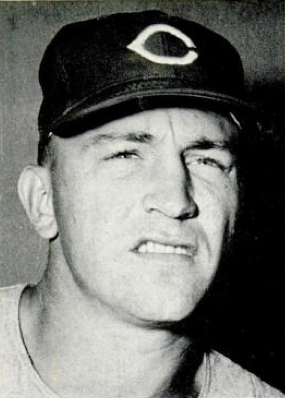
Bailey in 1961

In 1957, the Redlegs were once again in first place at mid-season, but faltered to finish the season in fourth place.[7] Bailey earned his second consecutive start for the National League All-Star Team, led National League catchers with a 46.2 Caught Stealing percentage and finished second to Roy Campanella with a .992 fielding percentage.[8][9] He remained as the Reds' starting catcher for the rest of the 1950s up until 12 games into the 1961 season, when he was traded to the San Francisco Giants for second baseman Don Blasingame and catcher Bob Schmidt.[10]

In 1962, Bailey platooned with catcher Tom Haller, as the two players—both left-handed hitters—combined to give the Giants 35 home runs and 100 runs batted in from the catcher's position.[11] In June of that year, Bailey had a streak of 3 clutch home runs in four games that propelled the Giants into first place.[12] The Giants battled the Los Angeles Dodgers in a tight pennant race as the two teams ended the season tied for first place and met in the 1962 National League tie-breaker series.[13] The Giants won the three-game series to clinch the National League championship.[13][14] Bailey appeared in six games of the 1962 World Series, hitting a home run in Game 3 as the Giants lost to the New York Yankees in seven games.[15][16] He had another strong year in 1963, hitting 21 home runs with 68 runs batted in, earning his fifth and final All-Star berth.[17]

In December 1963, Bailey was traded along with Felipe Alou and Billy Hoeft to the Milwaukee Braves for Del Crandall, Bob Hendley and Bob Shaw.[10] He served as Joe Torre's back up for two seasons with the Braves before being traded back to the Giants in February 1965.[10] After just fourteen games of the 1965 season, he was traded again, this time to the Chicago Cubs, where he served as a backup catcher to Vic Roznovsky.[10] On July 22, 1965, Bailey hit a grand slam home run, a three-run home run and a run-scoring single to drive home eight runs during a game against the Philadelphia Phillies.[18] After the 1965 season, he was traded to the California Angels and was released after appearing in only five games of the 1966 season.[10]

Career statistics

[edit]

In a fourteen-season major league career, Bailey played in 1,212 games with 915 hits in 3,581 at bats for a .256 batting average along with 155 home runs and 540 runs batted in, including 423 runs, a .355 on-base percentage and a .986 fielding percentage.[1] He was a six-time All-Star and led National League catchers in baserunners caught stealing and caught stealing percentage once each.[1] At the time of his retirement, he ranked 11th overall for career home runs by a catcher.[19] His younger brother, pitcher Jim Bailey, also played in the Major Leagues.[20] When his brother joined the Reds in 1959, the Bailey brothers became one of the few brother-batteries in Major League history.[21]

In between, Bailey guided both the Lácteos de Pastora[22] and Industriales de Valencia[23] to Venezuela League championship titles,[24] and later played with them in the Caribbean Series tournament in 1954 and 1956, respectively.[25]

1957 All-Star Game ballot stuffing controversy

[edit]

In 1957, Bailey and six of his Redleg teammates—Roy McMillan, Johnny Temple, Don Hoak, Gus Bell, Wally Post and Frank Robinson—were voted into the National League All-Star starting lineup, the result of a ballot stuffing campaign by Redlegs fans.[26][27] Major League Baseball Commissioner Ford Frick intervened, removing Bell and Post from the starting line up and replacing them with Hank Aaron and Willie Mays. Frick allowed Bell to remain on the team as a reserve while Post was removed from the team altogether. The Commissioner also transferred the responsibility for All-Star voting to the players, managers and coaches the following year.[26]

On television

[edit]

Later life

[edit]

Bailey later served for 12 years on the Knoxville, Tennessee city council from 1983 to 1995 and, worked for United States Congressman Jimmy Duncan.[2] He died in Knoxville in 2007, following a battle with throat cancer.[29]

Highlights

[edit]

References

[edit]
[edit]
Revisions and contributorsEdit on WikipediaRead on Wikipedia
from Grokipedia
Ed Bailey (April 15, 1931 – March 23, 2007) was an American professional baseball who played in for 14 seasons from 1953 to 1966, primarily with the Cincinnati Redlegs/Reds (1953–1961) and (1961–1962, 1965), along with stints for the Milwaukee Braves (1964), Chicago Cubs (1965), and California Angels (1966). A five-time selection known for his left-handed power hitting, strong throwing arm, and defensive skills in thwarting , Bailey contributed significantly to the Giants' 1962 National League pennant win and World Series appearance, while batting .256 over his career with 155 and 540 . Born Lonas Edgar "Ed" Bailey Jr. in Strawberry Plains, , he grew up in a -oriented family as the brother of fellow player and honed his skills at the on a dual and baseball scholarship before signing with the . His MLB debut came on September 26, 1953, with the Reds, where he quickly established himself as a reliable catcher, earning nods in , , , , and . Bailey's career highlights included a career-high 28 home runs in 1956 and his role in the ' move from to , where he helped anchor the team during their competitive years in the early 1960s. Defensively, Bailey was renowned for his accuracy and arm strength, ranking among the top catchers of his era in throwing out runners attempting to steal bases and leading the in in . After retiring as a player, he worked in and served as an aide to U.S. Representative John J. Duncan, Sr. for 12 years and as a member of the Knoxville City Council from 1983 to 1995, before being inducted into the in 1982 for his contributions to the sport. Bailey passed away in Knoxville, Tennessee, at age 75, leaving a legacy as one of the premier catchers of the 1950s and 1960s.

Early Life

Childhood and Family Background

Lonas Edgar Bailey Jr., known as Ed Bailey, was born on April 15, 1931, in the rural community of Strawberry Plains, Tennessee, just outside Knoxville. He was one of six children born to Lonas Edgar Bailey, who operated a general store, and Edna Floyd Cox, with the family residing on a farm that shaped their daily life. Growing up in this agricultural setting, Bailey and his four brothers shared responsibilities and leisure activities that fostered a strong family bond and early interest in physical pursuits. The brothers routinely milked cows as part of farm chores, while also engaging in and expeditions that provided both sustenance and recreation. Among his siblings was younger brother James Hopkins "Hop" Bailey, who later pursued a professional career as a left-handed pitcher, even forming a brief battery with Ed in the . Bailey's parents emphasized the value of education, influencing his early decisions regarding sports and opportunities. Despite early talent in , they encouraged him to prioritize schooling over immediate professional contracts, guiding the family toward a path that balanced rural traditions with academic aspirations.

Education and Amateur Sports

Ed Bailey attended Rush Strong High School in Strawberry Plains, Tennessee, where he distinguished himself as an all-state catcher in baseball and earned all-state honors in basketball. His achievements in these sports drew early attention from professional scouts, highlighting his potential as a multi-sport athlete. At age 14, Bailey participated in a tryout camp arranged by a Pittsburgh Pirates scout for their Class D farm club in Salisbury, North Carolina; appearing large enough to pass for 16, he impressed but later confessed his true age and returned home. Despite interest from following his high school success, Bailey rejected professional contract offers to honor his parents' wishes and pursue . He enrolled at the in Knoxville in 1948 on a basketball and . During his time at , Bailey balanced participation in both basketball and baseball, though academic challenges in his sophomore year—nearly leading to his flunking out—prompted him to prioritize baseball as a more promising path while still in his . His farm upbringing near Strawberry Plains further contributed to the physical conditioning that supported his athletic endeavors in these organized sports.

Professional Career

Signing and Minor Leagues

Ed Bailey signed with the in November 1949, receiving a reported to be as much as $35,000. This substantial offer came after his standout performances in , including time at the , where he had shifted focus from to before leaving after his sophomore year. Bailey's professional career in the began in 1950 with the Reds' organization, starting in Class C ball where he hit .313 as a . He spent time with the Ogden Reds in the , honing his skills behind the plate during this early developmental phase. Following a two-year stint in the at Fort Jackson, South Carolina, Bailey returned to in 1953, assigned to the Double-A Tulsa Oilers of the . There, he batted .243 with 21 and a .352 , demonstrating his growing power while adapting to higher-level competition. Throughout his , Bailey faced challenges such as being sent down for additional seasoning despite impressive showings, like a 5-for-5 performance with two in a 1953 exhibition game. Managers like Luke Sewell praised his potential, noting, “Bailey has everything you look for in a , plus a world of savvy.” Birdie Tebbetts provided crucial guidance on , advising him to avoid , which Bailey applied during in the to refine his approach. These experiences helped him overcome the demands of professional play and prepare for the .

Cincinnati Reds Tenure (1953–1961)

Ed Bailey made his major league debut with the on September 26, 1953, against the , where he doubled in his and finished the game 3-for-5. Following this promising start, Bailey saw limited action in 1953 and 1954, appearing in just two games in 1953 and 73 in 1954 while batting .197 with nine home runs, sharing catching duties with veterans like . His preparation, including a .313 average in Class C ball in 1950, had positioned him as a prospect, but early major league opportunities were scarce as he adjusted to the level. By , Bailey began to secure more playing time, though he still competed with for the starting role, appearing in 21 games with a .205 average. He became the regular in , delivering a breakout season with a .300 , 28 , and 75 in 118 games, earning him the starting nod for the All-Star Game. This performance highlighted his left-handed power and helped the Reds' offense, which tied a record with 221 home runs that year, finishing third in the National League with 91 wins. Bailey's prominence continued into amid a notable , where fans stuffed ballots—encouraged by local newspapers printing pre-marked forms—leading to seven , including Bailey at , topping the polls for starters. intervened to adjust the lineup, retaining Bailey along with four other while reinstating , , and , a move that stripped fans of for over a decade. Despite batting .261 with 20 home runs that season, Bailey's selection underscored his defensive value and the city's fervent support. Over his full tenure with the Reds from 1953 to 1961, Bailey appeared in 714 games, batting .261 with 94 home runs and 316 , solidifying his role as the primary due to his strong throwing arm and ability to handle , even as his offense stabilized around .250-.260 after 1956. In January 1959, the Reds traded to , affirming Bailey's status, and he briefly formed a brother battery with pitcher that year. However, on April 27, 1961, after just 12 games in which he hit .302, the Reds traded him to the for , catcher , and pitcher , a move that shocked Bailey and left the team scrambling at the position.

San Francisco Giants and Later Teams (1961–1966)

In April 1961, the Cincinnati Reds traded catcher Ed Bailey to the in exchange for second baseman Don Blasingame, catcher Bob Schmidt, and a (, completed on May 13). Bailey quickly became a key contributor for the Giants, platooning with Tom Haller behind the plate during their . In the three-game playoff series against the Los Angeles Dodgers to determine the pennant, Bailey batted 4-for-7 with a run scored and an , helping the Giants secure the victory. During the subsequent World Series against the , he appeared in six games, including hitting a home run in Game 3 at . Bailey earned an in while with the , showcasing his power at the plate. In 1963, he hit 21 home runs in 308 at-bats despite sharing catching duties with Haller, contributing significantly to the team's offense. Following the , the Giants traded him, along with , Billy Hoeft, and a (Ernie Bowman, January 8, ), to the Milwaukee Braves for , Bob Hendley, and Bob Shaw on December 3, 1963. With the Braves in 1964, Bailey had a brief stint, hitting five home runs while backing up , before being traded back to the Giants in February 1965 for reliever Billy O'Dell. In 1965, Bailey split time between the and the Chicago Cubs after being traded to the Cubs, along with and Bob Hendley, on May 29 for Dick Bertell and Len Gabrielson. One highlight came on July 22, when, playing for the Cubs against the Giants, he went 4-for-4 with two home runs—including a —and eight in a 17-2 victory. The Cubs then sold him to the California Angels on January 15, 1966, where he made his final appearance on April 26 before being released on May 7, marking the end of his playing career amid declining opportunities across multiple teams.

Playing Style and Achievements

Offensive Contributions

Ed Bailey, a left-handed batter renowned for his , compiled a career of .256, along with 155 and 540 over 1,212 games in . His offensive style emphasized with authority, leveraging his strong frame to generate , which allowed him to contribute significantly to his teams' lineups despite sharing . Bailey's offensive peak came during his early years with the Cincinnati Reds, where he established himself as a reliable power threat. In 1956, he enjoyed a breakout season, slashing .300/.385/.551 with 28 home runs and 75 RBIs in 118 games, marking his career high in batting average and long balls while demonstrating improved plate discipline with a .385 on-base percentage. The following year, 1957, saw him maintain solid production at .261 with 20 home runs, further solidifying his role as a key offensive contributor for the Reds. These performances highlighted his ability to blend average and power, though his output fluctuated in subsequent Reds seasons, such as .250 with 11 home runs in 1958. After being traded to the in April 1961, Bailey experienced a resurgence in power during the mid-1960s, adapting to the expansive despite its challenges for hitters. His most notable season offensively was , when he hit 21 home runs in just 105 games with a .263/.366/.494 slash line, showcasing sustained power in limited at-bats while splitting time . This period represented an evolution from his steadier but less explosive early Reds tenure to more concentrated power surges, though his overall batting average dipped to around .241 during his full seasons with the Giants. By the end of his career in , Bailey's offensive contributions had waned, but his career totals underscored his reputation as a left-handed power hitter capable of impactful seasons.

Defensive Skills

Ed Bailey was renowned for his defensive capabilities as a , particularly his strong throwing arm that enabled him to throw out a significant portion of during his career. Standing at 6 feet 2 inches and weighing 205 pounds, with a right-handed throwing motion, Bailey possessed the physical stature and arm strength that contributed to his reliability . His career stood at 40.0%, with 195 caught stealings out of 488 total attempts against him, demonstrating his effectiveness in deterring runners throughout much of his time in the . For instance, in a notable exhibition, he threw out three times in a single game, underscoring his arm's prowess. During his tenure with the from 1953 to 1961, Bailey's defensive skills were instrumental in managing the pitching staff, as he received tutelage from former and manager on catching and throwing techniques. Reds manager praised Bailey for having "everything you look for in a catcher, plus a world of savvy," highlighting his acumen in and handling pitchers effectively. This savvy helped Bailey maintain his position as the primary catcher over , whose superior offense was offset by Bailey's stronger defense. With the from 1961 to 1965, Bailey continued to leverage his defensive talents, contributing to the team's 1962 National League pennant win through reliable game management and pitch handling, though his dipped to 30% in 1961 partly due to factors like the Giants' pitching staff. His overall defensive reputation as a "damn good catcher," as he self-described, complemented his left-handed power hitting, making him a well-rounded contributor.

All-Star Selections and Postseason Play

Ed Bailey was selected to five National League during his career, in , , , , and . He earned a starting position as in the 1956 All-Star Game at , where he went hitless in three (with one ) during the National League's 7-3 victory. These selections were bolstered by his strong performances, such as leading NL catchers in in multiple years. Bailey's 1957 All-Star appearance was marred by controversy surrounding . Cincinnati Reds supporters, enthusiastic about their team, engaged in widespread , leading to five Reds starters—including Bailey at —being elected to the game at Busch Stadium. The scandal prompted to strip fans of starting in 1958, with players and managers taking over selections. Bailey started that game as well but recorded no hits in one at-bat amid the National League's 6-5 win in 11 innings. His later All-Star nods in 1960, 1961, and 1963 reflected continued recognition of his power-hitting and defensive skills, though he did not start any of those contests. Bailey's postseason opportunities were limited to the 1962 campaign with the , as the era featured only league champions advancing to the World Series with no . In the best-of-three National League tie-breaker series against the Los Angeles Dodgers, Bailey batted 4-for-7 (.571) over three games, including an in the ninth inning of Game 3 that forced in a run to help the Giants secure the with a 6-4 victory. He then appeared in six games of the World Series against the , starting five and contributing offensively with a in the ninth inning of Game 3, though the Giants lost 2-3. Despite these efforts, the Giants fell to the Yankees in seven games, marking Bailey's only World Series experience and underscoring the rarity of playoff berths in .

Personal Life and Legacy

Family and Post-Retirement Career

Ed Bailey married Betty Lou Carr in May 1952, shortly before the start of his career, and the couple raised four sons together in Knoxville, Tennessee, after his retirement from . One of their sons, Joe Bailey, later entered public service by serving on the Knoxville city council. Following his playing days, Bailey transitioned into work for a trash-hauling company in Knoxville, leveraging his communication skills from his background. He later served as a field representative for U.S. Congressman John J. Duncan Jr., assisting with constituent services and community outreach in . Bailey's post-retirement extended to politics, where he was elected to the Knoxville City Council and served from 1983 to 1995, focusing on addressing local constituent issues such as infrastructure and . During his tenure, he was noted for his in handling challenges, drawing on the perseverance he developed during his athletic career.

Civil Rights Involvement

During in 1954 in Tampa, Florida, Bailey participated in a notable act of protest against at a ballpark. While watching a game from the stands alongside his Black teammate Brooks Lawrence, they encountered segregated seating divided by a rope separating white and Black sections. Bailey, sitting on the white side with the rope between them, declared the situation "stupid" and removed the rope himself, allowing them to sit together without interference from authorities. This incident exemplified Bailey's brash and confident personality, traits that extended beyond the field into social issues during the pre-Civil Rights Act era, when was still legally enforced in many public spaces. Described by Cincinnati sportswriter Earl Lawson as unmatched in "sheer brashness and cockiness" since , Bailey's outspoken nature was supported by a team environment among the that disregarded racial divisions, as noted by teammate Bob Thurman. While no other documented instances of by Bailey have been recorded, this 1954 event stands as a significant example of his character and willingness to challenge firsthand.

Death and Honors

Ed Bailey died on March 23, 2007, at the age of 75 in Knoxville, Tennessee, from . He passed away at Parkwest Medical Center, where he had been receiving treatment. A memorial service was held for him on March 29, 2007, at the West End Church of Christ in Knoxville, honoring his legacy as a Tennessee Baseball Hall of Fame inductee. Bailey was buried at the Tennessee State Veterans Cemetery in Knoxville, reflecting his service in the during the Korean War era. Among his notable honors, Bailey was inducted into the Tennessee Sports Hall of Fame, recognizing his achievements as a native of Strawberry Plains, Tennessee, and his standout career as a . In reflecting on his legacy, Bailey is remembered for his contributions to , including five and his role in key team successes, as well as his 12 years of public service on the Knoxville City Council, which underscored his commitment to community involvement. His induction into halls of fame and posthumous tributes highlight his enduring impact on Tennessee sports and civic life.
Add your contribution
Related Hubs
User Avatar
No comments yet.