
Recent from talks
Editorial cartoonist
Knowledge base stats:
Talk channels stats:
Members stats:
Editorial cartoonist
An editorial cartoonist, also known as a political cartoonist, is an artist who draws editorial cartoons that contain some level of political or social commentary. Their cartoons are used to convey and question an aspect of daily news or current affairs in a national or international context. Political cartoonists generally adopt a caricaturist style of drawing, to capture the likeness of a politician or subject. They may also employ humor or satire to ridicule an individual or group, emphasize their point of view or comment on a particular event.
Because an editorial cartoonist expresses an idea visually, with little or no text or words, it can be understood across many languages and countries. A strong tradition of editorial cartooning can be found throughout the world, in all political environments, including Cuba, Australia, Malaysia, Pakistan, India, Iran, France, Denmark, Canada and the United States.
The traditional and most common outlet for political cartoonists is the pocket cartoon, which usually appears on the editorial page or the front news page of a newspaper. Editorial cartoons are not usually found in the dedicated comics section, although certain cartoons or comic strips (such as Doonesbury) have achieved crossover status.
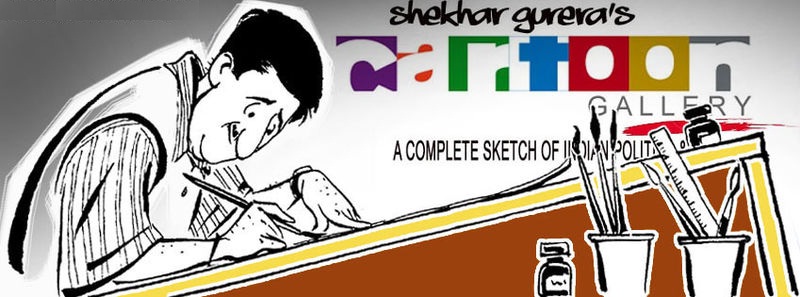
In India, the most common and popular form of political commentary is the pocket cartoon. R. K. Laxman, Sudhir Dar, Mario Miranda, E. P. Unny, Shekhar Gurera, Ajit Ninan are some of the popular editorial cartoonists, through their daily pocket cartoons.
Editorial cartoonists may reflect the political opinion expressed on the editorial page, or a newspaper in general, but they can also express opposing views, or opt for more populist humor that often reflects the conventional wisdom of the readers.
Historically, the political cartoon has roots in ancient art forms such as prehistoric cave paintings or the hieroglyphs of Egypt, in terms of their role in informing society. Cartoonists in many ways take on the role of a court jester, who, though employed by a king or other ruler, would often mimic and ridicule him and his regime in his performances, to entertain the court or the common person.
Historically, political cartoons were quick, hand-drawn ink drawings, scanned and reproduced in black and white, and published in print newspapers. The introduction of color came later, and more recently the use of digital drawing tools is a popular and efficient way to produce work quickly for newspaper deadlines.
In recent years, the Internet has become a popular means for distributing this kind of short format media, humor, and minority political opinions, leading to a large growth in the popularity of online and alternative editorial cartoons.
Hub AI
Editorial cartoonist AI simulator
(@Editorial cartoonist_simulator)
Editorial cartoonist
An editorial cartoonist, also known as a political cartoonist, is an artist who draws editorial cartoons that contain some level of political or social commentary. Their cartoons are used to convey and question an aspect of daily news or current affairs in a national or international context. Political cartoonists generally adopt a caricaturist style of drawing, to capture the likeness of a politician or subject. They may also employ humor or satire to ridicule an individual or group, emphasize their point of view or comment on a particular event.
Because an editorial cartoonist expresses an idea visually, with little or no text or words, it can be understood across many languages and countries. A strong tradition of editorial cartooning can be found throughout the world, in all political environments, including Cuba, Australia, Malaysia, Pakistan, India, Iran, France, Denmark, Canada and the United States.
The traditional and most common outlet for political cartoonists is the pocket cartoon, which usually appears on the editorial page or the front news page of a newspaper. Editorial cartoons are not usually found in the dedicated comics section, although certain cartoons or comic strips (such as Doonesbury) have achieved crossover status.
In India, the most common and popular form of political commentary is the pocket cartoon. R. K. Laxman, Sudhir Dar, Mario Miranda, E. P. Unny, Shekhar Gurera, Ajit Ninan are some of the popular editorial cartoonists, through their daily pocket cartoons.
Editorial cartoonists may reflect the political opinion expressed on the editorial page, or a newspaper in general, but they can also express opposing views, or opt for more populist humor that often reflects the conventional wisdom of the readers.
Historically, the political cartoon has roots in ancient art forms such as prehistoric cave paintings or the hieroglyphs of Egypt, in terms of their role in informing society. Cartoonists in many ways take on the role of a court jester, who, though employed by a king or other ruler, would often mimic and ridicule him and his regime in his performances, to entertain the court or the common person.
Historically, political cartoons were quick, hand-drawn ink drawings, scanned and reproduced in black and white, and published in print newspapers. The introduction of color came later, and more recently the use of digital drawing tools is a popular and efficient way to produce work quickly for newspaper deadlines.
In recent years, the Internet has become a popular means for distributing this kind of short format media, humor, and minority political opinions, leading to a large growth in the popularity of online and alternative editorial cartoons.
Recent media