Hubbry Logo
DrawingDrawingMain
Open search
Drawing
Community hub
Drawing
logo
8 pages, 0 posts
0 subscribers
Be the first to start a discussion here.
Contribute something
Drawing
Drawing
from Wikipedia
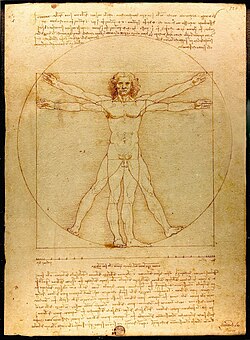
Leonardo da Vinci's Vitruvian Man (c. 1485) Accademia, Venice

Drawing is a visual art that uses an instrument to mark paper or another two-dimensional surface, or a digital representation of such. Traditionally, the instruments used to make a drawing include pencils, crayons, and ink pens, sometimes in combination. More modern tools include computer styluses with mice and graphics tablets and gamepads in VR drawing software.

A drawing instrument releases a small amount of material onto a surface, leaving a visible mark. The most common support for drawing is paper, although other materials, such as cardboard, vellum, wood, plastic, leather, canvas, and board, have been used. Temporary drawings may be made on a blackboard or whiteboard. Drawing has been a popular and fundamental means of public expression throughout human history. It is one of the simplest and most efficient means of communicating ideas.[1] The wide availability of drawing instruments makes drawing one of the most common artistic activities.

In addition to its more artistic forms, drawing is frequently used in commercial illustration, animation, architecture, engineering, and technical drawing. A quick, freehand drawing, usually not intended as a finished work, is sometimes called a sketch. An artist who practices or works in technical drawing may be called a drafter, draftsman, or draughtsman.[2]

Overview

[edit]
Madame Palmyre with Her Dog, 1897. Henri de Toulouse-Lautrec

Drawing is one of the oldest forms of human expression within the visual arts. It is generally concerned with the marking of lines and areas of tone onto paper/other material, where the accurate representation of the visual world is expressed upon a plane surface.[3] Traditional drawings were monochrome, or at least had little colour,[4] while modern colored-pencil drawings may approach or cross a boundary between drawing and painting. In Western terminology, drawing is distinct from painting, even though similar media often are employed in both tasks. Dry media, normally associated with drawing, such as chalk, may be used in pastel paintings. Drawing may be done with a liquid medium, applied with brushes or pens. Using a brush for drawing is very widespread and here it is more the process of using lines and hatching, that characterises something as a drawing. Similar supports likewise can serve both: painting generally involves the application of liquid paint onto prepared canvas or panels, but sometimes an underdrawing is drawn first on that same support.

Drawing is often exploratory, with considerable emphasis on observation, problem-solving and composition. Drawing is also regularly used in preparation for a painting, further obfuscating their distinction. Drawings created for these purposes are called sketches.

There are several categories of drawing, including:

There are also many drawing methods, such as:

In fields outside art, technical drawings or plans of buildings, machinery, circuitry and other things are often called "drawings" even when they have been transferred to another medium by printing.

History

[edit]

In communication

[edit]

Drawing is one of the oldest forms of human expression, with evidence for its existence preceding that of written communication.[5] It is believed that drawing was used as a specialised form of communication before the invention of the written language,[5][6] demonstrated by the production of cave and rock paintings around 30,000 years ago (Art of the Upper Paleolithic).[7] These drawings, known as pictograms, depicted objects and abstract concepts.[8] The sketches and paintings produced by Neolithic times were eventually stylised and simplified in to symbol systems (proto-writing) and eventually into early writing systems.

In manuscripts

[edit]

Before the widespread availability of paper in Europe, monks in European monasteries used drawings, either as underdrawings for illuminated manuscripts on vellum or parchment, or as the final image. Drawing has also been used extensively in the field of science, as a method of discovery, understanding and explanation.

In science

[edit]
Galileo Galilei, Phases of the Moon, 1609 or 1610, brown ink and wash on paper. 208 × 142 mm. National Central Library (Florence), Gal. 48, fol. 28r

[9]Drawing diagrams of observations is an important part of scientific study.

In 1609, astronomer Galileo Galilei explained the changing phases of Venus and also the sunspots through his observational telescopic drawings.[10] In 1924, geophysicist Alfred Wegener used illustrations to visually demonstrate the origin of the continents.[10]

As artistic expression

[edit]

Drawing is one of the easiest ways to visualise ideas and to express one's creativity; therefore it has been prominent in the world of art. Throughout much of history, drawing was regarded as the foundation for artistic practice.[11] Initially, artists used and reused wooden tablets for the production of their drawings.[12] Following the widespread availability of paper in the 14th century, the use of drawing in the arts increased. At this point, drawing was commonly used as a tool for thought and investigation, acting as a study medium whilst artists were preparing for their final pieces of work.[13][14] The Renaissance brought about a great sophistication in drawing techniques, enabling artists to represent things more realistically than before,[15] and revealing an interest in geometry and philosophy.[16]

The invention of the first widely available form of photography led to a shift in the hierarchy of the arts.[17] Photography offered an alternative to drawing as a method for accurately representing visual phenomena, and traditional drawing practice was given less emphasis as an essential skill for artists, particularly so in Western society.[10]

Notable artists and draftsmen

[edit]

Drawing became significant as an art form around the late 15th century, with artists and master engravers such as Albrecht Dürer and Martin Schongauer (c. 1448–1491), the first Northern engraver known by name. Schongauer came from Alsace, and was born into a family of goldsmiths. Albrecht Dürer, a master of the next generation, was also the son of a goldsmith.[18][19]

Old Master Drawings often reflect the history of the country in which they were produced, and the fundamental characteristics of a nation at that time. In 17th-century Holland, a Protestant country, there were almost no religious artworks, and, with no King or court, most art was bought privately. Drawings of landscapes or genre scenes were often viewed not as sketches but as highly finished works of art. Italian drawings, however, show the influence of Catholicism and the Church, which played a major role in artistic patronage. The same is often true of French drawings, although in the 17th century the disciplines of French Classicism[20] meant drawings were less Baroque than the more free Italian counterparts, which conveyed a greater sense of movement.[21]

In the 20th century Modernism encouraged "imaginative originality"[22] and some artists' approach to drawing became less literal, more abstract. World-renowned artists such as Pablo Picasso, Andy Warhol and Jean-Michel Basquiat helped challenge the status quo, with drawing being very much at the centre of their practice, and often re-interpreting traditional technique.[23]

Basquiat's drawings were produced in many different mediums, most commonly ink, pencil, felt-tip or marker, and oil-stick, and he drew on any surface that came to hand, such as doors, clothing, refrigerators, walls and baseball helmets.[24]

The centuries have produced a canon of notable artists and draftsmen, each with their own distinct language of drawing, including:

Materials

[edit]

The medium is the means by which ink, pigment, or color are delivered onto the drawing surface. Most drawing media either are dry (e.g. graphite, charcoal, pastels, Conté, silverpoint), or use a fluid solvent or carrier (marker, pen and ink). Watercolor pencils can be used dry like ordinary pencils, then moistened with a wet brush to get various painterly effects. Very rarely, artists have drawn with (usually decoded) invisible ink. Metalpoint drawing usually employs either silver or lead.[26] More rarely used are gold, platinum, copper, brass, bronze, and tinpoint.

Paper comes in a variety of different sizes and qualities, ranging from newspaper grade up to high quality and relatively expensive paper sold as individual sheets.[27] Papers vary in texture, hue, acidity, and strength when wet. Smooth paper is good for rendering fine detail, but a more "toothy" paper holds the drawing material better. Thus a coarser material is useful for producing deeper contrast.

Newsprint and typing paper may be useful for practice and rough sketches. Tracing paper is used to experiment over a half-finished drawing, and to transfer a design from one sheet to another. Cartridge paper is the basic type of drawing paper sold in pads. Bristol board and even heavier acid-free boards, frequently with smooth finishes, are used for drawing fine detail and do not distort when wet media (ink, washes) are applied. Vellum is extremely smooth and suitable for very fine detail. Coldpressed watercolor paper may be favored for ink drawing due to its texture.

Acid-free, archival quality paper keeps its color and texture far longer than wood pulp based paper such as newsprint, which turns yellow and becomes brittle much sooner.

The basic tools are a drawing board or table, pencil sharpener and eraser, and for ink drawing, blotting paper. Other tools used are circle compass, ruler, and set square. Fixative is used to prevent pencil and crayon marks from smudging. Drafting tape is used to secure paper to drawing surface, and also to mask an area to keep it free of accidental marks, such as sprayed or spattered materials and washes. An easel or slanted table is used to keep the drawing surface in a suitable position, which is generally more horizontal than the position used in painting.

Technique

[edit]
Antoine Watteau, trois crayons technique

Almost all draftsmen use their hands and fingers to apply the media, with the exception of some disabled individuals who draw with their mouth or feet.[28]

Prior to working on an image, the artist typically explores how various media work. They may try different drawing implements on practice sheets to determine value and texture, and how to apply the implement to produce various effects.

Raphael, study for what became the Alba Madonna, with other sketches

The artist's choice of drawing strokes affects the appearance of the image. Pen and ink drawings often use hatching – groups of parallel lines.[29] Cross-hatching uses hatching in two or more different directions to create a darker tone. Broken hatching, or lines with intermittent breaks, form lighter tones – and controlling the density of the breaks achieves a gradation of tone. Stippling uses dots to produce tone, texture and shade. Different textures can be achieved depending on the method used to build tone.[30]

Drawings in dry media often use similar techniques, though pencils and drawing sticks can achieve continuous variations in tone. Typically a drawing is filled in based on which hand the artist favors. A right-handed artist draws from left to right to avoid smearing the image. Erasers can remove unwanted lines, lighten tones, and clean up stray marks. In a sketch or outline drawing, lines drawn often follow the contour of the subject, creating depth by looking like shadows cast from a light in the artist's position.

Sometimes the artist leaves a section of the image untouched while filling in the remainder. The shape of the area to preserve can be painted with masking fluid or cut out of a frisket and applied to the drawing surface, protecting the surface from stray marks until the mask is removed.

Another method to preserve a section of the image is to apply a spray-on fixative to the surface. This holds loose material more firmly to the sheet and prevents it from smearing. However the fixative spray typically uses chemicals that can harm the respiratory system, so it should be employed in a well-ventilated area such as outdoors.

Another technique is subtractive drawing in which the drawing surface is covered with graphite or charcoal and then erased to make the image.[31]

Tone

[edit]
A pencil portrait by Henry Macbeth-Raeburn, with hatching and shading (1909)

Shading is the technique of varying the tonal values on the paper to represent the shade of the material as well as the placement of the shadows. Careful attention to reflected light, shadows and highlights can result in a very realistic rendition of the image.

Blending uses an implement to soften or spread the original drawing strokes. Blending is most easily done with a medium that does not immediately fix itself, such as graphite, chalk, or charcoal, although freshly applied ink can be smudged, wet or dry, for some effects. For shading and blending, the artist can use a blending stump, tissue, a kneaded eraser, a fingertip, or any combination of them. A piece of chamois is useful for creating smooth textures, and for removing material to lighten the tone. Continuous tone can be achieved with graphite on a smooth surface without blending, but the technique is laborious, involving small circular or oval strokes with a somewhat blunt point.

Shading techniques that also introduce texture to the drawing include hatching and stippling. A number of other methods produce texture. In addition to the choice of paper, drawing material and technique affect texture. Texture can be made to appear more realistic when it is drawn next to a contrasting texture; a coarse texture is more obvious when placed next to a smoothly blended area. A similar effect can be achieved by drawing different tones close together. A light edge next to a dark background stands out to the eye, and almost appears to float above the surface.

The direction and quality of light play a crucial role in shading, influencing the depth and dimension of a drawing. Understanding how light interacts with different surfaces helps artists create a sense of realism, whether rendering smooth, reflective materials or rough, matte textures. Observing real-world lighting conditions and practicing from life can enhance an artist’s ability to depict convincing shadows and highlights.

Additionally, advanced shading techniques, such as cross-hatching and scumbling, allow for greater control over tonal transitions and surface detail. Cross-hatching involves layering intersecting lines to build depth and tone, while scumbling uses circular or scribbled strokes to create soft, organic shading. These methods, when combined with careful blending and texture application, provide artists with a versatile toolkit for achieving a range of effects, from soft gradients to bold, high-contrast compositions.

Form and proportion

[edit]
Proportions of the human body

Measuring the dimensions of a subject while blocking in the drawing is an important step in producing a realistic rendition of the subject. Tools such as a compass can be used to measure the angles of different sides. These angles can be reproduced on the drawing surface and then rechecked to make sure they are accurate. Another form of measurement is to compare the relative sizes of different parts of the subject with each other. A finger placed at a point along the drawing implement can be used to compare that dimension with other parts of the image. A ruler can be used both as a straightedge and a device to compute proportions.

Variation of proportion with age

When attempting to draw a complicated shape such as a human figure, it is helpful at first to represent the form with a set of primitive volumes. Almost any form can be represented by some combination of the cube, sphere, cylinder, and cone. Once these basic volumes have been assembled into a likeness, then the drawing can be refined into a more accurate and polished form. The lines of the primitive volumes are removed and replaced by the final likeness. Drawing the underlying construction is a fundamental skill for representational art, and is taught in many books and schools. Its correct application resolves most uncertainties about smaller details, and makes the final image look consistent.[32]

A more refined art of figure drawing relies upon the artist possessing a deep understanding of anatomy and the human proportions. A trained artist is familiar with the skeleton structure, joint location, muscle placement, tendon movement, and how the different parts work together during movement. This allows the artist to render more natural poses that do not appear artificially stiff. The artist is also familiar with how the proportions vary depending on the age of the subject, particularly when drawing a portrait.

Perspective

[edit]
Two-point perspective drawing

Linear perspective is a method of portraying objects on a flat surface so that the dimensions shrink with distance. Each set of parallel, straight edges of any object, whether a building or a table, follows lines that eventually converge at a vanishing point. Typically this convergence point is somewhere along the horizon, as buildings are built level with the flat surface. When multiple structures are aligned with each other, such as buildings along a street, the horizontal tops and bottoms of the structures typically converge at a vanishing point.

When both the fronts and sides of a building are drawn, then the parallel lines forming a side converge at a second point along the horizon (which may be off the drawing paper.) This is a two-point perspective.[33] Converging the vertical lines to a third point above or below the horizon then produces a three-point perspective.

An artist drawing a figure from worm's-eye perspective

Depth can also be portrayed by several techniques in addition to the perspective approach above. Objects of similar size should appear ever smaller the further they are from the viewer. Thus the back wheel of a cart appears slightly smaller than the front wheel. Depth can be portrayed through the use of texture. As the texture of an object gets further away it becomes more compressed and busy, taking on an entirely different character than if it was close. Depth can also be portrayed by reducing the contrast in more distant objects, and by making their colors less saturated. This reproduces the effect of atmospheric haze, and cause the eye to focus primarily on objects drawn in the foreground.

Composition

[edit]
Study drawing with white highlights by William-Adolphe Bouguereau

The composition of the image is an important element in producing an interesting work of artistic merit. The artist plans element placement in the art to communicate ideas and feelings with the viewer. The composition can determine the focus of the art, and result in a harmonious whole that is aesthetically appealing and stimulating.

The illumination of the subject is also a key element in creating an artistic piece, and the interplay of light and shadow is a valuable method in the artist's toolbox. The placement of the light sources can make a considerable difference in the type of message that is being presented. Multiple light sources can wash out any wrinkles in a person's face, for instance, and give a more youthful appearance. In contrast, a single light source, such as harsh daylight, can serve to highlight any texture or interesting features.

When drawing an object or figure, the skilled artist pays attention to both the area within the silhouette and what lies outside. The exterior is termed the negative space, and can be as important in the representation as the figure. Objects placed in the background of the figure should appear properly placed wherever they can be viewed.

A study is a draft drawing that is made in preparation for a planned final image. Studies can be used to determine the appearances of specific parts of the completed image, or for experimenting with the best approach for accomplishing the end goal. However a well-crafted study can be a piece of art in its own right, and many hours of careful work can go into completing a study.

Process

[edit]
A young woman drawing the Barberini Faun in Munich

Individuals display differences in their ability to produce visually accurate drawings,[34] when a visually accurate drawing is "recognized as a particular object at a particular time and in a particular space, rendered with little addition of visual detail that can not be seen in the object represented or with little deletion of visual detail."[35]

Investigative studies have aimed to explain the reasons why some individuals draw better than others. One study posited four key abilities in the drawing process: motor skills required for mark-making, the drawer's own perception of their drawing, perception of objects being drawn, and the ability to make good representational decisions.[35] Following this hypothesis, several studies have sought to conclude which of these processes are most significant in affecting the accuracy of drawings.

Drawing process in the Academic Study of a Male Torso by Jean-Auguste-Dominique Ingres (1801, National Museum, Warsaw)
Motor control

Motor control is an important physical component in the 'Production Phase' of the drawing process.[36] It has been suggested that motor control plays a role in drawing ability, though its effects are not significant.[35]

Perception

It has been suggested that an individual's ability to perceive an object they are drawing is the most important stage in the drawing process.[35] This suggestion is supported by the discovery of a robust relationship between perception and drawing ability.[37]

This evidence acted as the basis of Betty Edwards' how-to-draw book, Drawing on the Right Side of the Brain.[38] Edwards aimed to teach her readers how to draw, based on the development of the reader's perceptual abilities.

Furthermore, the influential artist and art critic John Ruskin emphasised the importance of perception in the drawing process in his book The Elements of Drawing.[39] He stated, "For I am nearly convinced, that once we see keenly enough, there is very little difficult in drawing what we see."

Visual memory

This has also been shown to influence one's ability to create visually accurate drawings. Short-term memory plays an important part in drawing as one's gaze shifts between the object they are drawing and the drawing itself.[40]

Decision-making

Some studies comparing artists to non-artists have found that artists spend more time thinking strategically while drawing. In particular, artists spend more time on 'metacognitive' activities such as considering different hypothetical plans for how they might progress with a drawing.[41]

See also

[edit]

References

[edit]

Further reading

[edit]
[edit]
Revisions and contributorsEdit on WikipediaRead on Wikipedia
from Grokipedia
Drawing is a fundamental visual art form in which an uses instruments to mark a two-dimensional surface, such as or , typically employing lines, tones, washes, or other effects to represent subjects ranging from abstract forms to realistic depictions. It encompasses both preparatory sketches and independent works, often created with dry media like , , , or , and wet media such as or watercolor. The history of drawing dates back to prehistoric times, with the earliest known cave paintings dating back over 50,000 years and notable examples such as those at in from approximately 17,000 years ago, where simple linear designs captured animals and figures using natural pigments. In ancient civilizations, such as around 3000 BCE, drawings served decorative and narrative purposes on temple walls and , employing flat, linear styles. During the (c. 400–1400 CE), drawing was primarily integrated into illuminated manuscripts on , using pen-and-ink outlines, brush washes, and leadpoint for religious illustrations, scientific diagrams, and architectural plans, though few standalone drawings survive due to the scarcity of . The (14th–17th centuries) marked a pivotal evolution, as increased availability in elevated drawing to an autonomous practice for studying , perspective, and nature, with artists like employing techniques such as metalpoint, red and black chalk, and charcoal on prepared papers to create life studies and compositional sketches. Subsequent periods saw further innovation: the era introduced freer lines and washes (e.g., by ), while 19th-century developments like the enabled precise, portable works by artists such as Ingres, and modern movements expanded drawing into abstract and experimental forms with diverse media. Key techniques in drawing include line drawing for contours, and cross-hatching for and texture, for dotted effects, and blending for smooth tones, often combined across media to achieve depth and form. Materials have evolved from natural tools like sharpened stones in to specialized implements such as styluses on gesso-prepared surfaces during the , reflecting drawing's enduring role as a versatile foundation for istic expression, observation, and innovation across cultures and eras.

Introduction

Definition and Scope

Drawing is the visual art form involving the creation of images through direct mark-making on a two-dimensional surface, typically using media such as , , or to produce lines, tones, and shapes. This process emphasizes the immediacy of and , distinguishing it from more layered applications of color or texture. The term "drawing" originates as a from the "," meaning to pull or drag, reflecting the physical act of pulling a tool across a surface to form marks, a usage documented around 1300. Within its scope, drawing encompasses a range from preliminary sketches and studies to fully realized, independent artworks, serving both exploratory and final purposes in artistic practice. It includes preparatory drawings, such as those outlining compositions for sculptures or paintings; autonomous works, like detailed portraits intended as complete pieces; and functional drawings, such as architectural plans that prioritize utility over aesthetic expression. Drawing differs from , which involves three-dimensional modeling rather than planar mark-making, and from , which employs wet media like oils or watercolors for color layering and blending on prepared surfaces. While digital graphics share conceptual similarities, this entry focuses on analog methods using physical tools and substrates, deferring digital variants to specialized discussions.

Cultural and Artistic Significance

Drawing stands as one of the most accessible forms of human expression, requiring minimal materials and serving as a fundamental outlet for across all ages and backgrounds. As a practice that predates , it enables individuals to communicate ideas visually without linguistic or economic barriers, fostering and emotional release. In educational settings, drawing enhances observation skills, hand-eye coordination, and fine motor development, making it a of curricula that promote cognitive growth and problem-solving from onward. Across cultures, drawing fulfills vital roles in rituals, learning, and healing. In Indigenous Australian traditions, rock drawings function as narrative tools for , preserving ancestral , spiritual beliefs, and connections to the land through symbolic representations passed down generations. In formal art education, life drawing sessions in academies like the Royal Academy of Arts emphasize studying the human form to build technical proficiency and perceptual accuracy, integrating drawing into structured artistic training. Therapeutically, drawing-based facilitates self-expression and stress relief, allowing participants to externalize emotions through simple mark-making, as evidenced in practices that use scribbles or mandalas to support mental well-being. Artistically, drawing serves as a powerful medium for personal , conceptual , and societal critique, often prioritizing idea over execution. In , drawings convey abstract notions or challenge conventions, where the underlying concept drives the work's impact rather than aesthetic polish. It enables by depicting inequities or cultural narratives, transforming personal sketches into vehicles for broader discourse. Economically, original drawings command higher due to their uniqueness and , far surpassing reproductions, which lack the authenticity and investment potential that collectors seek. Beyond , drawing underpins interdisciplinary , bridging creative fields with practical applications. In , storyboarding uses sequential drawings to outline narratives, timing, and camera angles, ensuring cohesive translation from concept to motion. Fashion employs drawing to conceptualize garments and convey style, serving as a vital tool in design education and industry prototyping at institutions like the . These uses highlight drawing's foundational role in clarifying complex ideas across , design, and beyond, making it indispensable for collaborative .

History

Prehistoric and Ancient Drawing

The earliest evidence of drawing includes symbolic markings on bones and ochre pieces dating back to approximately 73,000 years ago, associated with anatomically modern humans primarily in during the . These incised lines and abstract patterns, found at sites like in , represent initial forms of intentional mark-making, possibly serving cognitive or communicative functions beyond mere decoration. In , during the period starting around 45,000 years ago, similar markings appeared. By as early as around 35,000 BCE, more complex parietal art had emerged in European caves, such as Chauvet in , featuring outline drawings of animals executed with charcoal and ; later examples include (c. 17,000 BCE). Petroglyphs—engravings on rock surfaces—also proliferated during this era, often depicting fauna and human figures through linear incisions. Scholars propose these drawings functioned in hunting magic rituals, where representations aimed to influence successful hunts, or as territorial markers to assert group presence in landscapes. In the , drawing evolved into systems around 3500 BCE, with Sumerian clay tablets from bearing pictographic impressions created by pressing reeds into wet clay. These linear depictions of commodities, animals, and humans served administrative purposes, such as recording trade and inventories, marking the shift from symbolic art to functional notation. In , by circa 3000 BCE, reed pens were used to produce ink drawings on sheets, facilitating both administrative sketches—like land surveys and tax records—and religious illustrations, including preparatory outlines for tomb decorations and divine scenes in temple contexts. These Egyptian drawings, often in script, combined representational lines with symbolic elements to document daily and beliefs. Classical Greece and Rome further integrated drawing into artistic and educational practices. Greek potters employed preliminary sketches on vases around the 6th century BCE, using incised lines or diluted clay slips to outline figures before applying black- or red-figure decoration, as revealed through modern imaging techniques. Roman frescoes, particularly from Pompeii dating to the 1st century CE, featured underdrawings in or sinewed lines on walls, guiding the layered application of pigments for murals depicting mythological narratives. In education, critiqued drawing as an imitation () of physical appearances, arguing in works like the that it distanced creators from ideal forms, yet acknowledged its role in training perception and proportion among apprentices. Drawing played a pivotal role in the transition to writing, evolving from pictographs—simple iconic representations—into around 3500 BCE in . Proto-cuneiform tablets initially used drawn symbols to denote objects and quantities, gradually abstracting into wedge-shaped signs that enabled and proto-literacy, bridging visual with linguistic systems across administrative and domains.

Medieval and Renaissance Developments

During the medieval period, drawing played a central role in the creation of illuminated manuscripts, which were meticulously crafted in monastic scriptoria across . These works combined textual copying with elaborate illustrations, where drawings served both decorative and interpretive functions, often using pens on to outline initials, borders, and miniature scenes before applying pigments and . A prime example is the , created around 800 CE in Ireland, featuring intricate interlaced patterns and symbolic figures that enhanced the religious texts of the Gospels. Marginal drawings, or doodles, were common in these manuscripts, appearing as pen trials by scribes to test ink flow and nib sharpness; these often included whimsical sketches of animals, humans, and abstract forms on flyleaves or edges, revealing the daily practices within scriptoria. Beyond manuscripts, medieval drawing extended to practical applications such as and . In , artists employed bold, stylized drawings to design coats of arms, using vibrant lines and symbolic motifs on shields, banners, and seals to represent lineage and authority, with techniques emphasizing clarity over realism to ensure recognizability in battle or tournaments. Architectural drawings emerged as essential tools for Gothic construction, with sketches on or outlining structural elements like arches, vaults, and elevations; collections from 1150 to 1550 CE demonstrate how these precise line drawings facilitated collaborative planning among master builders across . Byzantine and Islamic influences significantly shaped medieval drawing, introducing sophisticated geometric patterns and figure studies that preserved and adapted classical knowledge. In , Persian miniatures from around 1000 CE utilized fine brushes for delicate line work, depicting figures in flat, layered compositions without perspective or shadows, often incorporating intricate geometric motifs and arabesques to symbolize divine order. These traditions, alongside Byzantine adaptations of kufic script and tendril designs, facilitated the copying of and Roman texts and illustrations, maintaining classical anatomical and architectural knowledge through illuminated codices that circulated between cultures. The marked a pivotal shift from symbolic to observational drawing, emphasizing naturalistic representation and empirical study. Leonardo da Vinci's anatomical drawings from the 1490s, based on dissections, pioneered detailed, three-dimensional renderings of muscles, organs, and skeletons using pen and ink on paper, bridging art and science to capture human proportions with unprecedented accuracy. Innovations like emerged in drawing, employing tonal contrasts of light and shadow—often with hatching or wash on toned paper—to model form and volume, moving away from flat outlines toward realistic depth. This period also saw the formalization of drawing education through academies, such as Florence's Accademia del Disegno founded in 1563, which trained artists in life drawing and proportion to elevate the status of draughtsmanship as a foundational skill. The invention of the around 1450 by further transformed drawing by enabling the widespread dissemination of designs through and techniques, allowing patterns, diagrams, and artistic motifs to be reproduced affordably and reach broader audiences across , thus influencing stylistic exchanges and technical .

Modern and Contemporary Evolution

The advent of the in the transformed drawing tools, enabling of pencils that democratized access to the medium. By the mid-1800s, the process of mixing with clay had become widespread in and America, allowing for standardized, affordable graphite leads encased in wood, which shifted drawing from an elite craft to a widespread practice. In parallel, Impressionist artists like emphasized rapid, expressive sketches to capture fleeting moments, often using and for loose studies of dancers and urban life, prioritizing spontaneity over finish. The invention of in the 1830s further influenced drawing by providing accurate references that reduced the need for laborious preparatory sketches in painting, allowing artists to focus on interpretive or abstracted representations. In the , movements redefined drawing's role in artistic expression. During the , Pablo Picasso's line drawings in the Cubist style fragmented forms into geometric planes, using ink and pencil to explore multiple viewpoints simultaneously, as seen in works like Standing Female Nude (1910), which challenged traditional perspective. By the 1960s, elevated drawing as an instructional tool, with Sol LeWitt's wall drawings relying on precise directives for execution by others, emphasizing idea over object, as in his early serial projects that used lines and grids to generate infinite variations. Simultaneously, illustration flourished in , with comic strips emerging as a narrative drawing form in the 1890s; Richard Outcault's (1895) in the marked the first successful full-color newspaper strip, blending text and sequential images to engage broad audiences. Contemporary drawing integrates technology and global influences, expanding its boundaries beyond traditional supports. Digital tablets, refined in the with improved sensitivity and integration into software like , enabled precise vector-based sketching on devices such as the early models, revolutionizing professional illustration and animation. Post-2010, AI-assisted tools like generative adversarial networks (GANs) have supported sketching by auto-completing lines or suggesting compositions, as in platforms like Adobe Sensei, aiding artists in rapid ideation while sparking debates on authorship. and , rooted in 20th-century urban tagging, have evolved as ephemeral drawing practices using spray paint and markers on public walls, with artists like in the 1980s elevating tags into symbolic narratives. Globally, Japanese , booming in the mid-20th century under Osamu Tezuka's influence from 1947 onward, developed dynamic line work and panel sequencing for serialized storytelling, influencing international graphic novels. Current challenges in drawing include preserving traditional skills amid digital proliferation and addressing environmental concerns from synthetic media. The shift to software has steepened the learning curve for analog techniques like hand-shading, prompting educational efforts to balance both for skill retention, as digital tools prioritize undo functions over irreversible marks. Synthetic drawing materials, such as acrylic markers and plastic-based inks, contribute to microplastic through rinse water and waste, with petrochemical production emitting greenhouse gases; sustainable alternatives like plant-based pigments are emerging to mitigate these impacts.

Materials and Tools

Surfaces and Supports

Traditional surfaces for drawing encompass a range of materials that have evolved to support various media and techniques. Paper varieties, such as laid and wove, represent foundational options in Western art. Laid paper, characterized by its ribbed texture created by parallel wires in the mould during handmade production, was the predominant type until the mid-18th century and remains favored for charcoal drawings due to its tooth that grips powdery media. Wove paper, invented by English papermaker James Whatman around 1755 using a fine woven mesh mould, offers a smoother, more uniform surface that facilitates finer lines and details without visible laid lines. Watercolor papers, often adapted for drawing with wet or dry media, vary in absorbency; hot-pressed varieties, compressed with heated rollers, provide a smooth finish with reduced absorbency, ideal for precise line work and ink applications. Vellum and parchment, derived from treated animal skins (calfskin for vellum, sheep or goat for parchment), have served as durable supports since ancient times, with organized production of parchment dating to around the 2nd century BC in the ancient Mediterranean and earlier uses of treated skins around 2500 BCE in Egypt. They became the primary medium for illuminated manuscripts in medieval Europe until the widespread adoption of paper around 1450. Wood panels, typically birch or poplar, and canvas stretched over wooden frames offer rigid or flexible alternatives, respectively, prized for their stability in preparatory sketches. Alternative supports expand creative possibilities beyond conventional paper, influencing how marks are retained and perceived. , including matboard or board, provides an economical, rigid surface suitable for preliminary studies or mixed-media experiments. offers a non-porous, reflective base for reversible drawings, often used in or , while fabric like creates a textured weave that holds media unevenly for expressive effects. The choice between textured and smooth finishes significantly affects mark retention; textured surfaces, such as cold-pressed or rough laid varieties, enhance tonal range and grip for with pencils or pastels by trapping particles in their tooth, whereas smooth finishes like hot-pressed or support clean, precise lines but may require fixatives to prevent smudging. Preparation methods ensure longevity and compatibility of supports with drawing media. , a thin glue solution applied to porous surfaces like raw or wood, seals the substrate to limit excessive absorption and prevent warping from moisture. Priming follows with layers of —a mixture of , , and binder—for oil-based drawings, creating a matte, adherent ground that unifies the surface and reduces the support's natural absorbency. Archival considerations are paramount; acid-free papers, with a of 7.0 or higher and free of lignins, resist yellowing, embrittlement, and degradation from acidic degradation products, ensuring drawings remain intact for generations. Modern options reflect technological and environmental advancements in drawing supports. Digital canvases, rendered on tablets or computers, mimic traditional textures through software simulations, with screen resolutions typically set at DPI—such as 2550 x 3300 pixels for letter-sized works—to achieve print-quality detail without . Sustainable alternatives, emerging prominently since the , include recycled papers incorporating 30% or more post-consumer fiber, processed to retain strength and whiteness for sketching with or while minimizing environmental impact through reduced tree usage and .

Implements and Media

Drawing implements and media encompass a range of tools and substances designed to create marks on surfaces, evolving from natural materials to synthetic and digital alternatives. Dry media, such as pencils, provide versatile options for line work and shading, with the first pencils crafted in around the mid-1500s using from the deposit encased in wood. These pencils are graded on a scale from 9H (hardest, with more clay for light marks) to 9B (softest, with higher content for dark, bold strokes), a system that standardizes hardness based on the graphite-to-clay ratio. , derived from burned or vines, offers soft, powdery marks ideal for broad gestures, while compressed , bound with gum or wax, produces harder, more controlled lines and resists easy blending. crayons, invented in 1795 by French chemist during a shortage, combine and clay in square sticks for smooth tonal rendering without smudging as readily as pure . Liquid and semi-liquid media enable fluid applications, often with brushes or pens for expressive lines. , a carbon suspended in and glue originating in ancient around 2500 BCE and refined for European use by the , excels in brush drawings due to its permanence and ability to create varying line widths. Dip pens, requiring repeated immersion in ink, dominated until the 1880s when fountain pens, patented by Lewis E. Waterman in 1884 with an internal reservoir, allowed continuous writing without dipping. Markers, developed in the mid-20th century with felt or tips for even ink flow, come in alcohol-based types for blending and opacity in illustrations, contrasting with water-based variants for wash effects. include soft varieties, made from and for chalky, easily blended strokes, and oil pastels, invented in 1949 by Sakura using in oil and wax for creamy, non-drying layers that resist dusting. Specialized tools enhance precision and preservation in drawing. Rulers and compasses, dating to ancient drafting practices, ensure straight lines and circles for technical accuracy. Erasers vary by type: kneaded erasers, pliable rubber molded into shapes for gentle lifting of dry media like without abrasion, versus vinyl erasers, which provide clean, precise removal of marks on . Fixatives, resin-based solutions dating to at least the with spray forms developed in the 19th century, bind powdery media like and pastels to prevent smudging while allowing subtle . Digital equivalents replicate traditional implements through software and hardware, emerging from early (CAD) systems in the 1960s. Ivan Sutherland's program in 1963 pioneered interactive vector drawing on screens, laying groundwork for modern CAD used in engineering sketches. Stylus pens paired with graphics tablets simulate pen pressure and tilt for natural mark-making, while software brushes in programs like —released in 1990 with layers introduced in version 3.0 (1994) for non-destructive editing—mimic dry and wet media effects such as pencil hatching or ink washes.

Fundamental Techniques

Line Drawing and Mark-Making

Line drawing forms the foundational element of drawing, where artists use lines to define , suggest movement, and establish basic structure without relying on tonal variations. Continuous lines, created by a single unbroken , convey fluidity and cohesion, often employed to outline forms or capture the overall flow of a subject. In contrast, broken lines consist of short, interrupted segments that can imply texture, , or secondary details, adding dynamism without overwhelming the composition. Varying on the drawing tool adjusts line thickness—thicker lines emphasize weight and , while thinner ones suggest delicacy or —enhancing the expressive quality of the work. Gesture lines exemplify this approach, serving as quick, loose sketches to rapidly capture movement and the essence of a pose in short sessions, such as 30 seconds to two minutes. These lines prioritize energy over precision, using continuous or broken to outline major body parts like the or limbs, fostering a of vitality in the drawing. Mark-making extends line drawing by building texture and form through repetitive patterns. involves spaced to suggest and shadow, with closer lines creating darker tones and wider gaps indicating ; this technique is particularly effective for rendering smooth surfaces or directional textures. Cross-hatching builds on hatching by layering intersecting sets of , increasing for deeper shadows and complex textures, such as the roughness of fabric or . employs dots of varying size and proximity—denser clusters for shadows and sparser for —to achieve subtle gradations and intricate details, ideal for organic or atmospheric effects. Scribbling, with its random overlapping loops or curls, mimics irregular forms like foliage or , using and to imply and organic irregularity. Effective grip and stroke mechanics are essential for controlling these techniques. The overhand grip, where the pencil lies flat against the hand with the side of the lead contacting the surface, facilitates broad, sweeping s from the shoulder, suitable for loose work or filling large areas. In contrast, the underhand grip positions the upright, supported by the thumb and fingers, allowing precise, tip-based s for detailed lines or directional rendering, such as short, angled marks to depict texture. Directional s align with the subject's form—curved for rounded contours or straight for angular edges—promoting natural flow and avoiding mechanical repetition. Common pitfalls in line drawing include overworking lines, where excessive refinement leads to stiffness and loss of energy, often stemming from a tense grip or overly cautious approach that inhibits fluid motion. To counter this, artists should practice with relaxed pressure and varied speeds, ensuring lines retain vitality. Contour drawing exercises address these issues effectively; in blind contour , the artist traces an object's outline without looking at the paper or lifting the , matching eye movement to hand speed for 20 minutes or more. This builds hand-eye coordination, sharpens observation, and prevents premature over-correction, resulting in more confident, expressive lines over time.

Shading and Tonal Rendering

Shading and tonal rendering in drawing involve the strategic application of values to convey depth, , and effects on forms, extending beyond mere outlines to modulate surfaces realistically. Value scales serve as foundational tools for artists, typically progressing from lightest ( or highlight) to darkest ( or shadow) tones, with mid-tones occupying the majority to achieve naturalistic rendering. A standard often employs 5-7 steps, allowing precise gradation where mid-tones represent the bulk of an object's surface under diffused , enhancing the of three-dimensionality without stark contrasts. Key shading methods build these values through varied mark-making and manipulation. Blending, achieved by smudging graphite or charcoal with fingers, tortillons, or tissue, creates smooth transitions between tones, ideal for rendering soft skin or atmospheric effects. Scumbling involves layering irregular, dry strokes—often circular or scribbled—to produce textured, subtle buildup of tone, adding vibrancy and avoiding uniformity in shadowed areas. Placement of highlights and shadows is critical: highlights capture the brightest reflected light on protrusions, while shadows define recessed or turned-away surfaces, with the core shadow marking the darkest edge where form turns from light. Understanding source principles guides accurate shadow rendering. A single source produces consistent directionality, generating form shadows on the object's unlit side and cast shadows projected onto adjacent surfaces, which anchor the form in space. Multiple sources complicate tonal patterns, blending shadows and reducing contrast, as seen in daylight scenarios where diffused illumination softens edges. The distinction between form shadows—gradual tones on the object's surface—and cast shadows—sharp projections—relies on the 's and intensity, with the core shadow edge often serving as the transition point for deepest value. Material choices influence tonal execution, tailoring techniques to desired effects. excels in broad, bold tones due to its soft, powdery consistency, enabling quick coverage of large shadow masses and dramatic contrasts in expressive sketches. In contrast, suits subtle gradients through layered or blending, offering precise control over fine mid-tones and highlights for detailed realism. These media can integrate with line foundations, such as hatching, to modulate value density seamlessly.

Compositional Elements

Form, Proportion, and Anatomy

In drawing, artists often begin by deconstructing complex three-dimensional forms into simpler geometric , such as , , and , which serve as foundational building blocks for constructing more intricate shapes. represents rounded, volumetric forms like heads or fruits, allowing artists to capture and continuity without edges; establishes angular, planar structures with defined faces, useful for architectural elements or boxes; and conveys elongated, tubular volumes, ideal for limbs or vases. By combining these —such as overlaying a for a and for joints—drawers can approximate organic or mechanical objects, facilitating the transition from two-dimensional sketches to perceived depth and mass. Proportion rules provide systematic guidelines for achieving harmonious representations, particularly in the human figure, with the classical canon originating from the ancient Greek sculptor Polykleitos around 450 BCE. His treatise, the Canon, outlined ideal mathematical ratios for body parts, emphasizing symmetry and balance, such as dividing the figure into segments where the head serves as the primary unit—typically resulting in a 7-head height for adult males in his sculptures like the Doryphoros. A widely adopted modern adaptation is the 8-head canon, where the adult figure measures eight head lengths from crown to feet, with the first seven heads encompassing the torso and legs up to the knees, and the eighth completing the lower legs; this elongated proportion enhances dynamism in figure drawing. Additionally, the golden ratio, approximately 1:1.618, has been applied to artistic proportions for visual harmony, as explored by Leonardo da Vinci in studies of human anatomy, where it guides divisions like the placement of the navel at roughly 0.618 of the total height from the feet. Anatomical basics in drawing emphasize understanding skeletal and muscular structures to ensure believable forms, starting with simplified shapes for key components. The ribcage, often rendered as an egg-like or elliptical form tilted forward, forms the core of the upper , enclosing vital organs and providing attachment points for limbs; its width tapers from the broader upper chest to the narrower lower . landmarks, such as the deltoid at the , appear as a rounded, triangular mass capping the , defining the arm's insertion and aiding in depicting movement or tension. Artists differentiate between gesture drawings, which capture the overall flow and pose through loose lines emphasizing skeletal , and detailed studies that layer details for realism, allowing for accurate volume without overemphasizing every . To achieve precision in form and proportion, measurement techniques like sighting and are essential tools. The thumb method, a form of sighting, involves extending a pencil or brush at arm's length with the thumb marking a segment—such as the height of a head—then transferring that unit to compare other body parts, ensuring relative accuracy by aligning the eye with the tool's edge for angles and lengths. overlay a network of equal squares on both reference and drawing surface, scaling proportions by matching intersections point-by-point; for instance, a 1-inch grid on a photo might correspond to a 2-inch grid on for enlargement, promoting meticulous alignment without relying solely on freehand estimation. These methods, when combined, allow artists to verify anatomical landmarks and build forms methodically.

Perspective and Spatial Depth

Perspective in drawing refers to techniques that create the illusion of three-dimensional space on a two-dimensional surface, primarily through linear and atmospheric methods. Linear perspective uses converging lines to simulate depth, while atmospheric perspective employs variations in tone, color, and detail to suggest distance. These approaches, when combined, allow artists to depict realistic spatial relationships, from architectural interiors to expansive landscapes. Linear perspective organizes forms along lines that converge toward one or more s on a , mimicking how parallel lines appear to meet in the distance. In one-point perspective, a single lies on the horizon, with all parallel lines receding toward it; this system was pioneered by in the early 1410s through experiments demonstrating accurate spatial representation using mirrors and painted panels of Florentine architecture. It is ideal for frontal views, such as hallways or streets, where vertical and transverse lines remain parallel while depth lines converge. Two-point perspective extends this by placing two s on the horizon, typically for angled subjects like buildings viewed from a corner; here, vertical lines stay parallel, but both sets of receding horizontals converge separately, creating a dynamic sense of . Three-point perspective adds a third above or below the horizon for dramatic bird's-eye or worm's-eye views, where vertical lines also converge, as seen in depictions of towering skyscrapers; this requires careful alignment to maintain structural integrity. Atmospheric perspective, also known as , enhances depth by simulating the effects of air and on visibility. Distant objects appear lighter in value, cooler in color, and less saturated due to atmospheric , while foreground elements retain sharper edges and fuller tones; for instance, mountains in a landscape drawing fade from vibrant greens to hazy blues as they recede. Texture and detail diminish with distance—detailed foliage in the foreground contrasts with blurred, simplified shapes in the background—reinforcing spatial recession without relying solely on linear convergence. Foreshortening addresses the compression of forms when viewed at an angle, making closer parts appear larger and more prominent while farther parts seem shortened or overlapped. In drawing, this is achieved by aligning contours with perspective lines, as in an arm extended toward the viewer where the hand dominates and the recedes sharply. For curved forms like cylinders or circles in space, ellipses are constructed by first drawing a square or rectangle in perspective, then inscribing the ellipse so its major and minor axes align with the form's tilt; the ellipse's curve should touch the midpoints of the sides, ensuring it appears as a circle viewed obliquely. Common errors in perspective drawing often stem from misalignment or inconsistency. Inconsistent vanishing points occur when lines meant to converge do not meet at a single point, distorting spatial logic across the composition. In multi-point setups, over-correction—such as forcing verticals to slant excessively toward the third point—can make forms appear unstable or unnaturally tilted, particularly in three-point views. To avoid these, artists plot initial guidelines from the vanishing points before adding details, verifying alignment throughout the process.

Balance and Composition

Balance in drawing refers to the distribution of visual weight among elements to create stability and harmony within the composition. Symmetrical balance occurs when elements are mirrored across a central axis, producing a formal and stable appearance, as seen in bilateral arrangements where shapes, lines, or tones are evenly replicated on both sides. In contrast, asymmetrical balance achieves equilibrium through unequal but visually equivalent elements, such as varying sizes, colors, or textures that counterbalance each other without mirroring, allowing for more dynamic and natural arrangements in drawings. Radial balance, another variant, emanates from a central point, distributing elements outward in a circular manner to evoke movement and focus. Rhythm in drawing composition is established through the repetition of elements like lines, shapes, or patterns, guiding the viewer's eye in a flowing manner to enhance continuity and visual interest. Regular uses consistent intervals for a predictable flow, while flowing employs curved or organic repetitions to suggest motion, as in swirling lines that mimic natural forms. Progressive introduces gradual variations in size or spacing to build tension, and alternating contrasts elements for a dynamic . Emphasis creates a focal point through contrast in tone, scale, or isolation, drawing to key areas while subordinating others to support the overall . The divides the drawing surface into a nine-part grid by two horizontal and two vertical lines, positioning key elements along these lines or at their intersections to achieve dynamic placement and avoid central . Originating as an 18th-century compositional guideline, it was particularly applied in drawings to balance horizon lines and focal features, enhancing spatial harmony without rigid centering. Unity ensures cohesive integration of elements through repetition, proximity, or consistent motifs, making the drawing feel complete and harmonious, while variety introduces differences in texture, color, or form to prevent monotony and sustain engagement. , the unoccupied areas around subjects, contributes to unity by defining shapes and creating breathing room, as when broad white expanses isolate forms for emphasis; cropping adjusts the frame to manipulate this space, intensifying impact through views that heighten intimacy or wide compositions that convey expanse. In composition, leading lines—such as roads, edges, or implied paths—direct the viewer's through the drawing, establishing flow and reinforcing rhythm to unfold a story sequentially. This technique is essential in sequential sketches, like comic panels, where lines connect actions across frames to guide progression and maintain visual momentum.

Creative Process

Conceptualization and Sketching

Conceptualization in drawing initiates the creative process through idea development, where artists employ brainstorming methods to generate initial concepts. Mind mapping, a technique that visually organizes thoughts by branching from a central idea, facilitates connections between disparate elements and stimulates innovative approaches. Reference gathering complements this by involving the collection of photographs, direct observation of subjects, and immersion in related media such as books or museums to build a foundational visual . These steps ensure ideas are grounded in real-world references while allowing for imaginative expansion. Thumbnail sketches serve as a practical extension of ideation, consisting of small-scale, rapid drawings that test potential compositions, focal points, and spatial arrangements without commitment to details. Typically produced in multiples on a single page, they enable quick iteration and selection of the most promising layout before proceeding to larger formats. further refines this exploratory phase by capturing the dynamic essence of a subject, such as a figure in motion, through timed exercises lasting 30 seconds to 5 minutes. This method prioritizes sweeping action lines—fluid strokes that trace the primary flow of movement along the spine and limbs—over anatomical precision, training artists to perceive and convey and posture intuitively. Refining initial sketches involves transitioning from broad ideation to structured underdrawings, balancing looseness for exploratory freedom with tightness for controlled accuracy. Loose underdrawings, often created with broad marks or paint spots, allow for organic discovery and adjustment in complex scenes, though they risk losing definition if overworked. Tight underdrawings, by contrast, use precise lines in or to establish proportions and details early, facilitating iterative corrections through light, erasable lines that guide subsequent refinements without permanent commitment. Digital sketching adapts these traditional practices to software environments, where layered roughs enable flexible experimentation. In tools like , artists build initial drafts on separate layers, isolating elements such as gestures or thumbnails for isolated adjustments. Non-destructive edits, achieved via smart objects and adjustment layers, preserve the original roughs while permitting repeated modifications—such as opacity changes or blending—without altering underlying data, thus streamlining the path from concept to refined sketch.

Execution, Refinement, and Finishing

The execution phase of drawing involves progressively building upon initial sketches through layering techniques, where artists apply successive marks to develop form, texture, and depth. This process typically begins with light outlines or lines, followed by the addition of mid-tones using methods such as —parallel lines to create value—and cross-hatching for denser shading, allowing gradual intensification without overwhelming the composition. In drawing, for instance, layers of soft tones are applied first, with darker accents selectively added to refine volume, emerging over time as the work gains dimensionality. Mid-process evaluation is essential, involving periodic assessment of proportions and balance to make adjustments, often through sustained studies that transition from quick s to more defined structures, ensuring the drawing maintains its foundational energy. Refinement techniques focus on enhancing clarity and impact, frequently employing erasing and reworking to correct errors and highlight key areas. Kneaded or vinyl erasers are used subtractively to lift graphite or charcoal, creating clean highlights or softening edges, while blending tools smooth transitions for realistic gradients. Reworking involves revisiting lines to emphasize form, as in modelled drawings where weight and contour are iteratively adjusted to capture three-dimensionality. Contrast enhancement follows, deepening shadows or varying line weights to heighten drama via chiaroscuro, where stark light-dark oppositions define focal points and spatial recession, often applied in later layers to unify the piece. Finishing touches finalize the artwork for and preservation, including signing and in a consistent manner—typically in the lower corner with the artist's name and completion year—to authenticate ownership and track progression. Protective measures, such as applying fixative spray, seal media like or against smudging and environmental damage, providing a matte or gloss barrier without altering colors. For reproduction, high-resolution scanning at 300-600 dpi captures details faithfully, using flatbed scanners to produce digital files suitable for prints or archiving, ensuring the original's nuances are preserved. Common issues in this phase include over-rendering, where excessive detailing erodes the drawing's freshness and spontaneity, leading to a stiff or flattened appearance; artists mitigate this by limiting sessions and prioritizing simplicity in gesture-based approaches. Time management challenges arise from prolonged refinement, potentially causing fatigue or inconsistency; structured timed exercises, such as 30-minute studies, help maintain focus and prevent burnout.

Notable Draughtsmen

Historical Masters

(1452–1519) exemplified anatomical precision in his drawings, meticulously studying human proportions and musculature through dissections and observations, as seen in his iconic (c. 1490), which illustrates ideal geometric ratios of the body inscribed within a circle and square. He pioneered the technique, a subtle blending of tones without harsh lines to achieve soft transitions and lifelike depth, revolutionizing representational drawing by emphasizing gradual shading over contour definition. Albrecht Dürer (1471–1528) advanced drawing as a foundational tool for , creating detailed preparatory underdrawings for his woodcuts that captured intricate textures and forms with and , ensuring precise transfer to woodblocks by engravers. His systematic proportion studies culminated in Four Books on Human Proportion (1528), a with geometric diagrams and measured figures that standardized ideal body ratios, influencing empirical approaches to . Rembrandt van Rijn (1606–1669) elevated expressive drawing through dynamic ink washes, using and ink with broad, fluid brushstrokes to convey light, shadow, and movement, often layering washes for dramatic tonal contrasts in landscapes and figures. His self-portraits, numbering over 80 across media, revealed profound emotional depth, capturing aging, , and psychological nuance through loose, improvisational lines and subtle facial distortions. Michelangelo Buonarroti (1475–1564) produced monumental preparatory cartoons in the 1500s, such as those for the Battle of Cascina (c. 1504–1506), full-scale chalk drawings on paper that outlined dynamic poses and anatomical vigor for transfers, emphasizing torsion and muscular energy. In the Japanese tradition, Katsushika Hokusai (1760–1849) compiled the , a 15-volume series of sketches from 1814 to 1878, featuring thousands of rapid brush drawings of everyday life, animals, and fantastical forms that democratized observational sketching and influenced illustrative styles. The legacy of these historical masters profoundly shaped art academies and the pursuit of realism; da Vinci, Dürer, and Michelangelo's emphasis on anatomical accuracy and proportion became core curricula in institutions like the French Académie Royale (founded ), fostering systematic life drawing that prioritized observable truth over stylization. Rembrandt's emotive techniques further enriched academic realism by integrating psychological insight, while Hokusai's accessible sketches expanded global influences on drawing, collectively establishing realism as a dominant paradigm in Western and Eastern academies through the .

Modern and Contemporary Figures

(1881–1973) revolutionized drawing through his Cubist experiments with line in the 1930s, particularly in the , where he explored fragmented forms and dynamic compositions, as seen in the Minotaur-themed etchings that blend mythological figures with abstracted human . These works demonstrate Picasso's rapid sketch evolution, shifting from preparatory studies to intricate multi-plate techniques that captured movement and psychological depth in a single image. His innovative use of line broke from traditional representation, influencing modern draughtsmanship by emphasizing deconstruction and recombination of forms. Egon Schiele (1890–1918) advanced expressive with distorted proportions and angular lines that conveyed intense psychological states, evident in his self-portraits and nudes from the . His technique elongated limbs and contorted poses to externalize inner turmoil, creating a pathological aesthetic that prioritized emotional rawness over anatomical accuracy. Schiele's drawings, often executed in pencil and watercolor, captured vulnerability and erotic tension, marking a shift toward modernism's focus on subjectivity in the human form. Julie Mehretu (b. 1965), an Ethiopian-born artist based in the United States, is renowned for her large-scale drawings that layer architectural abstractions with gestural marks, creating intricate maps of urban and historical narratives. Works like Empirical Construction, Istanbul (2003) combine ink and acrylic on Mylar to overlay cityscapes with abstract lines, evoking the complexity of global migration and conflict. Her process involves projecting and tracing architectural elements, then adding chaotic, layered strokes to symbolize cultural intersections. Lois van Baarle, known professionally as Loish (b. 1985), exemplifies contemporary digital drawing through her fantasy illustrations, which feature fluid lines and vibrant characters developed since the early 2000s using software like Photoshop. Her style blends realism with imaginative elements, as in character designs for clients including , showcasing the versatility of digital tools in creating ethereal, narrative-driven works. Henry Ossawa Tanner (1859–1937), a pioneering African-American , employed drawing in his symbolic landscapes to explore spiritual and cultural themes, often sketching North African and European scenes that infused natural forms with biblical resonance. His preparatory drawings used subtle line work to evoke atmospheric depth and symbolic light, reflecting his experiences abroad amid racial barriers in the U.S. Tanner's draughtsmanship bridged realism and symbolism, highlighting marginalized perspectives in early . Keith Haring (1958–1990) popularized street drawing with bold, continuous outlines that simplified figures into iconic symbols, as in his chalk subway sketches from the early 1980s addressing social issues like AIDS and apartheid. His linear style, characterized by thick black contours and minimal shading, transformed public spaces into canvases for activist messages, influencing graphic and pop art traditions. William Kentridge (b. 1955) integrates drawing into animated installations using stop-motion charcoal techniques, beginning with his Drawings for Projection series in the late 1980s, which critiques South African apartheid through evolving, erased marks. In films like Johannesburg, 2nd Greatest City After Paris (1989), he redraws scenes on paper, filming erasures to create fluid narratives that embody memory and political flux. This method expands drawing's temporal dimension, blending analog process with cinematic output in contemporary multimedia practice.

References

Add your contribution
Related Hubs
Contribute something
User Avatar
No comments yet.