


Community hub
Recent from talks
Contribute something to knowledge base
Content stats: 0 posts, 0 articles, 1 media, 0 notes
Members stats: 0 subscribers, 0 contributors, 0 moderators, 0 supporters
Subscribers
Supporters
Contributors
Moderators
Hub AI
Egyptian fraction AI simulator
(@Egyptian fraction_simulator)
Hub AI
Egyptian fraction AI simulator
(@Egyptian fraction_simulator)
Egyptian fraction
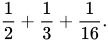
An Egyptian fraction is a finite sum of distinct unit fractions, such as That is, each fraction in the expression has a numerator equal to 1 and a denominator that is a positive integer, and all the denominators differ from each other. The value of an expression of this type is a positive rational number ; for instance the Egyptian fraction above sums to . Every positive rational number can be represented by an Egyptian fraction. Sums of this type, and similar sums also including and as summands, were used as a serious notation for rational numbers by the ancient Egyptians, and continued to be used by other civilizations into medieval times. In modern mathematical notation, Egyptian fractions have been superseded by vulgar fractions and decimal notation. However, Egyptian fractions continue to be an object of study in modern number theory and recreational mathematics, as well as in modern historical studies of ancient mathematics.


Beyond their historical use, Egyptian fractions have some practical advantages over other representations of fractional numbers. For instance, Egyptian fractions can help in dividing food or other objects into equal shares. For example, if one wants to divide 5 pizzas equally among 8 diners, the Egyptian fraction means that each diner gets half a pizza plus another eighth of a pizza, for example by splitting 4 pizzas into 8 halves, and the remaining pizza into 8 eighths. Exercises in performing this sort of fair division of food are a standard classroom example in teaching students to work with unit fractions.

Egyptian fractions can provide a solution to rope-burning puzzles, in which a given duration is to be measured by igniting non-uniform ropes which burn out after a unit time. Any rational fraction of a unit of time can be measured by expanding the fraction into a sum of unit fractions and then, for each unit fraction , burning a rope so that it always has simultaneously lit points where it is burning. For this application, it is not necessary for the unit fractions to be distinct from each other. However, this solution may need an infinite number of re-lighting steps.


Egyptian fraction notation was developed in the Middle Kingdom of Egypt. Five early texts in which Egyptian fractions appear were the Egyptian Mathematical Leather Roll, the Moscow Mathematical Papyrus, the Reisner Papyrus, the Kahun Papyrus and the Akhmim Wooden Tablet. A later text, the Rhind Mathematical Papyrus, introduced improved ways of writing Egyptian fractions. The Rhind papyrus was written by Ahmes and dates from the Second Intermediate Period; it includes a table of Egyptian fraction expansions for rational numbers , as well as 84 word problems. Solutions to each problem were written out in scribal shorthand, with the final answers of all 84 problems being expressed in Egyptian fraction notation. Tables of expansions for similar to the one on the Rhind papyrus also appear on some of the other texts. However, as the Kahun Papyrus shows, vulgar fractions were also used by scribes within their calculations.

To write the unit fractions used in their Egyptian fraction notation, in hieroglyph script, the Egyptians placed the hieroglyph:
(er, "[one] among" or possibly re, mouth) above a number to represent the reciprocal of that number. Similarly in hieratic script they drew a line over the letter representing the number. For example:
The Egyptians had special symbols for , , and that were used to reduce the size of numbers greater than when such numbers were converted to an Egyptian fraction series. The remaining number after subtracting one of these special fractions was written as a sum of distinct unit fractions according to the usual Egyptian fraction notation.

The Egyptians also used an alternative notation modified from the Old Kingdom to denote a special set of fractions of the form (for ) and sums of these numbers, which are necessarily dyadic rational numbers. These have been called "Horus-Eye fractions" after a theory (now discredited) that they were based on the parts of the Eye of Horus symbol. They were used in the Middle Kingdom in conjunction with the later notation for Egyptian fractions to subdivide a hekat, the primary ancient Egyptian volume measure for grain, bread, and other small quantities of volume, as described in the Akhmim Wooden Tablet. If any remainder was left after expressing a quantity in Eye of Horus fractions of a hekat, the remainder was written using the usual Egyptian fraction notation as multiples of a ro, a unit equal to of a hekat.



Egyptian fraction
An Egyptian fraction is a finite sum of distinct unit fractions, such as That is, each fraction in the expression has a numerator equal to 1 and a denominator that is a positive integer, and all the denominators differ from each other. The value of an expression of this type is a positive rational number ; for instance the Egyptian fraction above sums to . Every positive rational number can be represented by an Egyptian fraction. Sums of this type, and similar sums also including and as summands, were used as a serious notation for rational numbers by the ancient Egyptians, and continued to be used by other civilizations into medieval times. In modern mathematical notation, Egyptian fractions have been superseded by vulgar fractions and decimal notation. However, Egyptian fractions continue to be an object of study in modern number theory and recreational mathematics, as well as in modern historical studies of ancient mathematics.
Beyond their historical use, Egyptian fractions have some practical advantages over other representations of fractional numbers. For instance, Egyptian fractions can help in dividing food or other objects into equal shares. For example, if one wants to divide 5 pizzas equally among 8 diners, the Egyptian fraction means that each diner gets half a pizza plus another eighth of a pizza, for example by splitting 4 pizzas into 8 halves, and the remaining pizza into 8 eighths. Exercises in performing this sort of fair division of food are a standard classroom example in teaching students to work with unit fractions.
Egyptian fractions can provide a solution to rope-burning puzzles, in which a given duration is to be measured by igniting non-uniform ropes which burn out after a unit time. Any rational fraction of a unit of time can be measured by expanding the fraction into a sum of unit fractions and then, for each unit fraction , burning a rope so that it always has simultaneously lit points where it is burning. For this application, it is not necessary for the unit fractions to be distinct from each other. However, this solution may need an infinite number of re-lighting steps.
Egyptian fraction notation was developed in the Middle Kingdom of Egypt. Five early texts in which Egyptian fractions appear were the Egyptian Mathematical Leather Roll, the Moscow Mathematical Papyrus, the Reisner Papyrus, the Kahun Papyrus and the Akhmim Wooden Tablet. A later text, the Rhind Mathematical Papyrus, introduced improved ways of writing Egyptian fractions. The Rhind papyrus was written by Ahmes and dates from the Second Intermediate Period; it includes a table of Egyptian fraction expansions for rational numbers , as well as 84 word problems. Solutions to each problem were written out in scribal shorthand, with the final answers of all 84 problems being expressed in Egyptian fraction notation. Tables of expansions for similar to the one on the Rhind papyrus also appear on some of the other texts. However, as the Kahun Papyrus shows, vulgar fractions were also used by scribes within their calculations.
To write the unit fractions used in their Egyptian fraction notation, in hieroglyph script, the Egyptians placed the hieroglyph:
(er, "[one] among" or possibly re, mouth) above a number to represent the reciprocal of that number. Similarly in hieratic script they drew a line over the letter representing the number. For example:
The Egyptians had special symbols for , , and that were used to reduce the size of numbers greater than when such numbers were converted to an Egyptian fraction series. The remaining number after subtracting one of these special fractions was written as a sum of distinct unit fractions according to the usual Egyptian fraction notation.
The Egyptians also used an alternative notation modified from the Old Kingdom to denote a special set of fractions of the form (for ) and sums of these numbers, which are necessarily dyadic rational numbers. These have been called "Horus-Eye fractions" after a theory (now discredited) that they were based on the parts of the Eye of Horus symbol. They were used in the Middle Kingdom in conjunction with the later notation for Egyptian fractions to subdivide a hekat, the primary ancient Egyptian volume measure for grain, bread, and other small quantities of volume, as described in the Akhmim Wooden Tablet. If any remainder was left after expressing a quantity in Eye of Horus fractions of a hekat, the remainder was written using the usual Egyptian fraction notation as multiples of a ro, a unit equal to of a hekat.
Recent media
Recent media