
Recent from talks
Einstein–Szilard letter
Knowledge base stats:
Talk channels stats:
Members stats:
Einstein–Szilard letter
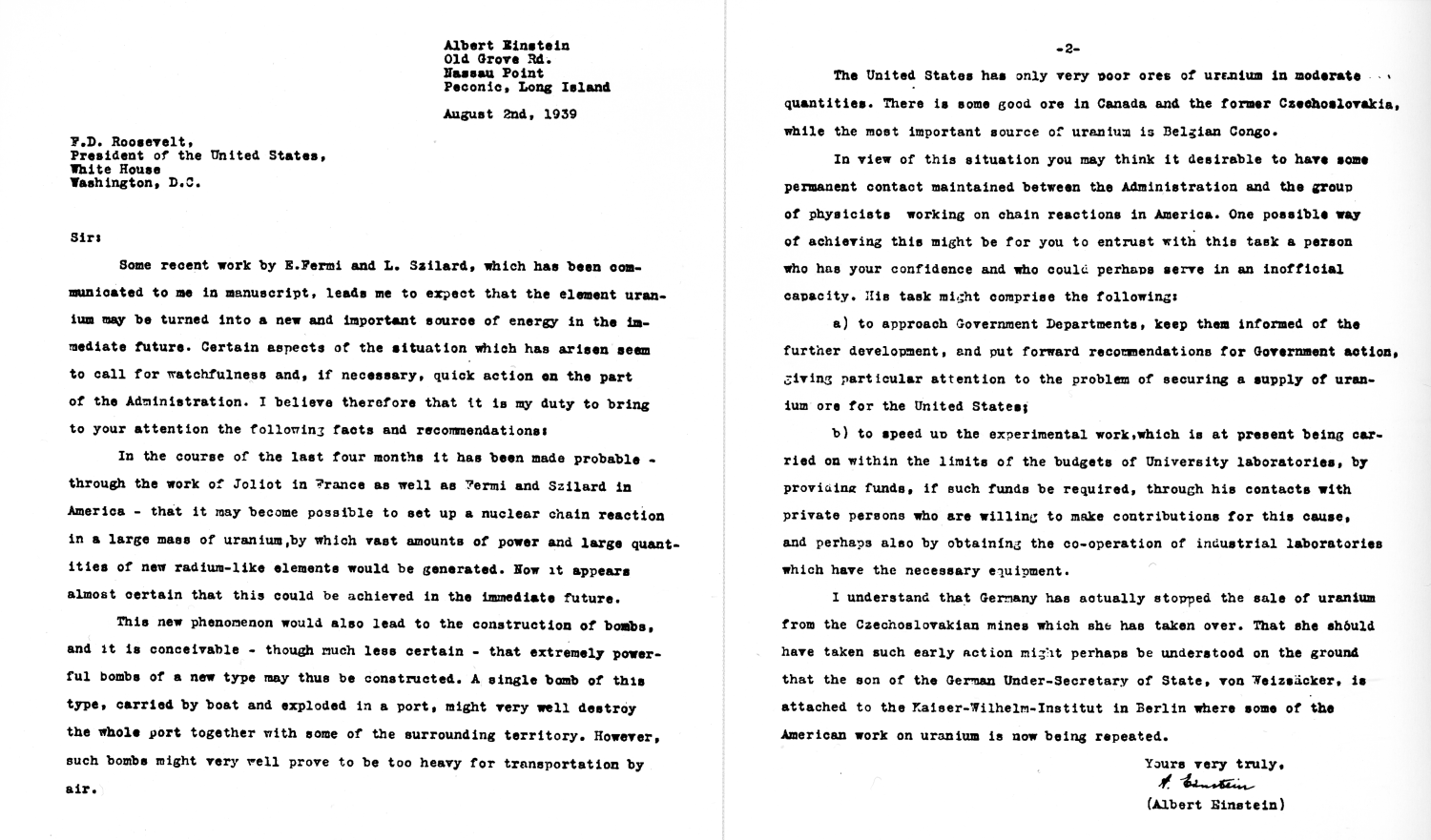
A letter written by Leo Szilard and signed by Albert Einstein on August 2, 1939, was sent to President of the United States Franklin D. Roosevelt. Szilard consulted with fellow Hungarian physicists Edward Teller and Eugene Wigner, warning that Germany might develop atomic bombs and suggested that the United States start its own nuclear program.
Despite the importance of the letter the US did not kick start their atomic bomb programme for another three years, and this was through other means.
Otto Hahn and Fritz Strassmann reported the discovery of nuclear fission in uranium in the January 6, 1939, issue of Die Naturwissenschaften, and Lise Meitner identified it as nuclear fission in the February 11, 1939 issue of Nature. This generated intense interest among physicists. Danish physicist Niels Bohr brought the news to the United States, and the U.S. opened the Fifth Washington Conference on Theoretical Physics with Enrico Fermi on January 26, 1939. The results were quickly corroborated by experimental physicists, most notably Fermi and John R. Dunning at Columbia University.
Hungarian physicist Leo Szilard realized that the neutron-driven fission of heavy atoms could be used to create a nuclear chain reaction which could yield vast amounts of energy for electric power generation or atomic bombs. He had first formulated and patented such an idea while he lived in London in 1933 after reading Ernest Rutherford's disparaging remarks about generating power from his team's 1932 experiment using protons to split lithium. However, Szilard had not been able to achieve a neutron-driven chain reaction with neutron-rich light atoms. In theory, if the number of secondary neutrons produced in a neutron-driven chain reaction was greater than one, then each such reaction could trigger multiple additional reactions, producing an exponentially increasing number of reactions.
Szilard collaborated with Fermi to build a nuclear reactor from natural uranium at Columbia University, where George B. Pegram headed the physics department. There was disagreement about whether fission was produced by uranium-235, which made up less than one percent of natural uranium, or the more abundant uranium-238 isotope, as Fermi maintained. Fermi and Szilard conducted a series of experiments and concluded that a chain reaction in natural uranium could be possible if they could find a suitable neutron moderator. They found that the hydrogen atoms in water slowed neutrons but tended to capture them. Szilard then suggested using carbon as a moderator. They then needed large quantities of carbon and uranium to create a reactor. Szilard was convinced that they would succeed if they could get the materials.
Szilard was concerned that German scientists might also attempt this experiment. German nuclear physicist Siegfried Flügge published two influential articles on the exploitation of nuclear energy in June–August 1939. After discussing this prospect with fellow Hungarian physicist Eugene Wigner, they decided that they should warn the Belgians, as the Belgian Congo was the best source of uranium ore. Wigner suggested that Albert Einstein might be a suitable person to do this, as he knew the Belgian royal family. Szilard knew Einstein well; between 1926 and 1930, he had worked with Einstein to develop the Einstein refrigerator.
On July 12, 1939, Szilard and Wigner drove in Wigner's car to Cutchogue on New York's Long Island, where Einstein was staying. When they explained the possibility of atomic bombs, Einstein replied: "Daran habe ich gar nicht gedacht" ("I did not even think about that"). Einstein dictated a letter in German to the Belgian Ambassador to the United States. Wigner wrote it down, and Einstein agreed and signed it. At Wigner's suggestion, they also prepared a letter for the State Department explaining what they were doing and why, giving it two weeks to respond if it had any objections.
This still left the problem of getting government support for uranium research. Another friend of Szilard's, the Austrian economist Gustav Stolper, suggested approaching Alexander Sachs, who had access to President Franklin D. Roosevelt. Sachs told Szilard that he had already spoken to the President about uranium, but that Fermi and Pegram had reported that the prospects for building an atomic bomb were remote. He told Szilard that he would deliver the letter, but suggested that it come from someone more prestigious. For Szilard, Einstein was again the obvious choice. Sachs and Szilard drafted a letter riddled with spelling errors and mailed it to Einstein.
Hub AI
Einstein–Szilard letter AI simulator
(@Einstein–Szilard letter_simulator)
Einstein–Szilard letter
A letter written by Leo Szilard and signed by Albert Einstein on August 2, 1939, was sent to President of the United States Franklin D. Roosevelt. Szilard consulted with fellow Hungarian physicists Edward Teller and Eugene Wigner, warning that Germany might develop atomic bombs and suggested that the United States start its own nuclear program.
Despite the importance of the letter the US did not kick start their atomic bomb programme for another three years, and this was through other means.
Otto Hahn and Fritz Strassmann reported the discovery of nuclear fission in uranium in the January 6, 1939, issue of Die Naturwissenschaften, and Lise Meitner identified it as nuclear fission in the February 11, 1939 issue of Nature. This generated intense interest among physicists. Danish physicist Niels Bohr brought the news to the United States, and the U.S. opened the Fifth Washington Conference on Theoretical Physics with Enrico Fermi on January 26, 1939. The results were quickly corroborated by experimental physicists, most notably Fermi and John R. Dunning at Columbia University.
Hungarian physicist Leo Szilard realized that the neutron-driven fission of heavy atoms could be used to create a nuclear chain reaction which could yield vast amounts of energy for electric power generation or atomic bombs. He had first formulated and patented such an idea while he lived in London in 1933 after reading Ernest Rutherford's disparaging remarks about generating power from his team's 1932 experiment using protons to split lithium. However, Szilard had not been able to achieve a neutron-driven chain reaction with neutron-rich light atoms. In theory, if the number of secondary neutrons produced in a neutron-driven chain reaction was greater than one, then each such reaction could trigger multiple additional reactions, producing an exponentially increasing number of reactions.
Szilard collaborated with Fermi to build a nuclear reactor from natural uranium at Columbia University, where George B. Pegram headed the physics department. There was disagreement about whether fission was produced by uranium-235, which made up less than one percent of natural uranium, or the more abundant uranium-238 isotope, as Fermi maintained. Fermi and Szilard conducted a series of experiments and concluded that a chain reaction in natural uranium could be possible if they could find a suitable neutron moderator. They found that the hydrogen atoms in water slowed neutrons but tended to capture them. Szilard then suggested using carbon as a moderator. They then needed large quantities of carbon and uranium to create a reactor. Szilard was convinced that they would succeed if they could get the materials.
Szilard was concerned that German scientists might also attempt this experiment. German nuclear physicist Siegfried Flügge published two influential articles on the exploitation of nuclear energy in June–August 1939. After discussing this prospect with fellow Hungarian physicist Eugene Wigner, they decided that they should warn the Belgians, as the Belgian Congo was the best source of uranium ore. Wigner suggested that Albert Einstein might be a suitable person to do this, as he knew the Belgian royal family. Szilard knew Einstein well; between 1926 and 1930, he had worked with Einstein to develop the Einstein refrigerator.
On July 12, 1939, Szilard and Wigner drove in Wigner's car to Cutchogue on New York's Long Island, where Einstein was staying. When they explained the possibility of atomic bombs, Einstein replied: "Daran habe ich gar nicht gedacht" ("I did not even think about that"). Einstein dictated a letter in German to the Belgian Ambassador to the United States. Wigner wrote it down, and Einstein agreed and signed it. At Wigner's suggestion, they also prepared a letter for the State Department explaining what they were doing and why, giving it two weeks to respond if it had any objections.
This still left the problem of getting government support for uranium research. Another friend of Szilard's, the Austrian economist Gustav Stolper, suggested approaching Alexander Sachs, who had access to President Franklin D. Roosevelt. Sachs told Szilard that he had already spoken to the President about uranium, but that Fermi and Pegram had reported that the prospects for building an atomic bomb were remote. He told Szilard that he would deliver the letter, but suggested that it come from someone more prestigious. For Szilard, Einstein was again the obvious choice. Sachs and Szilard drafted a letter riddled with spelling errors and mailed it to Einstein.
Recent media