



Community hub
Recent from talks
Contribute something
Nothing was collected or created yet.
Free variables and bound variables
View on Wikipedia | This article needs additional citations for verification. (December 2008) |
In mathematics, and in other disciplines involving formal languages, including mathematical logic and computer science, a variable may be said to be either free or bound. Some older books use the terms real variable and apparent variable for free variable and bound variable, respectively. A free variable is a notation (symbol) that specifies places in an expression where substitution may take place and is not a parameter of this or any container expression. The idea is related to a placeholder (a symbol that will later be replaced by some value), or a wildcard character that stands for an unspecified symbol.
In computer programming, the term free variable refers to variables used in a function that are neither local variables nor parameters of that function. The term non-local variable is often a synonym in this context.
An instance of a variable symbol is bound, in contrast, if the value of that variable symbol has been bound to a specific value or range of values in the domain of discourse or universe. This may be achieved through the use of logical quantifiers, variable-binding operators, or an explicit statement of allowed values for the variable (such as, "...where is a positive integer".) A variable symbol overall is bound if at least one occurrence of it is bound.[1] Since the same variable symbol may appear in multiple places in an expression, some occurrences of the variable symbol may be free while others are bound,[1]: 78 hence "free" and "bound" are at first defined for occurrences and then generalized over all occurrences of said variable symbol in the expression. However it is done, the variable ceases to be an independent variable on which the value of the expression depends, whether that value be a truth value or the numerical result of a calculation, or, more generally, an element of an image set of a function.

While the domain of discourse in many contexts is understood, when an explicit range of values for the bound variable has not been given, it may be necessary to specify the domain in order to properly evaluate the expression. For example, consider the following expression in which both variables are bound by logical quantifiers:
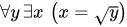
This expression evaluates to false if the domain of and is the real numbers, but true if the domain is the complex numbers.


The term "dummy variable" is also sometimes used for a bound variable (more commonly in general mathematics than in computer science), but this should not be confused with the identically named but unrelated concept of dummy variable as used in statistics, most commonly in regression analysis.[2]p.17
Examples
[edit]Before stating a precise definition of free variable and bound variable, the following are some examples that perhaps make these two concepts clearer than the definition would:
- In the expression:
- is a free variable and is a bound variable; consequently the value of this expression depends on the value of , but there is nothing called on which it could depend.


- In the expression:
- is a free variable and is a bound variable; consequently the value of this expression depends on the value of , but there is nothing called on which it could depend.
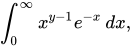
- In the expression:
- is a free variable and is a bound variable; consequently the value of this expression depends on the value of , but there is nothing called on which it could depend.
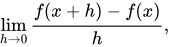

- In the expression:
- is a free variable and and are bound variables, associated with logical quantifiers; consequently the logical value of this expression depends on the value of , but there is nothing called or on which it could depend.
![{\displaystyle \forall x\ \exists y\ {\Big [}\varphi (x,y,z){\Big ]},}](https://wikimedia.org/api/rest_v1/media/math/render/svg/47da17bce01d9a1eaf29a4b325a8d9e1be3c0c10)

In proofs
[edit]In a broader context, bound variables are fundamental to the structure of mathematical proofs. For example, the following proof shows that the square of any positive even integer is divisible by 4:
Let be an arbitrary positive even integer. By definition, there exists an integer such that . Substituting this into the expression for the square gives . Since is an integer, is also an integer. Therefore, is divisible by 4.




In this proof, both and function as bound variables, but they are bound in different ways.[3]
The variable is introduced as an arbitrary but particular element of a set. The statement "Let be..." implicitly functions as a universal quantifier, binding for the scope of the proof. The proof establishes a property for this single, arbitrary , which licenses the general conclusion that the property holds for all positive even integers.[4]
The variable , on the other hand, is bound by an existential quantifier ("there exists an integer "). It is introduced to represent a specific, though unnamed, integer whose existence is guaranteed by the definition of being even. The scope of is limited to the reasoning that follows its introduction.[5]
Thus, neither variable is free; their meaning is entirely determined by their role within the logical structure of the proof.
Variable-binding operators
[edit]In mathematics and logic, a number of symbols function as variable-binding operators. These operators take a function or an open formula as an argument and bind a free variable within that expression to a specific domain or range of values, creating a new expression whose meaning does not depend on the bound variable.[6]
Common variable-binding operators include:


- The integral () and limit () operators, which bind a variable over a continuum or as it approaches a certain value.


- The logical quantifiers, such as the universal quantifier () and the existential quantifier (), which bind a variable over a domain of discourse.


In each case, the variable x is bound within the expression that follows the operator (e.g., or ). Many of these operators act on a function of the bound variable. While standard notation is often sufficient, complex expressions with nested operators can become ambiguous, particularly if the same variable name is reused. This can lead to a problem known as variable capture, where a variable intended to be free is incorrectly bound by an operator in a different scope.[7]


To avoid such ambiguity, it can be useful to switch to a notation that makes the binding explicit, treating the operators as higher-order functions. This approach, rooted in the principles of lambda calculus, clearly separates the function being operated on from the operator itself.[8]
For example:
- The summation can be written to make the functional argument explicit:


Here, the operator applies to the set S and the function f.

- The derivative operator can also be represented clearly as taking a function as its argument:

This notation clarifies that the operator is applied to the entire function , rather than just an expression in which happens to be a variable.


Formal explanation
[edit]

Variable-binding mechanisms occur in different contexts in mathematics, logic and computer science. In all cases, however, they are purely syntactic properties of expressions and variables in them. For this section we can summarize syntax by identifying an expression with a tree whose leaf nodes are variables, constants, function constants or predicate constants and whose non-leaf nodes are logical operators. This expression can then be determined by doing an in-order traversal of the tree. Variable-binding operators are logical operators that occur in almost every formal language. A binding operator takes two arguments: a variable and an expression , and when applied to its arguments produces a new expression . The meaning of binding operators is supplied by the semantics of the language and does not concern us here.


Variable binding relates three things: a variable , a location for that variable in an expression and a non-leaf node of the form . It worth noting that we define a location in an expression as a leaf node in the syntax tree. Variable binding occurs when that location is below the node .

In the lambda calculus, x is a bound variable in the term M = λx. T and a free variable in the term T. We say x is bound in M and free in T. If T contains a subterm λx. U then x is rebound in this term. This nested, inner binding of x is said to "shadow" the outer binding. Occurrences of x in U are free occurrences of the new x.[9]
Variables bound at the top level of a program are technically free variables within the terms to which they are bound but are often treated specially because they can be compiled as fixed addresses. Similarly, an identifier bound to a recursive function is also technically a free variable within its own body but is treated specially.
A closed term is one containing no free variables.
Function definition and operators as binders
[edit]A clear example of a variable-binding operator from mathematics is function definition. An expression that defines a function, such as the right-hand side of:
![{\displaystyle f=\left[(x_{1},\ldots ,x_{n})\mapsto t\right]\,,}](https://wikimedia.org/api/rest_v1/media/math/render/svg/787de793d212f57838a72626401b48ae54fcc3d6)
binds the variables . The expression , which forms the body of the function, may contain some, all, or none of the variables , which are its formal parameters. Any occurrence of these variables within is bound by the function definition. The body may also contain other variables, which would be considered free variables whose values must be determined from a wider context.[6]


The expression is directly analogous to lambda expressions in lambda calculus, where the symbol is the fundamental variable-binding operator. For instance, the function definition is equivalent to the lambda abstraction .[8]
![{\displaystyle \left[(x_{1},\ldots ,x_{n})\mapsto t\right]}](https://wikimedia.org/api/rest_v1/media/math/render/svg/67edc44c0971b51419f29ff587ac7593c857e078)


The same definition, binding the function being defined to the name , is more commonly written in mathematical texts in the form


Other mathematical operators can be understood as higher-order functions that bind variables. For example, the summation operator, , can be analyzed as an operator that takes a function and a set to evaluate that function over. The expression:

binds the variable x within the term . The scope of the binding is the term that follows the summation symbol. This expression can be treated as a more compact notation for:

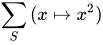
Here, is an operator with two parameters: a one-parameter function (in this case, ) and a set to evaluate that function over.


Other operators can be expressed in a similar manner. The universal quantifier can be understood as an operator that evaluates to the logical conjunction of the Boolean-valued function applied to each element in the (possibly infinite) set . Likewise, the product operator (), the limit operator (), and the integral operator () all function as variable binders, binding the variables and respectively over a specified domain.[10]


Natural language
[edit]When analyzed through the lens of formal semantics, natural languages exhibit a system of variable binding that is analogous to what is found in formal logic and computer science.[11] This system governs how referring expressions, particularly pronouns, are interpreted within a sentence or discourse.[12]
Pronouns as free variables
[edit]In English, personal pronouns such as he, she, they, and their variants (e.g., her, him) can function as free variables.[13] A free variable is a term whose referent is not determined within the immediate syntactic structure of the sentence and must be identified by the broader context, which can be either linguistic or situational (pragmatic).[14]
Consider the following sentence:
Lisa found her book.
The possessive pronoun her is a free variable. Its interpretation is flexible; it can refer to Lisa, an entity within the sentence, or to some other female individual salient in the context of the utterance.[12] This ambiguity leads to two primary interpretations, which can be formally represented using co-indexing subscripts.[15] An identical subscript indicates coreference, while different subscripts signal that the expressions refer to different entities.
- Lisai found heri book.
- (This interpretation signifies coreference, where "her" refers to Lisa. This is often called an anaphoric reading, where "her" is an anaphor and "Lisa" is its antecedent.)
- Lisai found herj book.
- (In this interpretation, "her" refers to a female individual who is not Lisa, for instance, a person named Jane who was mentioned earlier in the conversation.)
This distinction is not merely a theoretical exercise. Some languages have distinct pronominal forms to differentiate between these two readings. For example, Norwegian and Swedish use the reflexive possessive sin for the coreferential reading (heri) and a non-reflexive form like hennes (in Swedish) for the non-coreferential reading (herj).[16]
While English does not have this explicit distinction in its standard pronouns, it can force a coreferential reading by using the emphatic possessive own.[17]
- Lisai found heri own book. (Coreference is required)
- *Lisai found herj own book. (This interpretation is ungrammatical)
Anaphors as bound variables
[edit]In contrast to personal pronouns, reflexive pronouns (e.g., himself, herself, themselves) and reciprocal pronouns (e.g., each other) act as bound variables, also known in linguistics as anaphors.[15] A bound variable is an expression that must be co-indexed with, and c-commanded by, an antecedent within a specific syntactic domain.[15]
Consider the sentence:
Jane hurt herself.
The reflexive pronoun herself must refer to the subject of the clause, Jane. It cannot refer to any other individual.[12] This obligatory coreference is a hallmark of a bound variable.
- Janei hurt herselfi. (Grammatical interpretation: herself = Jane)
- *Janei hurt herselfj. (Ungrammatical interpretation: herself ≠ Jane)
This binding relationship can be formally captured using a lambda expression, a tool from lambda calculus used in formal semantics to model function abstraction and application.[18] The sentence can be represented as:
(λx.x hurt x)(Jane)
In this notation:
λxis the lambda operator that binds the variablex.x hurt xis the predicate, a function that takes an argument and states that this argument hurt itself.(Jane)is the argument applied to the function.
The expression evaluates to "Jane hurt Jane," correctly capturing the fact that the subject and object of the verb are the same entity.[18]
Binding theory
[edit]The distinct behavior of pronouns and anaphors is systematically explained by the binding theory, a central component of Noam Chomsky's Government and Binding Theory.[15] This theory proposes three principles that govern the interpretation of different types of noun phrases:
- Principle A: An anaphor (reflexive, reciprocal) must be bound in its governing category (roughly, the local clause).[15] This explains why herself in "Jane hurt herself" must be bound by Jane.
- Principle B: A pronoun must be free in its governing category.[15] This explains why a personal pronoun often cannot be bound by a local antecedent. For example, in "Ashley hit her," the pronoun her cannot refer to Ashley.[19]
- *Ashleyi hit heri. (Ungrammatical due to Principle B)
- Ashleyi hit herj. (Grammatical; her refers to someone other than Ashley)
- Principle C: An R-expression (a referring expression like a proper name, e.g., Jane, or a definite description, e.g., the woman) must be free everywhere.[15] This prevents an R-expression from being co-indexed with a c-commanding pronoun, as in *Hei said that Johni was tired*.[20]
Quantificational noun phrases
[edit]The concept of variable binding is essential for understanding quantificational noun phrases (QNPs), such as every student, some politician, or no one.[18] Unlike proper names, these phrases do not refer to a specific entity. Instead, they express a quantity over a set of individuals.[18] A QNP can bind a pronoun that falls within its scope, making the pronoun a bound variable.
Every studenti thinks hei is smart.
In this sentence, the pronoun he is most naturally interpreted as a bound variable.[21] Its reference co-varies with the individuals in the set denoted by "every student". The sentence does not mean that every student thinks a specific person (e.g., Peter) is smart; rather, it means that for each individual student , thinks that is smart. In syntactic theories, this is often analyzed via a process of quantifier raising (QR), where the QNP moves at the abstract syntactic level of logical form to a position where it c-commands and binds the pronoun.[21]
Wh-questions and relative clauses
[edit]Variable binding is also central to the analysis of wh-movement, which occurs in the formation of questions and relative clauses.[22] Wh-words like who, what, and which function as operators that bind a variable in the main clause.[23]
- Question: Whoi does John like ti?
- Relative Clause: The man [whoi Mary saw ti] is my brother.
In these structures, the wh-word is said to move from an underlying position, leaving behind a "trace" , which is treated as a bound variable.[15] The meaning of the question can be paraphrased as "For which person , does John like ?".[18] Similarly, the relative clause denotes a set of individuals such that "Mary saw ".[18]

Sloppy versus strict identity in ellipsis
[edit]The distinction between free and bound variables provides a powerful explanation for certain ambiguities that arise under VP-ellipsis.[24][25] Consider the following sentence:
John loves his mother, and Bill does too.
This sentence has two distinct interpretations:
- Strict identity: Bill loves John's mother.
- Sloppy identity: Bill loves Bill's mother.
This ambiguity can be explained by the status of the pronoun his in the first clause.[19]
- If his is treated as a free variable referring to John, the elided (or "missing") verb phrase is interpreted as "loves John's mother". When this is applied to Bill, the result is the strict reading.[19]
- If his is treated as a bound variable bound by the subject of its clause (i.e., John), the verb phrase is interpreted as a lambda-abstracted property:
λx.x loves x's mother. When this property is applied to Bill, the result is the sloppy reading.[19]
The existence of the sloppy identity reading is considered strong evidence for the psychological reality of bound variable interpretations in the grammar of natural languages.[26]
Thus, the distribution and interpretation of pronouns and other referring expressions in natural languages are not random but are governed by a sophisticated syntactic and semantic system.[12]
The distinction between free and bound variables is a cornerstone of modern linguistic theory, providing the analytical tools necessary to account for coreference, quantification, question formation, and ellipsis.
See also
[edit]References
[edit]- ^ a b Quine, Willard Van Orman (1982). Mathematical Logic (Revised ed.). Harvard University Press. pp. 142–143. ISBN 978-0674554511.
- ^ Robert S. Wolf (2005) A Tour through Mathematical Logic ISBN 978-0-88385-036-7
- ^ Velleman, Daniel J. (2006). How to Prove It: A Structured Approach (2nd ed.). Cambridge: Cambridge University Press. pp. 99–103, 129–131. ISBN 978-0-521-67599-4.
- ^ Hammack, Richard (2013). Book of Proof (2nd ed.). Richmond, VA: Virginia Commonwealth University. pp. 89–92. ISBN 978-0-9894721-0-4.
- ^ Enderton, Herbert B. (2001). A Mathematical Introduction to Logic (2nd ed.). Burlington, MA: Harcourt/Academic Press. pp. 70–73. ISBN 978-0-12-238452-3.
- ^ a b Forster, Thomas (2003). Logic, Induction and Sets. Cambridge: Cambridge University Press. pp. 13–15. ISBN 978-0-521-53361-4.
- ^ Pierce, Benjamin C. (2002). Types and Programming Languages. Cambridge, MA: MIT Press. pp. 59–62. ISBN 978-0-262-16209-8.
- ^ a b Barendregt, Hendrik P. (1984). The Lambda Calculus: Its Syntax and Semantics. Amsterdam: North-Holland. pp. 26–28. ISBN 978-0-444-87508-2.
- ^ Thompson 1991, p. 33.
- ^ Frege, Gottlob (1893). "§8–10". Grundgesetze der Arithmetik [Basic Laws of Arithmetic] (in German). Vol. I. Jena: Verlag Hermann Pohle.
- ^ Heim, Irene; Kratzer, Angelika (1998). Semantics in Generative Grammar. Malden, MA: Blackwell. pp. 93–125. ISBN 978-0-631-19713-3.
- ^ a b c d Büring, Daniel (2005). Binding Theory. Cambridge Textbooks in Linguistics. Cambridge: Cambridge University Press. pp. 1–4. ISBN 9780521812801.
- ^ In the terminology of Heim and Kratzer (1998), pronouns that are not bound are associated with an assignment function g provided by the context, which assigns them a referent. See Heim, Irene; Kratzer, Angelika (1998). Semantics in Generative Grammar. Malden, MA: Blackwell. p. 243. ISBN 978-0-631-19713-3.
- ^ Partee, Barbara H. (1978). "Bound variables and other anaphors". Proceedings of the 2nd Conference on Theoretical Issues in Natural Language Processing: 79–85. doi:10.3115/980228.980245 (inactive 5 August 2025).
{{cite journal}}: CS1 maint: DOI inactive as of August 2025 (link) - ^ a b c d e f g h Chomsky, Noam (1981). Lectures on Government and Binding. Dordrecht: Foris Publications. p. 188. ISBN 90-70176-28-9.
- ^ Haspelmath, Martin (2008). Haspelmath, Martin; Dryer, Matthew S.; Gil, David; Comrie, Bernard (eds.). "Chapter 105: Ditransitive Constructions". The World Atlas of Language Structures Online. Leipzig: Max Planck Institute for Evolutionary Anthropology.
- ^ Reinhart, Tanya; Reuland, Eric (1993). "Reflexivity". Linguistic Inquiry. 24 (4): 657–720. JSTOR 4178843.
- ^ a b c d e f Heim, Irene; Kratzer, Angelika (1998). Semantics in Generative Grammar. Malden, MA: Blackwell. pp. 184–186. ISBN 978-0-631-19713-3.
- ^ a b c d Reinhart, Tanya (2016). Anaphora and Semantic Interpretation. London: Routledge. ISBN 9781134993604.
- ^ Lasnik, Howard (1989). Essays on Anaphora. Studies in Natural Language and Linguistic Theory. Vol. 16. Dordrecht: Springer Netherlands. pp. 100–104. ISBN 9781556080906.
- ^ a b May, Robert (1985). Logical Form: Its Structure and Derivation. Linguistic inquiry monographs. Vol. 12. Cambridge, MA: MIT Press. pp. 64–70. ISBN 9780262631020.
- ^ Haegeman, Liliane (1994). Introduction to Government and Binding Theory (2nd ed.). Oxford: Blackwell. pp. 395–400. ISBN 978-0-631-19067-7.
- ^ Chomsky, Noam (1977). "On Wh-Movement". In Culicover, Peter W.; Wasow, Thomas; Akmajian, Adrian (eds.). Formal Syntax. New York: Academic Press. pp. 71–132. ISBN 978-0121992408.
- ^ Sag, Ivan (1976). Deletion and Logical Form. MIT dissertation.
- ^ Williams, Edwin S. (1977). "Discourse and Logical Form". Linguistic Inquiry. 8 (1): 101–39. JSTOR 4177974 – via JSTOR.
- ^ Dalrymple, Mary; Shieber, Stuart M.; Pereira, Fernando C. N. (1991). "Ellipsis and Higher-Order Unification". Linguistics and Philosophy. 14 (4): 399–452. doi:10.1007/BF00627759.
- Thompson, Simon (1991). Type theory and functional programming. Wokingham, England: Addison-Wesley. ISBN 0201416670. OCLC 23287456.
- Wolf, Robert S. (2005). A Tour through Mathematical Logic. Vol. 30. Mathematical Association of America. ISBN 978-0-88385-042-8. JSTOR 10.4169/j.ctt5hh94h.
Further reading
[edit]- Gowers, Timothy; Barrow-Green, June; Leader, Imre, eds. (2008). The Princeton Companion to Mathematics. Princeton, New Jersey: Princeton University Press. pp. 15–16. doi:10.1515/9781400830398. ISBN 978-0-691-11880-2. JSTOR j.ctt7sd01. LCCN 2008020450. MR 2467561. OCLC 227205932. OL 19327100M. Zbl 1242.00016.
Free variables and bound variables
View on Grokipediafunction (x) { return x + y; }, with x bound and y free.[4][3]
These notions are essential for operations like substitution, variable capture avoidance, and semantic interpretation across disciplines, ensuring precise reasoning in logic, computability, and software design.[3]
Fundamentals in Logic and Mathematics
Core Definitions
In mathematical logic and related formal systems, a variable is classified as bound or free based on its occurrence relative to binding operators. A bound variable is one whose occurrences lie within the scope of a quantifier or binder, such as the universal quantifier or existential quantifier in predicate logic, or operators like summation and integration in mathematics, where the binder fixes the variable's range or value across that scope.[6] Conversely, a free variable is an occurrence not governed by any such binder in the expression, functioning as an unbound placeholder that can be substituted with other terms without altering the formula's logical structure, provided no unintended capture occurs.[7] This distinction ensures precise interpretation, as free variables represent open parameters, while bound ones are locally quantified or abstracted.[8] The concepts of free and bound variables emerged in the early 20th century amid the formalization of predicate logic, particularly in the work of Bertrand Russell and Alfred North Whitehead. In their seminal Principia Mathematica (1910–1913), they introduced the distinction through the notions of "real variables" (free occurrences that ambiguously denote any instance) and "apparent variables" (bound occurrences governed by quantifiers), using Greek letters like for class variables in propositional function contexts.[9] This framework addressed ambiguities in denoting and quantification, laying groundwork for modern type theory and avoiding paradoxes in set theory.[9] To illustrate, consider a lambda abstraction , where is bound by the lambda binder, restricting its reference to the abstraction's body ; in contrast, the expression features as free, assuming no enclosing binder captures it.[4] Free variables differ from constants in first-order logic, as constants are fixed symbols denoting specific domain elements (e.g., individual names like or ), whereas free variables serve as unspecified placeholders ranging over the domain without inherent denotation.[10] This separation is crucial for defining terms recursively: constants and variables together form basic terms, but only variables admit binding.[11]Scope and Substitution Rules
The scope of a bound variable in a first-order logic formula is determined by the innermost binding operator, such as a universal or existential quantifier, that governs its occurrences, extending from the binder to the end of the subformula unless nested by another binder. This ensures that each occurrence of the variable within that subformula is bound to the specific quantifier, while occurrences outside remain free if not bound elsewhere. To resolve naming conflicts during manipulation, alpha-renaming (or alpha-conversion) renames bound variables to fresh ones, preserving the formula's meaning without altering free variables. Substitution rules allow uniform replacement of free variables in a formula while preserving logical equivalence, but bound variables demand caution to avoid variable capture, where a substituted term becomes inadvertently bound by an existing quantifier. Specifically, a term is freely substitutable for a free variable in a formula if no variable in is bound by a quantifier in a subformula where is free, preventing the substitution from introducing unintended bindings. For bound variables, direct substitution is generally prohibited or requires prior alpha-renaming to ensure the result matches the intended semantics. Capture-avoiding substitution provides a systematic algorithm to perform safe replacements, defined recursively on formula structure to rename binders as needed and avoid binding free variables in the substituting term.[12] The process proceeds as follows: (1) If substituting a term for a free variable in an atomic formula, replace all free occurrences of with . (2) For compound formulas like , apply the substitution independently to each conjunct. (3) For a quantified formula , if does not occur free in and , substitute into ; otherwise, alpha-rename to a fresh variable not in or free in , then substitute into . This ensures no capture occurs. For example, consider substituting for in the formula . Here, is free, and does not appear in the term , so the result is , where remains free and unbound by . If instead substituting a term like where might conflict, alpha-renaming would first adjust any overlapping binders before proceeding. The set of free variables in a formula , denoted , is defined recursively: for an atomic formula, it includes all variables appearing in the atomic parts; for or , and similarly for other connectives; for or , . This captures the variables available for substitution without being bound.Examples in Formal Systems
In Logical Proofs
In natural deduction systems for first-order logic, the universal introduction rule (∀I) exemplifies how a free variable in a subproof can become bound in the conclusion. Consider a proof where the assumption holds, with serving as a parameter (a free variable not occurring free in any undischarged assumptions). Applying ∀I allows derivation of , where now binds all occurrences of the parameter in the subproof, generalizing the statement over the entire domain.[13][14] At the proof level, free variables often appear in hypotheses as placeholders for arbitrary elements, which quantifier rules then bind in the conclusion to achieve generality. For instance, starting from the hypothesis (with free), the universal generalization rule (∀3) permits inferring , binding and transforming an open formula about a specific instance into a closed universal statement valid for all domain elements. This process ensures that proofs maintain logical rigor by distinguishing local free occurrences from globally bound ones, preventing unintended specificity in deductions.[15] In set theory proofs, careful distinctions between free and bound variables aid in avoiding Russell's paradox, particularly through restricted quantification in comprehension axioms. The paradox arises in naive set theory from the unrestricted formula , where the bound variable in the comprehension leads to self-referential contradiction upon substitution. Bertrand Russell's type theory resolves this by typing variables, ensuring that quantification binds only over same-type objects, thus scoping free variables in definitions to prevent circular self-reference; similarly, Zermelo's separation axiom binds the defining formula relative to an existing set (as in ), restricting the scope of bound variables and eliminating paradoxical sets.[16] A common error in logical proofs involves incorrect substitution that causes variable capture, where a free variable inadvertently becomes bound by an existing quantifier, altering the formula's meaning. For example, consider the formula , which states that x has a successor or something greater. Substituting the term y (free) for x naively yields , which is always false, capturing the free y in the term by the existential quantifier and changing the meaning. The correction requires alpha-conversion (renaming the bound variable, e.g., to before substitution, yielding ), ensuring the free variable remains unbound and preserving the proof's validity.[15]In Mathematical Operators
In mathematical operators such as summations, integrals, and derivatives, free and bound variables play a crucial role in defining the scope and meaning of expressions. A bound variable is one that is quantified or restricted by the operator, serving as a dummy variable whose specific name does not affect the overall value, while free variables remain parameters that can influence the result.[17] Consider the summation operator. In the expression , the index is a bound variable, as it is restricted to range from 1 to and acts as a dummy index over which the summation occurs; substituting another letter, such as , yields the equivalent . In contrast, is a free variable, representing the upper limit that can take any positive integer value and directly affects the sum's magnitude. For instance, if , the sum computes , where the result depends on but not on the choice of index symbol.[18][17] Similarly, in definite integrals, the variable of integration is bound. For , the variable is bound within the limits to , functioning as a dummy variable that traces the path of integration without retaining a fixed value; the integral equals for any other symbol . The limits and , however, are free variables, as they define the interval and alter the integral's value—for example, if , then , which varies with and .[19][20] In differentiation, particularly partial derivatives, variables are typically free unless constrained by limits in integral contexts. For a function of multiple variables, the partial derivative treats and as free variables held constant while varying , computing the rate of change with respect to alone; thus, and parameterize the derivative as a function of them. However, in expressions involving derivatives within bounded operators, such as , the inner is bound by the integral, while and remain free, with constant across the differentiation.[21] Multiple bindings arise in nested operators, where inner scopes bind their variables independently of outer ones. For example, in the iterated integral , the inner summation binds from 1 to , treating it as a dummy index, while the outer integral binds from to ; here, , , and are free. In a double integral like , the inner integral binds with limits depending on the free outer variable , and the outer binds from to , clarifying that 's scope is subordinate to 's, preventing overlap in variable usage. This nesting ensures precise evaluation, as changing dummy names (e.g., to inner) leaves the value unchanged.[17][22]Formal Frameworks
Lambda Calculus Bindings
In lambda calculus, a formal system for expressing functions and computation developed by Alonzo Church, variable binding is central to defining functional abstractions and enabling computational steps. The primary mechanism for binding is the lambda abstraction, denoted , where is a variable and is an expression (termed the body); this binds throughout , transforming any free occurrences of in into bound ones, while free variables in (those not bound by this or inner abstractions) remain unbound unless shadowed by nested bindings.[23] This binding structure facilitates beta-reduction, the core reduction rule that applies functions by substitution: an application reduces to the result of substituting for the free occurrences of in , denoted , provided no variable clashes occur between the bound variables of and the free variables of . For instance, the identity function applied to an argument, , reduces to , demonstrating how the binding of enables the argument to replace it seamlessly. This process preserves the bindings in while instantiating the abstraction with the actual argument.[23] To address issues with variable name clashes during substitutions and proofs in lambda calculus, N.G. de Bruijn introduced indices in 1972 as a nameless notation for bound variables, replacing explicit names with natural numbers indicating the binding depth (e.g., the nearest enclosing lambda is index 0, the next is 1). This approach, detailed in his work on automatic formula manipulation and applied to proving the Church-Rosser theorem, eliminates the need for alpha-conversion (renaming bound variables) and simplifies mechanized reasoning about bindings.[24] A concrete illustration of bindings in lambda calculus appears in Church numerals, which encode natural numbers as higher-order functions where variables are bound to represent iteration. For example, the numeral for 0 is (binding and to the identity, applying zero times); 1 is (applying once to ); and 2 is (applying twice). These encodings rely on the outer lambdas binding (the successor function) and (the base), with inner applications demonstrating how nested bindings capture recursive application without explicit loops.[23]Type Theory Connections
In the simply typed lambda calculus, variable binding is extended to incorporate types through constructs such as the dependent product type, often denoted as , where the variable is bound in the type with the explicit domain type . This formulation pairs term-level binders with type annotations, ensuring that functions are typed relative to their input domains, as originally developed by Alonzo Church to formalize a simple theory of types and avoid paradoxes in untyped systems.[25] The binding mechanism here treats types as part of the abstraction, allowing for well-typed terms where free variables must be resolved in a typing context to maintain type safety. Dependent type theories advance this by introducing binders that operate over types themselves, exemplified in Martin-Löf's intuitionistic type theory where universal quantification can bind type variables, such as , with ranging over the universe of types. In this setting, dependent types enable propositions to depend on values, and binders like the dependent product bind such that varies with the value of , unifying logical implication and function types. This binding structure supports higher-order dependencies, where types can be abstracted and instantiated parametrically.[26] Free variables play a crucial role in the judgments of type theories, appearing in contexts like , where assigns types to all free variables in the expression to enable type inference. During inference, unbound free variables require explicit typing in the context to derive principal types, preventing ambiguity and ensuring decidable checking in systems like those extending Martin-Löf type theory. This contextual handling of free variables facilitates modular reasoning about terms with open bindings.[27] A recent development in type theory connections arises in homotopy type theory (HoTT), formalized since 2013, where identity types introduce path-like structures that bind variables in equality proofs. In HoTT, an equality between terms is a type whose elements are paths, and higher paths between paths can bind variables via dependent path types, such as transport along a path binding a variable in a dependent family over the identity type. This univalent binding mechanism interprets equalities homotopically, allowing variable substitutions in proofs to respect path equivalences.[28]Applications in Natural Language
Pronouns and Anaphora
In natural language syntax, pronouns often function as free variables, whose interpretation relies on deictic reference to elements in the discourse context rather than a syntactic binder within the sentence. For instance, the pronoun "he" in a sentence like "He left early" remains unbound until the surrounding context specifies its referent, such as a prior mention of a male individual, allowing flexible coreference without structural constraints. This deictic usage treats the pronoun as a variable open to pragmatic resolution, distinct from variables bound by operators in logical forms. In contrast, anaphors such as reflexives (e.g., "himself") behave as bound variables, requiring a local antecedent to serve as their syntactic binder, as formalized in Principle A of Chomsky's binding theory. Principle A stipulates that an anaphor must be bound by an antecedent in its governing category, ensuring coindexation within a limited structural domain. A key structural condition for this binding is c-command, where the antecedent must c-command the anaphor—meaning the antecedent's branching node dominates the anaphor's position without being dominated by it—preventing illicit long-distance or downward bindings. This distinction is illustrated in example sentences: in "John saw himself," "himself" is bound by "John" as its local antecedent, satisfying Principle A and the c-command requirement, resulting in reflexive interpretation. Conversely, in "John saw him," "him" functions as a free variable, potentially coreferential with "John" via discourse pragmatics but not syntactically bound, allowing reference to external entities without violating binding constraints. These mechanisms underpin pronominal reference in syntax, with binding theory providing the framework for understanding such dependencies.Quantifiers and Binding Theory
In natural language semantics, quantifiers such as "every" and "some" function to bind variables, allowing noun phrases to denote sets or relations that restrict the scope of predicates.[29] This binding mechanism enables expressions like quantificational noun phrases (NPs) to interpret pronouns or other elements within their scope as variables dependent on the quantifier, rather than as independent referents. For instance, in the sentence "Every man loves his wife," the pronoun "his" can receive a bound variable interpretation, where it covaries with the quantified subject "every man," meaning each man loves his own wife, as opposed to a deictic reading where "his" refers to a specific external individual.[30] This contrasts with cases of sloppy identity in ellipsis, where a similar bound reading arises but through reconstruction rather than direct quantifier binding.[30] Linguistic binding theory, developed within the framework of generative grammar, provides principles that govern how quantifiers and antecedents bind anaphors, pronouns, and referring expressions. Principle A requires that an anaphor (such as a reflexive like "himself") be bound by an antecedent within its local governing category, ensuring co-indexation under c-command.[31] Principle B stipulates that a pronoun must be free (not bound) within its governing category, preventing local coreference with an antecedent to avoid redundancy, as in "*He saw him" where both refer to the same person locally.[31] Principle C mandates that R-expressions (full noun phrases like proper names) must be free everywhere, prohibiting binding by any c-commanding antecedent to maintain their referential independence.[31] These principles, formalized in Chomsky's government and binding theory, constrain variable binding by quantifiers and ensure interpretable syntactic structures across languages.[32] Scope ambiguities arise when multiple quantifiers interact, allowing different binding orders that alter sentence meanings. In "Someone loves everyone," the existential quantifier "someone" can take wide scope, yielding the reading that there exists a person who loves every individual (), or narrow scope, meaning for every person, there is someone who loves them ().[33] The choice of binding order depends on syntactic structure, prosody, and contextual factors, highlighting how quantifiers dynamically assign variable dependencies in interpretation.[34] Formal semantics connects these phenomena to logical systems through Montague grammar, developed in the 1970s, which treats quantificational NPs as higher-order functions using lambda abstraction to bind variables in verb phrases. For example, "every man" is represented as , where the lambda operator binds the variable in the predicate (e.g., "loves his wife"), composing to yield a bound interpretation via beta-reduction.[29] This approach, outlined in Montague's "The Proper Treatment of Quantification in English," integrates quantifier scope and binding into a compositional framework, influencing subsequent theories of natural language logic.[29]Applications in Computer Science
Variable Scoping
In programming languages, variable scoping rules determine the visibility and resolution of free and bound variables, where bound variables are those declared and fixed within a specific scope, and free variables are unbound in the current context and must be resolved from enclosing or outer scopes. These rules ensure that references to variables are unambiguously linked to their definitions, preventing errors in variable capture or unintended modifications. Scoping mechanisms directly influence how free variables are interpreted, either by the lexical structure of the code or by the dynamic execution environment.[35] Lexical (or static) scoping resolves free variables based on the program's source code structure at compile time, meaning the binding is determined by the nesting of scopes where the variable is referenced. In Python, for instance, free variables in a function are resolved by searching the nearest enclosing scope in the lexical hierarchy, following the LEGB rule (Local, Enclosing, Global, Built-in). This approach promotes predictability, as the resolution does not depend on runtime call sequences. In contrast, dynamic scoping resolves free variables at runtime by examining the current execution stack, binding to the most recent declaration in the calling chain regardless of lexical position. Early implementations of Lisp, such as LISP 1 to LISP 1.5, employed dynamic scoping, where inner functions would bind to variables from the active call frame rather than the defining context, leading to challenges in handling functional arguments like the FUNARG problem.[36][37] Block scoping, common in languages like C++ and Java, introduces nested scopes delimited by curly braces{} , binding local variables exclusively within that block while allowing access to free variables from outer scopes unless shadowed. In C++, a variable declared inside a block—such as within an if statement or loop—has block scope and is visible only from its declaration point to the closing brace, with outer scope variables remaining accessible for resolution of free references. Similarly, in Java, blocks defined by braces create scopes for local variables, which are bound to that block and cannot be accessed outside it, ensuring that free variables in nested code resolve to enclosing class or method scopes as per the language specification. This mechanism helps manage resource lifetimes and avoids namespace pollution in structured programming.[38][39]
Global and local scopes further delineate bound and free variables, with global variables serving as free variables accessible throughout the program unless shadowed by a local bound variable in an inner scope. In many languages, declaring a variable outside any function or block binds it globally, allowing inner scopes to resolve free references to it, but a local declaration with the same name hides the global one within that scope. For example, in Python, a free variable reference inside a function first checks the local scope; if unbound there, it proceeds to global without modification unless explicitly declared with global. This shadowing prevents accidental global alterations and enforces scope isolation.[36]
A practical illustration of these concepts appears in JavaScript's lexical scoping for nested functions, where an inner function treats variables from its outer function as free and resolves them to the lexical environment at definition time. Consider the following code:
function outer() {
  const outerVar = "bound in outer scope";
  function inner() {
    console.log(outerVar);  // Resolves free variable 'outerVar' to outer scope
  }
  inner();
}
outer();  // Outputs: "bound in outer scope"
function outer() {
  const outerVar = "bound in outer scope";
  function inner() {
    console.log(outerVar);  // Resolves free variable 'outerVar' to outer scope
  }
  inner();
}
outer();  // Outputs: "bound in outer scope"
outerVar is bound in the outer function's scope, while inner references it as a free variable, demonstrating how JavaScript's lexical rules chain scopes without runtime dependency. This pattern underscores the distinction from dynamic scoping, ensuring consistent behavior across invocations.[40]
Closures and Higher-Order Functions
In programming languages that support first-class functions, closures provide a mechanism for functions to capture and retain access to free variables from their enclosing lexical scope, even after the enclosing scope has terminated. A closure consists of the function itself along with a reference to the environment in which it was created, effectively binding those free variables to their values at the time of closure formation. This binding preserves the lexical scoping rules, allowing the inner function to reference or modify the captured variables as if the outer scope were still active.[41] In Scheme, as defined in the Revised^5 Report (R5RS), lambda expressions create closures that implicitly capture free variables from the defining environment. For instance, the expression(let ((x 1)) (lambda () x)) produces a closure where the anonymous function binds x as a free variable to the value 1 in the surrounding environment, enabling the function to return 1 regardless of later changes to outer variables. Similarly, in Lua, closures are formed when a function definition is executed within an outer scope, capturing upvalues—Lua's term for free variables referenced from enclosing locals. An example is local x = 20; local f = function() return x end, where f is a closure that retains access to x as an upvalue, sharing it across multiple instances if created in a loop. This upvalue mechanism ensures that each closure instance has its own binding to the captured variables, supporting stateful behavior without global variables.[41]
Higher-order functions, which accept or return functions as arguments or results, interact with free variables by resolving them according to the lexical scope where the passed function was defined. When a higher-order function like map receives a function f with free variables, those variables are resolved in the scope where f was defined or captured in its closure, consistent with lexical scoping rules. For example, in a functional language, map(\x -> x + y, [1,2,3]) where y is a free variable in the lambda, binds y to its value in the outer scope during the lambda's creation at the call site, allowing map to apply the partially bound function across the list. This binding of free variables enables higher-order functions to compose behaviors flexibly while adhering to lexical scoping.[42]
In Python, lambda expressions and nested functions form closures that capture free variables from enclosing scopes, but modifications to these variables require explicit declaration. The nonlocal keyword, introduced in Python 3.0, allows a nested function to rebind a free variable in the nearest enclosing namespace, preventing it from being treated as local. For instance:
def outer():
    count = 0
    def increment():
        nonlocal count
        count += 1
        return count
    return increment

inc = outer()
print(inc())  # Outputs 1
print(inc())  # Outputs 2
def outer():
    count = 0
    def increment():
        nonlocal count
        count += 1
        return count
    return increment

inc = outer()
print(inc())  # Outputs 1
print(inc())  # Outputs 2
count is a free variable in increment, captured by the closure, and nonlocal enables its modification, maintaining state across calls. Without nonlocal, attempts to assign to count would raise an error or shadow the outer variable.[43][44]
JavaScript's arrow functions, introduced in ECMAScript 2015 (ES6), create lexical bindings for free variables, including the this keyword, which is preserved from the enclosing scope rather than rebound dynamically. Unlike traditional functions, arrow functions do not have their own this binding; instead, they capture it from the context of definition, forming a closure that avoids common issues with dynamic scoping. For example:
const obj = {
  value: 42,
  getValue: function() {
    return () => this.value;  // Arrow function captures 'this' from getValue
  }
};
console.log(obj.getValue()());  // Outputs 42
const obj = {
  value: 42,
  getValue: function() {
    return () => this.value;  // Arrow function captures 'this' from getValue
  }
};
console.log(obj.getValue()());  // Outputs 42
this remain bound to the expected object, simplifying higher-order usage in callbacks or event handlers.[45][46]