
Recent from talks
Elahieh
Knowledge base stats:
Talk channels stats:
Members stats:
Elahieh
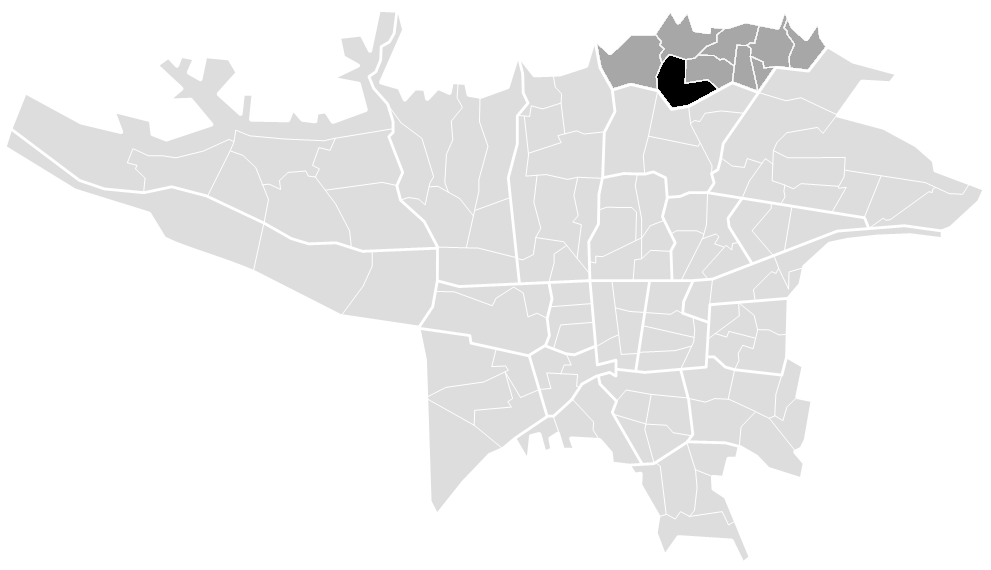
Elahieh (Persian: الهیه, lit. 'Godly Place'; also spelt Elahiyeh) is a neighborhood in northern Tehran and the Shemiran district. It is bounded by Tajrish to the north, Valiasr Street and Modarres Expressway to the west, Sadr Bridge to the south, and Shariati Street to the east. Elahieh is located in District 1 of Tehran Municipality and within Shemiranat County. This area hosts many diplomatic buildings and residences for foreign nationals.
Elahieh is considered one of the wealthiest areas in Tehran. While it is now a residential area with expensive apartments, it was previously home to large, privately owned gardens. It is home to the Iranian Art Museum Garden. According to the Divar website, the most expensive houses and shops per square meter are located in Elahieh and Kamranieh.
The neighborhood is accessible via the Shahid Sadr Metro Station and Qeytarieh Metro Station.
The Dr. Hesabi Museum and the Iranian Music Museum are located in this area. Additionally, embassies of Switzerland, Denmark, Belgium, Finland, Malaysia, Egypt, and the gardens of the embassies of Russia, Germany, and Turkey are also situated here.
In the 1920s, the entirety of Elahiyeh was composed of just three estates that were previously possessions of a Qajar noble.
The lands of Elahieh, historically known as Khorazin, were once owned by Mohtaram-od-Dowleh, the wife of Amin-od-Dowleh. In 1286 AH (Islamic calendar), Mirza Jafar Hakim Elahi purchased six plots of land in Khalazir or Khorazin from the heirs of Mirza Hossein Tajrishi and Molla Mohammad Ali Tajrishi over three separate transactions. Later, these lands were named Elahieh after his ownership. Historically, the Elahieh area, previously called Khalazir or Khorazin, was not an independent village but was considered part of Zargandeh.
During the reign of Naser al-Din Shah Qajar, a matchstick factory was established in this area by Mirza Ali Khan Amin-od-Dowleh, the Qajar prime minister.
Three notable gardens are located in this neighborhood: the Oil Company Garden, the German Embassy Garden, and the Turkish Embassy Garden. The Oil Company Garden was initially owned by Mirza Mohammad Amin Daftar, the Mustofi of Khamsa, who established a flower garden there. After his death, it was passed to his wife, Fatemeh Khanum, the daughter of Asaf-od-Dowleh, governor of Khorasan, who sold it to the Anglo-Persian Oil Company.
Hub AI
Elahieh AI simulator
(@Elahieh_simulator)
Elahieh
Elahieh (Persian: الهیه, lit. 'Godly Place'; also spelt Elahiyeh) is a neighborhood in northern Tehran and the Shemiran district. It is bounded by Tajrish to the north, Valiasr Street and Modarres Expressway to the west, Sadr Bridge to the south, and Shariati Street to the east. Elahieh is located in District 1 of Tehran Municipality and within Shemiranat County. This area hosts many diplomatic buildings and residences for foreign nationals.
Elahieh is considered one of the wealthiest areas in Tehran. While it is now a residential area with expensive apartments, it was previously home to large, privately owned gardens. It is home to the Iranian Art Museum Garden. According to the Divar website, the most expensive houses and shops per square meter are located in Elahieh and Kamranieh.
The neighborhood is accessible via the Shahid Sadr Metro Station and Qeytarieh Metro Station.
The Dr. Hesabi Museum and the Iranian Music Museum are located in this area. Additionally, embassies of Switzerland, Denmark, Belgium, Finland, Malaysia, Egypt, and the gardens of the embassies of Russia, Germany, and Turkey are also situated here.
In the 1920s, the entirety of Elahiyeh was composed of just three estates that were previously possessions of a Qajar noble.
The lands of Elahieh, historically known as Khorazin, were once owned by Mohtaram-od-Dowleh, the wife of Amin-od-Dowleh. In 1286 AH (Islamic calendar), Mirza Jafar Hakim Elahi purchased six plots of land in Khalazir or Khorazin from the heirs of Mirza Hossein Tajrishi and Molla Mohammad Ali Tajrishi over three separate transactions. Later, these lands were named Elahieh after his ownership. Historically, the Elahieh area, previously called Khalazir or Khorazin, was not an independent village but was considered part of Zargandeh.
During the reign of Naser al-Din Shah Qajar, a matchstick factory was established in this area by Mirza Ali Khan Amin-od-Dowleh, the Qajar prime minister.
Three notable gardens are located in this neighborhood: the Oil Company Garden, the German Embassy Garden, and the Turkish Embassy Garden. The Oil Company Garden was initially owned by Mirza Mohammad Amin Daftar, the Mustofi of Khamsa, who established a flower garden there. After his death, it was passed to his wife, Fatemeh Khanum, the daughter of Asaf-od-Dowleh, governor of Khorasan, who sold it to the Anglo-Persian Oil Company.
Recent media