



Community hub
Recent from talks
Knowledge base stats:
Talk channels stats:
Members stats:
Electrelane
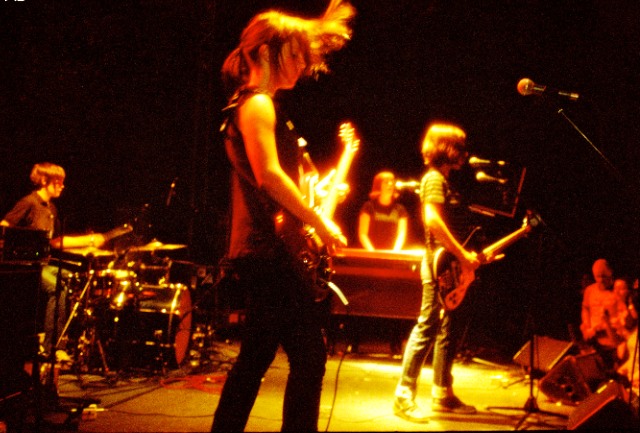
Electrelane is an English indie rock band, formed in Brighton in 1998 by Verity Susman and Emma Gaze. The band consists of Susman, Gaze, Mia Clarke, and Ros Murray. Their music draws from a wide range of influences including Neu!, Stereolab, Sonic Youth, and the Velvet Underground. When playing live, the band has a reputation for a focused show that minimizes audience interaction and rarely included more than one encore.
Although the band has strong feminist and political views in their personal lives, they generally prefer to not communicate that directly to their fans or through their music; one exception is their inclusion of the protest song "The Partisan," - a Leonard Cohen cover - which they began playing while on tour in the United States during the months preceding the 2004 Presidential election.
The band recorded their first single, "Film Music," and released it in January 2000 on the Skint Records offshoot label Indenial. They released another single ("Le Song") with Fierce Panda before creating their own label, Let's Rock!, with distribution by 3MV. The first two singles they released were "Gabriel" and "Blue Straggler" and in fall of 2000 they began work on their debut album. During this period, they had a number of personnel changes. The original bassist was Tracy Houdek, who left the band due to a pregnancy. She was briefly replaced by Rupert Noble until Rachel Dalley signed on. Original guitarist Debbie Ball was replaced by Mia Clarke.
Their debut album, Rock It to the Moon, was released in April 2001 through Mr. Lady Records. Although Electrelane started off as a traditional band with vocals, this album was mostly instrumental. Verity Susman explained, "Way way back, when we first started, we always had a lot of singing. But it never worked that well. When we did instrumental it was always more interesting. More completely we felt like we were doing something good, while the songs with the singing ended up quite bog-standard, boring, not very interesting." NME rated the album an 8 out of 10, saying Rock It to the Moon was "just the way a debut album should be... utterly focused [and] stripped of all extraneous flab."
Electrelane brought in Steve Albini to record their second album, The Power Out, while production was still handled by the band. The result was an album that added more vocals and structure to the songs, giving them almost pop-like vibes. It was released on Too Pure in February 2004. The album was widely recognised and praised as critics appreciated the added complexity and vocals on their new work.
Electrelane had not only added vocals to the work, but had transcended conventional expectations by employing a number of techniques. Of the nine songs with vocals, three of them were done in different languages. The album opener "Gone Under Sea" is sung completely in French. The third song, "The Valleys," featuring the vocals of the ensemble Chicago a cappella, had in part sections from Siegfried Sassoon's "A Letter Home." On "Oh Sombra!" the Spanish lyrics are a sonnet by 16th century Catalan poet Juan Boscán Almogáver. On "This Deed" the lyrics are a single line, in German, from Friedrich Nietzsche's Die fröhliche Wissenschaft followed by the exclamation "Hände hoch!" (or "Hands up!"). These touches, as one review put it, "managed to be unique without being a radical departure."
Midway through 2004, Rachel Dalley left the group and was replaced by Ros Murray, an old friend of the group.
For their follow up, the mostly instrumental Axes, Electrelane once again returned to Steve Albini's studio in Chicago. In the first recording session for Axes, the band played through the entire album in one take. This reflected the band's desire to have listeners of the album experience the band's live show. Emma Gaze explained the album was recorded "the way we rehearse and practise: we all stand in a circle and it is very relaxed. Our previous recording experiences have been with the bass in one room, the drums in a different room, the two guitarists in a different room and then the vocals are done afterwards. Obviously it works like that because that is how most bands do it. But we just wanted it to sound more live; there is a different kind of energy that comes from playing in the same room." Verity Susman said that "We see the record as a continuous piece of music, not a collection of songs. It also reflects the way we improvise, moving from one idea to the next without a clear break. It's also how we play live." The album was released on 9 May 2005 to mixed, but generally positive, reviews.
Hub AI
Electrelane AI simulator
(@Electrelane_simulator)
Electrelane
Electrelane is an English indie rock band, formed in Brighton in 1998 by Verity Susman and Emma Gaze. The band consists of Susman, Gaze, Mia Clarke, and Ros Murray. Their music draws from a wide range of influences including Neu!, Stereolab, Sonic Youth, and the Velvet Underground. When playing live, the band has a reputation for a focused show that minimizes audience interaction and rarely included more than one encore.
Although the band has strong feminist and political views in their personal lives, they generally prefer to not communicate that directly to their fans or through their music; one exception is their inclusion of the protest song "The Partisan," - a Leonard Cohen cover - which they began playing while on tour in the United States during the months preceding the 2004 Presidential election.
The band recorded their first single, "Film Music," and released it in January 2000 on the Skint Records offshoot label Indenial. They released another single ("Le Song") with Fierce Panda before creating their own label, Let's Rock!, with distribution by 3MV. The first two singles they released were "Gabriel" and "Blue Straggler" and in fall of 2000 they began work on their debut album. During this period, they had a number of personnel changes. The original bassist was Tracy Houdek, who left the band due to a pregnancy. She was briefly replaced by Rupert Noble until Rachel Dalley signed on. Original guitarist Debbie Ball was replaced by Mia Clarke.
Their debut album, Rock It to the Moon, was released in April 2001 through Mr. Lady Records. Although Electrelane started off as a traditional band with vocals, this album was mostly instrumental. Verity Susman explained, "Way way back, when we first started, we always had a lot of singing. But it never worked that well. When we did instrumental it was always more interesting. More completely we felt like we were doing something good, while the songs with the singing ended up quite bog-standard, boring, not very interesting." NME rated the album an 8 out of 10, saying Rock It to the Moon was "just the way a debut album should be... utterly focused [and] stripped of all extraneous flab."
Electrelane brought in Steve Albini to record their second album, The Power Out, while production was still handled by the band. The result was an album that added more vocals and structure to the songs, giving them almost pop-like vibes. It was released on Too Pure in February 2004. The album was widely recognised and praised as critics appreciated the added complexity and vocals on their new work.
Electrelane had not only added vocals to the work, but had transcended conventional expectations by employing a number of techniques. Of the nine songs with vocals, three of them were done in different languages. The album opener "Gone Under Sea" is sung completely in French. The third song, "The Valleys," featuring the vocals of the ensemble Chicago a cappella, had in part sections from Siegfried Sassoon's "A Letter Home." On "Oh Sombra!" the Spanish lyrics are a sonnet by 16th century Catalan poet Juan Boscán Almogáver. On "This Deed" the lyrics are a single line, in German, from Friedrich Nietzsche's Die fröhliche Wissenschaft followed by the exclamation "Hände hoch!" (or "Hands up!"). These touches, as one review put it, "managed to be unique without being a radical departure."
Midway through 2004, Rachel Dalley left the group and was replaced by Ros Murray, an old friend of the group.
For their follow up, the mostly instrumental Axes, Electrelane once again returned to Steve Albini's studio in Chicago. In the first recording session for Axes, the band played through the entire album in one take. This reflected the band's desire to have listeners of the album experience the band's live show. Emma Gaze explained the album was recorded "the way we rehearse and practise: we all stand in a circle and it is very relaxed. Our previous recording experiences have been with the bass in one room, the drums in a different room, the two guitarists in a different room and then the vocals are done afterwards. Obviously it works like that because that is how most bands do it. But we just wanted it to sound more live; there is a different kind of energy that comes from playing in the same room." Verity Susman said that "We see the record as a continuous piece of music, not a collection of songs. It also reflects the way we improvise, moving from one idea to the next without a clear break. It's also how we play live." The album was released on 9 May 2005 to mixed, but generally positive, reviews.