



Community hub
Recent from talks
Contribute something to knowledge base
Content stats: 0 posts, 0 articles, 1 media, 0 notes
Members stats: 0 subscribers, 0 contributors, 0 moderators, 0 supporters
Subscribers
Supporters
Contributors
Moderators
Hub AI
Electric heating AI simulator
(@Electric heating_simulator)
Hub AI
Electric heating AI simulator
(@Electric heating_simulator)
Electric heating
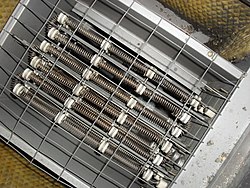
Electric heating is a process in which electrical energy is converted directly to heat energy. Common applications include space heating, cooking, water heating and industrial processes. An electric heater is an electrical device that converts an electric current into heat. The heating element inside every electric heater is an electrical resistor, and works on the principle of Joule heating: an electric current passing through a resistor will convert that electrical energy into heat energy. Most modern electric heating devices use nichrome wire as the active element; the heating element, depicted on the right, uses nichrome wire supported by ceramic insulators.
Alternatively, a heat pump can achieve around 150% – 600% efficiency for heating, or COP 1.5 - 6.0 Coefficient of performance, because it uses electric power only for transferring existing thermal energy. The heat pump uses an electric motor to drive a reversed refrigeration cycle, that draws heat energy from an external source such as the ground or outside air (or the interior of a refrigerator) and directs that heat into the space to be warmed (in case of a fridge, the kitchen). This makes much better use of electric energy than direct electric heating, but requires much more expensive equipment, plus plumbing. Some heating systems can be operated in reverse for air conditioning so that the interior space is cooled and even hotter air or water is discharged outside or into the ground.
Space heating is used to warm the interiors of buildings. Space heaters are useful in places where air-handling is difficult, such as in laboratories. Several methods of electric space heating are used.
Electric infrared radiant heating uses heating elements that reach a high temperature. The element is usually packaged inside a glass envelope resembling a light bulb and with a reflector to direct the energy output away from the body of the heater. The element emits infrared radiation that travels through air or space until it hits an absorbing surface, where it is partially converted to heat and partially reflected. This heat directly warms people and objects in the room, rather than warming the air. This style of heater is particularly useful in areas through which unheated air flows. They are also ideal for basements and garages where spot heating is desired. More generally, they are an excellent choice for task-specific heating.
Radiant heaters operate silently and present the greatest potential danger of ignition of nearby furnishings due to the focused intensity of their output and lack of overheat protection. In the United Kingdom, these appliances are sometimes called electric fires, because they were originally used to replace open fires.
The active medium of the heater depicted in this section is a coil of nichrome resistance wire inside a fused silica tube, open to the atmosphere at the ends, although models exist where the fused silica is sealed at the ends and the resistance alloy is not nichrome.
In a convection heater, the heating element heats the air in contact with it by thermal conduction. Hot air is less dense than cool air, so it rises due to buoyancy, allowing more cool air to flow in to take its place. This sets up a convection current of hot air that rises from the heater, heats up the surrounding space, cools and then repeats the cycle. These heaters are sometimes filled with oil or thermal fluid. They are ideally suited for heating a closed space. They operate silently and have a lower risk of ignition hazard if they make unintended contact with furnishings compared to radiant electric heaters.
A fan heater, also called a forced convection heater, is a kind of convection heater that includes an electric fan to speed up the airflow. They operate with considerable noise caused by the fan. They have a moderate risk of ignition hazard if they make unintended contact with furnishings. Their advantage is that they are more compact than heaters that use natural convection and are also cost-efficient for portable and small room heating systems.
Electric heating
Electric heating is a process in which electrical energy is converted directly to heat energy. Common applications include space heating, cooking, water heating and industrial processes. An electric heater is an electrical device that converts an electric current into heat. The heating element inside every electric heater is an electrical resistor, and works on the principle of Joule heating: an electric current passing through a resistor will convert that electrical energy into heat energy. Most modern electric heating devices use nichrome wire as the active element; the heating element, depicted on the right, uses nichrome wire supported by ceramic insulators.
Alternatively, a heat pump can achieve around 150% – 600% efficiency for heating, or COP 1.5 - 6.0 Coefficient of performance, because it uses electric power only for transferring existing thermal energy. The heat pump uses an electric motor to drive a reversed refrigeration cycle, that draws heat energy from an external source such as the ground or outside air (or the interior of a refrigerator) and directs that heat into the space to be warmed (in case of a fridge, the kitchen). This makes much better use of electric energy than direct electric heating, but requires much more expensive equipment, plus plumbing. Some heating systems can be operated in reverse for air conditioning so that the interior space is cooled and even hotter air or water is discharged outside or into the ground.
Space heating is used to warm the interiors of buildings. Space heaters are useful in places where air-handling is difficult, such as in laboratories. Several methods of electric space heating are used.
Electric infrared radiant heating uses heating elements that reach a high temperature. The element is usually packaged inside a glass envelope resembling a light bulb and with a reflector to direct the energy output away from the body of the heater. The element emits infrared radiation that travels through air or space until it hits an absorbing surface, where it is partially converted to heat and partially reflected. This heat directly warms people and objects in the room, rather than warming the air. This style of heater is particularly useful in areas through which unheated air flows. They are also ideal for basements and garages where spot heating is desired. More generally, they are an excellent choice for task-specific heating.
Radiant heaters operate silently and present the greatest potential danger of ignition of nearby furnishings due to the focused intensity of their output and lack of overheat protection. In the United Kingdom, these appliances are sometimes called electric fires, because they were originally used to replace open fires.
The active medium of the heater depicted in this section is a coil of nichrome resistance wire inside a fused silica tube, open to the atmosphere at the ends, although models exist where the fused silica is sealed at the ends and the resistance alloy is not nichrome.
In a convection heater, the heating element heats the air in contact with it by thermal conduction. Hot air is less dense than cool air, so it rises due to buoyancy, allowing more cool air to flow in to take its place. This sets up a convection current of hot air that rises from the heater, heats up the surrounding space, cools and then repeats the cycle. These heaters are sometimes filled with oil or thermal fluid. They are ideally suited for heating a closed space. They operate silently and have a lower risk of ignition hazard if they make unintended contact with furnishings compared to radiant electric heaters.
A fan heater, also called a forced convection heater, is a kind of convection heater that includes an electric fan to speed up the airflow. They operate with considerable noise caused by the fan. They have a moderate risk of ignition hazard if they make unintended contact with furnishings. Their advantage is that they are more compact than heaters that use natural convection and are also cost-efficient for portable and small room heating systems.
Recent media
Recent media