


Community hub
Recent from talks
Contribute something to knowledge base
Content stats: 0 posts, 0 articles, 1 media, 0 notes
Members stats: 0 subscribers, 0 contributors, 0 moderators, 0 supporters
Subscribers
Supporters
Contributors
Moderators
Hub AI
Electromagnetic Aircraft Launch System AI simulator
(@Electromagnetic Aircraft Launch System_simulator)
Hub AI
Electromagnetic Aircraft Launch System AI simulator
(@Electromagnetic Aircraft Launch System_simulator)
Electromagnetic Aircraft Launch System
The Electromagnetic Aircraft Launch System (EMALS) is a type of electromagnetic catapult system developed by General Atomics for the United States Navy. The system launches carrier-based aircraft by means of a catapult employing a linear induction motor rather than the conventional steam piston, providing greater precision and faster recharge compared to steam. EMALS was first installed on the lead ship of the Gerald R. Ford-class aircraft carrier, USS Gerald R. Ford, c. 2015.
Its main advantage is that it accelerates aircraft more smoothly, putting less stress on their airframes. Compared to steam catapults, the EMALS also weighs less, is expected to cost less and require less maintenance, and can launch both heavier and lighter aircraft than a steam piston-driven system. It also reduces the carrier's requirement of fresh water, thus reducing the demand for energy-intensive desalination.
Developed in the 1950s, steam catapults have proven exceptionally reliable. Carriers equipped with four steam catapults have been able to use at least one of them 99.5% of the time. However, there are a number of drawbacks. One group of Navy engineers wrote: "The foremost deficiency is that the catapult operates without feedback control. With no feedback, there often occurs large transients in tow force that can damage or reduce the life of the airframe." The steam system is massive, inefficient (4–6% useful work), and hard to control. These control problems allow Nimitz-class aircraft carrier steam-powered catapults to launch heavy aircraft, but not aircraft as light as many unmanned aerial vehicles.
A system somewhat similar to EMALS, Westinghouse's electropult, was developed in 1946 but not deployed.
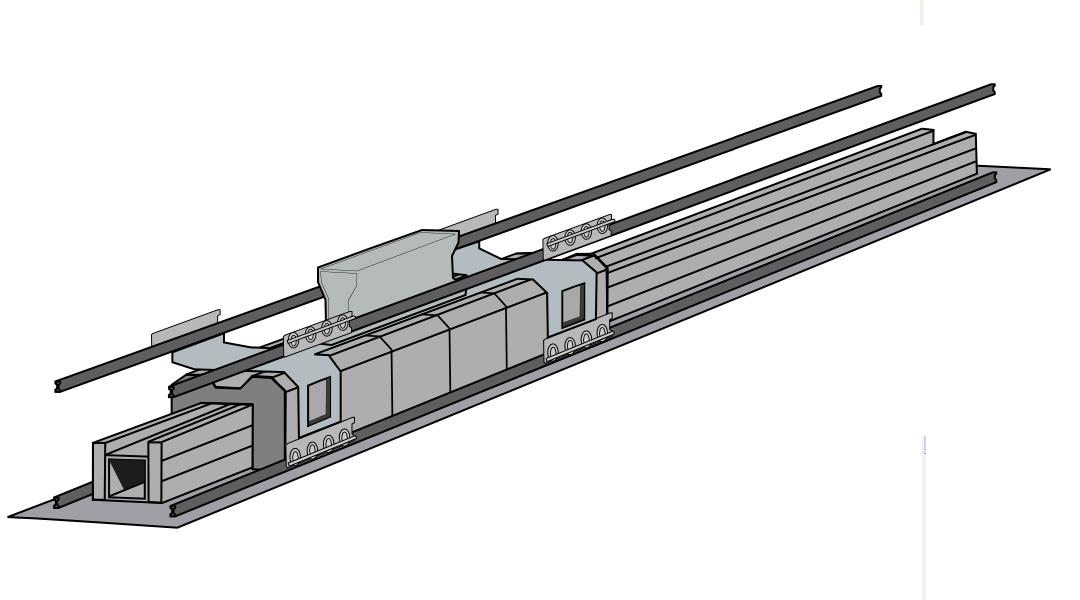
The EMALS uses a linear induction motor (LIM), which uses alternating current (AC) to generate magnetic fields that propel a carriage along a track to launch the aircraft. The EMALS consists of four main elements: The linear induction motor consists of a row of stator coils with the same function as the circular stator coils in a conventional induction motor. When energized, the motor accelerates the carriage along the track. Only the section of the coils surrounding the carriage is energized at any given time, thereby minimizing reactive losses. The EMALS's 300-foot (91 m) LIM can accelerate a 100,000-pound (45,000 kg) aircraft to 130 kn (240 km/h; 150 mph).
During a launch, the induction motor requires a large surge of electric power that exceeds what the ship's own continuous power source can provide. The EMALS energy-storage system design accommodates this by drawing power from the ship during its 45-second recharge period and storing the energy kinetically using the rotors of four disk alternators; the system then releases that energy (up to 484 MJ) in 2–3 seconds. Each rotor delivers up to 121 MJ (34 kWh) (approximately one gasoline gallon equivalent) and can be recharged within 45 seconds of a launch; this is faster than steam catapults. A maximum-performance launch using 121 MJ of energy from each disk alternator slows the rotors from 6400 rpm to 5205 rpm.
During the launch, the power-conversion subsystem releases the stored energy from the disk alternators using a cycloconverter. The cycloconverter provides a controlled rising frequency and voltage to the LIM, energizing only the small portion of stator coils that affect the launch carriage at any given moment.
Operators control the power through a closed-loop system. Hall-effect sensors on the track monitor its operation, allowing the system to ensure that it provides the desired acceleration. The closed-loop system allows the EMALS to maintain a constant tow force, which helps reduce launch stresses on the plane's airframe.
Electromagnetic Aircraft Launch System
The Electromagnetic Aircraft Launch System (EMALS) is a type of electromagnetic catapult system developed by General Atomics for the United States Navy. The system launches carrier-based aircraft by means of a catapult employing a linear induction motor rather than the conventional steam piston, providing greater precision and faster recharge compared to steam. EMALS was first installed on the lead ship of the Gerald R. Ford-class aircraft carrier, USS Gerald R. Ford, c. 2015.
Its main advantage is that it accelerates aircraft more smoothly, putting less stress on their airframes. Compared to steam catapults, the EMALS also weighs less, is expected to cost less and require less maintenance, and can launch both heavier and lighter aircraft than a steam piston-driven system. It also reduces the carrier's requirement of fresh water, thus reducing the demand for energy-intensive desalination.
Developed in the 1950s, steam catapults have proven exceptionally reliable. Carriers equipped with four steam catapults have been able to use at least one of them 99.5% of the time. However, there are a number of drawbacks. One group of Navy engineers wrote: "The foremost deficiency is that the catapult operates without feedback control. With no feedback, there often occurs large transients in tow force that can damage or reduce the life of the airframe." The steam system is massive, inefficient (4–6% useful work), and hard to control. These control problems allow Nimitz-class aircraft carrier steam-powered catapults to launch heavy aircraft, but not aircraft as light as many unmanned aerial vehicles.
A system somewhat similar to EMALS, Westinghouse's electropult, was developed in 1946 but not deployed.
The EMALS uses a linear induction motor (LIM), which uses alternating current (AC) to generate magnetic fields that propel a carriage along a track to launch the aircraft. The EMALS consists of four main elements: The linear induction motor consists of a row of stator coils with the same function as the circular stator coils in a conventional induction motor. When energized, the motor accelerates the carriage along the track. Only the section of the coils surrounding the carriage is energized at any given time, thereby minimizing reactive losses. The EMALS's 300-foot (91 m) LIM can accelerate a 100,000-pound (45,000 kg) aircraft to 130 kn (240 km/h; 150 mph).
During a launch, the induction motor requires a large surge of electric power that exceeds what the ship's own continuous power source can provide. The EMALS energy-storage system design accommodates this by drawing power from the ship during its 45-second recharge period and storing the energy kinetically using the rotors of four disk alternators; the system then releases that energy (up to 484 MJ) in 2–3 seconds. Each rotor delivers up to 121 MJ (34 kWh) (approximately one gasoline gallon equivalent) and can be recharged within 45 seconds of a launch; this is faster than steam catapults. A maximum-performance launch using 121 MJ of energy from each disk alternator slows the rotors from 6400 rpm to 5205 rpm.
During the launch, the power-conversion subsystem releases the stored energy from the disk alternators using a cycloconverter. The cycloconverter provides a controlled rising frequency and voltage to the LIM, energizing only the small portion of stator coils that affect the launch carriage at any given moment.
Operators control the power through a closed-loop system. Hall-effect sensors on the track monitor its operation, allowing the system to ensure that it provides the desired acceleration. The closed-loop system allows the EMALS to maintain a constant tow force, which helps reduce launch stresses on the plane's airframe.
Recent media
Recent media