
Recent from talks
Electron spin resonance dating
Knowledge base stats:
Talk channels stats:
Members stats:
Electron spin resonance dating
Electron spin resonance dating, or ESR dating, is a technique used to date materials, for which radiocarbon dating does not work well, such as minerals (e.g. carbonates, silicates, sulphates), inorganic biological materials (e.g., tooth enamel), inorganic archaeological materials (e.g., ceramics) and certain foods. Electron spin resonance dating was first introduced to the science community in 1975, when Japanese nuclear physicist Motoji Ikeya dated a speleothem in Akiyoshi Cave, Japan. ESR dating measures the amount of unpaired electrons in crystalline structures that were previously exposed to natural radiation. The age of a substance can be determined by measuring the dosage of radiation since the time of its formation.
Electron spin resonance dating is being used in fields like radiation chemistry, biochemistry, and as well as geology, archaeology, and anthropology. ESR dating is used instead of radiocarbon dating or radiometric dating because ESR dating can be applied on materials different from other methods, as well as covering different age ranges. ESR dating has been used to date fossilised teeth. The dating of buried human teeth has served as the basis for the dating of human remains. Studies have been used to date burnt flint and quartz found in certain ancient ceramics. ESR dating has been widely applied to date hydrothermal vents and sometimes to mine minerals. Newer ESR dating applications include dating previous earthquakes from fault gouge, past volcanic eruptions, tectonic activity along coastlines, fluid flow in accretionary prisms, and cold seeps.
ESR dating can be applied to newly formed materials or previously heated samples, as long the heating is below the closure temperature or the heating time is much shorter than the characteristic decay time. The closure temperature of quartz in granite is about 30–90 °C and of barite is about 190–340 °C for ESR dating.
Electron spin resonance dating can be described as trapped charge dating. Radioactivity causes negatively charged electrons to move from a ground state, the valence band, to a higher energy level at the conduction band. After a short time, electrons eventually recombine with the positively charged holes left in the valence band. The trapped electrons form para-magnetic centers and give rise to certain signals that can be detected by ESR spectrometry. The amount of trapped electrons corresponds to the magnitude of the ESR signal. This ESR signal is directly proportional to the number of trapped electrons in the mineral, the dosage of radioactive substances, and the age.
The electron spin resonance age of a substance is found from the following equation:
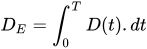
where DE is the equivalent dose, or paleodose (in Gray or Gy), i.e. the amount of radiation a sample has received during the time elapsed between the zeroing of the ESR clock (t = 0) and the sampling (t = T). D(t) is the dose rate (usually in Gy/ka or microGy/a), which is the average dose absorbed by the sample in 1000 or 1 years. If D(t) is considered constant over time, then, the equation may be expressed as follows:

Hub AI
Electron spin resonance dating AI simulator
(@Electron spin resonance dating_simulator)
Electron spin resonance dating
Electron spin resonance dating, or ESR dating, is a technique used to date materials, for which radiocarbon dating does not work well, such as minerals (e.g. carbonates, silicates, sulphates), inorganic biological materials (e.g., tooth enamel), inorganic archaeological materials (e.g., ceramics) and certain foods. Electron spin resonance dating was first introduced to the science community in 1975, when Japanese nuclear physicist Motoji Ikeya dated a speleothem in Akiyoshi Cave, Japan. ESR dating measures the amount of unpaired electrons in crystalline structures that were previously exposed to natural radiation. The age of a substance can be determined by measuring the dosage of radiation since the time of its formation.
Electron spin resonance dating is being used in fields like radiation chemistry, biochemistry, and as well as geology, archaeology, and anthropology. ESR dating is used instead of radiocarbon dating or radiometric dating because ESR dating can be applied on materials different from other methods, as well as covering different age ranges. ESR dating has been used to date fossilised teeth. The dating of buried human teeth has served as the basis for the dating of human remains. Studies have been used to date burnt flint and quartz found in certain ancient ceramics. ESR dating has been widely applied to date hydrothermal vents and sometimes to mine minerals. Newer ESR dating applications include dating previous earthquakes from fault gouge, past volcanic eruptions, tectonic activity along coastlines, fluid flow in accretionary prisms, and cold seeps.
ESR dating can be applied to newly formed materials or previously heated samples, as long the heating is below the closure temperature or the heating time is much shorter than the characteristic decay time. The closure temperature of quartz in granite is about 30–90 °C and of barite is about 190–340 °C for ESR dating.
Electron spin resonance dating can be described as trapped charge dating. Radioactivity causes negatively charged electrons to move from a ground state, the valence band, to a higher energy level at the conduction band. After a short time, electrons eventually recombine with the positively charged holes left in the valence band. The trapped electrons form para-magnetic centers and give rise to certain signals that can be detected by ESR spectrometry. The amount of trapped electrons corresponds to the magnitude of the ESR signal. This ESR signal is directly proportional to the number of trapped electrons in the mineral, the dosage of radioactive substances, and the age.
The electron spin resonance age of a substance is found from the following equation:
where DE is the equivalent dose, or paleodose (in Gray or Gy), i.e. the amount of radiation a sample has received during the time elapsed between the zeroing of the ESR clock (t = 0) and the sampling (t = T). D(t) is the dose rate (usually in Gy/ka or microGy/a), which is the average dose absorbed by the sample in 1000 or 1 years. If D(t) is considered constant over time, then, the equation may be expressed as follows: