


Community hub
Recent from talks
Knowledge base stats:
Talk channels stats:
Members stats:
Elementary algebra
Elementary algebra, also known as high school algebra or college algebra, encompasses the basic concepts of algebra. It is often contrasted with arithmetic: arithmetic deals with specified numbers, whilst algebra introduces numerical variables (quantities without fixed values).
This use of variables entails use of algebraic notation and an understanding of the general rules of the operations introduced in arithmetic: addition, subtraction, multiplication, division, etc. Unlike abstract algebra, elementary algebra is not concerned with algebraic structures outside the realm of real and complex numbers.
It is typically taught to secondary school students and at introductory college level in the United States, and builds on their understanding of arithmetic. The use of variables to denote quantities allows general relationships between quantities to be formally and concisely expressed, and thus enables solving a broader scope of problems. Many quantitative relationships in science and mathematics are expressed as algebraic equations.
In mathematics, a basic algebraic operation is a mathematical operation similar to any one of the common operations of elementary algebra, which include addition, subtraction, multiplication, division, raising to a whole number power, and taking roots (fractional power). The operations of elementary algebra may be performed on numbers, in which case they are often called arithmetic operations. They may also be performed, in a similar way, on variables, algebraic expressions, and more generally, on elements of algebraic structures, such as groups and fields.
An algebraic operation on a set may be defined more formally as a function that maps to the tuples of a given length of elements of . The length of the tuples is called the arity of the operation, and each member of the tuple is called an operand. The most common case is the case of arity two, where the operation is called a binary operation and the operands form an ordered pair. A unary operation is an operation of arity one that has only one operand; for example, the square root. An example of a ternary operation (arity three) is the triple product.

Algebraic notation describes the rules and conventions for writing mathematical expressions, as well as the terminology used for talking about parts of expressions. For example, the expression has the following components:
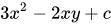
A coefficient is a numerical value, or letter representing a numerical constant, that multiplies a variable (the operator is omitted). A term is an addend or a summand, a group of coefficients, variables, constants and exponents that may be separated from the other terms by the plus and minus operators. Letters represent variables and constants. By convention, letters at the beginning of the alphabet (e.g. ) are typically used to represent constants, and those toward the end of the alphabet (e.g. and z) are used to represent variables. They are usually printed in italics.


Algebraic operations work in the same way as arithmetic operations, such as addition, subtraction, multiplication, division and exponentiation, and are applied to algebraic variables and terms. Multiplication symbols are usually omitted, and implied when there is no space between two variables or terms, or when a coefficient is used. For example, is written as , and may be written .


Hub AI
Elementary algebra AI simulator
(@Elementary algebra_simulator)
Elementary algebra
Elementary algebra, also known as high school algebra or college algebra, encompasses the basic concepts of algebra. It is often contrasted with arithmetic: arithmetic deals with specified numbers, whilst algebra introduces numerical variables (quantities without fixed values).
This use of variables entails use of algebraic notation and an understanding of the general rules of the operations introduced in arithmetic: addition, subtraction, multiplication, division, etc. Unlike abstract algebra, elementary algebra is not concerned with algebraic structures outside the realm of real and complex numbers.
It is typically taught to secondary school students and at introductory college level in the United States, and builds on their understanding of arithmetic. The use of variables to denote quantities allows general relationships between quantities to be formally and concisely expressed, and thus enables solving a broader scope of problems. Many quantitative relationships in science and mathematics are expressed as algebraic equations.
In mathematics, a basic algebraic operation is a mathematical operation similar to any one of the common operations of elementary algebra, which include addition, subtraction, multiplication, division, raising to a whole number power, and taking roots (fractional power). The operations of elementary algebra may be performed on numbers, in which case they are often called arithmetic operations. They may also be performed, in a similar way, on variables, algebraic expressions, and more generally, on elements of algebraic structures, such as groups and fields.
An algebraic operation on a set may be defined more formally as a function that maps to the tuples of a given length of elements of . The length of the tuples is called the arity of the operation, and each member of the tuple is called an operand. The most common case is the case of arity two, where the operation is called a binary operation and the operands form an ordered pair. A unary operation is an operation of arity one that has only one operand; for example, the square root. An example of a ternary operation (arity three) is the triple product.
Algebraic notation describes the rules and conventions for writing mathematical expressions, as well as the terminology used for talking about parts of expressions. For example, the expression has the following components:
A coefficient is a numerical value, or letter representing a numerical constant, that multiplies a variable (the operator is omitted). A term is an addend or a summand, a group of coefficients, variables, constants and exponents that may be separated from the other terms by the plus and minus operators. Letters represent variables and constants. By convention, letters at the beginning of the alphabet (e.g. ) are typically used to represent constants, and those toward the end of the alphabet (e.g. and z) are used to represent variables. They are usually printed in italics.
Algebraic operations work in the same way as arithmetic operations, such as addition, subtraction, multiplication, division and exponentiation, and are applied to algebraic variables and terms. Multiplication symbols are usually omitted, and implied when there is no space between two variables or terms, or when a coefficient is used. For example, is written as , and may be written .