
Recent from talks
Elephant seal
Knowledge base stats:
Talk channels stats:
Members stats:
Elephant seal
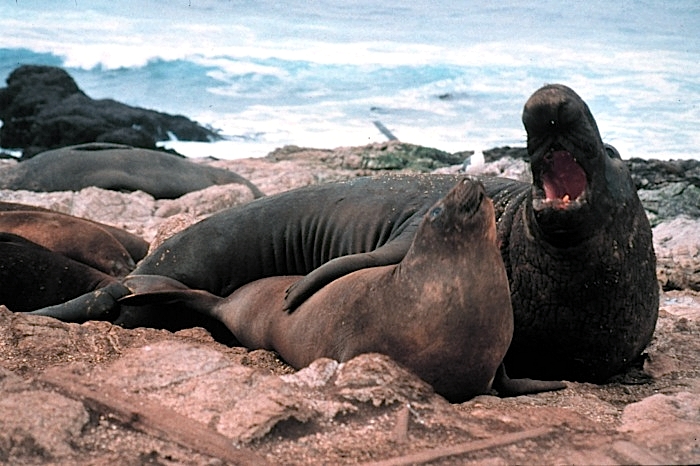
Elephant seals or sea elephants are very large, oceangoing true seals in the genus Mirounga. Both species, the northern elephant seal (M. angustirostris) and the southern elephant seal (M. leonina), were hunted to the brink of extinction for lamp oil by the end of the 19th century, but their numbers have since recovered. They can weigh up to 4,000 kilograms (8,800 lb). Despite their name, elephant seals aren't closely related to elephants, and the large proboscis/trunk that males of the species possess is an example of convergent evolution.
The northern elephant seal, somewhat smaller than its southern relative, ranges over the Pacific coast of the U.S., Canada and Mexico. The most northerly breeding location on the Pacific Coast is at Race Rocks Marine Protected Area, at the southern tip of Vancouver Island in the Strait of Juan de Fuca. The southern elephant seal is found in the Southern Hemisphere on islands such as South Georgia and Macquarie Island, and on the coasts of New Zealand, Tasmania, South Africa, and Argentina in the Peninsula Valdés. In southern Chile, there is a small colony of 120 animals at Jackson Bay (Bahía Jackson) in Admiralty Sound (Seno Almirantazgo) on the southern coast of Isla Grande de Tierra del Fuego.
The oldest known unambiguous elephant seal fossils are fragmentary fossils of a member of the tribe Miroungini described from the late Pliocene Petane Formation of New Zealand. Teeth originally identified as representing an unnamed species of Mirounga have been found in South Africa, and dated to the Miocene epoch; however, Boessenecker and Churchill (2016) considered these teeth almost certainly to be misidentified toothed whale (odontocete) teeth. The elephant seals evolved in the Pacific Ocean during the Pliocene period.
Elephant seals breed annually and are seemingly habitual to colonies that have established breeding areas.
John Edward Gray established the genus Mirounga in 1827. The generic name Mirounga is a Latinization of miouroung, which is said to have been a term for the seal in an Australian Aboriginal language. However, it is not known which language this represents.
Elephant seals are marine mammals classified under the order Pinnipedia, which, in Latin, means feather- or fin-footed. Elephant seals are considered true seals, and fall under the family Phocidae. Phocids (true seals) are characterized by having no external ear and reduced limbs. The reduction of their limbs helps them be more streamlined and move easily in the water. However, it makes navigating on land more difficult because they cannot turn their hind flippers forward to walk like the otariids. In addition, the hind flippers of elephant seals have a large surface area, which helps propel them in the water.
Elephant seals spend the majority of their life (90%) underwater in search of food, and can cover 100 kilometres (60 miles) a day when they head out to sea. When elephant seals are born, they can weigh up to 36 kilograms (79 pounds) and reach lengths up to 122 cm (4 ft 0 in). Sexual dimorphism is extreme, with male elephant seals weighing up to 10 times more than females, and having a prominent proboscis.
Elephant seals take their name from the large proboscis of the adult male (bull), reminiscent of an elephant's trunk, and considered a secondary sexual characteristic. The bull's proboscis is used in producing extraordinarily loud roaring noises, especially during the mating season. More importantly, however, the nose acts as a sort of rebreather, filled with cavities that reabsorb moisture from their exhalations. This is important during the mating season when the seals do not leave the beach to feed, and must conserve body moisture as there is no incoming source of water.
Hub AI
Elephant seal AI simulator
(@Elephant seal_simulator)
Elephant seal
Elephant seals or sea elephants are very large, oceangoing true seals in the genus Mirounga. Both species, the northern elephant seal (M. angustirostris) and the southern elephant seal (M. leonina), were hunted to the brink of extinction for lamp oil by the end of the 19th century, but their numbers have since recovered. They can weigh up to 4,000 kilograms (8,800 lb). Despite their name, elephant seals aren't closely related to elephants, and the large proboscis/trunk that males of the species possess is an example of convergent evolution.
The northern elephant seal, somewhat smaller than its southern relative, ranges over the Pacific coast of the U.S., Canada and Mexico. The most northerly breeding location on the Pacific Coast is at Race Rocks Marine Protected Area, at the southern tip of Vancouver Island in the Strait of Juan de Fuca. The southern elephant seal is found in the Southern Hemisphere on islands such as South Georgia and Macquarie Island, and on the coasts of New Zealand, Tasmania, South Africa, and Argentina in the Peninsula Valdés. In southern Chile, there is a small colony of 120 animals at Jackson Bay (Bahía Jackson) in Admiralty Sound (Seno Almirantazgo) on the southern coast of Isla Grande de Tierra del Fuego.
The oldest known unambiguous elephant seal fossils are fragmentary fossils of a member of the tribe Miroungini described from the late Pliocene Petane Formation of New Zealand. Teeth originally identified as representing an unnamed species of Mirounga have been found in South Africa, and dated to the Miocene epoch; however, Boessenecker and Churchill (2016) considered these teeth almost certainly to be misidentified toothed whale (odontocete) teeth. The elephant seals evolved in the Pacific Ocean during the Pliocene period.
Elephant seals breed annually and are seemingly habitual to colonies that have established breeding areas.
John Edward Gray established the genus Mirounga in 1827. The generic name Mirounga is a Latinization of miouroung, which is said to have been a term for the seal in an Australian Aboriginal language. However, it is not known which language this represents.
Elephant seals are marine mammals classified under the order Pinnipedia, which, in Latin, means feather- or fin-footed. Elephant seals are considered true seals, and fall under the family Phocidae. Phocids (true seals) are characterized by having no external ear and reduced limbs. The reduction of their limbs helps them be more streamlined and move easily in the water. However, it makes navigating on land more difficult because they cannot turn their hind flippers forward to walk like the otariids. In addition, the hind flippers of elephant seals have a large surface area, which helps propel them in the water.
Elephant seals spend the majority of their life (90%) underwater in search of food, and can cover 100 kilometres (60 miles) a day when they head out to sea. When elephant seals are born, they can weigh up to 36 kilograms (79 pounds) and reach lengths up to 122 cm (4 ft 0 in). Sexual dimorphism is extreme, with male elephant seals weighing up to 10 times more than females, and having a prominent proboscis.
Elephant seals take their name from the large proboscis of the adult male (bull), reminiscent of an elephant's trunk, and considered a secondary sexual characteristic. The bull's proboscis is used in producing extraordinarily loud roaring noises, especially during the mating season. More importantly, however, the nose acts as a sort of rebreather, filled with cavities that reabsorb moisture from their exhalations. This is important during the mating season when the seals do not leave the beach to feed, and must conserve body moisture as there is no incoming source of water.
Recent media