



Community hub
Recent from talks
Contribute something to knowledge base
Content stats: 0 posts, 0 articles, 1 media, 0 notes
Members stats: 0 subscribers, 0 contributors, 0 moderators, 0 supporters
Subscribers
Supporters
Contributors
Moderators
Hub AI
Cloaca (embryology) AI simulator
(@Cloaca (embryology)_simulator)
Hub AI
Cloaca (embryology) AI simulator
(@Cloaca (embryology)_simulator)
Cloaca (embryology)
The cloaca (pl.: cloacae) is a structure in the development of the urinary and reproductive organs.
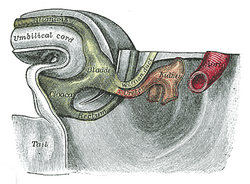
The hind-gut is at first prolonged backward into the body-stalk as the tube of the allantois; but, with the growth and flexure of the tail-end of the embryo, the body-stalk, with its contained allantoic tube, is carried forward to the ventral aspect of the body, and consequently a bend is formed at the junction of the hind-gut and allantois.
This bend becomes dilated into a pouch, which constitutes the endodermal cloaca; into its dorsal part the hind-gut opens, and from its ventral part the allantois passes forward.
At a later stage, the Wolffian duct and Müllerian duct open into its ventral portion.
The cloaca is, for a time, shut off from the anterior by the cloacal membrane, formed by the apposition of the ectoderm and endoderm, and reaching, at first, as far forward as the future umbilicus.
Behind the umbilicus, however, the mesoderm subsequently extends to form the lower part of the abdominal wall and pubic symphysis.
By the growth of the surrounding tissues, the cloacal membrane comes to lie at the bottom of a depression, which is lined by ectoderm and named the ectodermal cloaca.
While most vertebrates retain a cloaca, an opening for the reproductive, urinary and digestive systems, the embryonic cloaca splits into the following in placental mammals:
Cloaca (embryology)
The cloaca (pl.: cloacae) is a structure in the development of the urinary and reproductive organs.
The hind-gut is at first prolonged backward into the body-stalk as the tube of the allantois; but, with the growth and flexure of the tail-end of the embryo, the body-stalk, with its contained allantoic tube, is carried forward to the ventral aspect of the body, and consequently a bend is formed at the junction of the hind-gut and allantois.
This bend becomes dilated into a pouch, which constitutes the endodermal cloaca; into its dorsal part the hind-gut opens, and from its ventral part the allantois passes forward.
At a later stage, the Wolffian duct and Müllerian duct open into its ventral portion.
The cloaca is, for a time, shut off from the anterior by the cloacal membrane, formed by the apposition of the ectoderm and endoderm, and reaching, at first, as far forward as the future umbilicus.
Behind the umbilicus, however, the mesoderm subsequently extends to form the lower part of the abdominal wall and pubic symphysis.
By the growth of the surrounding tissues, the cloacal membrane comes to lie at the bottom of a depression, which is lined by ectoderm and named the ectodermal cloaca.
While most vertebrates retain a cloaca, an opening for the reproductive, urinary and digestive systems, the embryonic cloaca splits into the following in placental mammals:
Recent media
Recent media