



Community hub
Recent from talks
Contribute something to knowledge base
Content stats: 0 posts, 0 articles, 1 media, 0 notes
Members stats: 0 subscribers, 0 contributors, 0 moderators, 0 supporters
Subscribers
Supporters
Contributors
Moderators
Hub AI
Ectoderm AI simulator
(@Ectoderm_simulator)
Hub AI
Ectoderm AI simulator
(@Ectoderm_simulator)
Ectoderm
The ectoderm is one of the three primary germ layers formed in early embryonic development. It is the outermost layer, and is superficial to the mesoderm (the middle layer) and endoderm (the innermost layer). It emerges and originates from the outer layer of germ cells. The word ectoderm comes from the Greek ektos meaning "outside", and derma meaning "skin".
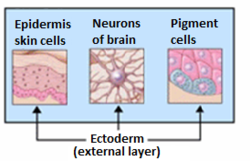
Generally speaking, the ectoderm differentiates to form epithelial and neural tissues (spinal cord, nerves and brain). This includes the skin, linings of the mouth, anus, nostrils, sweat glands, hair and nails, and tooth enamel. Other types of epithelium are derived from the endoderm.
In vertebrate embryos, the ectoderm can be divided into two parts: the dorsal surface ectoderm also known as the external ectoderm, and the neural plate, which invaginates to form the neural tube and neural crest. The surface ectoderm gives rise to most epithelial tissues, and the neural plate gives rise to most neural tissues. For this reason, the neural plate and neural crest are also referred to as the neuroectoderm.
Heinz Christian Pander, a Baltic German–Russian biologist, has been credited for the discovery of the three germ layers that form during embryogenesis. Pander received his doctorate in zoology from the University of Würzburg in 1817. He began his studies in embryology using chicken eggs, which allowed for his discovery of the ectoderm, mesoderm and endoderm. Due to his findings, Pander is sometimes referred to as the "founder of embryology".
Pander's work of the early embryo was continued by a Prussian–Estonian biologist named Karl Ernst von Baer. Baer took Pander's concept of the germ layers and through extensive research of many different types of species, he was able to extend this principle to all vertebrates. Baer also received credit for the discovery of the blastula. Baer published his findings, including his germ layer theory, in a textbook which translates to On the Development of Animals which he released in 1828.
The ectoderm can first be observed in amphibians and fish during the later stages of gastrulation. At the start of this process, the developing embryo has divided into many cells, forming a hollow ball called the blastula. The blastula is polar, and its two halves are called the animal hemisphere and vegetal hemisphere. It is the animal hemisphere will eventually become the ectoderm.
Like the other two germ layers – i.e., the mesoderm and endoderm – the ectoderm forms shortly after fertilization, after which rapid cell division begins. The position of the ectoderm relative to the other germ layers of the embryo is governed by "selective affinity", meaning that the inner surface of the ectoderm has a strong (positive) affinity for the mesoderm, and a weak (negative) affinity for the endoderm layer. This selective affinity changes during different stages of development. The strength of the attraction between two surfaces of two germ layers is determined by the amount and type of cadherin molecules present on the cells' surface. For example, the expression of N-cadherin is crucial to maintaining separation of precursor neural cells from precursor epithelial cells. Likewise, while the surface ectoderm becomes the epidermis, the neuroectoderm is induced along the neural pathway by the notochord, which is typically positioned above it.
During the process of gastrulation, bottle cells invaginate on the dorsal surface of the blastula to form the blastopore. The cells continue to extend inward and migrate along the inner wall of the blastula to form a fluid-filled cavity called the blastocoel. The once superficial cells of the animal pole are destined to become the cells of the middle germ layer called the mesoderm. Through the process of radial extension, cells of the animal pole that were once several layers thick divide to form a thin layer. At the same time, when this thin layer of dividing cells reaches the dorsal lip of the blastopore, another process occurs termed convergent extension. During convergent extension, cells that approach the lip intercalate mediolaterally, in such a way that cells are pulled over the lip and inside the embryo. These two processes allow for the prospective mesoderm cells to be placed between the ectoderm and the endoderm. Once convergent extension and radial intercalation are underway, the rest of the vegetal pole, which will become endoderm cells, is completely engulfed by the prospective ectoderm, as these top cells undergo epiboly, where the ectoderm cells divide in a way to form one layer. This creates a uniform embryo composed of the three germ layers in their respective positions.
Ectoderm
The ectoderm is one of the three primary germ layers formed in early embryonic development. It is the outermost layer, and is superficial to the mesoderm (the middle layer) and endoderm (the innermost layer). It emerges and originates from the outer layer of germ cells. The word ectoderm comes from the Greek ektos meaning "outside", and derma meaning "skin".
Generally speaking, the ectoderm differentiates to form epithelial and neural tissues (spinal cord, nerves and brain). This includes the skin, linings of the mouth, anus, nostrils, sweat glands, hair and nails, and tooth enamel. Other types of epithelium are derived from the endoderm.
In vertebrate embryos, the ectoderm can be divided into two parts: the dorsal surface ectoderm also known as the external ectoderm, and the neural plate, which invaginates to form the neural tube and neural crest. The surface ectoderm gives rise to most epithelial tissues, and the neural plate gives rise to most neural tissues. For this reason, the neural plate and neural crest are also referred to as the neuroectoderm.
Heinz Christian Pander, a Baltic German–Russian biologist, has been credited for the discovery of the three germ layers that form during embryogenesis. Pander received his doctorate in zoology from the University of Würzburg in 1817. He began his studies in embryology using chicken eggs, which allowed for his discovery of the ectoderm, mesoderm and endoderm. Due to his findings, Pander is sometimes referred to as the "founder of embryology".
Pander's work of the early embryo was continued by a Prussian–Estonian biologist named Karl Ernst von Baer. Baer took Pander's concept of the germ layers and through extensive research of many different types of species, he was able to extend this principle to all vertebrates. Baer also received credit for the discovery of the blastula. Baer published his findings, including his germ layer theory, in a textbook which translates to On the Development of Animals which he released in 1828.
The ectoderm can first be observed in amphibians and fish during the later stages of gastrulation. At the start of this process, the developing embryo has divided into many cells, forming a hollow ball called the blastula. The blastula is polar, and its two halves are called the animal hemisphere and vegetal hemisphere. It is the animal hemisphere will eventually become the ectoderm.
Like the other two germ layers – i.e., the mesoderm and endoderm – the ectoderm forms shortly after fertilization, after which rapid cell division begins. The position of the ectoderm relative to the other germ layers of the embryo is governed by "selective affinity", meaning that the inner surface of the ectoderm has a strong (positive) affinity for the mesoderm, and a weak (negative) affinity for the endoderm layer. This selective affinity changes during different stages of development. The strength of the attraction between two surfaces of two germ layers is determined by the amount and type of cadherin molecules present on the cells' surface. For example, the expression of N-cadherin is crucial to maintaining separation of precursor neural cells from precursor epithelial cells. Likewise, while the surface ectoderm becomes the epidermis, the neuroectoderm is induced along the neural pathway by the notochord, which is typically positioned above it.
During the process of gastrulation, bottle cells invaginate on the dorsal surface of the blastula to form the blastopore. The cells continue to extend inward and migrate along the inner wall of the blastula to form a fluid-filled cavity called the blastocoel. The once superficial cells of the animal pole are destined to become the cells of the middle germ layer called the mesoderm. Through the process of radial extension, cells of the animal pole that were once several layers thick divide to form a thin layer. At the same time, when this thin layer of dividing cells reaches the dorsal lip of the blastopore, another process occurs termed convergent extension. During convergent extension, cells that approach the lip intercalate mediolaterally, in such a way that cells are pulled over the lip and inside the embryo. These two processes allow for the prospective mesoderm cells to be placed between the ectoderm and the endoderm. Once convergent extension and radial intercalation are underway, the rest of the vegetal pole, which will become endoderm cells, is completely engulfed by the prospective ectoderm, as these top cells undergo epiboly, where the ectoderm cells divide in a way to form one layer. This creates a uniform embryo composed of the three germ layers in their respective positions.
Recent media
Recent media