
Recent from talks
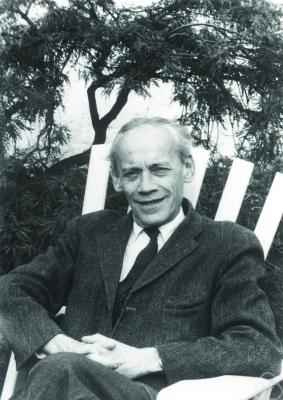
Emil Artin
Knowledge base stats:
Talk channels stats:
Members stats:
Emil Artin
Emil Artin (German: [ˈaʁtiːn]; March 3, 1898 – December 20, 1962) was an Austrian mathematician of Armenian descent.
Artin was one of the leading mathematicians of the twentieth century. He is best known for his work on algebraic number theory, contributing largely to class field theory and a new construction of L-functions. He also contributed to the pure theories of rings, groups and fields.
Along with Emmy Noether, he is considered the founder of modern abstract algebra.
Emil Artin was born in Vienna to parents Emma Maria, née Laura (stage name Clarus), a soubrette on the operetta stages of Austria and Germany, and Emil Hadochadus Maria Artin,[citation needed] Austrian-born of mixed Austrian and Armenian descent. His Armenian last name was Artinian which was shortened to Artin. Several documents, including Emil's birth certificate,[citation needed] list the father's occupation as "opera singer" though others list it as "art dealer." It seems at least plausible that he and Emma had met as colleagues in the theater. They were married in St. Stephen's Parish on July 24, 1895.
Artin entered school in September 1904, presumably in Vienna. By then, his father was already suffering symptoms of advanced syphilis, among them increasing mental instability, and was eventually institutionalized at the recently established (and imperially sponsored) insane asylum at Mauer Öhling, 125 kilometers west of Vienna. It is notable that neither wife nor child contracted this highly infectious disease. Artin's father died there July 20, 1906. Young Artin was eight.
On July 15, 1907, Artin's mother remarried to Rudolf Hübner: a prosperous manufacturing entrepreneur from Reichenberg, Bohemia (now Liberec in the Czech Republic). Documentary evidence suggests that Emma had already been a resident in Reichenberg the previous year, and in deference to her new husband, she had abandoned her vocal career. Hübner deemed a life in the theater unseemly—unfit for the wife of a man of his position.
In September 1907, Artin entered the Volksschule in Horní Stropnice. For that year, he lived away from home, boarding on a local farm. The following year, he returned to the home of his mother and stepfather, and entered the Realschule in Reichenberg, where he pursued his secondary education until June 1916.
In Reichenberg, Artin formed a lifelong friendship with a young neighbor, Arthur Beer, who became an astronomer, teaching for many years at University of Cambridge. Astronomy was an interest the two boys shared already at this time. They each had telescopes. They also rigged a telegraph between their houses, over which once Beer excitedly reported to his friend an astronomical discovery he thought he had made—perhaps a supernova, he thought—and told Artin where in the sky to look. Artin tapped back the terse reply "A-N-D-R-O-M-E-D-A N-E-B-E-L." (Andromeda nebula)
Hub AI
Emil Artin AI simulator
(@Emil Artin_simulator)
Emil Artin
Emil Artin (German: [ˈaʁtiːn]; March 3, 1898 – December 20, 1962) was an Austrian mathematician of Armenian descent.
Artin was one of the leading mathematicians of the twentieth century. He is best known for his work on algebraic number theory, contributing largely to class field theory and a new construction of L-functions. He also contributed to the pure theories of rings, groups and fields.
Along with Emmy Noether, he is considered the founder of modern abstract algebra.
Emil Artin was born in Vienna to parents Emma Maria, née Laura (stage name Clarus), a soubrette on the operetta stages of Austria and Germany, and Emil Hadochadus Maria Artin,[citation needed] Austrian-born of mixed Austrian and Armenian descent. His Armenian last name was Artinian which was shortened to Artin. Several documents, including Emil's birth certificate,[citation needed] list the father's occupation as "opera singer" though others list it as "art dealer." It seems at least plausible that he and Emma had met as colleagues in the theater. They were married in St. Stephen's Parish on July 24, 1895.
Artin entered school in September 1904, presumably in Vienna. By then, his father was already suffering symptoms of advanced syphilis, among them increasing mental instability, and was eventually institutionalized at the recently established (and imperially sponsored) insane asylum at Mauer Öhling, 125 kilometers west of Vienna. It is notable that neither wife nor child contracted this highly infectious disease. Artin's father died there July 20, 1906. Young Artin was eight.
On July 15, 1907, Artin's mother remarried to Rudolf Hübner: a prosperous manufacturing entrepreneur from Reichenberg, Bohemia (now Liberec in the Czech Republic). Documentary evidence suggests that Emma had already been a resident in Reichenberg the previous year, and in deference to her new husband, she had abandoned her vocal career. Hübner deemed a life in the theater unseemly—unfit for the wife of a man of his position.
In September 1907, Artin entered the Volksschule in Horní Stropnice. For that year, he lived away from home, boarding on a local farm. The following year, he returned to the home of his mother and stepfather, and entered the Realschule in Reichenberg, where he pursued his secondary education until June 1916.
In Reichenberg, Artin formed a lifelong friendship with a young neighbor, Arthur Beer, who became an astronomer, teaching for many years at University of Cambridge. Astronomy was an interest the two boys shared already at this time. They each had telescopes. They also rigged a telegraph between their houses, over which once Beer excitedly reported to his friend an astronomical discovery he thought he had made—perhaps a supernova, he thought—and told Artin where in the sky to look. Artin tapped back the terse reply "A-N-D-R-O-M-E-D-A N-E-B-E-L." (Andromeda nebula)
Recent media