Hubbry Logo
SoubretteSoubretteMain
Open search
Soubrette
Community hub
Soubrette
logo
8 pages, 0 posts
0 subscribers
Be the first to start a discussion here.
Soubrette
Soubrette
from Wikipedia
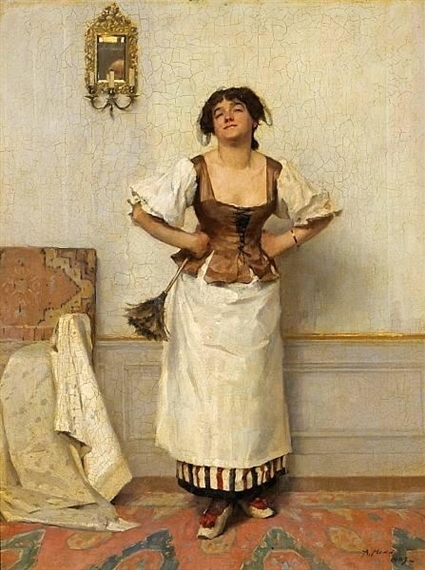
Soubrette by Alexander Mann

A soubrette is a female minor stock character in opera and theatre, often a pert lady's maid. By extension, the term can refer generally to any saucy or flirtatious young woman. The term arrived in English from Provençal via French, and means "conceited" or "coy".[1]

Theatre

[edit]
The soubrette Alice Kingsbury, by J.W. Winder & Co.

In theatre, a soubrette is a comedy character who is vain and girlish, mischievous, lighthearted, coquettish and gossipy—often a chambermaid or confidante of the ingénue. She often displays a flirtatious or even sexually aggressive nature. The soubrette appeared in commedia dell'arte scenarios, often in the role of Columbina, where the actress would provide the details of her behaviour and dialogue.[2] From there, she moved to the works of Molière, which were influenced by the Commedia; the role of Dorine in Tartuffe (1664) fits the description. A famous example, though a hundred years later, is Suzanne in Beaumarchais' Le Mariage de Figaro (1784).[3]

Opera

[edit]

In classical music and opera, the term soubrette refers to both a soprano voice type or fach, and a type of opera role. A soubrette voice is light with a bright, sweet timbre, a tessitura in the mid-range, but lacking extensive coloratura.[4] A soubrette's vocal range extends approximately from middle C (C4) to "high D" (D6).[5] The voice has a lighter vocal weight than other soprano voices with a brighter timbre. Many young singers start out as soubrettes but as they grow older and the voice matures more physically they may be reclassified as another voice type, usually either a light lyric soprano, a lyric coloratura soprano, or a coloratura mezzo-soprano. Rarely does a singer remain a soubrette throughout her entire career.[6] The tessitura of the soubrette tends to lie a bit lower than the lyric soprano and spinto soprano.[7]

Soubrette roles are typically found in comic operas or operettas and they usually portray good-looking, youthful girls who are flirtatious, saucy, and street-wise. Typically these roles are sung by younger singers and both sopranos and mezzo-sopranos are cast in them.[7] Many soubrette roles have a considerable amount of spoken German dialogue, and therefore the soubrette singer must possess both an excellent comprehension of the German language and considerable acting skills. It is rare to find true soubrettes singing in major opera houses as their voices are typically unable to carry over larger orchestras in larger halls.[citation needed] Often lyric, coloratura, and mezzo-sopranos are cast in soubrette roles, especially in the early part of their singing careers. This does not mean that these singers are soubrette sopranos but it does mean they can play soubrette roles.[7] The coloratura soprano has a higher range, can sing more dexterous vocal passages and has a somewhat brighter sound than the soubrette. The lyric soprano has a richer voice and higher range than the soubrette soprano. The mezzo-soprano can sing as high as a soubrette but with a darker timbre and heavier weight in the voice. Mezzos also have a much more extensive range in the lower register.[8] In addition, the beautiful light voice of the soubrette is ideal for baroque music, early music and baroque opera, as well as many art songs. However, the soubrette soprano voice is limited even in this repertoire by its lack of coloratura skill and relatively limited range.[7] Many operettas and musicals include soubrette characters, such as Valencienne in The Merry Widow,[9] and in Gilbert and Sullivan the Jessie Bond mezzo-soprano roles such as Pitti-Sing (The Mikado).[10] Another example is the character Ellie Mae Chipley, who sings "Life Upon the Wicked Stage" in Kern and Hammerstein's Show Boat.[11]

Roles in opera and operettas

[edit]

Source:[12]

References

[edit]
Revisions and contributorsEdit on WikipediaRead on Wikipedia
from Grokipedia
A soubrette is a stock female character in , theater, and musicals, typically portrayed as a pert, witty, and coquettish young woman, often a or servant involved in intrigue and . The term derives from the French soubrette, referring to a coquettish or conceited servant, originating from soubret meaning "conceited," evolving from the figure Colombina in the 17th century and entering with the role of Serpina in Giovanni Battista Pergolesi's La serva padrona (1733), where the character uses clever schemes to advance the plot. In performance, soubrettes are sung by light, agile sopranos with bright, flexible voices suited to passages, rapid articulation, and expressive recitatives, demanding strong to convey playfulness, cunning, and social boundary-crossing. These roles, often secondary to the principal heroine, provide narrative energy through subplots of romance, mischief, and satire, as seen in iconic examples like Susanna in Mozart's Le nozze di Figaro, Zerlina in Don Giovanni, Despina in Così fan tutte, and Adele in Johann Strauss II's Die Fledermaus. Historically, soubrettes in 18th- and 19th-century and reflected lower-class perspectives, using bubbling rhythms and shorter melodic phrases to embody peasant vitality and drive social commentary.

Origins and Definition

Etymology

The term soubrette originates from French, where it first appeared in the as a feminine substantive derived from the adjective soubret (or soubreto), meaning "conceited," "affected," or "coquettish," ultimately tracing back to Latin superāre ("to surpass") through Old Provençal sobra ("to exceed" or "to be arrogant"). This etymology reflects the word's initial connotation of a proud or flirtatious young woman, often with a pert demeanor. An alternative etymology, less commonly accepted, proposes a connection to Spanish sobretarde ("late" or ""), suggesting the soubrette as a maidservant who arranged clandestine romantic encounters under cover of night; however, linguistic evidence favors the root as primary. The word entered English in the to describe an portraying a , but its specific application to the coquettish character type in is attested from onward. Its adoption in English theater criticism during the mid-18th century was shaped by translations of 17th-century French plays, such as those by featuring witty female servants, and the broader influence of conventions.

Characteristics and Role Type

The soubrette is a in the , typically depicted as a pert, clever, flirtatious, and resourceful young woman who often embodies the role of a or ingenue, serving as a lively contrast to more tragic or virtuous heroines in the narrative. Her core traits include sharp wit, mischievousness, and a proactive demeanor that drives much of the play's energy through clever schemes and romantic entanglements. Originating from the French term denoting a domestic servant, the soubrette usually occupies a lower-class , functioning as a foil to higher-status characters by using her to challenge or subvert figures. This allows her to advance the plot via intrigue, such as or deception, while highlighting social dynamics between classes. In terms of dramatic function, the soubrette delivers through her bold interventions and embodies themes of female agency and class mobility, often outmaneuvering superiors to influence outcomes in 17th- to 19th-century works. Unlike the , characterized by naivety and innocence, the soubrette is manipulative and worldly in her approach to conflicts. She also remains distinctly feminine and non-tragic, setting her apart from roles involving male disguise.

In Theater

Historical Development

The soubrette character first emerged in 17th-century French comedy, drawing on traditions of witty female servants who provided and social commentary through their sharp wit and coquettish demeanor. In Molière's works, such as (1664), the role of Dorine exemplifies this proto-soubrette as a bold maidservant who challenges hypocrisy and advances the plot with her irreverent interventions, embodying the archetype of the clever domestic foil to higher-class pretensions. This figure was influenced by the tradition, particularly the saucy servant Colombina, whose adroit and flirtatious traits permeated European theater. Molière's integration of such elements helped establish the soubrette as a staple in comedic structures, where the character's lower social status amplified her satirical edge against aristocratic folly. By the , the soubrette role solidified within French neoclassical theater and extended to English , where it evolved into a vehicle for intrigue and verbal sparring among servants. Playwrights like incorporated the type in works such as (1775), featuring as the manipulative chambermaid who deceives suitors and exposes pretensions, serving as a witty to characters like Mrs. Malaprop. This period marked the character's adaptation to ensemble dynamics in neoclassical forms, emphasizing her role in plot machinations while highlighting class tensions through humorous asides and deceptions. In the 19th century, the soubrette spread to vaudeville and melodrama, adapting to the preferences of bourgeois audiences seeking light-hearted escapism amid rapid social changes. Touring companies introduced these roles to American stages in the 1820s, blending European comedic stocks with local flavors in urban playhouses and frontier circuits, where soubrettes often embodied youthful vivacity in sentimental plots. Actresses in 1860s London further popularized the type through their versatile performances in burlesque and comedy, influencing productions that emphasized the character's charm and agility in multi-role spectacles. However, the rise of realism after 1900 diminished the soubrette's prominence, as dramatists prioritized nuanced psychological portraits over stylized stock figures, leading to a temporary decline in spoken theater. The archetype experienced a revival in 20th-century musical theater, where its flirtatious energy and vocal lightness found new expression in integrated song-and-dance formats.

Archetypal Roles and Tropes

The primary of the soubrette in theater is the scheming maidservant who aids young lovers in their romantic pursuits, exposes social hypocrisy through sharp observation, or advances her own subplot of romance and intrigue. This character often employs tropes such as to gather information or adopting disguises to manipulate events, serving as a catalyst for plot progression while highlighting class tensions. A seminal example is Suzanne in Pierre-Augustin Caron de Beaumarchais's Le Mariage de Figaro (1784), where she conspires with Figaro to thwart the Count's advances, uses feigned illness and impersonation to outmaneuver him, and pursues her marriage amid the nobility's machinations. Variations on this archetype appear across theatrical genres, adapting the soubrette to fit narrative needs. In romantic comedies, she manifests as a coquettish ingenue whose flirtatious charm drives amorous entanglements, as seen in the figure of Colombina, a clever servant who balances mischief with romantic agency alongside . In farces, the soubrette evolves into a vengeful servant who retaliates against overbearing employers through clever , amplifying the genre's chaotic reversals. Satires, meanwhile, position her as a moral commentator, using unfiltered wit to critique pretension and folly among the upper classes, thereby underscoring the play's social critique. Key tropes defining the soubrette include flirtation with superiors to extract favors or secrets, strategic alliances with fellow underdogs like valets or pages to subvert authority, and reliance on verbal acuity rather than for humor. These elements trace back to her roots in French classical but show in 19th-century works, where the character shifts from a largely reactive figure to one with greater , asserting in domestic and romantic spheres amid rising social reforms. Genre-specific adaptations further diversify the soubrette. In , such as the works of and , the archetype emphasizes sexual innuendo, with chambermaids like those in (1700) aiding mistresses' liaisons through bawdy banter and covert arrangements that mock aristocratic libertinism. By the , in revues and light comedies, she modernizes as a sassy , injecting contemporary irreverence and quick retorts, exemplified by stock figures like Sis Hopkins in American tent theater, who evolved from rural ingenue to bold commentator on urban pretensions.

In Opera and Operetta

Voice Classification and Technique

In opera and operetta, the soubrette is classified as a light lyric soprano within the German system of vocal categorization, which organizes singers based on range, timbre, and vocal weight to facilitate role assignment. This placement situates the soubrette between the more florid and the fuller , prioritizing vocal agility and clarity over dramatic power or sustained intensity. The typical vocal range spans approximately from C4 to D6, allowing for comfortable navigation of the middle and upper registers while maintaining a light, even production across the . Technique for the soubrette emphasizes rapid passages to convey quick wit and energy, paired with precise essential for in dialogue-heavy scenes. A bright, youthful is key, achieved through light vocal placement that projects without strain, alongside strong breath control to support songs and extended phrases in fast tempos. These demands highlight the soubrette's role in agile, character-driven music rather than lyrical expanses. Distinctions from other soprano types include a lighter, more playful quality compared to the or , which possess greater volume and emotional depth for heroic leads; soubrettes thus focus on supporting roles that require charm and vivacity over romantic or tragic weight. Historically, the soubrette developed in the late 19th-century German tradition, building on influences from Italian where light, flexible sopranos excelled in ornate, agile lines, and was later adapted in German and traditions to suit operetta's comedic, less grandiose style.

Evolution and Key Examples

The soubrette role in opera and operetta originated in the within the buffa tradition, drawing heavily from the stock characters of , where lively female servants like Colombina embodied wit and resourcefulness. One of the earliest operatic exemplars was Serpina in Giovanni Battista Pergolesi's (1733), a clever maid who schemes to win her master's affection, marking the transition from theatrical stereotypes to musical portrayals with agile, light-voiced demands. further refined these figures in his operas, evolving them from simple comedic foils into more psychologically complex individuals with emotional depth and agency, as seen in the ensemble-driven dynamics of works like Le Nozze di Figaro (1786) and (1787). By the , the soubrette reached its zenith in French and Viennese , where composers integrated humor with incisive social commentary on class and gender. Jacques Offenbach's Parisian works, such as those premiered at the Théâtre des Bouffes-Parisiens, featured soubrettes as pert, scheming women who disrupted bourgeois conventions through satirical ensemble numbers. extended this in , blending waltzes and can-cans with soubrette characters that highlighted flirtatious intrigue and ensemble interplay, as in Die Fledermaus (1874), reflecting the era's operetta boom. These developments emphasized the soubrette's role in balancing lighthearted comedy with broader critiques of society. In the 20th century, soubrettes continued in light opera, often portraying more empowered women amid shifting cultural narratives. Key examples illustrate these trends: In Gioachino Rossini's Il Barbiere di Siviglia (1816), supporting soubrettes contribute to the opera buffa's rapid patter and ensemble energy, underscoring the character's catalytic role in plot advancement. Similarly, Franz Lehár's Die Lustige Witwe (, 1905) exemplifies Viennese operetta's mature phase, with soubrettes enhancing waltz-infused ensembles that blend romance, satire, and social dance dynamics.

Notable Roles and Performers

Iconic Opera and Operetta Roles

One of the most iconic soubrette roles is Susanna in Wolfgang Amadeus Mozart's (1786), where she serves as the clever and resourceful wife of the page Figaro. As the Countess's maid, Susanna navigates the aristocratic household's intrigues by plotting against the lecherous Count Almaviva, who seeks to exercise his feudal right to bed her on her wedding night, ultimately outwitting him to secure her marital happiness. Her character embodies soubrette wit and agency, blending sharp intelligence with playful defiance to drive the opera's central conflicts toward resolution. Equally emblematic is Zerlina in Mozart's (1787), a naive yet flirtatious girl betrothed to Masetto on her day. Seduced by the aristocratic , who promises her a better life amid the chaos of his pursuits, Zerlina succumbs temporarily to his charms before recommitting to her fiancé, highlighting classic tropes within the opera's moral drama. Her portrayal underscores the soubrette's role as a youthful, impulsive figure caught between rural simplicity and forbidden allure, contributing to the work's exploration of desire and consequence. In , stands out as a mischievous chambermaid in Johann Strauss II's (1874), forging a false excuse about a sick aunt to attend a lavish masked ball hosted by Prince Orlofsky. At the party, she encounters her employer Gabriel von Eisenstein in disguise and mocks his advances through her witty "Mein Herr Marquis," turning the tables in a comedic that exposes his amid the farce's escalating confusions. This role exemplifies the soubrette's sparkling energy in Viennese , where her quick-thinking disguises and saucy banter propel the lighthearted plot of mistaken identities and social satire. Other influential examples include Rosina in Gioachino Rossini's (1816), whose initial soubrette-like traits of cunning improvisation and bold pursuit of love against her guardian Dr. Bartolo's restrictions mark an early template for the archetype's spirited independence. Similarly, Valencienne in Franz Lehár's (1905) navigates a delicate balance between her extramarital romance with the French Camille de Rosillon and her duties as the wife of the bumbling Baron Zeta, injecting coquettish tension into the operetta's waltz-driven intrigues. These roles collectively drive comic subplots in and , often through the soubrette's central position as a clever underling who resolves entanglements with humor and resolve. Their arias, such as Susanna's "Deh vieni, non tardar," highlight vocal agility with intricate runs and expressive phrasing that capture the character's feigned innocence and underlying triumph.

Prominent Soubrette Artists

Throughout the , several sopranos distinguished themselves in the soubrette , embodying the vivacious, agile, and often coquettish characters central to and . These performers typically possessed light, bright voices suited to roles requiring technical precision, charm, and dramatic sparkle, such as Susanna in Mozart's Le nozze di Figaro or Adele in Johann Strauss II's . Their interpretations not only highlighted vocal agility but also brought nuanced personality to these supporting yet pivotal figures, influencing subsequent generations of singers. Elisabeth Schumann (1888–1952), a German , was renowned for her soubrette roles early in her career, which expanded into lyrical parts while retaining a sparkling quality ideal for lighter characters. She debuted in in 1909 with soubrette parts and became celebrated for her portrayals of in Richard Strauss's and Zerbinetta in , showcasing her pure tone and expressive phrasing in recordings that remain benchmarks for the . Erna Berger (1900–1990), another German artist, began as a soubrette at the State Opera in 1925, where her debut role was the First Boy in Mozart's Die Zauberflöte. Her repertoire expanded to include iconic roles like the Queen of the Night in the same opera and Olympia in Offenbach's Les contes d'Hoffmann, blending brilliance with dramatic vitality; she was also acclaimed for soubrette roles such as in . She performed internationally until the 1960s, earning acclaim for her technical mastery and stage presence. Graziella Sciutti (1927–2001), an Italian soprano, epitomized the Mozart soubrette in the mid-20th century, with her lively characterizations of Despina in and Zerlina in at major houses like and . Dubbed "the Callas of the Piccola Scala" for her precision and charm, she excelled in vivacious roles demanding wit and agility, contributing to landmark recordings that preserved the playful essence of these parts. Reri Grist (b. 1932), an American , gained prominence in the for her sparkling soubrette interpretations, particularly Blondchen in Mozart's and in , which she performed at the and the . As one of the first African-American sopranos to achieve international stardom in this repertoire, her agile voice and engaging persona made her a favorite in the "-ina" roles, as seen in her Decca recordings. Lucia Popp (1939–1993), a Slovak , started her career as a soubrette, debuting in 1963 as the Queen of the Night before transitioning to lyrical roles, but her early work in parts like Norina in Donizetti's and Oscar in Verdi's showcased her silvery and dramatic flair. Incomparable in Czech opera, her early roles informed her versatile portrayals, such as the Queen of the Night, which she sang with ethereal purity across European stages. Kathleen Battle (b. 1948), an American , built her reputation on soubrette-type roles like Zerlina, Adina in Donizetti's , and Despina, which highlighted her light, bright voice and refined artistry at the and beyond. Her performances in the 1980s, including Susanna under , demonstrated exceptional control and emotional depth, establishing her as a leading interpreter of these agile, character-driven parts. In the , sopranos like (b. 1978) have continued the tradition, starting in soubrette roles such as Adina and Susanna before expanding into lyric repertoire, performing at major venues including the and as of 2025.

References

Add your contribution
Related Hubs
User Avatar
No comments yet.