



Community hub
Recent from talks
Knowledge base stats:
Talk channels stats:
Members stats:
Empire of Nicaea
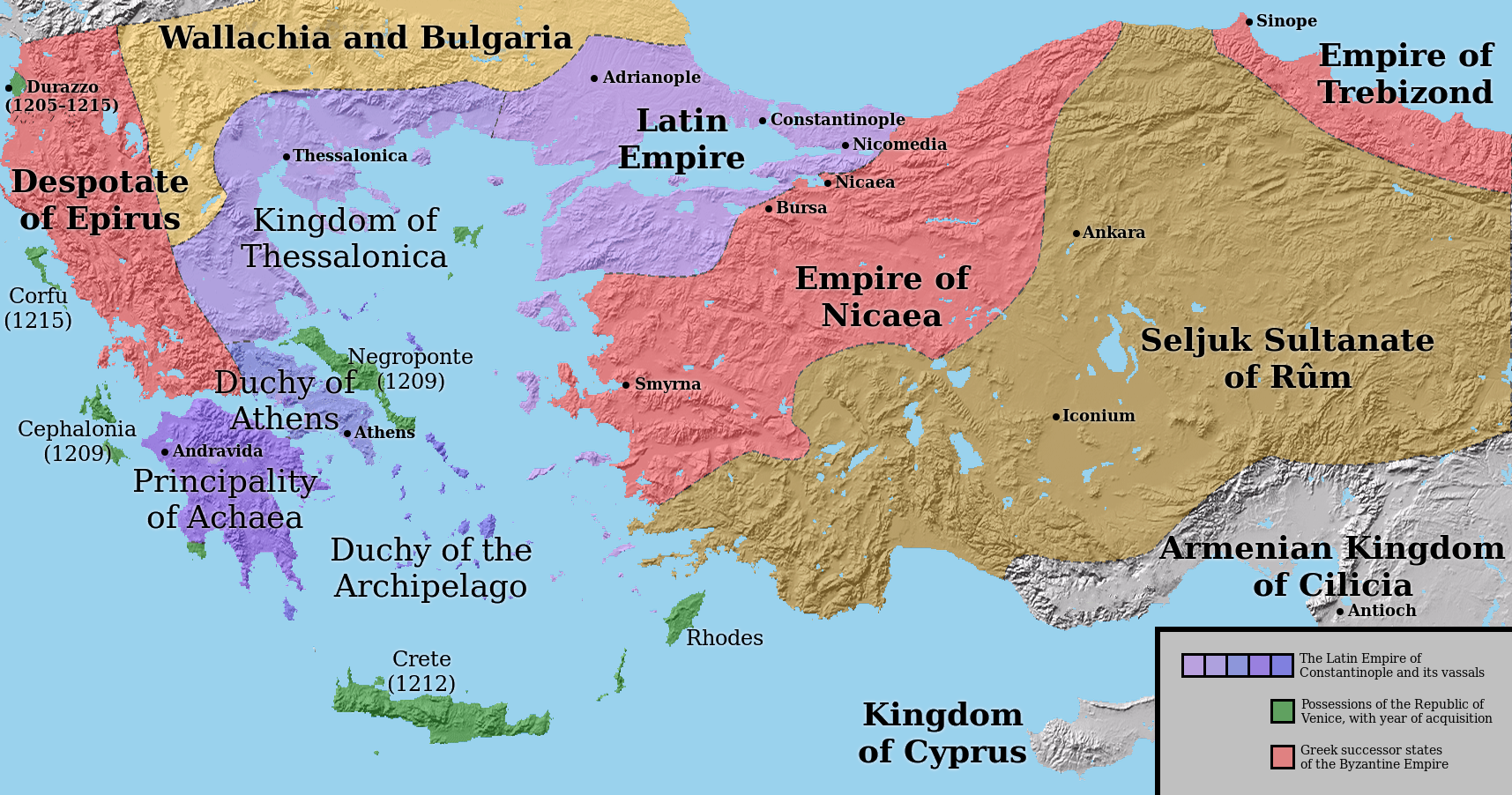
The Empire of Nicaea (Greek: Βασιλεία Ῥωμαίων), also known as the Nicene Empire, was the largest of the three Byzantine Greek rump states founded by the aristocracy of the Byzantine Empire that fled when Constantinople was occupied by Western European and Venetian armed forces during the Fourth Crusade, a military event known as the Sack of Constantinople. Like the other Byzantine rump states that formed due to the 1204 fracturing of the empire, such as the Empire of Trebizond and the Despotate of Epirus, it was a continuation of the eastern half of the Roman Empire that survived well into the Middle Ages. A fourth state, known in historiography as the Latin Empire, was established by an army of Crusaders and the Republic of Venice after the capture of Constantinople and the surrounding environs.
Founded by the Laskaris family, it lasted from 1204 to 1261, when the Nicenes restored the Byzantine Empire after they recaptured Constantinople. Thus, the Nicene Empire is seen as a direct continuation of the Byzantine Empire, as it fully assumed the traditional titles and government of the Byzantines in 1205.
The Despotate of Epirus contested the claim[clarification needed] in 1224 and became the Empire of Thessalonica, but was forced to renounce its claim by the Nicenes in 1242. The Empire of Trebizond, which declared its independence a few weeks before the Sack of Constantinople in 1204, withdrew all claims to being a continuation of the Byzantine Empire in the Treaty of 1282.
In 1204, Byzantine emperor Alexios V Doukas Mourtzouphlos fled Constantinople after crusaders invaded the city. Soon after, Theodore I Laskaris, the son-in-law of Emperor Alexios III Angelos, was proclaimed emperor, but he too, realizing the situation in Constantinople was hopeless, fled to the city of Nicaea in Bithynia.
The Latin Empire, established by the Crusaders in Constantinople, had poor control over former Byzantine territory, and Greek successor states of the Byzantine Empire sprang up in Epirus, Trebizond, and Nicaea. Trebizond had broken away as an independent state a few weeks before the fall of Constantinople. Nicaea, however, was the closest to the Latin Empire and was in the best position to attempt to re-establish the Byzantine Empire.
Theodore Laskaris was not immediately successful, as Henry of Flanders defeated him at Poimanenon and Prusa (now Bursa) in 1204. But Theodore was able to capture much of northwestern Anatolia after the Bulgarian defeat of Latin Emperor Baldwin I in the Battle of Adrianople, because Henry was recalled to Europe to defend against invasions from Tsar Kaloyan of Bulgaria. Theodore also defeated an army from Trebizond, as well as other minor rivals, leaving him in charge of the most powerful of the successor states.
Numerous truces and alliances were formed and broken over the next few years, as the Byzantine successor states, the Latin Empire, the Bulgarian Empire and the Seljuks of Iconium (whose territory also bordered Nicaea) fought each other. In 1211, at Antioch on the Meander, Theodore defeated a major invasion by the Seljuks, who were backing a bid by Alexios III Angelos to return to power. The losses suffered at Antioch, however, led to a defeat at the hands of the Latin Empire at the Rhyndacus River and the loss of most of Mysia and the Marmara Sea coast in the subsequent Treaty of Nymphaeum. The Nicenes were compensated for this territorial loss when, in 1212, the death of David Komnenos allowed their annexation of his lands in Paphlagonia.
In 1205, Theodore assumed the traditional titles of the Byzantine emperors. Three years later, he convoked a church council to elect a new Orthodox patriarch of Constantinople. The new patriarch crowned Theodore emperor and established his seat at Theodore's capital, Nicaea. In 1219, he married the daughter of Latin Empress Yolanda of Flanders, but he died in 1221 and was succeeded by his son-in-law, John III Doukas Vatatzes.
Hub AI
Empire of Nicaea AI simulator
(@Empire of Nicaea_simulator)
Empire of Nicaea
The Empire of Nicaea (Greek: Βασιλεία Ῥωμαίων), also known as the Nicene Empire, was the largest of the three Byzantine Greek rump states founded by the aristocracy of the Byzantine Empire that fled when Constantinople was occupied by Western European and Venetian armed forces during the Fourth Crusade, a military event known as the Sack of Constantinople. Like the other Byzantine rump states that formed due to the 1204 fracturing of the empire, such as the Empire of Trebizond and the Despotate of Epirus, it was a continuation of the eastern half of the Roman Empire that survived well into the Middle Ages. A fourth state, known in historiography as the Latin Empire, was established by an army of Crusaders and the Republic of Venice after the capture of Constantinople and the surrounding environs.
Founded by the Laskaris family, it lasted from 1204 to 1261, when the Nicenes restored the Byzantine Empire after they recaptured Constantinople. Thus, the Nicene Empire is seen as a direct continuation of the Byzantine Empire, as it fully assumed the traditional titles and government of the Byzantines in 1205.
The Despotate of Epirus contested the claim[clarification needed] in 1224 and became the Empire of Thessalonica, but was forced to renounce its claim by the Nicenes in 1242. The Empire of Trebizond, which declared its independence a few weeks before the Sack of Constantinople in 1204, withdrew all claims to being a continuation of the Byzantine Empire in the Treaty of 1282.
In 1204, Byzantine emperor Alexios V Doukas Mourtzouphlos fled Constantinople after crusaders invaded the city. Soon after, Theodore I Laskaris, the son-in-law of Emperor Alexios III Angelos, was proclaimed emperor, but he too, realizing the situation in Constantinople was hopeless, fled to the city of Nicaea in Bithynia.
The Latin Empire, established by the Crusaders in Constantinople, had poor control over former Byzantine territory, and Greek successor states of the Byzantine Empire sprang up in Epirus, Trebizond, and Nicaea. Trebizond had broken away as an independent state a few weeks before the fall of Constantinople. Nicaea, however, was the closest to the Latin Empire and was in the best position to attempt to re-establish the Byzantine Empire.
Theodore Laskaris was not immediately successful, as Henry of Flanders defeated him at Poimanenon and Prusa (now Bursa) in 1204. But Theodore was able to capture much of northwestern Anatolia after the Bulgarian defeat of Latin Emperor Baldwin I in the Battle of Adrianople, because Henry was recalled to Europe to defend against invasions from Tsar Kaloyan of Bulgaria. Theodore also defeated an army from Trebizond, as well as other minor rivals, leaving him in charge of the most powerful of the successor states.
Numerous truces and alliances were formed and broken over the next few years, as the Byzantine successor states, the Latin Empire, the Bulgarian Empire and the Seljuks of Iconium (whose territory also bordered Nicaea) fought each other. In 1211, at Antioch on the Meander, Theodore defeated a major invasion by the Seljuks, who were backing a bid by Alexios III Angelos to return to power. The losses suffered at Antioch, however, led to a defeat at the hands of the Latin Empire at the Rhyndacus River and the loss of most of Mysia and the Marmara Sea coast in the subsequent Treaty of Nymphaeum. The Nicenes were compensated for this territorial loss when, in 1212, the death of David Komnenos allowed their annexation of his lands in Paphlagonia.
In 1205, Theodore assumed the traditional titles of the Byzantine emperors. Three years later, he convoked a church council to elect a new Orthodox patriarch of Constantinople. The new patriarch crowned Theodore emperor and established his seat at Theodore's capital, Nicaea. In 1219, he married the daughter of Latin Empress Yolanda of Flanders, but he died in 1221 and was succeeded by his son-in-law, John III Doukas Vatatzes.