Hubbry Logo
Latin EmpireLatin EmpireMain
Open search
Latin Empire
Community hub
Latin Empire
logo
8 pages, 0 posts
0 subscribers
Be the first to start a discussion here.
Contribute something
Latin Empire
Latin Empire
from Wikipedia

The Latin Empire, also referred to as the Latin Empire of Constantinople or the Constantinopolitan Empire, was a feudal Crusader state founded by the leaders of the Fourth Crusade on lands captured from the Byzantine Empire. The Latin Empire was intended to replace the Byzantine Empire as the Western-recognized Roman Empire in the east, with a Catholic emperor enthroned in place of the Eastern Orthodox Roman emperors. The main objective to form a Latin Empire was planned over the course of the Fourth Crusade, promoted by crusade leaders such as Boniface I of Montferrat,[2] as well as the Republic of Venice.[3]

Key Information

The Fourth Crusade had originally been called to retake the Muslim-controlled city of Jerusalem, but a sequence of economic and political events culminated in the Crusader army sacking the city of Constantinople, the capital of the Byzantine Empire. Originally, the plan had been to restore the deposed Byzantine Emperor Isaac II Angelos, who had been usurped by Alexios III Angelos, to the throne. The crusaders had been promised financial and military aid by Isaac's son Alexios IV, with which they had planned to continue to Jerusalem. When the crusaders reached Constantinople, the situation quickly turned volatile, and while Isaac and Alexios briefly ruled, the crusaders did not receive the payment they had hoped for. In April 1204, they captured and plundered the city's enormous wealth.

The crusaders selected their own emperor from among their own ranks, Baldwin IX of Flanders, and divided the territory of the Byzantine Empire into various new vassal crusader states. The Latin Empire's authority was immediately challenged by Byzantine rump states led by the Laskaris family (connected to the Angelos dynasty of 1185–1204) in Nicaea and the Komnenos family (which had ruled as Byzantine Emperors 1081–1185) in Trebizond. From 1224 to 1242, the Komnenos Doukas family, also connected to the Angeloi, challenged Latin authority from Thessalonica. The Latin Empire failed to attain political or economic dominance over the other Latin powers that had been established in former Byzantine territories in the wake of the Fourth Crusade, especially Venice, and after a short initial period of military successes, it went into a steady decline due to constant war with Bulgaria to the north and the various Byzantine claimants. Eventually, the Nicene Empire recovered Constantinople and restored the Byzantine Empire under Michael VIII Palaiologos in 1261. The last Latin emperor, Baldwin II, went into exile, but the imperial title survived, with several pretenders to it, until the 14th century.

Etymology

[edit]
Seal of Philip of Courtenay, Latin Emperor in exile 1273–1283. His title in the seal is Dei gratia imperator Romaniae et semper augustus ("By the Grace of God, Emperor of Romania, ever august").

The term "Latin Empire" was not contemporary, and was first used by historians in the 16th century to distinguish the Crusader state from the classical Roman Empire and the Byzantine Empire, all of which called themselves "Roman". The term "Latin" was chosen because the crusaders (Franks, Venetians, and other Westerners) were Roman Catholic and used Latin as their liturgical and scholarly language in contrast to the Eastern Orthodox locals who used Greek in both liturgy and common speech. The Byzantines referred to the Latin Empire as the Frankokratia 'rule of the Franks', or the Latinokratia 'rule of the Latins'.[4]

Founding treaties issued by the crusaders specifically refer to the empire as the imperium Constantinopolitanum ("Constantinopolitan Empire"). Although this is a marked departure from the standard Byzantine nomenclature and ideology, designating the empire as the Basileía Rhōmaíōn 'Empire of the Romans', imperium Constantinopolitanum was the standard name used for the eastern empire in western sources, such as in papal correspondence, and suggests that the Latin leaders viewed themselves as "taking over" the empire rather than "replacing" it. It would have been difficult for the crusaders to justify referring to the empire as "Roman" considering that Western Europe generally held the Germanic Holy Roman Empire to represent the legitimate Roman Empire.[5] These two conclusions—that for outsiders the Roman identity of this empire remained controversial and that its conquest was considered a takeover, not a replacement—are further supported by an entry in Deeds of the Bishops of Halberstadt, a contemporaneous chronicle made in Germany. When referring to the elevation of the first Latin Emperor, Baldwin I, the chronicle called him imperator Grecorum ("emperor of the Greeks"), the same title used on an earlier page for Alexios I Komnenos. Similarly, the Emperor Isaac Angelos is listed in the chronicle as rex Grecorum ("king of the Greeks").[6]

Seal of Baldwin I, the first Latin Emperor. The abbreviation Rom. leaves it open to interpretation if he refers to Romaniae 'Romania' or Romanorum 'the Romans'

The full title Baldwin actually used was dei gratia fidelissimus in Christo imperator a Deo coronatus Romanorum moderator et semper augustus, a near perfect replication of the one used by Alexios IV Angelos, placed on the throne by the crusaders previously, in a letter (only known in its Latin version) to Pope Innocent III: fidelis in Christo imperator a Deo coronatus Romanorum moderator et semper augustus. Letters by Baldwin to Pope Innocent III give his title as imperator Constantinopolitanus, possibly altered by Papal scribes as the Pope recognized the Holy Roman Emperor as the imperator Romanorum. In his seals, Baldwin abbreviated Romanorum as Rom., conveniently leaving it open for interpretation whether he referred to Romaniae 'land of the Romans' or Romanorum 'the Romans'. It is probably more likely that he meant Romanorum. Baldwin's successor Henry called the empire imperium Romanum at least in one letter.[5] A Venetian statesman Marino Sanuto the Elder used yet another appellative, Sebastō Latíno Basilía ton Rhōmaíōn (Σεβαστό Λατίνο βασιλιά των Ρωμαίων, lit. "August Latin Empire of the Romans").[7] The term "Romania" had been a vernacular name used for centuries by the population of the Late Roman polity for their country.[8][9]

Three different versions of imperial titulature are attested under Henry; Henricus Dei Gratia Imperator Romaniae 'Emperor of Romania', Henricus Dei Gratia Imperator Romanorum 'Emperor of the Romans' and Henricus Dei Gratia Imperator Constantinopolitani 'Constantinopolitan Emperor', possibly intended for different recipients. Usage of the title Emperor of Constantinople may not just have been to appease the Pope and Western Europe, but might also have been used to legitimize the rule of the Latin Emperors in regards to the Byzantines that they ruled. Possession of the city itself was a key legitimizing factor that set the Latin Emperors apart from Byzantine claimants in Nicaea, Trebizond and Thessalonica.[5]

History

[edit]

Origins

[edit]
A 19th century tomb marker of the probable location of the tomb of Enrico Dandolo, the leader of the Fourth Crusade and Doge of Venice, inside the Hagia Sophia

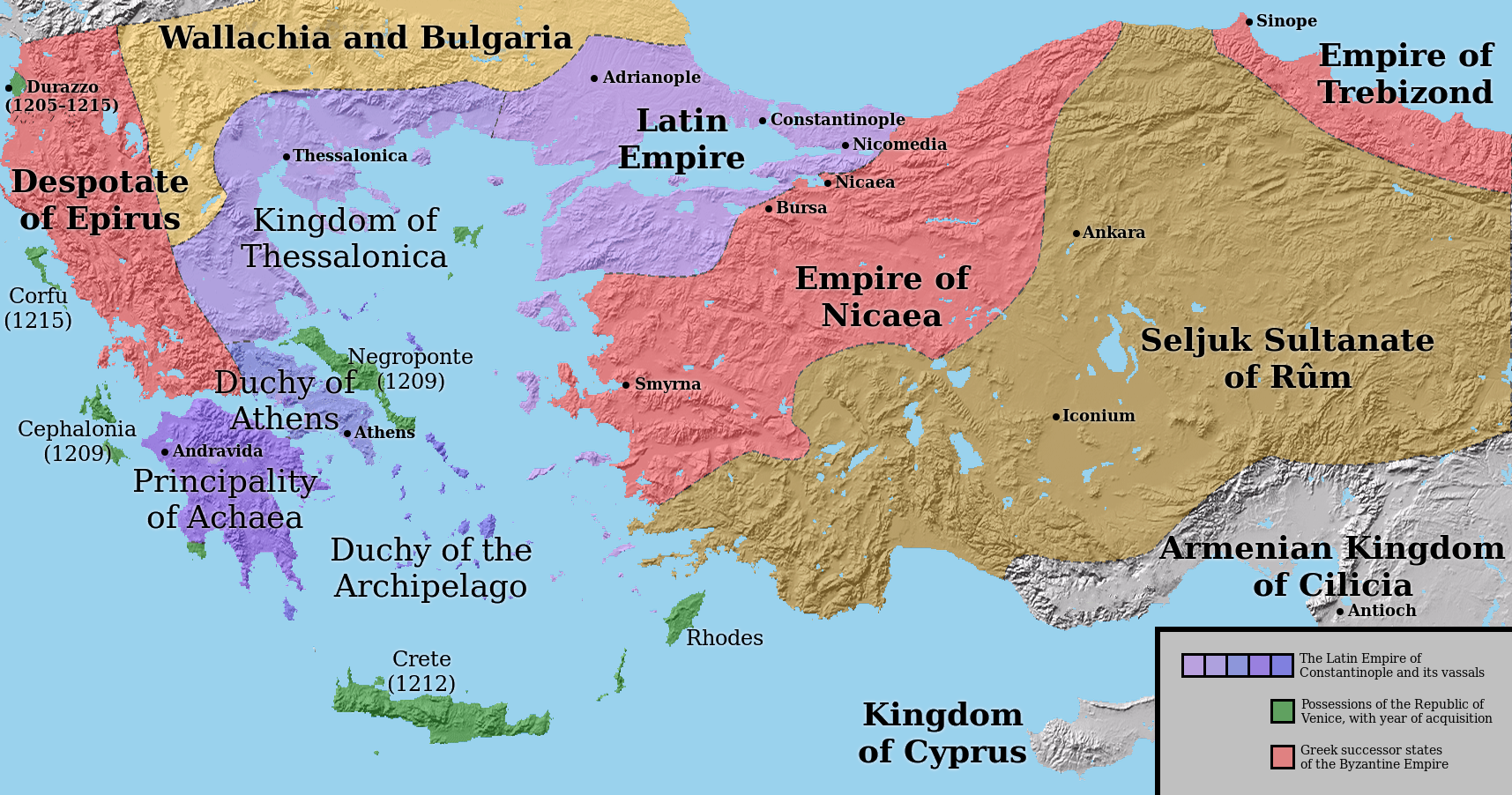
After the Sack of Constantinople, the crusaders agreed to divide up Byzantine territory. In the Partitio terrarum imperii Romaniae, signed on 1 October 1204, three eighths of the empire—including Crete and other islands—went to the Republic of Venice. The Latin Empire claimed the remainder and exerted control over:

Further duchies were projected in Asia Minor, at Nicaea (for Louis of Blois), Nicomedia (Thierry de Loos), Philadelphia (Stephen du Perche), and Neokastra. These duchies remained theoretical, due to the establishment of the Empire of Nicaea in the area.[10] Nicaea itself was never occupied and Louis of Blois was killed in 1205.[11] Thierry de Loos was captured by the Nicaeans in 1207 and, although released, left the Latin Empire two years later. After a brief Nicaean reconquest, Nicomedia returned to Latin control, but the ducatus Nichomedie remained part of the Imperial domain.[12] Philadelphia never came under actual Latin control, although the Latin emperor Henry of Flanders laid claim to the region after defeating the local strongman, Theodore Mangaphas, in 1205.[13] The duchy of Neokastra (ducatus Novi Castri) on the other hand was never accorded to a single holder, but was divided among the Knights Hospitaller (one quarter) and other feudatories. The term "duchy" in this case reflects the earlier Byzantine term theme, usually governed by a doux, to designate a province.[14]

The Doge of Venice did not rank as a vassal to the Latin Empire. Still, his position in control of three-eighths of its territory and of parts of Constantinople itself ensured Venice's influence in the Empire's affairs. However, much of the former Byzantine territory remained in the hands of rival successor states led by Byzantine Greek aristocrats, such as the Despotate of Epirus, the Empire of Nicaea, and the Empire of Trebizond, each bent on reconquest from the Latins.

On 9 May 1204, Baldwin I was elected the emperor with Venetian support, and crowned on 16 May in the Hagia Sophia in a ceremony that closely followed Eastern Roman practices.[15] Not long after the coronation, Baldwin ventured out into the Thracian countryside, posturing not as a conqueror but as a legitimate ruler, expecting to be universally acclaimed by the populace as the Emperor of the Romans.[16] The establishment of the Latin Empire had the curious effect of creating five simultaneously existing polities claiming to be the Roman Empire: the Latin empire, the Holy Roman Empire, and the three remnants of the Byzantine Empire, the Despotate of Epirus, the empire of Nicaea, and the empire of Trebizond.

In Asia Minor

[edit]
Capture of Constantinople during the Fourth Crusade in 1204.

The initial campaigns of the crusaders in Asia Minor resulted in the capture of most of Bithynia by 1205, with the defeat of the forces of Theodore I Laskaris at Poemanenum and Prusa. Latin successes continued, and in 1207 a truce was signed with Theodore, newly proclaimed Emperor of Nicaea. The Latins inflicted a further defeat on Nicaean forces at the Rhyndakos river in October 1211, and three years later the Treaty of Nymphaeum (1214) recognized their control of most of Bithynia and Mysia.

The peace was maintained until 1222, when the resurgent power of Nicaea felt sufficiently strong to challenge the Latin Empire, by that time weakened by constant warfare in its European provinces. At the battle of Poimanenon in 1224, the Latin army was defeated, and by the next year Emperor Robert of Courtenay was forced to cede all his Asian possessions to Nicaea, except for Nicomedia and the territories directly across from Constantinople. Nicaea turned also to the Aegean, capturing the islands awarded to the empire. In 1235, finally, the last Latin possessions fell to Nicaea.

In Europe

[edit]

Unlike in Asia, where the Latin Empire faced only an initially weak Nicaea, in Europe it was immediately confronted with a powerful enemy: the Bulgarian tsar Kaloyan. When Baldwin campaigned against the Byzantine lords of Thrace, they called upon Kaloyan for help. At the Battle of Adrianople on 14 April 1205, the Latin heavy cavalry and knights were crushed by Kaloyan's troops and Cuman allies, and Emperor Baldwin was captured. He was imprisoned in the Bulgarian capital Tarnovo until his death later in 1205. Kaloyan was murdered a couple of years later (1207) during a siege of Thessalonica, and the Bulgarian threat conclusively defeated with a victory the following year, which allowed Baldwin's successor, Henry of Flanders, to reclaim most of the lost territories in Thrace until 1210, when peace was concluded with the marriage of Henry to Maria of Bulgaria, tsar Kaloyan's daughter.

Despotate of Epirus, one of the successor states of the Byzantine Empire

At the same time, another Byzantine successor state, the Despotate of Epirus, under Michael I Komnenos Doukas, posed a threat to the empire's vassals in Thessalonica and Athens. Henry demanded his submission, which Michael provided, giving off his daughter to Henry's brother Eustace in the summer of 1209. This alliance allowed Henry to launch a campaign in Macedonia, Thessaly and Central Greece against the rebellious Lombard lords of Thessalonica. However, Michael's attack on the Kingdom of Thessalonica in 1210 forced him to return north to relieve the city and to force Michael back into submission.

In 1214 however, Michael died, and was succeeded by Theodore Komnenos Doukas, who was determined to capture Thessalonica. On 11 June 1216, while supervising repairs to the walls of Thessalonica, Henry died, and was succeeded by Peter of Courtenay, who himself was captured and executed by Theodore the following year. Peter's widow Yolanda of Flanders ruled alone in Constantinople until her death in 1219. Her son Robert of Courtenay being absent in France, the regency passed first to Conon de Béthune, and after his death shortly after, to Cardinal Giovanni Colonna, until 1221, when Robert of Courtenay arrived in Constantinople. Distracted by the renewed war with Nicaea, and waiting in vain for assistance from Pope Honorius III and the King of France Philip II, the Latin Empire was unable to prevent the final fall of Thessalonica to Epirus in 1224. Epirote armies then conquered Thrace in 1225–26, appearing before Constantinople itself. The Latin Empire was saved for a time by the threat posed to Theodore by the Bulgarian tsar Ivan II Asen, and a truce was concluded in 1228.

Decline and fall

[edit]

After Robert of Courtenay died in 1228, a new regency under John of Brienne was set up. After the disastrous Epirote defeat by the Bulgarians at the Battle of Klokotnitsa, the Epirote threat to the Latin Empire was removed, only to be replaced by Nicaea, which started acquiring territories in Greece. Emperor John III Doukas Vatatzes of Nicaea concluded an alliance with Bulgaria, which in 1235 resulted in a joint campaign against the Latin Empire, and an unsuccessful siege of Constantinople the same year. In 1237, Baldwin II attained majority and took over the reins of a much-diminished state. The empire's precarious situation forced him to travel often to Western Europe seeking aid, but largely without success. In order to raise funds, he was forced to resort to desperate means, from removing the lead roofs of the Great Palace and selling them, to handing over his only son, Philip, to Venetian merchants as a guarantee for a loan.

By 1247, the Nicaeans had effectively surrounded the main holdings of the Emperor in the new European land system. Following the victory at the Battle of Pelagonia in 1259 Michael VIII Palaiologos of the Nicaean empire had only one obstacle left. The Theodosian walls and the Latin Forces. He had already cut off the Latins from aid from the Latin estates of Greece or the Nicaeans rivals and also a successor state to the Byzantines the Despotate of Epirus.

The first attempt to take Constantinople occurred in 1260 when a Latin knight taken prisoner in Pelagonia, whose house was in the city walls, promised to open a gate for the emperor's troops. He failed to do so, and Palaiologos launched an unsuccessful assault on Galata Instead. In preparation for another attempt, an alliance with Genoa was concluded in March 1261, and in July 1261

As the one-year truce concluded after the failed Nicaean attack was nearing its end, the general Alexios Strategopoulos was sent with a small advance force of 800 soldiers (most of them Cumans) to keep a watch on the Bulgarians and spy out the defences of the Latins.

When the Nicaean force reached the village of Selymbria, some 30 miles (48 km) west of Constantinople, they learned from some independent local farmers (thelematarioi) that the entire Latin garrison, as well as the Venetian fleet, were absent conducting a raid against the Nicaean island of Daphnousia. Strategopoulos initially hesitated to take advantage of the situation, since his small force might be destroyed if the Latin army returned too soon, and because he would exceed the emperor's orders, but eventually decided he could not squander such a golden opportunity to retake the city.

On the night of 24/25 July 1261, Strategopoulos and his men approached the city walls and hid at a monastery near the Gate of the Spring. Strategopoulos sent a detachment of his men, led by some of the thelematarioi, to make their way to the city through a secret passage. They attacked the walls from the inside, surprised the guards and opened the gate, giving the Nicaean force entry into the city. The Latins were taken completely unaware, and after a short struggle, the Nicaeans gained control of the land walls. As news of this spread across the city, the Latin inhabitants, from Emperor Baldwin II downwards, hurriedly rushed to the harbours of the Golden Horn, hoping to escape by ship. At the same time, Strategopoulos' men set fire to the Venetian buildings and warehouses along the coast to prevent them from landing there. Thanks to the timely arrival of the returning Venetian fleet, many of the Latins managed to evacuate to the still Latin-held parts of Greece, but the city was lost.

Nicaean general Alexios Strategopoulos found an unguarded entrance to the city, and entered it with only 800 troops, restoring the Byzantine Empire for his master, Michael VIII Palaiologos.

The remaining Latin states ruled territories of present-day Greece, some of them until the 18th century, and are known as Latinokratia.

Titular claimants

[edit]

For about a century thereafter, the heirs of Baldwin II continued to use the title of Emperor of Constantinople, and were seen as the overlords of the various remaining Latin states in the Aegean. They exercised effective authority in Greece only when actually ruling as princes of Achaea, from 1333 to 1383.

James of Baux was the last of these Latin emperors to govern any imperial territory through Achaea. His reign lasted from 1374 until his death on 7 July 1383.[citation needed]

Organization and society

[edit]

Administration

[edit]

The empire was formed and administered on Western European feudal principles, incorporating some elements of the Byzantine bureaucracy. The emperor was assisted by a council, composed of the various barons, the Venetian Podestà of Constantinople and his six-member council. This council had a major voice in the governance of the realm, especially in periods of regency, when the Regent (moderator imperii) was dependent on their consent to rule. The podestà, likewise, was an extremely influential member, being practically independent of the emperor. He exercised authority over the Venetian quarters of Constantinople and Pera and the Venetian dominions within the empire, assisted by a separate set of officials. His role was more that of an ambassador and vicegerent of Venice than a vassal to the empire. The podestà was granted the title of Governor of One-Fourth and One-Half of the Empire of Romania, and was entitled to wearing the imperial crimson buskins like the emperor.[17]

Economy

[edit]

The Latins did not trust the professional Greek bureaucracy, and in the immediate aftermath of the conquest completely dismantled the Greek economic administration of the areas they controlled. The result was disastrous, disrupting all forms of production and trade. Almost from its inception the Latin Empire was sending requests back to the papacy for aid. For a few years, the major commodities it exported from the surrounding region of Thrace were wheat and furs; it also profited from Constantinople's strategic location on major trade routes. While the empire showed some moderate vitality while Henry of Flanders was alive, after his death in 1216 there was a major deficit in leadership. By the 1230s, Constantinople – even with its drastically reduced population – was facing a major shortage of basic foodstuffs. In several senses, the only significant export on which the economy of the Latin Empire had any real basis was the sale of relics back to Western Europe which had been looted from Greek churches.[citation needed] For example, Emperor Baldwin II sold the relic of the Crown of Thorns while in France trying to raise new funds.[citation needed]

Society

[edit]

The elite of the empire were the Frankish and Venetian lords, headed by the emperor, the barons and the lower-ranking vassals and liege lords, including many former Byzantine aristocrats. The bulk of the people were Orthodox Greeks, still divided according to the Byzantine system in income classes based on land ownership.

Church

[edit]

As with all Latin states, the Orthodox hierarchy was replaced by Roman Catholic prelates, but not suppressed.[citation needed] An expansive Catholic hierarchy was established, under the dual supervision of the Latin archbishop of Constantinople and the Papal legate, until the two offices were merged in 1231. Western Catholic religious orders, such as the Cistercians, the Dominicans and the Franciscans were established in the empire. The Orthodox clergy retained its rites and customs, including its right to marriage, but was demoted to a subordinate position, subject to the local Latin bishops.[citation needed]

See also

[edit]

Notes

[edit]

References

[edit]

Bibliography

[edit]
[edit]
Revisions and contributorsEdit on WikipediaRead on Wikipedia
from Grokipedia
The Latin Empire was a short-lived feudal monarchy established by Western European Crusaders after they captured Constantinople, the capital of the Byzantine Empire, on 13 April 1204 during the Fourth Crusade, which had deviated from its original objective of recapturing Jerusalem from Muslim control. Baldwin IX, Count of Flanders, was elected and crowned as Baldwin I, the first emperor, on 16 May 1204, with the empire's core territories encompassing Constantinople, much of Thrace, and portions of northwestern Anatolia under direct control, supplemented by vassal principalities such as the Kingdom of Thessalonica and the Duchy of Athens. Governed by a sequence of emperors from the houses of Flanders and Courtenay—including Henry (1205–1216), Peter II (1216–1217), Robert I (1221–1228), and Baldwin II (1228–1261)—the empire faced persistent military challenges from resurgent Byzantine states in Nicaea, Epirus, and Trebizond, as well as financial strains from maintaining a Latin nobility amid a predominantly Greek population resistant to Western rule. Its defining controversy stemmed from the Crusade's redirection, orchestrated partly by Venetian commercial interests and unpaid transport debts, resulting in the sack of a Christian city and the looting of invaluable relics and treasures, which irreparably fractured Eastern Christendom and sowed seeds for future Islamic advances. The empire collapsed in July 1261 when forces of the Empire of Nicaea, led by general Alexios Strategopoulos under Emperor Michael VIII Palaiologos, exploited a undefended entry to retake Constantinople, ending 57 years of Latin occupation and restoring Byzantine rule albeit in a diminished form. Despite transient achievements like the imposition of feudal structures and brief stabilization under Henry, the Latin Empire's legacy lies in accelerating the Byzantine Empire's fragmentation, rendering it vulnerable to Ottoman conquest centuries later.

Formation

Prelude to the Fourth Crusade

, elected in January 1198, issued the Post miserabile on August 15 of that year, summoning a new crusade aimed at recapturing following its loss to in 1187. The pope's appeal emphasized spiritual rewards, including indulgences, but recruitment faced challenges due to recent crusade failures and ongoing European conflicts. Key Western nobles responded, including Baldwin IX, Count of Flanders, who pledged significant forces, and , who assumed leadership in late 1201 after the death of initial commander Thibaut III, . These leaders represented pragmatic feudal alliances rather than unified ideological zeal, with participation driven by prospects of land, wealth, and papal favor amid feudal obligations. To facilitate transport to the via —a strategic shift from direct Syrian assaults—the crusaders negotiated a contract with the in April 1201. agreed to supply 200 ships and 50 galleys to carry approximately 4,500 knights, 9,000 squires, 20,000 infantry, and 4,500 horses, in exchange for 85,000 silver marks plus half the conquests. Fewer participants arrived by mid-1202 than anticipated, leaving the crusaders short of funds and uncompensated for its massive investment, which strained its economy. Under the ambitious, blind Doge , conditioned further aid on capturing Zara (modern ), a Dalmatian port under Hungarian suzerainty and rival to Venetian trade interests; the city fell after a from October 10 to November 24, 1202, despite Innocent III's of participants for attacking a Christian holdout. This diversion highlighted economic pragmatism over crusading purity, as Venetian commercial incentives aligned with debt recovery. The Byzantine Empire's internal weaknesses amplified these financial pressures. Since seized power in 1185 after the tyrannical Andronikos I's overthrow, the Angelos dynasty presided over fiscal mismanagement, corruption, and revolts, including the 1185–1187 Vlach-Bulgarian uprising that detached key Balkan territories. Isaac's 1195 deposition by his brother Alexios III exacerbated economic decline through heavy taxation and failed diplomacy, eroding central authority and creating a exploitable by external actors. In late 1202, after Zara's fall, Isaac's son Alexios IV—having fled in 1201 and appealed to —intercepted the crusaders at , promising 200,000 silver marks to settle Venetian debts, an additional 10,000 for the Venetians, supplies for 500 knights annually, and subordination of the Orthodox Church to in exchange for military restoration to co-emperorship. These commitments, verified through negotiations with Boniface, addressed immediate fiscal shortfalls while tapping Byzantine wealth, redirecting the expedition eastward as a creditor-enforced rather than unprovoked .

Diversion and Sack of Constantinople

The Fourth Crusade's forces, facing financial obligations to and failed negotiations with Byzantine Emperor —who had overthrown the pro-Latin in late January 1204—initiated assaults on 's defenses in early April. On 9 April, the first coordinated attack across the utilized siege engines and naval superiority but was repelled by Byzantine forces, including the , resulting in significant Crusader losses estimated at around 900 men by contemporary chronicler Geoffrey de Villehardouin. Alexios V's regime, backed by aristocratic factions opposed to Latin influence and unwilling to fulfill payment promises to the Crusaders, exacerbated internal disunity, with reports of inadequate provisioning and morale issues among defenders that hindered a unified response. This opportunism amid Byzantine instability, rather than a fully premeditated plot, enabled the Crusaders' persistence, as debated by historians analyzing whether Venetian interests or contingent financial pressures primarily drove the diversion. A second assault on 12 April succeeded when Venetian galleys, equipped with scaling ladders and siege towers mounted on masts, breached the sea walls near the palace after overcoming the harbor chain blockade. Crusader knights stormed ashore, overwhelming the defenders and prompting Alexios V to flee the city that night; he was later captured and executed by Latin forces in 1205. The ensuing sack lasted three days, with Crusaders and Venetians looting treasures from sites like , including relics such as the (later disputed) and vast quantities of gold, silver, and artworks valued in contemporary accounts at 900,000 silver marks. Empirical casualty figures remain uncertain, with Villehardouin noting heavy Byzantine deaths during the breach but no precise totals, while modern estimates suggest up to 2,000 Latin fatalities across assaults and 10,000 or more Byzantine civilian and military losses amid the chaos, though these derive from biased eyewitness narratives prone to exaggeration. Prior to the final assault, Crusade leaders formalized a partition agreement allocating three-eighths of spoils to the Venetians, three-eighths to the Frankish Crusaders (from which the elected would receive a quarter), and the remainder effectively under Latin control post-sack, superseding earlier pledges to the claimant. This division, executed through auctions and lots as described by Villehardouin, reflected pragmatic enabled by Byzantine divisions—such as the aristocracy's rejection of Alexios IV's Latin alliances—which fragmented resistance and invited exploitation, countering interpretations of the events as purely external aggression divorced from imperial vulnerabilities. The sack's immediacy thus installed provisional Latin authority, setting the stage for the empire's formal establishment without prior administrative designs.

Establishment and Initial Organization

Following the capture of Constantinople on April 13, 1204, the crusader leaders elected Baldwin IX, Count of Flanders and Hainaut, as emperor on May 9, 1204, prioritizing his royal connections and military leadership over other candidates like Boniface of Montferrat. He was crowned Baldwin I on May 16, 1204, in the Hagia Sophia, utilizing Byzantine ceremonial rites to assert legitimacy as the successor to the Roman imperial tradition, thereby positioning the new state as the continuation of the Eastern Roman Empire under Latin rule. The , formalized in 1204, divided the Byzantine territories among the crusaders and Venetians, establishing the Latin Empire centered on and while creating vassal states to secure feudal loyalty. Key fiefs included the Kingdom of Thessalonica granted to Boniface of , the Duchy of Athens awarded to Otho de la Roche in 1205, and the , founded in the by William of Champlitte around the same period, all owing homage to the emperor. This feudal overlay aimed to transplant Western European systems onto Eastern lands, with barons receiving fiefdoms in exchange for . Initial organization faced severe challenges due to the exodus of much of the Greek population following the sack, which depopulated Constantinople and strained resources, necessitating the resettlement of approximately 3,000 Latin knights and families into abandoned properties for duties. The regime's early sustenance derived from the partition of imperial treasures and properties, supplemented by duties on trade through the and tithes from controlled lands, though these proved insufficient against ongoing fiscal pressures.

Territorial Extent and Conflicts

Campaigns in Asia Minor

Following the in 1204, Latin forces under leaders like Boniface of Montferrat initially secured portions of northwestern Asia Minor, including much of , to counter Seljuk and emerging Greek resistance. However, Emperor Baldwin I's attention shifted decisively after his defeat and capture at the on April 14, 1205, by Bulgarian Kaloyan, which compelled the Latins to prioritize European defenses against Bulgarian incursions rather than consolidating Anatolian gains. This diversion left Asia Minor holdings vulnerable, as Latin troops—already stretched thin—could not maintain garrisons amid ongoing threats from the Seljuks of Rum and Greek successors. Under Baldwin's brother , who assumed regency and later emperorship in 1206, Latin campaigns resumed with tactical successes against the nascent led by . In winter 1206–1207, Latin forces captured and , expanding control over key coastal and inland sites in while exploiting local Greek alliances, including appointments of Byzantine nobles as governors to bolster loyalty. A truce signed in spring 1207 with temporarily halted hostilities, allowing Henry to redirect resources, but renewed offensives in 1211 targeted Nicaean heartlands. The pivotal Battle of the Rhyndacus on October 15, 1211, saw Henry's army rout Laskaris's forces after the Nicaeans failed in an ambush attempt along the river; the Latins advanced unopposed to , seizing additional fortresses without significant casualties. These victories temporarily extended Latin influence into , but manpower shortages—exacerbated by European commitments and feudal levies' unreliability—prevented permanent occupation, as garrisons proved insufficient against Nicaean counter-raids. By 1212, Henry captured further western Anatolian strongholds but withdrew due to troop exhaustion, highlighting the causal overextension: initial momentum from dissipated as the empire lacked the demographic and logistical depth to hold expansive frontiers against consolidated Greek resistance. The Treaty of Nymphaeum in December 1214 formalized a fragile , with the Latins retaining only a northwestern sliver of , including sites like and Pegai, while ceding most of to . This demarcation underscored the campaigns' ultimate failure to secure , as under exploited Latin vulnerabilities to reclaim territories by the mid-1210s, eroding the empire's eastern buffer and contributing to its strategic fragility.

Struggles in European Territories

The Latin Empire's European territories, encompassing , Macedonia, and parts of , faced immediate threats from the Second Bulgarian Empire due to the region's geographic exposure along the frontier and the fragmented feudal structure of Latin holdings, which hindered coordinated defenses. Following the 1204 , Kaloyan exploited local unrest by sheltering Byzantine refugees and inciting revolts in and Macedonia, launching raids that overran key outposts. In April 1205, Emperor Baldwin I marched with tens of thousands of troops, including 300 heavy knights, to relieve the besieged city of Adrianople; however, Bulgarian forces numbering around 40,000, bolstered by 14,000 Cuman cavalry under Kaloyan's command, ambushed the Latins on April 13-14 near the city. The result was a decisive Bulgarian victory, with most Latin knights slain and Baldwin captured, who later died in Bulgarian captivity in Tarnovgrad; this disaster enabled Bulgarian advances deep into and Macedonia, severely weakening the empire's cohesion. Under Regent and later Emperor (crowned August 20, 1206), stabilization efforts from 1206 to 1216 focused on reclaiming lost ground through targeted campaigns and diplomatic marriages amid ongoing feudal disunity, where lords often prioritized local interests over imperial defense. Henry reconquered eastern from Kaloyan, who continued raids until his death in 1207 during the siege of Thessalonica. Against Kaloyan's successor, Boril, Henry secured a victory at the Battle of Philippopolis in 1208, repelling Bulgarian incursions and restoring control over parts of . To bolster loyalty among fractious nobles, Henry enforced allegiance in the Kingdom of Thessalonica in 1209 amid the minority of Demetrios of , recapturing the city from Bulgarian influence and quelling Lombard rebellions through military pressure. Strategic marriages aided these gains, including Henry's union with Agnes of on February 4, 1207, to solidify alliances against Bulgaria, and his sister's marriage to a Bulgarian noble in 1213 to seal a pact with Boril. Parallel threats emerged from the in , where expanded aggressively after establishing control over northwestern by 1205, exploiting Latin vulnerabilities in and Macedonia. Initially a nominal , Michael broke a 1209 with Henry and launched offensives, including a 1210 joint assault with Dobromir Strez on Thessalonica, which Latin forces repelled but at significant cost. By 1212-1214, Epirote gains included , , Durazzo, and , isolating Latin enclaves through skirmishes that highlighted the empire's overextended lines and reliance on unreliable feudal levies. To mitigate disunity, Latin rulers issued land grants and charters in , awarding fiefs to knights and urban communities to ensure military service and loyalty, as evidenced in feudal documents guaranteeing noble fealty to . These measures provided temporary respite but underscored the empire's structural frailties against cohesive regional powers.

Relations with Neighboring Powers

The Latin Empire's foundational alliance with the , enshrined in the March 1204 partition treaty following the , allocated Venice three-eighths of the conquered territories, including the city's harbors, key , and commercial quarters with tax exemptions, effectively granting the maritime power a monopoly over trade routes critical to the empire's economy. This arrangement positioned Venice as a quasi-sovereign partner, extracting economic concessions that prioritized Genoese rival exclusion and Venetian shipping dominance over unified imperial governance, though underlying frictions arose from the republic's extraterritorial privileges eroding Latin authority. Papal diplomacy under Innocent III provided essential legitimacy despite initial outrage over the Crusade's diversion; by May 1205, the pope recognized Baldwin I's coronation and urged Western monarchs to furnish , framing the empire as a vanguard against Orthodox schism and Islamic expansion. His successor, Honorius III, reinforced this stance by crowning Peter of Courtenay as emperor in 1217 and issuing bulls in 1217–1218 mobilizing crusader reinforcements from and the to counter Byzantine successor threats, though material support remained sporadic due to European distractions. Interactions with the exemplified opportunistic truces amid rivalry; after Latin offensives under in 1211–1212, the 1214 Treaty of Nymphaeion established a fragile peace with , enabling both states to redirect forces against the Seljuk Sultanate of Rûm's incursions in without immediate mutual interference. This accord collapsed by 1222 as Nicaean resurgence under John III Vatatzes exploited Latin overextension, resuming border clashes driven by territorial ambitions rather than ideological enmity, with Nicaea occasionally leveraging Seljuk alliances to counter Latin campaigns in . Hostility toward the Seljuks of Rûm dominated Asian frontier policy, with Baldwin I's 1204–1205 expeditions capturing territories around before Bulgarian defeats forced retrenchment; subsequent emperors like Henry sought tactical pacts with Armenian against Seljuk raids, but chronic manpower shortages precluded lasting gains, allowing Rûm to reclaim much of western by the 1220s. In the , the empire navigated volatile ties with , where King Emeric initially extended in 1204–1205 amid shared interests against Bulgarian expansion, though Hungarian claims on Thessalonica vassals strained cooperation; external nomadic pressures intensified isolation, as Cuman mercenaries allied with Tsar enabled the decisive 1205 victory at Adrianople, capturing Baldwin I and fracturing Latin cohesion in without Hungarian intervention to offset the steppe warriors' mobility advantage. Similar Cuman-Bulgarian coalitions recurred, underscoring how peripheral powers amplified the empire's strategic encirclement by successor states like , whose despot mounted opportunistic assaults on Latin Thessalonica by 1210.

Rulers and Dynasties

Baldwin I and Early Regency

Baldwin IX, Count of Flanders and Count of Hainaut, emerged as a leading figure in the Fourth Crusade due to his military prowess and commitment to the expedition. On 9 May 1204, following the crusaders' capture of Constantinople, he was elected emperor by the Latin barons and Venetian allies, chosen for his prestige and ability to unify the disparate crusader factions. Baldwin was crowned Baldwin I on 16 May 1204 in the Hagia Sophia, utilizing adapted Byzantine rituals to legitimize his rule over the nascent Latin Empire. Baldwin's reign prioritized securing against Bulgarian incursions by Kaloyan, who sought to exploit the post-conquest instability. In spring 1205, Baldwin mobilized approximately 500 knights and infantry to besiege Adrianople, a city harboring Bulgarian allies and rebel forces. On 14 April 1205, during the ensuing , Kaloyan's combined Bulgarian, Cuman, and Vlach army overwhelmed the Latin through ambushes and superior numbers, leading to heavy casualties among the crusader elite. Baldwin himself was captured alive by Kaloyan and imprisoned in , where he died in captivity by late 1205, possibly strangled on the tsar's orders amid reports of Bulgarian unrest in . With Baldwin's fate uncertain but presumed fatal, his brother , a seasoned crusader commander, assumed the regency in mid-1205 to safeguard the empire's fragile holdings and Baldwin's infant son as nominal heir. Henry focused on fortifying and its environs, rallying Latin garrisons to repel follow-up Bulgarian raids and addressing baronial disputes over succession rights. This early regency period involved diplomatic overtures to for naval support and tactical withdrawals from vulnerable outposts, preventing immediate collapse despite the loss of Baldwin's leadership and the empire's premier knights.

Henry of Flanders and Consolidation

, brother of Baldwin I, assumed the role of in late 1205 following Baldwin's capture by Bulgarian forces under Kaloyan after the . He was formally crowned as Henry I in the on 20 August 1206, marking the transition to his direct rule over the Latin Empire. Unlike his brother's aggressive , Henry's approach emphasized stabilization and integration, earning him recognition as the most capable Latin emperor through pragmatic governance and tolerance toward Greek subjects, including alliances with local Byzantine nobles such as Theodore Branas, whom he appointed as governor of Adrianople. Under Henry's leadership from 1206 to 1216, the empire reached its territorial zenith, consolidating control over , parts of Macedonia, and key Aegean outposts through defensive campaigns and feudal grants rather than outright conquest. He reclaimed Adrianople and surrounding Thracian territories from Bulgarian incursions in 1206–1207, while extending influence into Macedonia via subjugated principalities and securing Aegean islands like those under Venetian suzerainty or Latin vassals in the . These efforts temporarily halted the fragmentation seen under Baldwin, fostering a brief period of administrative coherence amid ongoing threats from the and Bulgarian tsars. To bolster imperial legitimacy and feudal cohesion, Henry convened assemblies of Latin barons, akin to Western European feudal courts, to address , taxation, and succession disputes, thereby distributing while centralizing . He also initiated coinage reforms, minting silver deniers and gold hyperpyra of improved quality and Byzantine-inspired design to restore monetary confidence and symbolize continuity with pre-1204 imperial traditions, countering the that plagued early Latin issues. Henry's death on 11 June 1216 at the age of approximately 38, attributed to a sudden fever but with contemporary suspicions of by Greek agents, abruptly terminated this era of relative consolidation, paving the way for regency instability and territorial erosion.

Later Emperors and Decline

succeeded as emperor in 1216, elected by the Latin barons due to his marriage ties to the dynasty. Traveling overland to Constantinople, he was captured near Durazzo by Theodore I , , in 1217 and imprisoned, disappearing after June 1219 with his death presumed in captivity. His brief, absent rule left the empire without effective central authority, accelerating vulnerabilities to regional rivals. Yolanda of Flanders, Peter's widow, arrived in Constantinople by sea in 1217 and assumed regency duties, crowned empress on 9 April that year. She repelled immediate Nicaean threats through defensive measures and , including arranging her daughter Marie's marriage to of to secure a fragile truce. Yolanda died on 26 August 1219, her two-year stewardship providing temporary stabilization amid ongoing regency instability. Robert I of Courtenay, Yolanda's son, arrived in Constantinople in 1220 and was crowned emperor on 25 March 1221. His reign featured catastrophic losses, including defeat by Nicaean forces at the Battle of Poimanenon in 1224 and the surrender of Thessalonica to Epirus that same year, followed by cessions of remaining Anatolian territories to Nicaea in exchange for aid against Epirus. Robert died in late January 1228 en route from Rome, his incapacity to counter rival expansions—stemming from internal factionalism and limited resources—marked a pivotal erosion of Latin hegemony, reducing the empire's scope beyond Thrace. Baldwin II of Courtenay, Robert's younger brother and a minor born in 1217, acceded nominally in 1228 under successive regencies, including that of John of Brienne from 1231 to 1237. As adult ruler from 1237, Baldwin's chronic penury forced desperate measures, such as pawning the Crown of Thorns to Louis IX of France in 1239 and other relics to Venetian lenders, underscoring his pawn-like dependence on Italian commerce powers. He embarked on extended aid quests in Western Europe, including 1237–1239 in France and Italy and 1243–1248 across multiple courts, yielding sporadic subsidies but no sustained military reinforcement. By the 1230s, unchecked Nicaean advances had confined effective Latin control to Constantinople and adjacent Thracian districts, a contraction directly tied to leadership vacuums, fiscal exhaustion, and failure to mobilize feudal levies or Western crusading zeal.

Post-1261 Titular Claims

Following the Byzantine on 25 July 1261, Baldwin II, the last reigning , fled westward and resided primarily in , continuing to assert his imperial title without territorial control. Baldwin II died on 2 January 1273, leaving the titular claim to his son Philip I (born 1243, died 15 December 1283), who had been born in during the empire's existence. Philip I of Courtenay assumed the title of from 1273 to 1283, recognized nominally by surviving Latin principalities in , such as the , though these entities operated independently and offered no substantive support for restoration. In 1281, participated in the Treaty of Orvieto, allying with Charles I of Sicily and the to plan a potential reconquest, underscoring the title's lingering diplomatic utility among Western powers despite its lack of enforcement power. Upon 's death, the claim passed to his daughter Catherine I (born 1274, died 1307 or 1308), who married Charles of Valois in 1301 and transferred her rights to him, merging the lineage with Angevin interests while the broader Courtenay family retained assertions in European courts. The papacy, which had formally recognized Latin emperors from Baldwin I onward—including coronations and diplomatic correspondence—continued selective acknowledgment of the post-1261 claimants in documents urging against the restored Byzantines, though without committing resources, reflecting a for Latin over Greek rule in principle but pragmatic disinterest after the reconquest. These titular claims, documented in Courtenay genealogies and charters, persisted as vestiges of Western dynastic prestige into the , with descendants invoking the inheritance alongside French titles like counts of , but exerted no causal influence on Eastern politics, symbolizing the ultimate failure of the Fourth Crusade's vision for a Latin-dominated universal empire. By the mid-15th century, as Byzantine territories fell to the Ottomans and Courtenay lines integrated into lesser nobility, the claims faded into antiquarian references without revival attempts.

Government and Administration

Imperial Structure and Feudalism

The Latin Empire introduced a modeled on French customs, overlaying it upon the Byzantine Empire's centralized bureaucratic and thematic systems, which emphasized imperial over hereditary and . This adaptation created a structure where the served as suzerain overlord, granting fiefs in exchange for and from Latin barons and knights, while retaining theoretical over princes ruling semi-autonomous principalities. However, the scarcity of Latin settlers—estimated at only a few thousand amid a much larger Greek —rendered many grants nominal, fostering inefficiencies such as fragmented control and dependence on local Greek administrators who often harbored loyalties to Byzantine successor states. The foundational hierarchies were outlined in the , formalized between May and September 1204, which divided the conquered "" into quarters: one-quarter reserved for the emperor's domain around , with the remaining three-quarters allocated among non-Venetian crusaders to establish fiefs and principalities. An October 1205 treaty further defined vassal obligations, stipulating hereditary fief-holding with administrative, fiscal, and judicial rights, alongside seasonal military service from 1 June to 29 September for the empire's defense. Emperors like Baldwin I (r. 1204–1205) distributed these in to secure loyalty, granting estates to Flemish knights and barons such as those under his immediate command, while in broader , vassals like Boniface of received the Kingdom of Thessalonica as a major fief in exchange for nominal subordination and aid against Asian threats. Governance diverged from Byzantine through consultative mechanisms, including baronial assemblies known as parlements, where Latin magnates advised the on disputes, campaigns, and , reflecting feudal traditions of shared counsel akin to Western curia but ill-suited to the empire's vast, contested territories. These assemblies, convened after , underscored the barons' leverage, as emperors functioned more as primus inter pares than absolute rulers, with decisions often requiring consensus to enforce compliance. The Assises de Romanie, a legal compilation emerging from this milieu, fused French feudal customs with elements of Byzantine nomoi and Latin practices, codifying inheritance, homage, and servitia debita (due services) but failing to resolve underlying tensions from incomplete conquests and cultural mismatches. This hybrid system's inefficiencies manifested in poor integration: feudal fragmentation exacerbated vulnerabilities to Greek revolts and rival empires (, Trebizond, ), as barons prioritized personal domains over imperial cohesion, and the lack of a dense knightly class left fiefs under-manned and revenues insufficient for sustained defense. Emperors like (r. 1205–1216) attempted mitigations by employing Greek officials in lower administration, blending pronoia-like grants with Western vassalage, yet persistent baronial autonomy and geographic ignorance—crusaders' unfamiliarity with inland —undermined central authority, contributing to the empire's territorial contraction by the 1220s.

Role of Latin Nobility and Venice

The Latin nobility originated predominantly from French-speaking regions of northern and , with key figures such as Baldwin of Flanders and nobles from Hainaut and Courtenay participating in the . These knights formed the core of the empire's feudal elite, receiving hereditary fiefs in , Macedonia, and Asia Minor as rewards for their role in the 1204 conquest of , which established a Western-style vassalage system under the emperor. Intermarriages with Greek families emerged as a strategy to consolidate power, including diplomatic unions like the 1219 marriage of Marie de Courtenay to of , aimed at bridging Latin and Byzantine interests despite ongoing hostilities. Internal divisions among the frequently challenged imperial authority, exemplified by the 1216 poisoning of Emperor , attributed to Oberto II di Biandrate, an Italian noble serving as in Thessalonica, highlighting baronial ambitions and factional rivalries that weakened unified governance. Such infighting persisted through regencies and succession disputes, diverting resources from external threats and contributing to the empire's fragmentation. Venice's role was enshrined in the March 1204 partition treaty, which granted the republic three-eighths of Byzantine territories, retention of prior privileges, and the right to nominate the of upon the of a non-Venetian like Baldwin I on 9 May 1204. The doge, exempt from personal allegiance, exercised influence via a Venetian in who joined a mixed council of Latin magnates to deliberate on , defense, and of imperial disputes, effectively providing oversight over core empire functions. This structure, initiated under Doge , positioned as a semi-independent power within the empire, prioritizing commercial and strategic interests often at variance with the emperor's centralizing efforts.

Administrative Challenges

The Latin Empire's administration was hampered by the stark demographic imbalance between its ruling Latin elite—numbering perhaps only a few thousand settlers—and the overwhelming Greek Orthodox majority, fostering widespread ethnic distrust and administrative inefficiency. Latin lords, operating under a feudal system ill-suited to the Byzantine bureaucratic tradition, largely supplanted experienced Greek officials, whom they viewed with suspicion due to loyalties to exiled successor states like and . This reliance on inexperienced or opportunistic Latin administrators, combined with the retention of some Greek intermediaries under strained oversight, invited allegations of , as local power brokers exploited the chaos of post-conquest to extract rents without . Fiscal pressures exacerbated these issues, as the empire's chronic warfare demanded revenue beyond its diminished base, leading to the of the gold , the standard Byzantine coin, to approximately 16 karats fineness in imitations of Nicaean issues during the mid-13th century. Efforts to impose feudal levies and direct es on a war-ravaged peasantry, often without corresponding investments in or local legitimacy, provoked resistance among Greek subjects, who associated Latin rule with exploitative exactions reminiscent of the sack's depredations. This over-ation, unmitigated by effective or assessment mechanisms, eroded compliance and fueled passive , indirectly bolstering external revolts by successor regimes that capitalized on internal discontent.

Society and Economy

Demographics and Migration Patterns

Prior to the in 1204, the city housed an estimated 300,000 to 400,000 residents, supported by its vast of nearly 1,400 hectares and role as a commercial hub. The subsequent three-day pillage resulted in tens of thousands killed or enslaved, prompting a mass exodus of Greek inhabitants to successor states like the and , which drastically reduced the population to roughly 50,000 or fewer by the mid-13th century. This decline reflected not only direct casualties—estimated in the tens of thousands—but also the flight of urban elites and artisans unwilling to submit to Latin rule, leaving behind a hollowed-out amid broader territorial fragmentation. Latin migration into the empire was limited, with only a few thousand Western knights, nobles, and their families—primarily from , , and —settling in and key fiefdoms like the and . These settlers, numbering perhaps 2,000 to 3,000 core migrants bolstered by smaller waves of and merchants, formed a ruling minority that imposed feudal structures but struggled with low immigration due to the empire's instability and distance from . In contrast, rural demographics showed greater continuity, as Greek peasants persisted under Latin overlords in and Macedonia, providing agricultural labor without significant displacement, though periodic revolts and raids by Bulgarian and Nicaean forces induced localized flight. Contemporary accounts from Western pilgrims and chroniclers, such as those documenting visits in the 1220s and 1230s, underscored , with overgrown fields within walls and abandoned districts signaling persistent low density and failed repopulation efforts. Overall, the Latin Empire's demographics highlighted a stark ethnic imbalance, with Latins comprising less than 5% of the total populace, reliant on a subdued Greek majority whose migration patterns—urban exodus countered by rural stasis—undermined long-term viability amid ongoing Byzantine restoration movements.

Trade, Agriculture, and Economic Policies

The Latin Empire's economy heavily relied on Venetian maritime networks, which provided essential sustenance through control of key ports and exemptions from customs duties granted in the 1204 partition treaty. Venice secured strategic outposts such as the Duchy of and three-eighths of Constantinople's quarters, enabling dominance over routes linking the Aegean to the and facilitating imports of grain, timber, and luxury goods to offset local shortages. This dependency arose because the Empire lacked a robust independent navy post-1204, compelling reliance on Venetian galleys for protection and supply, which prioritized Venetian commercial interests over imperial needs. Access to Black Sea trade routes, enhanced by the Latin conquest, allowed Venetian merchants to tap into grain exports from the Pontic steppes and , critical for feeding Constantinople's population amid disrupted Anatolian supplies. While the Empire briefly benefited from this influx, Venetian exemptions from tolls—extending privileges originally from the 1082 chrysobull—monopolized profits from silk, spices, and furs transiting via Trebizond and Caffa, limiting imperial revenues to sporadic transit fees. Historians note that this arrangement yielded short-term liquidity for the Latin court but entrenched economic subordination, as Venice redirected trade flows to its own depots rather than fostering local enterprise. Agriculturally, the Empire transitioned from the Byzantine theme system—where soldier-farmers held conditional lands tied to —to Western-style feudal manors, with Latin nobles receiving hereditary fiefs in and Macedonia divided among approximately 100 major barons by 1205. This shift emphasized grain tithes and seigneurial dues, extracting one-tenth to one-third of harvests for lords and the , but it disrupted the more integrated Byzantine agrarian administration, leading to reduced yields from abandoned estates and peasant flight. Core production centered on and from the Thracian plains, yet chronic territorial losses to Bulgarian and Nicaean forces after 1205 eroded cultivable lands, exacerbating food insecurity. Economic policies centered on feudal levies and ad hoc taxation, supplemented initially by the 1204 sack's loot—estimated at 900,000 silver marks divided among crusaders, providing Baldwin I with funds for coinage and regency expenses—but this windfall proved unsustainable, funding only immediate military needs without structural reforms. Long-term stagnation ensued from overreliance on plunder and Venetian subsidies, as feudal fragmentation hindered centralized revenue collection, and incessant warfare deterred investment in irrigation or inherited from Byzantine practices. By the 1230s under , imperial finances dwindled to pawned and loans, underscoring how initial conquest gains masked underlying vulnerabilities in a geared toward extraction rather than endogenous growth.

Social Structure and Daily Life

The of the Latin Empire blended Western European with remnants of Byzantine hierarchies, creating a stratified system dominated by a small Latin elite. At the apex were Latin nobles and knights, who received fiefs from Emperor Baldwin I—elected on 9 May 1204—in exchange for , including mounted sergeants granted land for their contributions during the conquest. , comprising the majority of the population, were generally subordinated as villeins or serfs tied to the land, with upward mobility severely restricted unless they integrated into Latin customs or demonstrated loyalty, though such cases remained exceptional and did not alter the overall ethnic divide. Burgesses, including merchants and artisans, formed an intermediate urban class, often Latin or Venetian, benefiting from trade privileges but outnumbered by rural dependents. Legal customs, as codified in the Assizes of Romania—a mid-13th-century compilation of 219 clauses—reflected this hybrid feudal order, merging Frankish vassalage obligations, Byzantine elements, and precedents from the Assizes of Jerusalem to regulate , , and lord-vassal relations. These laws emphasized customary feudal practices, such as the enfeoffment of knights and the binding of serfs to lords, while adapting to local conditions like mixed marriages or disputes over paroikoi (Byzantine tenant farmers reclassified as serfs), thereby institutionalizing limited hybridization without dismantling ethnic hierarchies. Daily life in Constantinople highlighted segregation and decline, with the Latin population—estimated at around 3,000 by 1261—concentrated in affluent quarters like the Venetian scalus, featuring private timber dwellings, workshops, and repairs to walls by 1207, while were dispersed to suburbs or peripheral areas post-1203 fires. Urban infrastructure in the imperial sector deteriorated, as evidenced by Emperor Baldwin II's sale of palace lead roofing and stripping of church materials like Hagia Sophia's buttresses after 1231, contributing to reduced maintenance of and a broader decay in living standards, including implied declines in hygiene from neglected water systems and depopulated streets. Rural existence for serfs involved obligatory labor on fiefs, contrasting with the knightly elite's focus on military duties and courtly administration, underscoring the empire's reliance on coerced Greek labor amid constant threats.

Military Organization

Composition of Forces

The Latin Empire's land forces centered on a core of Frankish and other Western European knights, typically numbering 500 to 1,000 in the early years following the conquest of , with occasional reinforcements swelling totals to around 2,000 during major mobilizations. These elite mounted warriors, drawn primarily from , and Lombard nobility, formed the empire's offensive spearhead but represented a fragile foundation due to their limited numbers and high vulnerability to battle losses, which could not be rapidly replenished without fresh Western arrivals. Unlike the Byzantine Empire's tagmata—professional standing regiments of and supported by thematic levies—the Latin military lacked a comparable permanent force, relying instead on feudal summons that yielded inconsistent turnout. Auxiliaries supplemented this knightly core, including transient pilgrims en route to the who could be induced to fight, as well as mercenaries such as Cuman horsemen and Turkish hired for campaigns in and Asia Minor. Local Greek levies were occasionally incorporated but proved unreliable due to ethnic tensions and divided loyalties, further straining the empire's capacity to field balanced armies with substantial infantry. Recruitment methods emphasized feudal incentives, such as grants of Byzantine fiefs (often confiscated from Orthodox nobles) to Western settlers, which bound recipients to provide proportional to their holdings. Papal support facilitated additional manpower through indulgences, with popes like Innocent III and Gregory IX offering plenary remission of sins to Westerners joining expeditions to defend or expand the empire, framing such efforts as against schismatic or infidels. These measures attracted sporadic contingents but failed to generate a sustainable influx, exacerbating the knight-centric structure's attrition risks. Naval capabilities were critically dependent on the , which retained control over key ports and supplied the bulk of the empire's warships under the partition granting it commercial monopolies and territorial quarters. The Latins maintained no independent fleet of comparable scale, rendering maritime operations—essential for supply lines and blockades—contingent on Venetian priorities and commitments, which often prioritized trade over imperial defense.

Key Military Engagements

The on April 14, 1205, marked an early and devastating setback for the Latin Empire shortly after its establishment. Emperor Baldwin I led an army estimated at 3,500 knights and in pursuit of Bulgarian forces under Kaloyan, who commanded around 14,000 troops bolstered by Cuman cavalry; overconfident Latin charges were ambushed in unfavorable near the city, resulting in heavy , the of the Latin host, and Baldwin's capture, from which he died in captivity later that year. This defeat allowed Bulgarian expansion into and temporarily halted Latin consolidation in the . Under Baldwin's brother , who succeeded as regent and later emperor, the Latins achieved a measure of recovery through victories such as the in 1208, where Latin forces defeated a Bulgarian invasion, reclaiming parts of and stabilizing the empire's European frontiers. Against the , Henry secured tactical successes, including engagements along the Rhyndacus River in 1211, where Latin heavy cavalry overwhelmed Nicaean lighter infantry and Turkish auxiliaries, forcing into a defensive posture and culminating in the Treaty of Nymphaeum in 1214, which recognized Latin holdings in northwestern . These wins highlighted the effectiveness of Frankish knightly charges against less cohesive Greek forces but depended on numerical parity and open terrain. By the 1230s, as Latin resources dwindled, engagements shifted toward attritional sieges and defensive stands, including failed Latin attempts to dislodge Epirote forces from Thessalonica and surrounding territories during the 1235–1240 period, where protracted operations exposed the empire's manpower shortages against Despot John II Doukas' fortified positions. The tide turned decisively against Latin arms in the in September 1259, where an anti-Nicaean coalition—including Baldwin II's brother Henry of Hainault, Prince William II of Achaea, and Epirote allies—fielding around 1,000–2,000 Western knights, was outmaneuvered by Nicaean general Alexios Strategopoulos' forces of approximately 5,000–8,000, incorporating mobile Seljuk horse archers; feigned retreats drew the heavy Latin into ambushes in marshy Macedonian plains, leading to a , the capture of key leaders, and the collapse of Latin influence in the western . This engagement underscored the tactical mismatch between Latin reliance on massed charges and the agile, skirmish-oriented armies of successor states, accelerating the empire's erosion.

Defensive Strategies Against Threats

The Latin Empire faced persistent threats from Bulgarian incursions in and the , as well as Seljuk Turkish pressures in Asia Minor, prompting a reliance on fortified positions and selective alliances to extend defensive lines beyond . Emperors such as (r. 1205–1216) focused on restoring the damaged Theodosian Walls of the capital following the 1204 sack, which enabled the city to endure prolonged sieges despite resource constraints. These walls, originally constructed in the , formed the core of urban defenses, repelling joint assaults by the and Bulgarian forces during the 1235–1236 siege. To safeguard against Bulgarian raids, the Latins established chains of outposts and minor fortresses, including garrisons at key sites like Adrianople (though lost early in 1205), aiming to create a for early warning and skirmishing. However, these peripheral defenses proved vulnerable to mobile Bulgarian-Cuman forces, as demonstrated by Kaloyan's victory at Adrianople on April 14, 1205, where Latin was ambushed in marshy terrain. In response to ongoing Bulgarian aggression, Emperor Baldwin II (r. 1228–1261) forged a pact with Cuman nomads, formalized through a blood-mingling ceremony, to secure auxiliary horse archers against Ivan Asen II's campaigns. Attempts to form broader coalitions against Seljuk Turks faltered due to fragmented interests among Latin vassals, Venetian traders, and Byzantine successors, with early gains in under Henry offset by defeats and inability to sustain joint operations. These efforts, such as sporadic campaigns near , collapsed amid rivalries, allowing Seljuk forces to consolidate in without unified opposition. Underlying these strategies were structural vulnerabilities: the empire's military comprised a thin cadre of Western knights—rarely exceeding 1,000–2,000 effectives—outnumbered by adversaries fielding tens of thousands, compounded by overstretched supply lines reliant on irregular reinforcements from distant , , and . Chronic poverty and local Greek disaffection further eroded garrison strength, rendering field defenses reactive rather than proactive, as chroniclers noted the emperors' dependence on ad hoc levies unable to match enemy mobility or numbers.

Religion and Culture

Latinization of the Church

Following the on April 13, 1204, Latin forces deposed the Orthodox patriarch John X Kamateros, who fled to , and promptly reorganized the ecclesiastical structure under Roman primacy by installing a . The Venetian cleric Morosini was elected as the first Latin patriarch on March 19, 1205, with the support of Emperor Baldwin I and Doge , establishing a dominated by Western prelates who assumed control over key sees and monasteries previously held by Greeks. This replacement aimed to integrate the Orthodox Church into the Latin rite framework, though Morosini's tenure faced immediate Orthodox opposition, including refusals from Greek bishops to recognize his authority. Pope , despite his prior condemnation of the crusade's diversion, ratified Morosini's election in summer 1205 and issued decrees mandating the submission of Greek clergy to the Roman see as a prerequisite for legitimacy. In letters such as those dated November 1204 and subsequent apostolic mandates, Innocent instructed Latin leaders to compel Orthodox adherence while prohibiting outright persecution, framing union as a path to salvation through . To facilitate this, he initially tolerated hybrid practices, allowing Greek liturgy and married clergy in subordinate roles under Latin oversight, viewing such concessions as pragmatic inducements toward eventual full Latinization rather than permanent pluralism. Efforts at conversion yielded limited empirical results, with genuine shifts to Catholicism confined primarily to urban elites in and select coastal enclaves who converted for political or economic advantage amid Latin rule. Rural populations and most clergy resisted, often maintaining parallel Orthodox structures in or clandestinely, as evidenced by the rapid establishment of a rival Greek patriarchate in by 1208 under Theodore . Papal bulls enforcing submission, such as those requiring Greek bishops to be reconsecrated in the , provoked backlash and superficial compliance at best, with historians noting that coercive measures deepened alienation without achieving widespread doctrinal acceptance. This pattern underscores the causal disconnect between imposed and voluntary union, as Orthodox identity proved resilient against top-down reforms lacking grassroots support.

Interactions with Orthodox Christianity

The East–West Schism of 1054, marked by mutual excommunications between papal legate Humbert of Silva Candida and Patriarch Michael I Cerularius, had already formalized the rupture between Latin and Greek churches over disputes including papal primacy, the filioque clause, and liturgical practices such as the use of unleavened bread in the Eucharist. Byzantine actions preceding the Fourth Crusade, including Cerularius's 1053 order to close Latin-rite churches in Constantinople and the 1182 Massacre of the Latins—which killed thousands of Western merchants, clergy, and residents amid anti-Latin riots encouraged by Byzantine clergy—further entrenched animosity, framing Latins as schismatics and economic exploiters. Following the Crusaders' capture of Constantinople on April 13, 1204, Latin authorities installed Thomas Morosini as Latin Patriarch, subordinating the Orthodox hierarchy while permitting Greek clergy to retain their married status, liturgical rites, and under Latin oversight; this arrangement aimed at administrative control but provoked widespread Orthodox resentment, as the sack itself involved the of Orthodox relics, icons, and churches, with an estimated 2,000 and killed or displaced. Exiled Orthodox leaders in the under and the , establishing rival patriarchates by 1208 and 1222 respectively, issued formal denunciations of the Latins as heretics, usurpers, and defilers of the faith, portraying the Latin Empire as an illegitimate occupation that invalidated any ecclesiastical concessions. Attempts at reconciliation, such as the 1231–1234 negotiations between , , and even Rus' principalities, collapsed amid irreconcilable demands over papal authority and doctrinal uniformity; discussions at and in 1234 ended with Nicaean Germanos II reaffirming Orthodox positions on the procession of the and rejecting Latin primacy, leading to renewed Greek-Latin confrontations and the of Latin envoys. Persecutions manifested reciprocally: Latin rulers enforced subordination through property seizures from resistant Orthodox monasteries and occasional forced conversions in urban centers like Thessalonica, while Nicaean and Epirote forces in reconquest campaigns targeted Latin and settlers, exacerbating cycles of retaliation tied to territorial wars. These interactions reflected not merely religious divergence but the instrumentalization of amid political fragmentation, where the pre-1204 —rooted in jurisdictional clashes and Byzantine assertions of Constantinople's equality—intersected with post-Crusade rivalries for imperial legitimacy, rendering accommodation untenable without resolution of sovereignty disputes; Orthodox narratives often emphasize Latin aggression, yet contemporary Latin accounts and the 's bilateral provocations indicate shared culpability in perpetuating division.

Cultural Exchanges and Artistic Developments

The in 1204 led to the dispersal of numerous Byzantine relics to , constituting a significant vector of cultural exchange between the Latin Empire and the Latin West. Latin crusaders and clergy systematically collected and transported sacred objects, including body parts of saints, contact relics, and icons, which were then venerated in new Western contexts. For example, Bishop Nivelon de Fréjus, who participated in the conquest, compiled an itinerary detailing the distribution of relics such as fragments of the and bones of apostles to churches in and other northern French dioceses, thereby integrating Byzantine hagiographic traditions into Frankish devotional life. This transfer peaked during the Latin Empire's existence, with ongoing shipments from ; records indicate that between 1204 and 1261, relics continued to flow westward, often to fund Latin military needs or as diplomatic gifts. In addition to relics, Greek manuscripts from imperial libraries were looted and conveyed to the West, preserving classical and patristic texts amid the disruption of Byzantine centers. This movement introduced or reinforced access to works by , , and early in Latin , where they were sometimes copied or translated, laying groundwork for later scholastic integrations despite the era's predominant focus on extraction over systematic scholarship. Such transfers exemplified causal exchanges driven by rather than collaborative , yet they ensured continuity of Byzantine intellectual artifacts beyond the empire's borders. Artistic developments under Latin rule emphasized pragmatic continuity over innovation, with repairs to Byzantine structures preserving architectural heritage amid fiscal strain. The church complex, a key , underwent maintenance by Latin authorities to sustain its role in imperial ceremonies, though without extensive Gothic overlays typical of contemporaneous Western builds; instead, efforts prioritized structural integrity using local Byzantine techniques. Evidence of hybrid styles appears in select 13th-century artifacts from Latin-controlled regions, such as frescoes and icons blending elongated Byzantine figures with subtle Western narrative emphases, produced by Greek artisans for Latin patrons—countering narratives of total cultural rupture by demonstrating adaptive production. These fusions, while sparse due to the empire's 57-year duration and incessant warfare, highlight resilience in artisanal traditions, with manuscript illumination and relic encasings occasionally incorporating or Frankish motifs on Eastern forms.

Decline and Fall

Internal Weaknesses and External Pressures

The death of Emperor Henry in 1216 precipitated a period of regency marked by instability and noble divisions, as Peter of Courtenay, elected successor, was captured and likely killed by forces of the Despotate of Epirus en route to Constantinople, leaving his wife Yolanda to assume regency for their young children. Yolanda's subsequent marriage in 1219 to Theodore Branas, a Byzantine noble serving the Latins, further strained relations with segments of the Latin aristocracy, who viewed the union as compromising feudal solidarity and favoring local Greek elements over Western cohesion. These regency intrigues exacerbated underlying factionalism among the barons, whose feudal grants prioritized personal fiefdoms—such as the Duchy of Athens and Principality of Achaea—over imperial unity, resulting in fragmented loyalties and reluctance to contribute troops or resources to central campaigns. Economic strain compounded these internal fissures, as the empire's revenues dwindled from disrupted routes and the loss of prosperous Byzantine hinterlands, forcing reliance on sporadic Western that often failed to materialize. Efforts in the 1230s to rally crusading support through papal indulgences yielded minimal reinforcements, with preached expeditions diverting to other fronts like the , leaving vulnerable without sustained manpower or funds. By 1237, Emperor Baldwin II resorted to pawning sacred relics, including the Crown of Thorns, to Venetian creditors for 13,134 gold hyperpyra to finance defenses and mercenaries, underscoring the empire's fiscal desperation and dependence on Italian lenders who extracted high . External pressures intensified after the 1240s, as the Mongol invasion disrupted regional balances and exposed Latin frailties. In summer 1242, a Mongol detachment under Qadan, fresh from ravaging , invaded , defeating imperial forces at Tzurulum and advancing to , roughly 40 miles from ; Baldwin II fled the field, abandoning regalia, before the invaders withdrew upon news of Ögedei Khan's death, but the raid inflicted heavy losses and compelled diplomatic overtures to the . This incursion distracted from eastern defenses, while the concurrent Mongol victory over the Seljuk at Köse Dağ in 1243 fragmented Anatolian Turkic polities, enabling sporadic raids by vassal emirs into Thracian borderlands and indirectly bolstering Greek successor states like by reducing Seljuk cohesion as a mutual foe. These events eroded the empire's capacity to project power, as noble feuds hampered mobilization against such nomadic threats.

The Reconquest of 1261

In the summer of 1261, , emperor of the , dispatched a scouting force of approximately 800 men under the command of Alexios Strategopoulos to assess conditions in near , exploiting the Latin Empire's depleted defenses following the departure of a Venetian fleet. Upon reaching the suburb of , Strategopoulos received intelligence from local Greek inhabitants about the city's vulnerability, including an unguarded postern gate near the Monastery of the Spring (Pege). On July 25, 1261, a detachment of Strategopoulos' troops, including Cuman mercenaries known as thelematarioi, entered through this overlooked entrance, surprised and overpowered the small Latin guard, and raised a signal to the main Nicaean force outside the walls. The intruders then assaulted the defenses from within, capturing key sections of the Theodosian Walls and compelling the Latin garrison to surrender or flee, thereby securing the city with minimal resistance. Latin remnants faced a brutal , with many inhabitants killed outright and survivors often enslaved, reflecting the pent-up resentment of the Greek population after 57 years of occupation. Baldwin II, the last , awoke to the chaos in the Palace, escaped amid the turmoil, and fled by sea, eventually reaching where he sought vain support from Western rulers. Michael VIII entered the recaptured capital triumphantly on August 15, 1261, reestablishing Byzantine rule and restoring the Palaiologos dynasty to the imperial throne. However, the reconquest yielded a devastated city: its population had dwindled to perhaps 40,000, infrastructure lay in ruins from neglect and prior sackings, and economic resources were insufficient to sustain a robust defense or reconstruction, leaving the restored empire fragmented and exposed to ongoing threats from Latin, Bulgarian, and Seljuk forces.

Immediate Aftermath

Following the Nicaean forces' surprise recapture of Constantinople on 25 July 1261, Latin Emperor Baldwin II hastily fled the city aboard a Venetian galley, abandoning and seeking refuge first in Negropont (), then , before arriving in to rally Western support for a counter-crusade that never materialized. entered the capital soon after, directing the bulk of remaining Latin residents—estimated at several thousand—to depart peacefully where possible, though undisciplined troops committed sporadic reprisals against stragglers amid the chaos of occupation. Most Latins evacuated to Italian ports or entrenched Frankish outposts in , effectively ending organized Latin governance in and the city's core districts. Byzantine restoration prioritized ecclesiastical reversal, expelling the Latin and reinstating Orthodox by late 1261, but broader administrative and cultural de-Latinization lagged due to fiscal exhaustion and pressing threats. Michael VIII allocated scarce revenues—derived from inflated taxes and relic sales—to fortify walls, repair aqueducts damaged over 57 years of neglect, and reconquer peripheral territories like , leaving limited capacity for systematic purging of Latin legal codes or feudal land grants that lingered in rural areas. Campaigns against Epirote forces and Bulgarian incursions through the 1260s further diverted resources, preserving hybrid Latin-Byzantine practices in frontier zones until the early . To offset Venetian dominance in eastern trade, Michael VIII extended commercial concessions to via the 1261 Treaty of Nymphaeum and follow-up pacts by 1265, restoring Genoese access to ports and imperial markets previously monopolized by . This favoritism, aimed at securing naval aid against Latin remnants, provoked Venetian retaliation, escalating maritime skirmishes in the Aegean and fueling the broader Venetian-Genoese antagonism that erupted in sustained warfare by the 1290s. Latin exiles bolstered holdouts in the and central Greece, where the repelled Byzantine assaults until 1263–1278 truces, and the maintained autonomy under Burgundian lords. This entrenched division—compounded by independent Slavic principalities—sustained balkanized polities through 1300, undermining coordinated defenses as Anatolian Turkish beyliks exploited border vacuums to raid by the 1280s.

Legacy and Historiography

Long-Term Impacts on the Region

The Latin conquest of in 1204 fragmented the into competing successor states, including the in western , the in the northwest Balkans, and the along the Black Sea coast, preventing unified reconstruction efforts. This persisted after the Byzantine reconquest of the capital in 1261, as the dynasty inherited a diminished unable to reclaim core Anatolian territories lost to Turkish beyliks by the 1260s. In and the , the resulting power vacuums facilitated Seljuk advances, with the capturing key Byzantine strongholds like Antioch in 1268, eroding defenses that Ottoman forces later exploited starting from their founding around 1299. The fragmented Greek polities, preoccupied with mutual rivalries—such as Nicaea's victory over at the in 1259—diverted resources from eastern frontiers, enabling Turkish migration and settlement that reshaped demographics by the 14th century. Feudal institutions implanted in the via the , established in 1205, divided the into knightly fiefs under Frankish lords, introducing Western-style vassalage and castle-based defense that outlasted Latin rule until Ottoman subjugation in 1460. This system altered agrarian structures, promoting fortified estates over Byzantine thematic organization and influencing local power dynamics into the Venetian and Ottoman periods. The sack of 1204 disrupted axial trade corridors through , redirecting commerce southward via Venetian outposts in the Aegean and eroding the city's function, which contributed to fiscal strain across the region by the 13th century. Latin military engagements temporarily stalled Bulgarian incursions into post-1205, providing a brief buffer, though ethnic tensions from imposed Catholic hierarchies deepened Orthodox-Greek cohesion against foreign dominion.

Debates on Legitimacy and Morality

Geoffrey of Villehardouin, a participant in the and marshal of Champagne, portrayed the conquest of Constantinople in 1204 as an act of , arguing that had guided the crusaders to fulfill a higher purpose despite initial setbacks, including the diversion from . He framed the Latin establishment as legitimate retribution against Byzantine duplicity, particularly the failure of emperors like to honor promises of aid and submission to the Roman Church. This Catholic perspective extended to viewing the sack as on Byzantine and , with initially excommunicating the crusaders for deviating from the crusade's vow but later ratifying the Latin Empire's creation in 1205 as a means to enforce ecclesiastical union. In contrast, Byzantine chronicler , an eyewitness to the events, condemned the Latin conquest as barbaric , describing the crusaders' pillage of — including the of churches, slaughter of civilians, and melting of sacred icons for coin—as the deeds of "nefarious men" driven by greed and impiety rather than piety. Orthodox accounts emphasized the moral outrage of fellow Christians violating the city's holy status, portraying the Latin emperors as usurpers who profaned the imperial throne inherited from Roman and , thus rendering their rule illegitimate in the eyes of Eastern rite adherents. The Latin Empire exacerbated the longstanding "," pitting its rulers' claims to Roman universality against both the Holy Roman Empire's western pretensions and the Byzantine successor states in , Trebizond, and . Latin emperors like Baldwin I asserted sovereignty over the East as rightful heirs to Constantine's legacy, yet pragmatically acknowledged Henry VI's title while seeking his recognition, creating diplomatic tensions unresolved until the empire's fall in 1261. This multiplicity undermined the Latin regime's legitimacy, as no single authority could monopolize the Roman imperial ideology, fueling rival claims and internal divisions. Debates on the conquest's morality hinge on the Fourth Crusade's diversion to Constantinople, with some historians positing a premeditated Venetian plot orchestrated by Doge to cripple Byzantine commercial rivals and secure Venetian dominance in the , citing the republic's strategic debts and exclusionary terms. Others, emphasizing contingency, argue the redirection resulted from unforeseen financial shortfalls, Alexios IV's appeals for aid against his usurper uncle, and tactical necessities, rejecting conspiracy as unsupported by primary oaths binding the crusaders to the original Egyptian target. Modern secular analyses critique the episode's beyond religious framing, highlighting the disproportionate violence—estimated at 2,000 civilian deaths and the of relics worth millions in Venetian ducats—as a causal breach of just war principles, prioritizing opportunistic gain over professed spiritual aims and accelerating the East-West schism's irreconcilability.

Modern Scholarly Perspectives

Modern of the Latin Empire has evolved from 19th-century narratives emphasizing cultural catastrophe and Latin barbarism toward empirical analyses highlighting administrative adaptations and the empire's role in a transitional Mediterranean order. Jean Longnon's detailed the imposition of Western feudal hierarchies on Byzantine territories, crediting Latin rulers with pragmatic governance innovations, such as integrating local elites into a to stabilize fragmented regions post-1204. This marked a departure from earlier vilification, prioritizing archival evidence over romanticized Byzantine exceptionalism. Filip van Tricht's 2011 study frames the early Latin Empire under Baldwin I and as a deliberate "renovatio" of Byzantine imperial structures, blending Latin with Roman universalist claims to legitimacy, evidenced by and coinage reforms asserting continuity with prior basileia. Such works underscore causal factors like Byzantine pre-1204 factionalism—evident in the deposition of and Alexios III's inept rule—which eroded central authority and facilitated the crusaders' foothold, rather than attributing the empire's viability solely to momentum. Nikos Chrissis's 2012 analysis of papal crusading rhetoric and policy reveals thirteenth-century popes' selective endorsement of Latin , often subordinating military aid to broader Levantine priorities or diplomatic overtures toward , filling evidentiary gaps in Innocent III's era through registers showing restrained excommunications and monastery tolerances amid fiscal incentives for indulgences. Critiques of the 1204 sack in recent scholarship, drawing on cross-referenced Latin and Greek accounts, temper Byzantine chroniclers' inflated atrocity claims—such as Niketas Choniates's reports of mass desecrations—by noting comparable medieval sieges and archaeological continuity in Constantinople's , attributing narrative excess to Orthodox polemics amid internal regime failures. These perspectives privilege verifiable diplomatic and fiscal records over ideologically charged sources, revealing the Latin Empire's structural constraints as extensions of Byzantine decay rather than exogenous rupture.

References

Add your contribution
Related Hubs
Contribute something
User Avatar
No comments yet.