


Community hub
Recent from talks
Contribute something to knowledge base
Content stats: 0 posts, 0 articles, 1 media, 0 notes
Members stats: 0 subscribers, 0 contributors, 0 moderators, 0 supporters
Subscribers
Supporters
Contributors
Moderators
Hub AI
Enabling Act of 1933 AI simulator
(@Enabling Act of 1933_simulator)
Hub AI
Enabling Act of 1933 AI simulator
(@Enabling Act of 1933_simulator)
Enabling Act of 1933
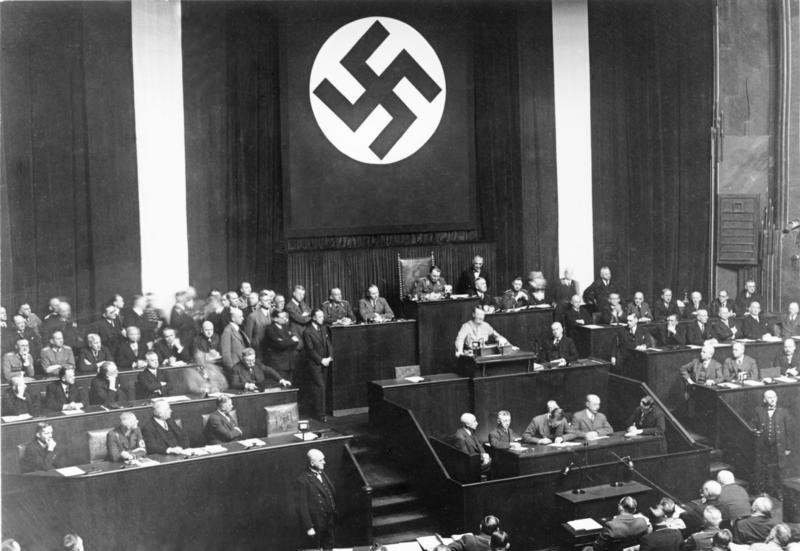
The Enabling Act of 1933 (German: Ermächtigungsgesetz, officially titled Gesetz zur Behebung der Not von Volk und Reich lit. 'Law to Remedy the Distress of People and Reich') was a law that gave the German Cabinet—most importantly, the chancellor, Adolf Hitler—the power to make and enforce laws without the involvement of the Reichstag or President Paul von Hindenburg. By allowing the chancellor to override the checks and balances in the constitution, the Enabling Act of 1933 was a pivotal step in the transition from the democratic Weimar Republic to the totalitarian dictatorship of Nazi Germany.
On 30 January 1933, Adolf Hitler, leader of the Nazi Party (NSDAP), was appointed as Chancellor, the head of the German government. Hitler immediately asked President von Hindenburg to dissolve the Reichstag. A general election was scheduled for 5 March 1933.
On 27 February 1933, the Reichstag building of the German parliament caught fire. Acting as chancellor, Hitler immediately accused the Communists of perpetrating the arson as part of a larger effort to overthrow the German government. He persuaded Hindenburg to enact the Reichstag Fire Decree, which abolished most civil liberties, including the right to speak, assemble and protest, and the right to due process. A state of emergency was declared on the basis of the decree, which enabled a violent crackdown against the Nazis' political enemies, in particular the Communist Party.
Amid the ongoing repression, Hitler contended that the Reichstag Fire Decree was nonetheless insufficient and demanded a more sweeping measure. He submitted to the Reichstag a proposal for an enabling law that would grant effectively untrammeled power to his cabinet.
For the general election of 5 March 1933, the Nazis were allied with other nationalist and conservative factions. At a secret meeting on 20 February, major German industrialists had agreed to finance the Nazis' election campaign. The main residual opposition was the Social Democrats. On election day Germans voted in an atmosphere of extreme voter intimidation, perpetrated mainly by the Nazi Sturmabteilung (SA) militia.
The NSDAP emerged from the election with five million more votes than in the previous election, but failed to gain an absolute majority in parliament. It remained dependent on the 8% of seats won by its coalition partner, the German National People's Party (DNVP), to attain a 52% majority.
In the first post-election cabinet meeting on 7 March, Hitler declared his intention to pass an Enabling Act in the form of a constitutional amendment that would enable the cabinet to bypass the Reichstag and the president in order to promulgate laws on its own.
The Enabling Act would allow the National Ministry (essentially the cabinet) to enact legislation, including laws deviating from or altering the constitution, without the consent of the Reichstag, for a period of four years. The law was thus itself considered a constitutional amendment. It therefore required a two-thirds super-majority support from a quorum of at least two-thirds of all members of the Reichstag.
Enabling Act of 1933
The Enabling Act of 1933 (German: Ermächtigungsgesetz, officially titled Gesetz zur Behebung der Not von Volk und Reich lit. 'Law to Remedy the Distress of People and Reich') was a law that gave the German Cabinet—most importantly, the chancellor, Adolf Hitler—the power to make and enforce laws without the involvement of the Reichstag or President Paul von Hindenburg. By allowing the chancellor to override the checks and balances in the constitution, the Enabling Act of 1933 was a pivotal step in the transition from the democratic Weimar Republic to the totalitarian dictatorship of Nazi Germany.
On 30 January 1933, Adolf Hitler, leader of the Nazi Party (NSDAP), was appointed as Chancellor, the head of the German government. Hitler immediately asked President von Hindenburg to dissolve the Reichstag. A general election was scheduled for 5 March 1933.
On 27 February 1933, the Reichstag building of the German parliament caught fire. Acting as chancellor, Hitler immediately accused the Communists of perpetrating the arson as part of a larger effort to overthrow the German government. He persuaded Hindenburg to enact the Reichstag Fire Decree, which abolished most civil liberties, including the right to speak, assemble and protest, and the right to due process. A state of emergency was declared on the basis of the decree, which enabled a violent crackdown against the Nazis' political enemies, in particular the Communist Party.
Amid the ongoing repression, Hitler contended that the Reichstag Fire Decree was nonetheless insufficient and demanded a more sweeping measure. He submitted to the Reichstag a proposal for an enabling law that would grant effectively untrammeled power to his cabinet.
For the general election of 5 March 1933, the Nazis were allied with other nationalist and conservative factions. At a secret meeting on 20 February, major German industrialists had agreed to finance the Nazis' election campaign. The main residual opposition was the Social Democrats. On election day Germans voted in an atmosphere of extreme voter intimidation, perpetrated mainly by the Nazi Sturmabteilung (SA) militia.
The NSDAP emerged from the election with five million more votes than in the previous election, but failed to gain an absolute majority in parliament. It remained dependent on the 8% of seats won by its coalition partner, the German National People's Party (DNVP), to attain a 52% majority.
In the first post-election cabinet meeting on 7 March, Hitler declared his intention to pass an Enabling Act in the form of a constitutional amendment that would enable the cabinet to bypass the Reichstag and the president in order to promulgate laws on its own.
The Enabling Act would allow the National Ministry (essentially the cabinet) to enact legislation, including laws deviating from or altering the constitution, without the consent of the Reichstag, for a period of four years. The law was thus itself considered a constitutional amendment. It therefore required a two-thirds super-majority support from a quorum of at least two-thirds of all members of the Reichstag.
Recent media
Recent media