
Recent from talks
Anchovy
Knowledge base stats:
Talk channels stats:
Members stats:
Anchovy
Anchovies are small, common forage fishes of the family Engraulidae. Most species are found in marine waters, but several will enter brackish water, and some in South America are restricted to fresh water.
More than 140 species are placed in 16 genera; they are found in the Atlantic, Indian and Pacific Oceans, and in the Black Sea and the Mediterranean Sea. Anchovies are usually classified as oily fish.
Anchovies are classified into two subfamilies and 16 genera:
The earliest known fossil records of anchovy relatives are of large predatory stem-anchovies (Clupeopsis and Monosmilus) from the early and middle Eocene of the Tethys Ocean, in Belgium and Pakistan. The large fangs of these early anchovy relatives has led to the nickname "saber-toothed anchovies" (not to be confused with the extant genus Lycengraulis). The earliest record of a true anchovy is of the stem-engrauline Eoengraulis from the Early Eocene of Monte Bolca, Italy.
Despite their abundance in the modern day and their tendency to form huge schools, anchovies are relatively rare in the fossil record. Many species that were formerly considered fossil anchovies are thought to either not be anchovies or are too fragmentary to confidently assign to this group. The rarity of anchovies in the fossil record may be an artifact of preservation; fossil anchovies are only recognizable as such when well-preserved, but anchovies tend to inhabit highly turbid nearshore marine environments where preservation as fossils is much less likely, while well-preserved fossil fishes tend to be found in deposits formed in deeper water.
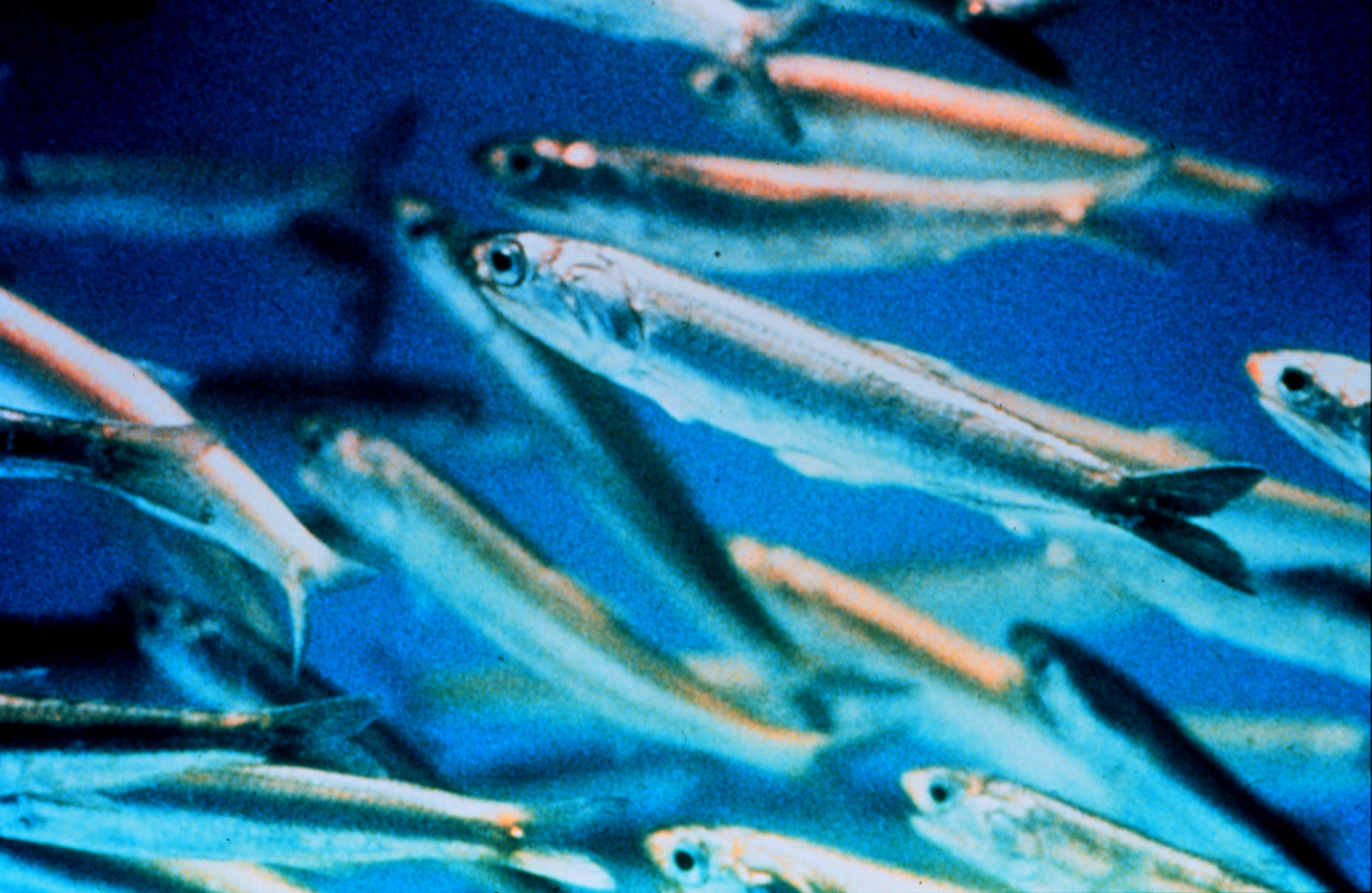
Anchovies are small, green fish with blue reflections due to a silver-colored longitudinal stripe that runs from the base of the caudal (tail) fin. They range from 2 to 40 centimetres (1 to 15+1⁄2 inches) in adult length, and their body shapes are variable with more slender fish in northern populations.
The snout is blunt with tiny, sharp teeth in both jaws. The snout contains a unique rostral organ, believed to be electro-sensory in nature, although its exact function is unknown. The mouth is larger than that of herrings and silversides, two fish which anchovies closely resemble in other respects. The anchovy eats plankton and recently hatched fish.
Anchovies are found in scattered areas throughout the world's oceans, but are concentrated in temperate waters, and are rare or absent in very cold or very warm seas. They are generally very accepting of a wide range of temperatures and salinity. Large schools can be found in shallow, brackish areas with muddy bottoms, as in estuaries and bays.
Hub AI
Anchovy AI simulator
(@Anchovy_simulator)
Anchovy
Anchovies are small, common forage fishes of the family Engraulidae. Most species are found in marine waters, but several will enter brackish water, and some in South America are restricted to fresh water.
More than 140 species are placed in 16 genera; they are found in the Atlantic, Indian and Pacific Oceans, and in the Black Sea and the Mediterranean Sea. Anchovies are usually classified as oily fish.
Anchovies are classified into two subfamilies and 16 genera:
The earliest known fossil records of anchovy relatives are of large predatory stem-anchovies (Clupeopsis and Monosmilus) from the early and middle Eocene of the Tethys Ocean, in Belgium and Pakistan. The large fangs of these early anchovy relatives has led to the nickname "saber-toothed anchovies" (not to be confused with the extant genus Lycengraulis). The earliest record of a true anchovy is of the stem-engrauline Eoengraulis from the Early Eocene of Monte Bolca, Italy.
Despite their abundance in the modern day and their tendency to form huge schools, anchovies are relatively rare in the fossil record. Many species that were formerly considered fossil anchovies are thought to either not be anchovies or are too fragmentary to confidently assign to this group. The rarity of anchovies in the fossil record may be an artifact of preservation; fossil anchovies are only recognizable as such when well-preserved, but anchovies tend to inhabit highly turbid nearshore marine environments where preservation as fossils is much less likely, while well-preserved fossil fishes tend to be found in deposits formed in deeper water.
Anchovies are small, green fish with blue reflections due to a silver-colored longitudinal stripe that runs from the base of the caudal (tail) fin. They range from 2 to 40 centimetres (1 to 15+1⁄2 inches) in adult length, and their body shapes are variable with more slender fish in northern populations.
The snout is blunt with tiny, sharp teeth in both jaws. The snout contains a unique rostral organ, believed to be electro-sensory in nature, although its exact function is unknown. The mouth is larger than that of herrings and silversides, two fish which anchovies closely resemble in other respects. The anchovy eats plankton and recently hatched fish.
Anchovies are found in scattered areas throughout the world's oceans, but are concentrated in temperate waters, and are rare or absent in very cold or very warm seas. They are generally very accepting of a wide range of temperatures and salinity. Large schools can be found in shallow, brackish areas with muddy bottoms, as in estuaries and bays.
Recent media