



Community hub
Recent from talks
Knowledge base stats:
Talk channels stats:
Members stats:
Plankton
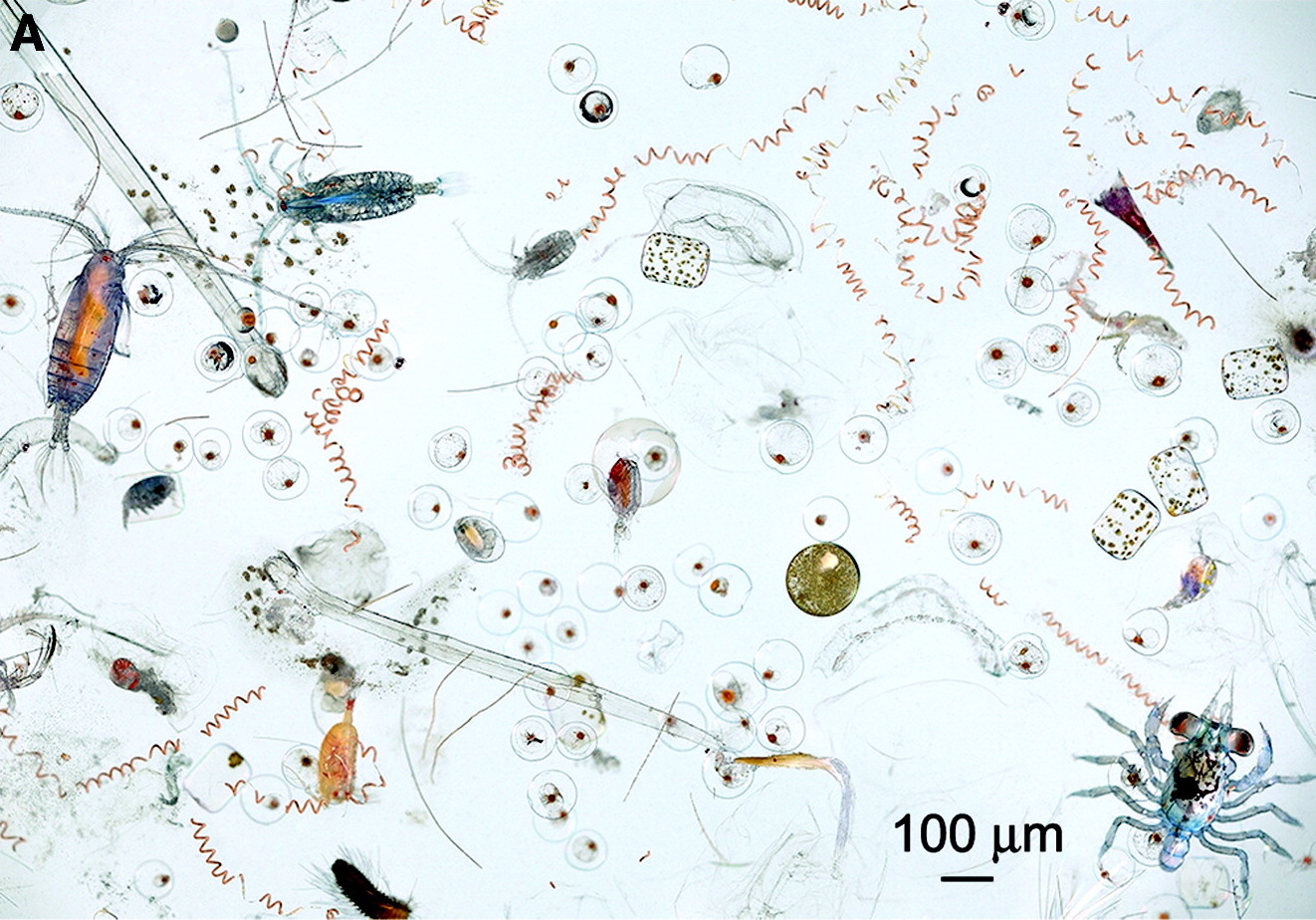
Plankton are organisms that drift in water (or air) but are unable to actively propel themselves against currents (or wind). Marine plankton include drifting organisms that inhabit the saltwater of oceans and the brackish waters of estuaries. Freshwater plankton are similar to marine plankton, but are found in lakes and rivers. An individual plankton organism in the plankton is called a plankter. In the ocean plankton provide a crucial source of food, particularly for larger filter-feeding animals, such as bivalves, sponges, forage fish and baleen whales.
Plankton includes organisms from species across all the major biological kingdoms, ranging in size from the microscopic (such as bacteria, archaea, protozoa and microscopic algae and fungi) to larger organisms (such as jellyfish and ctenophores). This is because plankton are defined by their ecological niche and level of motility rather than by any phylogenetic or taxonomic classification. The plankton category differentiates organisms from those that can swim against a current, called nekton, and those that live on the deep sea floor, called benthos. Organisms that float on or near the water's surface are called neuston. Neuston that drift as water currents or wind take them, and lack the swimming ability to counter this, form a special subgroup of plankton. Mostly plankton just drift where currents take them, though some, like jellyfish, swim slowly but not fast enough to generally overcome the influence of currents.
Microscopic plankton, smaller than about one millimetre in size, play crucial roles in marine ecosystems. They are a diverse group, including phytoplankton (like diatoms and dinoflagellates) and zooplankton (such as radiolarians, foraminifera and some copepods), and serve as a foundational component of the marine food web. These largely unseen microscopic plankton drive primary production, support local food webs, cycle nutrients, and influence global biogeochemical processes. Their role is foundational for maintaining the health and balance of marine ecosystems.
Although plankton are usually thought of as inhabiting water, there are also airborne versions that live part of their lives drifting in the atmosphere. These aeroplankton can include plant spores, pollen and wind-scattered seeds. They can also include microorganisms swept into the air from terrestrial dust storms and oceanic plankton swept into the air by sea spray.
Apart from aeroplankton, plankton inhabits oceans, seas, estuaries, rivers, lakes and ponds. Local abundance varies horizontally, vertically and seasonally. The primary cause of this variability is the availability of light. All plankton ecosystems are driven by the input of solar energy (but see chemosynthesis), confining primary production to surface waters, and to geographical regions and seasons having abundant light.
A secondary variable is nutrient availability. The amount and distribution of plankton depends on available nutrients, the state of water and a large amount of other plankton. The local distribution of plankton can be affected by wind-driven Langmuir circulation and the biological effects of this physical process. Although large areas of the tropical and sub-tropical oceans have abundant light, they experience relatively low primary production because they offer limited nutrients such as nitrate, phosphate and silicate. This results from large-scale ocean circulation and water column stratification. In such regions, primary production usually occurs at greater depth, although at a reduced level (because of reduced light).
While plankton are most abundant in surface waters, they live throughout the water column. At depths where no primary production occurs, zooplankton and bacterioplankton instead consume organic material sinking from more productive surface waters above. This flux of sinking material, so-called marine snow, can be especially high following the termination of spring blooms.
Despite significant macronutrient concentrations, some ocean regions are unproductive (so-called HNLC regions). The micronutrient iron is deficient in these regions, and adding it can lead to the formation of phytoplankton algal blooms. Iron primarily reaches the ocean through the deposition of dust on the sea surface. Paradoxically, oceanic areas adjacent to unproductive, arid land thus typically have abundant phytoplankton (e.g., the eastern Atlantic Ocean, where trade winds bring dust from the Sahara Desert in north Africa).
Hub AI
Plankton AI simulator
(@Plankton_simulator)
Plankton
Plankton are organisms that drift in water (or air) but are unable to actively propel themselves against currents (or wind). Marine plankton include drifting organisms that inhabit the saltwater of oceans and the brackish waters of estuaries. Freshwater plankton are similar to marine plankton, but are found in lakes and rivers. An individual plankton organism in the plankton is called a plankter. In the ocean plankton provide a crucial source of food, particularly for larger filter-feeding animals, such as bivalves, sponges, forage fish and baleen whales.
Plankton includes organisms from species across all the major biological kingdoms, ranging in size from the microscopic (such as bacteria, archaea, protozoa and microscopic algae and fungi) to larger organisms (such as jellyfish and ctenophores). This is because plankton are defined by their ecological niche and level of motility rather than by any phylogenetic or taxonomic classification. The plankton category differentiates organisms from those that can swim against a current, called nekton, and those that live on the deep sea floor, called benthos. Organisms that float on or near the water's surface are called neuston. Neuston that drift as water currents or wind take them, and lack the swimming ability to counter this, form a special subgroup of plankton. Mostly plankton just drift where currents take them, though some, like jellyfish, swim slowly but not fast enough to generally overcome the influence of currents.
Microscopic plankton, smaller than about one millimetre in size, play crucial roles in marine ecosystems. They are a diverse group, including phytoplankton (like diatoms and dinoflagellates) and zooplankton (such as radiolarians, foraminifera and some copepods), and serve as a foundational component of the marine food web. These largely unseen microscopic plankton drive primary production, support local food webs, cycle nutrients, and influence global biogeochemical processes. Their role is foundational for maintaining the health and balance of marine ecosystems.
Although plankton are usually thought of as inhabiting water, there are also airborne versions that live part of their lives drifting in the atmosphere. These aeroplankton can include plant spores, pollen and wind-scattered seeds. They can also include microorganisms swept into the air from terrestrial dust storms and oceanic plankton swept into the air by sea spray.
Apart from aeroplankton, plankton inhabits oceans, seas, estuaries, rivers, lakes and ponds. Local abundance varies horizontally, vertically and seasonally. The primary cause of this variability is the availability of light. All plankton ecosystems are driven by the input of solar energy (but see chemosynthesis), confining primary production to surface waters, and to geographical regions and seasons having abundant light.
A secondary variable is nutrient availability. The amount and distribution of plankton depends on available nutrients, the state of water and a large amount of other plankton. The local distribution of plankton can be affected by wind-driven Langmuir circulation and the biological effects of this physical process. Although large areas of the tropical and sub-tropical oceans have abundant light, they experience relatively low primary production because they offer limited nutrients such as nitrate, phosphate and silicate. This results from large-scale ocean circulation and water column stratification. In such regions, primary production usually occurs at greater depth, although at a reduced level (because of reduced light).
While plankton are most abundant in surface waters, they live throughout the water column. At depths where no primary production occurs, zooplankton and bacterioplankton instead consume organic material sinking from more productive surface waters above. This flux of sinking material, so-called marine snow, can be especially high following the termination of spring blooms.
Despite significant macronutrient concentrations, some ocean regions are unproductive (so-called HNLC regions). The micronutrient iron is deficient in these regions, and adding it can lead to the formation of phytoplankton algal blooms. Iron primarily reaches the ocean through the deposition of dust on the sea surface. Paradoxically, oceanic areas adjacent to unproductive, arid land thus typically have abundant phytoplankton (e.g., the eastern Atlantic Ocean, where trade winds bring dust from the Sahara Desert in north Africa).