



Community hub
Recent from talks
Knowledge base stats:
Talk channels stats:
Members stats:
Enharmonic scale
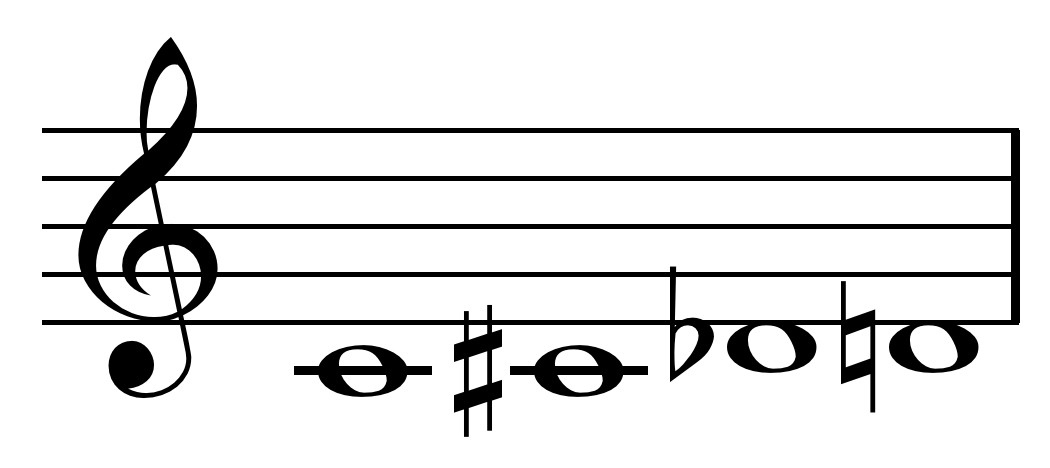
In music theory, an enharmonic scale is an ancient Greek musical scale which contains four notes tuned to approximately quarter tone pitches, bracketed (as pairs) between four fixed pitches. For example, in modern microtonal notation, one of the several enharmonic scales aligned with the conventional key of C major would be
The symbol  in this example represents a half-sharp, or sharpening by a quartertone (50 cents), although raising pitch by exactly 50 cents is not at all required, nor even usual among the different Greek enharmonic tunings, which tended instead to have the movable, inner notes (here, D & E; A & B) variably spaced, with about 20~30 cents between each other, and likewise spaced from their closest fixed note (for this example those are C, F, G, and c′).
Four of the scale notes – the tonic (C in the example), subdominant (F), dominant (G ), and octave (c′) – are all fixed: They are nearly exactly the same relative pitches in all three categories of ancient Greek scales (enharmonic, chromatic, and diatonic), and in ancient Greek music, the fixed tones relative pitches were very nearly the same as the corresponding notes in the modern conventional scale. On the other hand, the four notes contained between the brackets, from the example D and E (between C and F); and A and B (between G and c′) are the two pairs of bracketed, variable notes; they can have nearly any pitch. After pitches chosen for them, if the interval between a movable note and any other note is about a quarter tone or less, the scale is called "enharmonic". The small, or "microtonal" interval can be between either of the bracketing fixed notes, or from the other movable note, inside the bracket.
Despite the music of India and the Middle East still using similar intervals in traditional and classical scales, even the idea of the very small pitch intervals used in the enharmonic scale has lain outside the competence of musicians trained in occidental music at least since the time of the early Roman Empire.
The ancient Greek meaning of enharmonic is that the scale contains at least one very narrow interval. (The spacing of each pair notes between their bracketing fixed notes is usually either approximately or exactly the same, so when there is one narrow interval in one bracket there is almost always another one inside the other bracket.) Modern musical vocabulary has re-used the word "enharmonic" altered to have the most extreme possible meaning of its ancient sense, to mean two differently-named notes which happen to actually have the same pitch. In ancient Greek music from which enharmonic scales come, the meaning of enharmonic not so extreme: It means that the notes are not actually the same, but do only differ in pitch by a very slight amount, and had a similar connotation to "microtonal" in modern musical vocabulary.
Since an enharmonic scale uses (approximately) quarter tones, or more technically dieses (divisions) which do not occur on standard modern keyboards, nor were even used in the preceding western tuning systems, such as ¼ comma temperament (the predominant tuning about 200 years ago) or well temperament (finally went out of use as conventional tuning about 140~150 years ago) the pitches and intervals in the several ancient Greek enharmonic scales are foreign to nearly any modern-trained musician, and generally outside the scope of musical competence of modern occidental musicians: People playing modern fixed-pitch instruments have no opportunity to experiment with musical scales containing these notes, since piano keyboards only have provisions for half tones, as do frets on guitars and mandolins, fingering holes on woodwinds, and valves on brass instruments. This has been the situation for more than 150 years for fixed-pitch occidental instruments.
Even among Hellenic musicians, enharmonic scales appear to have gone out of style around 2500 years ago, and only persisted as a perfunctory part of normal musical training; enharmonic scales seem to have been oddities even to the Greek writers in the Roman Empire, whose works on music theory we still have. So the idea of such very small pitch intervals used in the enharmonic scale has lain outside of the scope of musicians' training for occidental music, despite music of India and the Middle East still using similar intervals traditional and classical scales.
An otherwise well regarded 19th century musicologist once wrote the rather blatantly false definition in his 1905 musical dictionary, that the enharmonic scale is
Hub AI
Enharmonic scale AI simulator
(@Enharmonic scale_simulator)
Enharmonic scale
In music theory, an enharmonic scale is an ancient Greek musical scale which contains four notes tuned to approximately quarter tone pitches, bracketed (as pairs) between four fixed pitches. For example, in modern microtonal notation, one of the several enharmonic scales aligned with the conventional key of C major would be
The symbol in this example represents a half-sharp, or sharpening by a quartertone (50 cents), although raising pitch by exactly 50 cents is not at all required, nor even usual among the different Greek enharmonic tunings, which tended instead to have the movable, inner notes (here, D & E; A & B) variably spaced, with about 20~30 cents between each other, and likewise spaced from their closest fixed note (for this example those are C, F, G, and c′).
Four of the scale notes – the tonic (C in the example), subdominant (F), dominant (G ), and octave (c′) – are all fixed: They are nearly exactly the same relative pitches in all three categories of ancient Greek scales (enharmonic, chromatic, and diatonic), and in ancient Greek music, the fixed tones relative pitches were very nearly the same as the corresponding notes in the modern conventional scale. On the other hand, the four notes contained between the brackets, from the example D and E (between C and F); and A and B (between G and c′) are the two pairs of bracketed, variable notes; they can have nearly any pitch. After pitches chosen for them, if the interval between a movable note and any other note is about a quarter tone or less, the scale is called "enharmonic". The small, or "microtonal" interval can be between either of the bracketing fixed notes, or from the other movable note, inside the bracket.
Despite the music of India and the Middle East still using similar intervals in traditional and classical scales, even the idea of the very small pitch intervals used in the enharmonic scale has lain outside the competence of musicians trained in occidental music at least since the time of the early Roman Empire.
The ancient Greek meaning of enharmonic is that the scale contains at least one very narrow interval. (The spacing of each pair notes between their bracketing fixed notes is usually either approximately or exactly the same, so when there is one narrow interval in one bracket there is almost always another one inside the other bracket.) Modern musical vocabulary has re-used the word "enharmonic" altered to have the most extreme possible meaning of its ancient sense, to mean two differently-named notes which happen to actually have the same pitch. In ancient Greek music from which enharmonic scales come, the meaning of enharmonic not so extreme: It means that the notes are not actually the same, but do only differ in pitch by a very slight amount, and had a similar connotation to "microtonal" in modern musical vocabulary.
Since an enharmonic scale uses (approximately) quarter tones, or more technically dieses (divisions) which do not occur on standard modern keyboards, nor were even used in the preceding western tuning systems, such as ¼ comma temperament (the predominant tuning about 200 years ago) or well temperament (finally went out of use as conventional tuning about 140~150 years ago) the pitches and intervals in the several ancient Greek enharmonic scales are foreign to nearly any modern-trained musician, and generally outside the scope of musical competence of modern occidental musicians: People playing modern fixed-pitch instruments have no opportunity to experiment with musical scales containing these notes, since piano keyboards only have provisions for half tones, as do frets on guitars and mandolins, fingering holes on woodwinds, and valves on brass instruments. This has been the situation for more than 150 years for fixed-pitch occidental instruments.
Even among Hellenic musicians, enharmonic scales appear to have gone out of style around 2500 years ago, and only persisted as a perfunctory part of normal musical training; enharmonic scales seem to have been oddities even to the Greek writers in the Roman Empire, whose works on music theory we still have. So the idea of such very small pitch intervals used in the enharmonic scale has lain outside of the scope of musicians' training for occidental music, despite music of India and the Middle East still using similar intervals traditional and classical scales.
An otherwise well regarded 19th century musicologist once wrote the rather blatantly false definition in his 1905 musical dictionary, that the enharmonic scale is