



Community hub
Recent from talks
Contribute something
Nothing was collected or created yet.
Cent (music)
View on Wikipedia


The cent is a logarithmic unit of measure used for musical intervals. Twelve-tone equal temperament divides the octave into 12 semitones of 100 cents each. Typically, cents are used to express small intervals, to check intonation, or to compare the sizes of comparable intervals in different tuning systems. For humans, a single cent is too small to be perceived between successive notes.
Cents, as described by Alexander John Ellis, follow a tradition of measuring intervals by logarithms that began with Juan Caramuel y Lobkowitz in the 17th century.[a] Ellis chose to base his measures on the hundredth part of a semitone, , at Robert Holford Macdowell Bosanquet's suggestion. Making extensive measurements of musical instruments from around the world, Ellis used cents to report and compare the scales employed,[1] and further described and utilized the system in his 1875 edition of Hermann von Helmholtz's On the Sensations of Tone. It has become the standard method of representing and comparing musical pitches and intervals.[2][3]
![{\displaystyle {\sqrt[{1200}]{2}}}](https://wikimedia.org/api/rest_v1/media/math/render/svg/6b986b7c5e3577d1d7a161a19c847c57c2950812)
History
[edit]Alexander John Ellis' paper On the Musical Scales of Various Nations,[1] published by the Journal of the Society of Arts in 1885, officially introduced the cent system to be used in exploring, by comparing and contrasting, musical scales of various nations. The cent system had already been defined in his History of Musical Pitch, where Ellis writes:
- "If we supposed that, between each pair of adjacent notes, forming an equal semitone [...], 99 other notes were interposed, making exactly equal intervals with each other, we should divide the octave into 1200 equal hundrecths [sic] of an equal semitone, or cents as they may be briefly called."[4]
Ellis defined the pitch of a musical note in his 1880 work History of Musical Pitch[5] to be
- "the number of double or complete vibrations, backwards and forwards, made in each second by a particle of air while the note is heard".[6]
He later defined musical pitch to be "the pitch, or V [for "double vibrations"] of any named musical note which determines the pitch of all the other notes in a particular system of tunings."[7] He notes that these notes, when sounded in succession, form the scale of the instrument, and an interval between any two notes is measured by "the ratio of the smaller pitch number to the larger, or by the fraction formed by dividing the larger by the smaller".[8] Absolute and relative pitches were also defined based on these ratios.[8]
Ellis noted that
- "the object of the tuner is to make the interval [...] between any two notes answering to any two adjacent finger keys throughout the instrument precisely the same. The result is called equal temperament or tuning, and is the system at present used throughout Europe.[9]
He further gives calculations to approximate the measure of a ratio in cents, adding that
- "it is, as a general rule, unnecessary to go beyond the nearest whole number of cents."[10]
Ellis presents applications of the cent system in this paper on musical scales of various nations, which include: (I. Heptatonic scales) Ancient Greece and Modern Europe,[11] Persia, Arabia, Syria and Scottish Highlands,[12] India,[13] Singapore,[14] Burmah[15] and Siam,;[16] (II. Pentatonic scales) South Pacific, [17] Western Africa,[18] Java,[19] China[20] and Japan.[21] And he reaches the conclusion that
- "the Musical Scale is not one, not 'natural', nor even founded necessarily on the laws of the constitution of musical sound, so beautifully worked out by Helmholtz, but very diverse, very artificial, and very capricious".[22]
Use
[edit]
A cent is a unit of measure for the ratio between two frequencies. An equally tempered semitone (the interval between two adjacent piano keys) spans 100 cents by definition. An octave—two notes that have a frequency ratio of 2:1—spans twelve semitones and therefore 1200 cents. The ratio of frequencies one cent apart is precisely equal to 21⁄1200 = 1200√2, the 1200th root of 2, which is approximately 1.0005777895. Thus, raising a frequency by one cent corresponds to multiplying the original frequency by this constant value. Raising a frequency by 1200 cents doubles the frequency, resulting in its octave.
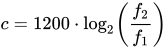
If one knows the frequencies and of two notes, the number of cents measuring the interval from to is:


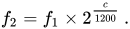
Likewise, if one knows and the number of cents in the interval from to , then equals:
Comparison of major third in just and equal temperament
[edit]The major third in just intonation has a frequency ratio 5:4 or ~386 cents, but in equal temperament is 400 cents. This 14 cent difference is about a seventh of a half step and large enough to be clearly audible, and noticeably dissonant to musicians trained in meantone scales for period-authentic performance.[citation needed]
Piecewise linear approximation
[edit]As x increases from 0 to 1⁄12, the function 2x increases almost linearly from 1.00000 to 1.05946, allowing for a piecewise linear approximation. Thus, although cents represent a logarithmic scale, small intervals (under 100 cents) can be loosely approximated with the linear relation 1 + 0.0005946 instead of the true exponential relation 2c⁄1200. The rounded error is zero when is 0 or 100, and is only about 0.72 cents high at =50 (whose correct value of 21⁄24 ≅ 1.02930 is approximated by 1 + 0.0005946 × 50 ≅ 1.02973). This error is well below anything humanly audible, making this piecewise linear approximation adequate for most practical purposes.
Human perception
[edit]
It is difficult to establish how many cents are perceptible to humans; this precision varies greatly from person to person. One author stated that humans can distinguish a difference in pitch of about 5–6 cents.[23] The threshold of what is perceptible, technically known as the just noticeable difference (JND), also varies as a function of the frequency, the amplitude and the timbre. In one study, changes in tone quality reduced student musicians' ability to recognize, as out-of-tune, pitches that deviated from their appropriate values by ±12 cents.[24] It has also been established that increased tonal context enables listeners to judge pitch more accurately.[25] "While intervals of less than a few cents are imperceptible to the human ear in a melodic context, in harmony very small changes can cause large changes in beats and roughness of chords."[26]
When listening to pitches with vibrato, there is evidence that humans perceive the mean frequency as the center of the pitch.[27] One study of modern performances of Schubert's Ave Maria found that vibrato span typically ranged between ±34 cents and ±123 cents with a mean of ±71 cents and noted higher variation in Verdi's opera arias.[28]
Normal adults are able to recognize pitch differences of as small as 25 cents very reliably. Adults with amusia, however, have trouble recognizing differences of less than 100 cents and sometimes have trouble with these or larger intervals.[29]
Other representations of intervals by logarithms
[edit]Octave
[edit]The representation of musical intervals by logarithms is almost as old as logarithms themselves. Logarithms had been invented by Lord Napier in 1614.[30] As early as 1647, Juan Caramuel y Lobkowitz (1606-1682) in a letter to Athanasius Kircher described the usage of base-2 logarithms in music.[31] In this base, the octave is represented by 1, the semitone by 1/12, etc.
Heptamerides
[edit]Joseph Sauveur, in his Principes d'acoustique et de musique of 1701, proposed the usage of base-10 logarithms, probably because tables were available. He made use of logarithms computed with three decimals. The base-10 logarithm of 2 is equal to approximately 0.301, which Sauveur multiplies by 1000 to obtain 301 units in the octave. In order to work on more manageable units, he suggests to take 7/301 to obtain units of 1/43 octave.[b] The octave therefore is divided in 43 parts, named "merides", themselves divided in 7 parts, the "heptamerides". Sauveur also imagined the possibility to further divide each heptameride in 10, but does not really make use of such microscopic units.[32]
Prony
[edit]Early in the 19th century, Gaspard de Prony proposed a logarithmic unit of base , where the unit corresponds to a semitone in equal temperament.[33] Alexander John Ellis in 1880 describes a large number of pitch standards that he noted or calculated, indicating in pronys with two decimals, i.e. with a precision to the 1/100 of a semitone,[34] the interval that separated them from a theoretical pitch of 370 Hz, taken as point of reference.[35]
![{\displaystyle {\sqrt[{12}]{2}}}](https://wikimedia.org/api/rest_v1/media/math/render/svg/bc835f27425fb3140e1f75a5faa35b1e8b9efc35)
Centitones
[edit]A centitone (also Iring) is a musical interval (21⁄600, ) equal to two cents (22⁄1200)[36][37] proposed as a unit of measurement (ⓘ) by Widogast Iring in Die reine Stimmung in der Musik (1898) as 600 steps per octave and later by Joseph Yasser in A Theory of Evolving Tonality (1932) as 100 steps per equal tempered whole tone.
![{\displaystyle {\sqrt[{600}]{2}}}](https://wikimedia.org/api/rest_v1/media/math/render/svg/ea43c0bc8f62081f2f0b830dd7da893a9d97a9a9)
Iring noticed that the Grad/Werckmeister (1.96 cents, 12 per Pythagorean comma) and the schisma (1.95 cents) are nearly the same (≈ 614 steps per octave) and both may be approximated by 600 steps per octave (2 cents).[38] Yasser promoted the decitone, centitone, and millitone (10, 100, and 1000 steps per whole tone = 60, 600, and 6000 steps per octave = 20, 2, and 0.2 cents).[39][40]
For example: Equal tempered perfect fifth = 700 cents = 175.6 savarts = 583.3 millioctaves = 350 centitones.[41]
| Centitones | Cents |
|---|---|
| 1 centitone | 2 cents |
| 0.5 centitone | 1 cent |
| 21⁄600 | 21⁄1200 |
| 50 per semitone | 100 per semitone |
| 100 per whole tone | 200 per whole tone |
Savart
[edit]The savart[42] was proposed by Auguste Guillemin in 1902,[43] named after Félix Savart (1791-1841), who however had never considered the possibility of measuring intervals by logarithms. The attribution to Savart himself appeared later in several Anglo-Saxon sources.[44][45]
Guillemin first defined the savart as the decimal logarithm itself, 1 savart being the logarithm of the decade (10/1), and the millisavart as the base-10 logatrithm times 1000. This later was taken to be the savart itself.[46]
The savart has been described without limiting the number of decimals, so that the value of his unit varies according to sources. With five decimals, the base-10 logarithm of 2 is 0.30103, giving 301.03 savarts in the octave.[47] This value often is rounded to 1/301 or to 1/300 octave.[48][49]
Sound files
[edit]The following audio files play various intervals. In each case the first note played is middle C. The next note is sharper than C by the assigned value in cents. Finally, the two notes are played simultaneously.
Note that the JND for pitch difference is 5–6 cents. Played separately, the notes may not show an audible difference, but when they are played together, beating may be heard (for example if middle C and a note 10 cents higher are played). At any particular instant, the two waveforms reinforce or cancel each other more or less, depending on their instantaneous phase relationship. A piano tuner may verify tuning accuracy by timing the beats when two strings are sounded at once.
ⓘ, beat frequency = 0.16 Hz
ⓘ, beat frequency = 1.53 Hz
ⓘ, beat frequency = 3.81 Hz

See also
[edit]
References
[edit]Footnotes
[edit]- ^ Caramuel mentioned the possible use of binary logarithms for music in a letter to Athanasius Kircher in 1647; this usage often is attributed to Leonhard Euler in 1739 (see Binary logarithm). Isaac Newton described musical logarithms using the semitone (12√2) as base in 1665; Gaspard de Prony did the same in 1832. Joseph Sauveur in 1701, and Félix Savart in the first half of the 19th century, divided the octave in 301 or 301,03 units. See Barbieri 1987, pp. 145–168 and also Stigler's law of eponymy.
- ^ 301 can be divided only by 7 or by 43.
Citations
[edit]- ^ a b Ellis 1885, p. 485-527.
- ^ Benson 2007, p. 166:The system most often employed in the modern literature.
- ^ Renold 2004, p. 138.
- ^ Ellis 1880, p. 295.
- ^ Ellis 1880, p. 293-336.
- ^ Ellis 1880, p. 293-294.
- ^ Ellis 1880, p. 294.
- ^ a b Ellis 1885, p. 487.
- ^ Ellis 1885, p. 491.
- ^ Ellis 1885, p. 488.
- ^ Ellis 1885, p. 491-492.
- ^ Ellis 1885, p. 492-500.
- ^ Ellis 1885, p. 500-505.
- ^ Ellis 1885, p. 505-506.
- ^ Ellis 1885, p. 506.
- ^ Ellis 1885, p. 506-507.
- ^ Ellis 1885, p. 507.
- ^ Ellis 1885, p. 507-508.
- ^ Ellis 1885, p. 508-514.
- ^ Ellis 1885, p. 514-520.
- ^ Ellis 1885, p. 520-525.
- ^ Ellis 1885, p. 526.
- ^ Loeffler 2006.
- ^ Geringer & Worthy 1999, pp. 135–149.
- ^ Warrier & Zatorre 2002, pp. 198–207.
- ^ Benson 2007, p. 368.
- ^ Brown & Vaughn 1996, pp. 1728–1735.
- ^ Prame 1997, pp. 616–621.
- ^ Peretz & Hyde 2003, pp. 362–367.
- ^ Ernest William Hobson (1914), John Napier and the invention of logarithms, 1614, Cambridge, The University Press
- ^ Ramon Ceñal, "Juan Caramuel, su epistolario con Athanasio Kircher, S.J.", Revista de Filosofia XII/44, Madrid 1954, p. 134 ss.
- ^ Joseph Sauveur, Principes d'acoustique et de musique ou Système général des intervalles des sons, Minkoff Reprint, Geneva, 1973; see online Mémoires de l'Académie royale des sciences, 1700, Acoustique; 1701 Acoustique.
- ^ Gaspard de Prony, Instruction élémentaire sur les moyens de calculer les intervalles musicaux, Paris, 1832. Online: [1].
- ^ The precision is the same as with cents, but Ellis had not yet devised this unit.
- ^ Alexander John Ellis, "On the History of Musical Pitch," Journal of the Society of Arts, 1880, reprinted in Studies in the History of Musical Pitch, Frits Knuf, Amsterdam, 1968, p. 11-62.
- ^ Randel 1999, p. 123.
- ^ Randel 2003, pp. 154, 416.
- ^ "Logarithmic Interval Measures". Huygens-Fokker.org. Retrieved 2021-06-25.
- ^ Yasser 1932, p. 14.
- ^ Farnsworth 1969, p. 24.
- ^ Apel 1970, p. 363.
- ^ See N. Meeùs, "Qu'est-ce qu'un savart ?", Musurgia XXX/4 (2023), pp. 35-50.
- ^ Auguste Guillemin, "Échelle universelle des mouvements périodiques, graduée en savarts et millisavarts", Comptes rendus hebdomadaires des séances de l'Académie des sciences 134 (1902), pp. 980-982. Online.
- ^ Alexander Wood, The Physics of Music, London, Methuen & Co Ltd, 1944, p. 53.
- ^ W. Apel, art. "Savart," Harvard Dictionary of Music, Cambridge (Mass.), 1944, p. 662.
- ^ Étienne Souriau, "L'Algorithme musical", Revue philosophique de la France et de l'Étranger 104 (1927), pp. 204-241. Online.
- ^ Émile Leipp, Acoustique et musique : Données physiques et technologiques, problèmes de l'audition des sons musicaux, principes de fonctionnement et signification acoustique des principaux archétypes d'instruments de musique, les musiques expérimentales, l'acoustique des salles, Masson, 1989, 4th edition, p. 16.
- ^ "Ordinary savart", 1/301 octave, and "modified savart", 1/300 octave. Herbert Arthur Klein, The Science of Measurement. A Historical Survey, New York, 1974, p. 605
- ^ Alexander Wood, The Physics of Music, London, 1944, ²2007, p. 53-54.
Sources
[edit]- Apel, Willi (1970). Harvard Dictionary of Music. Taylor & Francis.
- Barbieri, Patrizio (1987). "Juan Caramuel Lobkowitz (1606–1682): über die musikalischen Logarithmen und das Problem der musikalischen Temperatur". Musiktheorie. 2 (2): 145–168.
- Benson, Dave (2007). Music: A Mathematical Offering. Cambridge. ISBN 9780521853873.
{{cite book}}: CS1 maint: location missing publisher (link) - Brown, J.C.; Vaughn, K.V. (September 1996). "Pitch Center of Stringed Instrument Vibrato Tones" (PDF). Journal of the Acoustical Society of America. 100 (3): 1728–1735. Bibcode:1996ASAJ..100.1728B. doi:10.1121/1.416070. PMID 8817899. Retrieved 2008-09-28.
- Ellis, Alexander J.; Hipkins, Alfred J. (1884), "Tonometrical Observations on Some Existing Non-Harmonic Musical Scales", Proceedings of the Royal Society of London, 37 (232–234): 368–385, doi:10.1098/rspl.1884.0041, JSTOR 114325, Zenodo: 1432077.
- Ellis, Alexander J. (1880), "History of Musical Pitch", Journal of the Society of Arts, 21 (545): 293–337, Bibcode:1880Natur..21..550E, doi:10.1038/021550a0, S2CID 4107831
- Ellis, Alexander J. (1885), "On the Musical Scales of Various Nations", Journal of the Society of Arts: 485–527, retrieved 1 January 2020
- Farnsworth, Paul Randolph (1969). The Social Psychology of Music. Iowa State University Press. ISBN 9780813815473.
- Geringer, J. M.; Worthy, M.D. (1999). "Effects of Tone-Quality Changes on Intonation and Tone-Quality Ratings of High School and College Instrumentalists". Journal of Research in Music Education. 47 (2): 135–149. doi:10.2307/3345719. JSTOR 3345719. S2CID 144918272.
- Loeffler, D.B. (April 2006). Instrument Timbres and Pitch Estimation in Polyphonic Music (Master's). Department of Electrical and Computer Engineering, Georgia Tech. Archived from the original on 2007-12-18.
- Peretz, I.; Hyde, K.L. (August 2003). "What is specific to music processing? Insights from congenital amusia". Trends in Cognitive Sciences. 7 (8): 362–367. CiteSeerX 10.1.1.585.2171. doi:10.1016/S1364-6613(03)00150-5. PMID 12907232. S2CID 3224978.
- Prame, E. (July 1997). "Vibrato extent and intonation in professional Western lyric singing". The Journal of the Acoustical Society of America. 102 (1): 616–621. Bibcode:1997ASAJ..102..616P. doi:10.1121/1.419735.
- Randel, Don Michael (1999). The Harvard Concise Dictionary of Music and Musicians. Harvard University Press. ISBN 978-0-674-00084-1.
- Randel, Don Michael (2003). The Harvard Dictionary of Music (4th ed.). Harvard University Press. ISBN 978-0-674-01163-2.
- Renold, Maria (2004) [1998], Anna Meuss (ed.), Intervals, Scales, Tones and the Concert Pitch C = 128 Hz, translated by Bevis Stevens, Temple Lodge, ISBN 9781902636467,
Interval proportions can be converted to the cent values which are in common use today
{{citation}}: CS1 maint: location missing publisher (link) - Warrier, C.M.; Zatorre, R.J. (February 2002). "Influence of tonal context and timbral variation on perception of pitch". Perception & Psychophysics. 64 (2): 198–207. doi:10.3758/BF03195786. PMID 12013375. S2CID 15094971.
- Yasser, Joseph (1932). A Theory of Evolving Tonality. American Library of Musicology.
External links
[edit]- Cent conversion: Whole number ratio to cent Archived 2017-04-22 at the Wayback Machine [rounded to whole number]
- Cent conversion: Online utility with several functions
| Twelve- semitone (post-Bach Western) |
| ||||||||||||||
|---|---|---|---|---|---|---|---|---|---|---|---|---|---|---|---|
| Other tuning systems |
| ||||||||||||||
| Other intervals |
| ||||||||||||||

Cent (music)
View on GrokipediaFundamentals
Definition
In music theory, the cent is a logarithmic unit used to quantify musical intervals, defined as one hundredth (1/100) of an equal-tempered semitone in the twelve-tone equal temperament system.[1] This makes one cent equivalent to 1/1200 of an octave, allowing for precise subdivision of pitch differences beyond the coarser semitone scale.[2] The logarithmic basis of the cent arises from the multiplicative nature of musical intervals, where pitch intervals are ratios of frequencies rather than absolute differences.[1] Human perception of pitch tends to follow a logarithmic scale, meaning that equal perceived intervals correspond to constant frequency ratios across the audible range; thus, cents employ base-2 logarithm scaling to convert these ratios into additive units, ensuring perceptual uniformity.[2] The fundamental conversion formula for the interval between two frequencies and (with ) is: This equation scales the octave (a frequency ratio of 2) to exactly 1200 cents, with each semitone spanning 100 cents.[1] In contrast to linear units like Hertz, which measure absolute frequency in cycles per second and yield varying differences for equal intervals at different pitch heights (e.g., the Hertz span of a semitone doubles from low to high registers), cents maintain consistent values for equivalent intervals regardless of absolute pitch.[1] This perceptual alignment makes cents essential for analyzing tuning systems, intonation deviations, and microtonal music, where subtle pitch variations—often as small as a few cents—are musically significant.[2]Mathematical Formulation
The cent is derived from the equal temperament system, where the octave is divided into 12 semitones, with each semitone subdivided into 100 equal parts called cents, resulting in 1200 cents per octave.[1] This subdivision provides a fine-grained logarithmic scale for measuring pitch intervals, where the frequency ratio (with ) corresponds to an interval of cents given by the formula [7][1] The base-2 logarithm is chosen to ensure octave equivalence: a frequency doubling () yields , so cents, aligning the scale such that each octave spans exactly 1200 cents regardless of the absolute frequencies involved.[7] This formulation exhibits additivity for concatenated intervals, a key property stemming from the logarithm's functional equation. For intervals from frequency to (ratio , cents ) and from to (ratio , cents ), the combined interval from to has ratio , so .[7] In contrast, frequency ratios multiply under concatenation (), lacking this linear additivity. The cent measure can be expressed using other logarithmic bases via the change-of-base formula. For the natural logarithm, , where the constant follows directly from the base conversion.[7] Similarly, for base-10 logarithms, .[7]Historical Development
Invention by Alexander J. Ellis
The cent, a logarithmic unit for measuring musical intervals, was invented in 1885 by British mathematician and philologist Alexander John Ellis (1814–1890) as part of the second edition of his English translation and expansion of Hermann von Helmholtz's seminal work On the Sensations of Tone as a Physiological Basis for the Theory of Music.[8] In Appendix XX of this translation, Ellis introduced the cent to address the limitations of existing interval nomenclature, such as terms like "comma" or Pythagorean fractions, which were inherently tied to specific historical tuning systems and hindered objective cross-cultural analysis.[8] His motivation stemmed from a need for a neutral, precise, and universally applicable measure that could quantify pitch differences independently of any particular temperament, enabling systematic comparisons of musical scales from diverse traditions and facilitating advancements in physiological acoustics and comparative musicology.[8] Ellis's original proposal defined the cent as one-hundredth of an equal-tempered semitone, allowing for fine-grained expression of intervals—for instance, rendering the equal temperament's structure in readily computable units—while emphasizing logarithmic scaling to reflect the perceptual nature of pitch.[8] Although initially framed within equal temperament, Ellis noted its adaptability to other systems, and the unit was recognized for broader utility, standardizing around equal temperament where each of the 12 semitones comprises 100 cents, totaling 1200 cents per octave.[8] The mathematical basis, involving base-2 logarithms of frequency ratios, provided a rigorous foundation but was presented primarily for theoretical clarity rather than exhaustive computation in the original work (detailed further in the encyclopedia's Mathematical Formulation section). The cent's introduction gained early traction through Ellis's 1885 paper "On the Musical Scales of Various Nations," delivered to the Society of Arts in London on March 25 and published in the Journal of the Society of Arts. There, Ellis applied cents to dissect and compare scales from over 70 global traditions, including Arabic, Indian, and ancient Greek systems, demonstrating the unit's practicality for empirical measurements derived from instruments like monochords. The paper received positive reception among acoustical and musical scholars, with discussions highlighting its potential to unify disparate ethnomusicological data and advance objective studies of tone sensations, marking the cent as a foundational tool in 19th-century acoustics.Adoption in the 20th Century
Following Alexander J. Ellis's introduction of the cent as a unit for measuring musical intervals in 1885, its adoption accelerated in the early 20th century among acousticians and music scholars seeking a standardized logarithmic scale for pitch analysis. The founding of the Acoustical Society of America in 1929 and the subsequent launch of the Journal of the Acoustical Society of America provided a key platform for promoting the cent's application in acoustics research, with early articles employing it to quantify musical intervals and pitch deviations in experimental settings. This promotion extended through contributions from figures influenced by 19th-century pioneers like Hermann von Helmholtz, whose resonance theories informed 20th-century studies of consonance and interval perception expressed in cents.[9] By the 1930s and 1940s, the cent achieved greater standardization in musicology through influential texts and institutional efforts, including analyses of historical pitch standards that converted frequency data into cent deviations from equal temperament. Arthur Mendel's seminal work, Studies in the History of Musical Pitch (1948), co-edited with Ellis's original appendix, exemplified this by systematically applying cents to re-examine Western pitch evolution from 1500 onward, establishing it as a core tool for temperament analysis in academic musicology.[10] Although the International Organization for Standardization (ISO) formalized concert pitch at A=440 Hz in 1955 (ISO 16), this indirectly supported cent-based measurements by providing a reference frequency for interval calculations in acoustic standards.[11] In ethnomusicology, the cent proved invaluable for dissecting non-Western scales during the 1940s, particularly in Jaap Kunst's detailed analyses of Indonesian gamelan tunings. In his landmark book Music in Java (1949, third edition), Kunst measured pelog and slendro scale intervals in cents—such as approximating the Javanese "large" whole tone at around 240–250 cents—drawing on wax cylinder recordings to compare them against equal temperament, thus pioneering quantitative cross-cultural tuning studies. These measurements highlighted subtle microtonal variations, like gamelan octave equivalents spanning 1180–1220 cents, fostering the cent's role in global music scholarship. The mid-20th century also saw a shift toward computational tools for cent calculations, as logarithmic slide rules and early electronic calculators enabled rapid conversion of frequency ratios to cent values via the formula , where and are frequencies.[12] This facilitated precise interval analysis in acoustic laboratories during the 1940s and 1950s, such as in psychoacoustic experiments measuring just noticeable differences, transitioning from manual approximations to data-driven precision in tuning research.[1]Practical Applications
Measuring Musical Intervals
Cents provide a standardized logarithmic measure for quantifying the size of musical intervals, calculated as 1200 times the base-2 logarithm of the frequency ratio between two pitches, allowing precise comparisons across different tuning systems.[1] This unit divides the equal-tempered semitone into 100 cents, facilitating the expression of both large-scale intervals and subtle microtonal adjustments.[13] In equal temperament, common intervals are expressed as multiples of 100 cents per semitone; for instance, a perfect fifth spans seven semitones and thus measures exactly 700 cents, while a minor second covers one semitone at approximately 100 cents.[1] In just intonation, these values deviate slightly: the perfect fifth (3:2 ratio) equals about 701.96 cents, highlighting the small but perceptible difference from equal temperament.[14] Such calculations enable musicians to assess interval purity relative to acoustic ideals or tempered approximations. In score analysis, particularly for microtonal music, staff notation intervals—traditionally representing equal-tempered steps—are converted to cents to specify exact pitch deviations, often using extended accidentals that denote fractional semitone adjustments like 25 or 50 cents.[13] This process involves mapping the notated interval to its frequency ratio and then to cents, allowing composers and analysts to document non-standard tunings precisely without altering the visual structure of the score.[15] Analyses of Western classical repertoire, such as Beethoven's works when performed on period instruments tuned to quarter-comma meantone, quantify deviations from equal temperament in cents; for example, the major third measures approximately 386 cents—about 14 cents flatter than the 400 cents of equal temperament—revealing how such tunings affect harmonic color in pieces like sonatas.[16] These measurements help performers recreate historical sonorities by adjusting intervals to align with the temperament's characteristic "sweet" thirds at the expense of some fifths being 5 to 6 cents flat.[17] In composition, cents specify detunings for acoustic instruments emulating natural overtones; for natural trumpets, the fourth harmonic (top-space E) is inherently about 14 cents flat relative to equal temperament, requiring composers to notate compensatory sharpenings to achieve intended intonation in ensemble contexts.[18] This precise notation ensures that harmonic series-based instruments integrate seamlessly with tuned ensembles, preserving the intended intervallic relationships.[19]Tuning and Temperament Analysis
Cents provide a standardized logarithmic scale for quantifying deviations in tuning systems, enabling precise comparisons between intervals in different temperaments. In Pythagorean tuning, the major third spans approximately 407.82 cents, derived from stacking two major seconds of 203.91 cents each, which exceeds the equal temperament major third of exactly 400 cents by about 7.82 cents.[20][21] This discrepancy highlights the "wolf" intervals inherent in Pythagorean tuning, such as the diminished sixth (e.g., G♯ to E♭) measuring roughly 678.54 cents—flat by 23.46 cents relative to a pure fifth of 701.96 cents—arising from the Pythagorean comma of 23.46 cents that prevents perfect circle-of-fifths closure without tempering.[20] Circulating temperaments, such as those in the well-tempered family, distribute small cent deviations across intervals to achieve approximate closure of the circle of fifths while allowing modulation across all keys. In Werckmeister III temperament, four fifths (C-G, G-D, D-A, and B-F♯) are narrowed by about 5.87 cents from the Pythagorean value of 701.96 cents to approximately 696.09 cents, while the remaining eight retain the pure 3:2 ratio; this tempering, equivalent to one-quarter of the Pythagorean comma, ensures the overall circle closes exactly without a prominent wolf interval.[22][20] Such deviations, typically on the order of 2 to 6 cents per affected fifth, create subtle variations in consonance that characterize the expressive qualities of these systems compared to the uniform 700 cents of equal temperament fifths.[20] In microtonal extensions beyond the 12-tone framework, cents measure the granularity of equal divisions finer than the semitone. For instance, 19-tone equal temperament divides the octave into steps of approximately 63.16 cents each (1200/19), yielding a perfect fifth of about 11 steps or 694.74 cents—close to the just intonation fifth of 701.96 cents but with reduced error in approximating the syntonic major third.[23][20] Cent-based diagrams, such as circle-of-fifths visualizations annotated with deviation values, serve as analytical tools for measuring commas—the small intervals tuned out in temperaments. The syntonic comma, for example, measures -21.51 cents as the difference between the Pythagorean major third (407.82 cents) and the just major third (386.31 cents), representing the interval eliminated in meantone tunings to align stacked fifths with consonant thirds.[24][20] These diagrams facilitate the identification of tempering strategies by plotting cumulative cent offsets around the circle, revealing how systems like Werckmeister distribute comma fractions to balance intonation across keys.[25]Digital Audio and Software Tools
In digital audio workstations (DAWs), the cent serves as a standard unit for precise pitch adjustments and detuning. For instance, Ableton Live's instrument devices, such as Operator and Wavetable, include Detune knobs that allow users to adjust oscillator pitch in one-cent increments, with a range up to ±300 cents (three semitones), enabling fine-tuned timbral variations without altering the fundamental note.[26] Similarly, Logic Pro provides a Tune slider in its project settings for global software instrument detuning in cent steps from the concert pitch of A=440 Hz, and supports custom tuning tables where intervals are defined and analyzed in cents for non-standard temperaments.[27] Spectral analysis software leverages cents to visualize and quantify pitch deviations in audio recordings. Sonic Visualiser, an open-source tool for music audio examination, displays pitch tracks using plugins like pYIN, where deviations from equal temperament are shown in cents relative to a reference frequency, facilitating detailed intonation analysis in performances.[28] Praat, a phonetics-focused application, extracts pitch contours from audio in Hz, which users commonly convert to cents for musical applications, such as measuring interval accuracy in singing or speech prosody.[29] In algorithmic composition, cents enable the creation and management of custom scales beyond equal temperament. The Scala software, designed for microtonal experimentation, represents scale degrees and intervals in cents (with an octave as 1200 cents), allowing composers to generate and export tuning files compatible with synthesizers and notation programs for precise microtonal music production.[30] Post-2000 advancements in AI-assisted tuning tools have integrated cents for automated pitch correction, enhancing efficiency in music production. Auto-Tune Pro, evolving from its 1997 origins, incorporates a Detune parameter adjustable from -100 to +100 cents to shift reference pitches, and uses AI-driven tracking for real-time correction that snaps vocals to the nearest scale degree in cent increments, minimizing artifacts in professional workflows.[31] Melodyne, introduced in 2001, employs cents in its Pitch Tool for editing note centers independently of vibrato, with macros that correct deviations to within ±50 cents or less, supporting polyphonic audio and AI-enhanced detection for natural-sounding results in DAWs.[32]Comparisons and Approximations
Just Intonation vs. Equal Temperament
In just intonation, musical intervals are derived from simple whole-number frequency ratios, producing pure consonances without beats, whereas equal temperament distributes the 1200 cents of an octave evenly across 12 semitones of 100 cents each, enabling modulation across all keys at the cost of slight impurities in most intervals. The cent unit quantifies these discrepancies precisely, revealing how equal temperament systematically sharpens or flattens intervals relative to just intonation. A key example is the major third, with a just intonation value of 386.31 cents (frequency ratio 5:4) compared to 400 cents in equal temperament, yielding a 13.69-cent sharpness that introduces audible dissonance.[21][33] The differences extend across the diatonic scale, where just intonation prioritizes harmonic purity in a single key, while equal temperament maintains consistent semitone steps. The table below enumerates cumulative cent values from the tonic for the major scale degrees in both systems, highlighting representative deviations such as the minor third (e.g., from the tonic to the flat third degree, 315.64 cents just vs. 300 cents equal, a 15.64-cent flatness).[33][34]| Scale Degree | Just Intonation (cents) | Equal Temperament (cents) | Deviation (equal minus just, cents) |
|---|---|---|---|
| 1 (tonic) | 0.00 | 0 | 0.00 |
| 2 | 203.91 | 200 | -3.91 |
| 3 (major third) | 386.31 | 400 | +13.69 |
| 4 (perfect fourth) | 498.04 | 500 | +1.96 |
| 5 (perfect fifth) | 701.96 | 700 | -1.96 |
| 6 (major sixth) | 884.36 | 900 | +15.64 |
| 7 (major seventh) | 1088.27 | 1100 | +11.73 |
| 8 (octave) | 1200.00 | 1200 | 0.00 |