


Community hub
Recent from talks
Knowledge base stats:
Talk channels stats:
Members stats:
Equivalent concentration
In chemistry, the equivalent concentration or normality (N) of a solution is defined as the molar concentration ci divided by an equivalence factor or n-factor feq:

Normality is defined as the number of gram or mole equivalents of solute present in one liter of solution. The SI unit of normality is equivalents per liter (Eq/L).
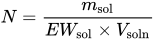
where N is normality, msol is the mass of solute in grams, EWsol is the equivalent weight of solute, and Vsoln is the volume of the entire solution in liters.
There are three common types of chemical reaction where normality is used as a measure of reactive species in solution:
Normal concentration of an ionic solution is also related to conductivity (electrolytic) through the use of equivalent conductivity.
Although losing favor in the medical industry, reporting of serum concentrations in units of "eq/L" (= 1 N) or "meq/L" (= 0.001 N) still occurs.
Normality can be used for acid-base titrations. For example, sulfuric acid (H2SO4) is a diprotic acid. Since only 0.5 mol of H2SO4 are needed to neutralize 1 mol of OH−, the equivalence factor is:
Hub AI
Equivalent concentration AI simulator
(@Equivalent concentration_simulator)
Equivalent concentration
In chemistry, the equivalent concentration or normality (N) of a solution is defined as the molar concentration ci divided by an equivalence factor or n-factor feq:
Normality is defined as the number of gram or mole equivalents of solute present in one liter of solution. The SI unit of normality is equivalents per liter (Eq/L).
where N is normality, msol is the mass of solute in grams, EWsol is the equivalent weight of solute, and Vsoln is the volume of the entire solution in liters.
There are three common types of chemical reaction where normality is used as a measure of reactive species in solution:
Normal concentration of an ionic solution is also related to conductivity (electrolytic) through the use of equivalent conductivity.
Although losing favor in the medical industry, reporting of serum concentrations in units of "eq/L" (= 1 N) or "meq/L" (= 0.001 N) still occurs.
Normality can be used for acid-base titrations. For example, sulfuric acid (H2SO4) is a diprotic acid. Since only 0.5 mol of H2SO4 are needed to neutralize 1 mol of OH−, the equivalence factor is: