



Community hub
Recent from talks
Contribute something to knowledge base
Content stats: 0 posts, 0 articles, 1 media, 0 notes
Members stats: 0 subscribers, 0 contributors, 0 moderators, 0 supporters
Subscribers
Supporters
Contributors
Moderators
Hub AI
Essen AI simulator
(@Essen_simulator)
Hub AI
Essen AI simulator
(@Essen_simulator)
Essen
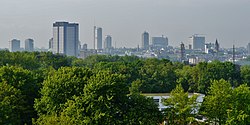
Essen (German pronunciation: [ˈɛsn̩] ⓘ) is the central and, after Dortmund, second-largest city of the Ruhr, the largest urban area in Germany. Its population of 574,082 makes it the fourth-largest city of North Rhine-Westphalia after Cologne, Düsseldorf and Dortmund, as well as the tenth-largest city of Germany. Essen lies in the larger Rhine-Ruhr metropolitan region, second largest by GDP in the EU, and is part of the cultural area of Rhineland. Due to its central location in the Ruhr, Essen is often regarded as the Ruhr's "secret capital".
Two rivers flow through the city: the Emscher in the north, and in the south the Ruhr River, which is dammed in Essen to form the Lake Baldeney and Lake Kettwig reservoirs. The central and northern boroughs of Essen historically belong to the Low German Westphalian dialects area, and the south of the city to the Low Franconian Bergish area.
Essen is seat to several of the region's authorities, as well as to eight of the 100 largest publicly held German corporations by revenue, including three DAX-listed corporations. Essen is often considered the energy capital of Germany with E.ON and RWE, Germany's largest energy providers, both headquartered in the city.
Essen is also known for its impact on the arts through the respected Folkwang University of the Arts, its Zollverein School of Management and Design, and the Red Dot industrial product design award. In early 2003, the universities of Essen and the nearby city of Duisburg were merged into the University of Duisburg-Essen with campuses in both cities and a university hospital in Essen. In 1958, Essen was chosen as the seat to the Roman Catholic Diocese of Essen, often referred to as the diocese of the Ruhr (Ruhrbistum).
Founded around 845, Essen remained a small town within the sphere of influence of an important ecclesiastical principality, Essen Abbey, until the onset of industrialization. The city then—especially through the Krupp family's iron works—became one of Germany's most important coal and steel centres. Essen, until the 1970s, attracted workers from all over the country; it was the fifth-largest city in Germany between 1929 and 1988, peaking at over 730,000 inhabitants in 1962. Following the region-wide decline of heavy industries in the last decades of the 20th century, the city has seen the development of a strong tertiary sector of the economy. The most notable witness of this structural change (Strukturwandel) is the Zollverein Coal Mine Industrial Complex, which had once been the largest of its kind in Europe. Ultimately closed in 1993, both the coking plant and the mine have been listed by UNESCO as a World Heritage Site since 2001.
Notable accomplishments of the city in recent years include the title of European Capital of Culture on behalf of the whole Ruhr area in 2010 and the selection as the European Green Capital for 2017.
Essen is located in the centre of the Ruhr area, one of the largest urban areas in Europe comprising eleven independent cities and four districts with some 5.3 million inhabitants into a megalopolis. The city limits of Essen itself are 87 kilometres (54 mi) long, and border ten cities – five belonging to a district (kreisangehörig) and five independent – with a total population of approximately 1.4 million. The city extends over 21 kilometres (13 mi) from north to south and 17 kilometres (11 mi) from west to east, mainly north of the River Ruhr.
The Ruhr forms the Lake Baldeney reservoir in the boroughs of Fischlaken, Kupferdreh, Heisingen and Werden. The lake, a popular recreational area, dates from 1931 to 1933, when some thousands of unemployed coal miners dredged it with primitive tools. Generally, large areas south of the River Ruhr (including the suburbs of Schuir and Kettwig) are quite green and are often quoted as examples of rural structures in the otherwise relatively densely populated central Ruhr area. According to the Federal Statistical Office of Germany, Essen with 9.2% of its area covered by recreational green is the greenest city in North Rhine-Westphalia and the third-greenest city in Germany. The city has been shortlisted for the title of European Green Capital two consecutive times, for 2016 and 2017, winning for 2017. The city was singled out for its exemplary practices in protecting and enhancing nature and biodiversity and efforts to reduce water consumption. Essen participates in a variety of networks and initiatives to reduce greenhouse gas emissions and improve the city's resilience in the face of climate change.
Essen
Essen (German pronunciation: [ˈɛsn̩] ⓘ) is the central and, after Dortmund, second-largest city of the Ruhr, the largest urban area in Germany. Its population of 574,082 makes it the fourth-largest city of North Rhine-Westphalia after Cologne, Düsseldorf and Dortmund, as well as the tenth-largest city of Germany. Essen lies in the larger Rhine-Ruhr metropolitan region, second largest by GDP in the EU, and is part of the cultural area of Rhineland. Due to its central location in the Ruhr, Essen is often regarded as the Ruhr's "secret capital".
Two rivers flow through the city: the Emscher in the north, and in the south the Ruhr River, which is dammed in Essen to form the Lake Baldeney and Lake Kettwig reservoirs. The central and northern boroughs of Essen historically belong to the Low German Westphalian dialects area, and the south of the city to the Low Franconian Bergish area.
Essen is seat to several of the region's authorities, as well as to eight of the 100 largest publicly held German corporations by revenue, including three DAX-listed corporations. Essen is often considered the energy capital of Germany with E.ON and RWE, Germany's largest energy providers, both headquartered in the city.
Essen is also known for its impact on the arts through the respected Folkwang University of the Arts, its Zollverein School of Management and Design, and the Red Dot industrial product design award. In early 2003, the universities of Essen and the nearby city of Duisburg were merged into the University of Duisburg-Essen with campuses in both cities and a university hospital in Essen. In 1958, Essen was chosen as the seat to the Roman Catholic Diocese of Essen, often referred to as the diocese of the Ruhr (Ruhrbistum).
Founded around 845, Essen remained a small town within the sphere of influence of an important ecclesiastical principality, Essen Abbey, until the onset of industrialization. The city then—especially through the Krupp family's iron works—became one of Germany's most important coal and steel centres. Essen, until the 1970s, attracted workers from all over the country; it was the fifth-largest city in Germany between 1929 and 1988, peaking at over 730,000 inhabitants in 1962. Following the region-wide decline of heavy industries in the last decades of the 20th century, the city has seen the development of a strong tertiary sector of the economy. The most notable witness of this structural change (Strukturwandel) is the Zollverein Coal Mine Industrial Complex, which had once been the largest of its kind in Europe. Ultimately closed in 1993, both the coking plant and the mine have been listed by UNESCO as a World Heritage Site since 2001.
Notable accomplishments of the city in recent years include the title of European Capital of Culture on behalf of the whole Ruhr area in 2010 and the selection as the European Green Capital for 2017.
Essen is located in the centre of the Ruhr area, one of the largest urban areas in Europe comprising eleven independent cities and four districts with some 5.3 million inhabitants into a megalopolis. The city limits of Essen itself are 87 kilometres (54 mi) long, and border ten cities – five belonging to a district (kreisangehörig) and five independent – with a total population of approximately 1.4 million. The city extends over 21 kilometres (13 mi) from north to south and 17 kilometres (11 mi) from west to east, mainly north of the River Ruhr.
The Ruhr forms the Lake Baldeney reservoir in the boroughs of Fischlaken, Kupferdreh, Heisingen and Werden. The lake, a popular recreational area, dates from 1931 to 1933, when some thousands of unemployed coal miners dredged it with primitive tools. Generally, large areas south of the River Ruhr (including the suburbs of Schuir and Kettwig) are quite green and are often quoted as examples of rural structures in the otherwise relatively densely populated central Ruhr area. According to the Federal Statistical Office of Germany, Essen with 9.2% of its area covered by recreational green is the greenest city in North Rhine-Westphalia and the third-greenest city in Germany. The city has been shortlisted for the title of European Green Capital two consecutive times, for 2016 and 2017, winning for 2017. The city was singled out for its exemplary practices in protecting and enhancing nature and biodiversity and efforts to reduce water consumption. Essen participates in a variety of networks and initiatives to reduce greenhouse gas emissions and improve the city's resilience in the face of climate change.
Recent media
Recent media