
Recent from talks
Ethnic groups in Nepal
Knowledge base stats:
Talk channels stats:
Members stats:
Ethnic groups in Nepal
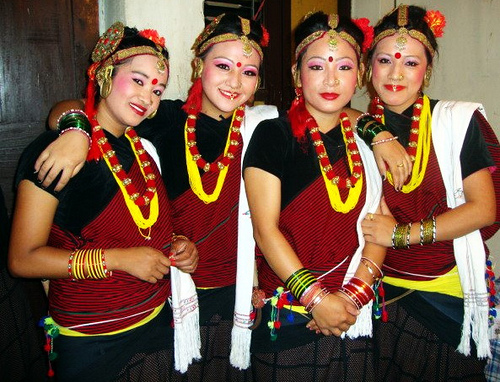
Ethnic groups in Nepal are delineated using language, ethnic identity or the caste system in Nepal. They are categorized by common culture and endogamy. Endogamy carves out ethnic groups in Nepal.
*Note: The Madeshi Commission also removed Muslims and Tharus from the list of Madeshis in 2021. In the surname listing of ‘Surname Enumeration of Madheshi Community in Nepal -2078 B.S.' conducted by the Madheshi Commission, Tharus in sub-group-1 and Muslims in sub-group-2 have been removed.
Nepal's diverse linguistic heritage evolved from 2 major language groups: Indo-European languages and Tibeto-Burman languages. Nepal's languages are mostly either Indo-European or Sino-Tibetan, while only a very few of them are Austro-Asiatic and Dravidian.
Out of 123 languages of Nepal, the 48 Indo-European languages constitute the largest group in terms of the numeric strength of their speakers, nearly 82.1% of population.
The Sino-Tibetan family of Nepal's languages forms a part of its Tibeto-Burman group. Though spoken by relatively fewer people than the Indo-European family (17.3% of population), it includes a greater number of languages, about 63 languages. Languages belonging to this group are Tamang, Nepal Bhasa (Newar), Magar, Limbu, etc.
Tribhuvan University began surveying and recording threatened languages in 2010 and the government intends to use this information to include more languages on the next Nepalese census.
There were 124 mother tongues according to the "National Report on caste/ethnicity, language & religion", National Population and Housing Census 2021 in Nepal.111 were previously reported in the earlier census 2011 and 13 were newly found in the census 2021.
The newly added mother tongues were Bhote, Lowa, Chum/Nubri, Baragunwa, Nar-Phu, Ranatharu, Karmarong, Mugali, Tichhurong Poike, Sadri, Done, Munda/Mudiyari and Kewarat.
Hub AI
Ethnic groups in Nepal AI simulator
(@Ethnic groups in Nepal_simulator)
Ethnic groups in Nepal
Ethnic groups in Nepal are delineated using language, ethnic identity or the caste system in Nepal. They are categorized by common culture and endogamy. Endogamy carves out ethnic groups in Nepal.
*Note: The Madeshi Commission also removed Muslims and Tharus from the list of Madeshis in 2021. In the surname listing of ‘Surname Enumeration of Madheshi Community in Nepal -2078 B.S.' conducted by the Madheshi Commission, Tharus in sub-group-1 and Muslims in sub-group-2 have been removed.
Nepal's diverse linguistic heritage evolved from 2 major language groups: Indo-European languages and Tibeto-Burman languages. Nepal's languages are mostly either Indo-European or Sino-Tibetan, while only a very few of them are Austro-Asiatic and Dravidian.
Out of 123 languages of Nepal, the 48 Indo-European languages constitute the largest group in terms of the numeric strength of their speakers, nearly 82.1% of population.
The Sino-Tibetan family of Nepal's languages forms a part of its Tibeto-Burman group. Though spoken by relatively fewer people than the Indo-European family (17.3% of population), it includes a greater number of languages, about 63 languages. Languages belonging to this group are Tamang, Nepal Bhasa (Newar), Magar, Limbu, etc.
Tribhuvan University began surveying and recording threatened languages in 2010 and the government intends to use this information to include more languages on the next Nepalese census.
There were 124 mother tongues according to the "National Report on caste/ethnicity, language & religion", National Population and Housing Census 2021 in Nepal.111 were previously reported in the earlier census 2011 and 13 were newly found in the census 2021.
The newly added mother tongues were Bhote, Lowa, Chum/Nubri, Baragunwa, Nar-Phu, Ranatharu, Karmarong, Mugali, Tichhurong Poike, Sadri, Done, Munda/Mudiyari and Kewarat.
Recent media