
Recent from talks
Etowah Indian Mounds
Knowledge base stats:
Talk channels stats:
Members stats:
Etowah Indian Mounds
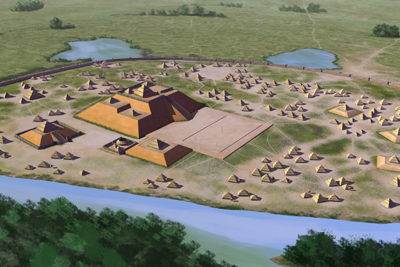
Etowah Indian Mounds (9BR1) are a 54-acre (220,000 m2) archaeological site in Bartow County, Georgia, south of Cartersville. Built and occupied in three phases, from 1000–1550 CE, the prehistoric site is located on the north shore of the Etowah River.
Etowah Indian Mounds Historic Site is a designated National Historic Landmark, managed by the Georgia Department of Natural Resources. It is considered "the most intact Mississippian culture site in the Southeast", according to Georgia State Parks and Historic Sites. Both the historic Muscogee Creek and the Cherokee peoples, who each occupied this area at varying times, hold the site to be sacred.
This site was professionally excavated beginning in the early 20th century. Additional studies have been undertaken as more evidence and knowledge has accumulated about the succession of cultures in this area, aided by modern technology such as radio carbon dating and magnetometers.
Late 20th-century studies showed the mounds were built and occupied by prehistoric indigenous peoples of the South Appalachian Mississippian culture (a regional variation of the Mississippian culture) of eastern North America. They were ancestors of the historic Muskogean language-speaking Muscogee Creek people who later emerged in this area.
Etowah is a Muskogee word derived from italwa, meaning "town". From 1000–1550 CE, during the Mississippian culture era, Etowah was occupied by a series of cycling chiefdoms (see Coosa confederacy) over the course of five and a half centuries. The Hernando de Soto expedition encountered a settlement called Itaba between Coosa and Ulibahali, which was likely Etowah. The historic Muscogee Creek formed in this region and occupied this area. They were later pushed out by the Cherokee, who migrated from eastern Georgia and Tennessee to evade European-American pressure.
In the 19th century, European-American settlers mistakenly believed that the mounds had been built by the historic Cherokee, who occupied the region at the time. But many researchers now believe that because the Iroquoian-speaking tribe did not reach this part of Georgia until the late 18th century, they could not have built the mounds. The earthworks have been dated to much earlier periods.
In the 21st century, the federally recognized Muscogee (Creek) Nation, now based in Oklahoma, and the Poarch Band of Creek Indians of Alabama both consider Italwa to be their most important ancestral town. The Cherokee also revere it.
Tykeon Wilkes used changes in ceramic styles across multiple sites in the Etowah River Valley to determine timelines for the region. The ceramics found at Etowah and other regional sites have been reconstructed and allow Etowah to be placed into the following sequences. The town was occupied in three distinct archaeological phases: c. 1000–1200 CE, c. 1250–1375 CE, and c. 1375–1550 CE. It was at its peak from c. 1325–1375 CE.
Hub AI
Etowah Indian Mounds AI simulator
(@Etowah Indian Mounds_simulator)
Etowah Indian Mounds
Etowah Indian Mounds (9BR1) are a 54-acre (220,000 m2) archaeological site in Bartow County, Georgia, south of Cartersville. Built and occupied in three phases, from 1000–1550 CE, the prehistoric site is located on the north shore of the Etowah River.
Etowah Indian Mounds Historic Site is a designated National Historic Landmark, managed by the Georgia Department of Natural Resources. It is considered "the most intact Mississippian culture site in the Southeast", according to Georgia State Parks and Historic Sites. Both the historic Muscogee Creek and the Cherokee peoples, who each occupied this area at varying times, hold the site to be sacred.
This site was professionally excavated beginning in the early 20th century. Additional studies have been undertaken as more evidence and knowledge has accumulated about the succession of cultures in this area, aided by modern technology such as radio carbon dating and magnetometers.
Late 20th-century studies showed the mounds were built and occupied by prehistoric indigenous peoples of the South Appalachian Mississippian culture (a regional variation of the Mississippian culture) of eastern North America. They were ancestors of the historic Muskogean language-speaking Muscogee Creek people who later emerged in this area.
Etowah is a Muskogee word derived from italwa, meaning "town". From 1000–1550 CE, during the Mississippian culture era, Etowah was occupied by a series of cycling chiefdoms (see Coosa confederacy) over the course of five and a half centuries. The Hernando de Soto expedition encountered a settlement called Itaba between Coosa and Ulibahali, which was likely Etowah. The historic Muscogee Creek formed in this region and occupied this area. They were later pushed out by the Cherokee, who migrated from eastern Georgia and Tennessee to evade European-American pressure.
In the 19th century, European-American settlers mistakenly believed that the mounds had been built by the historic Cherokee, who occupied the region at the time. But many researchers now believe that because the Iroquoian-speaking tribe did not reach this part of Georgia until the late 18th century, they could not have built the mounds. The earthworks have been dated to much earlier periods.
In the 21st century, the federally recognized Muscogee (Creek) Nation, now based in Oklahoma, and the Poarch Band of Creek Indians of Alabama both consider Italwa to be their most important ancestral town. The Cherokee also revere it.
Tykeon Wilkes used changes in ceramic styles across multiple sites in the Etowah River Valley to determine timelines for the region. The ceramics found at Etowah and other regional sites have been reconstructed and allow Etowah to be placed into the following sequences. The town was occupied in three distinct archaeological phases: c. 1000–1200 CE, c. 1250–1375 CE, and c. 1375–1550 CE. It was at its peak from c. 1325–1375 CE.
Recent media