
Recent from talks
Ewald Hering
Knowledge base stats:
Talk channels stats:
Members stats:
Ewald Hering
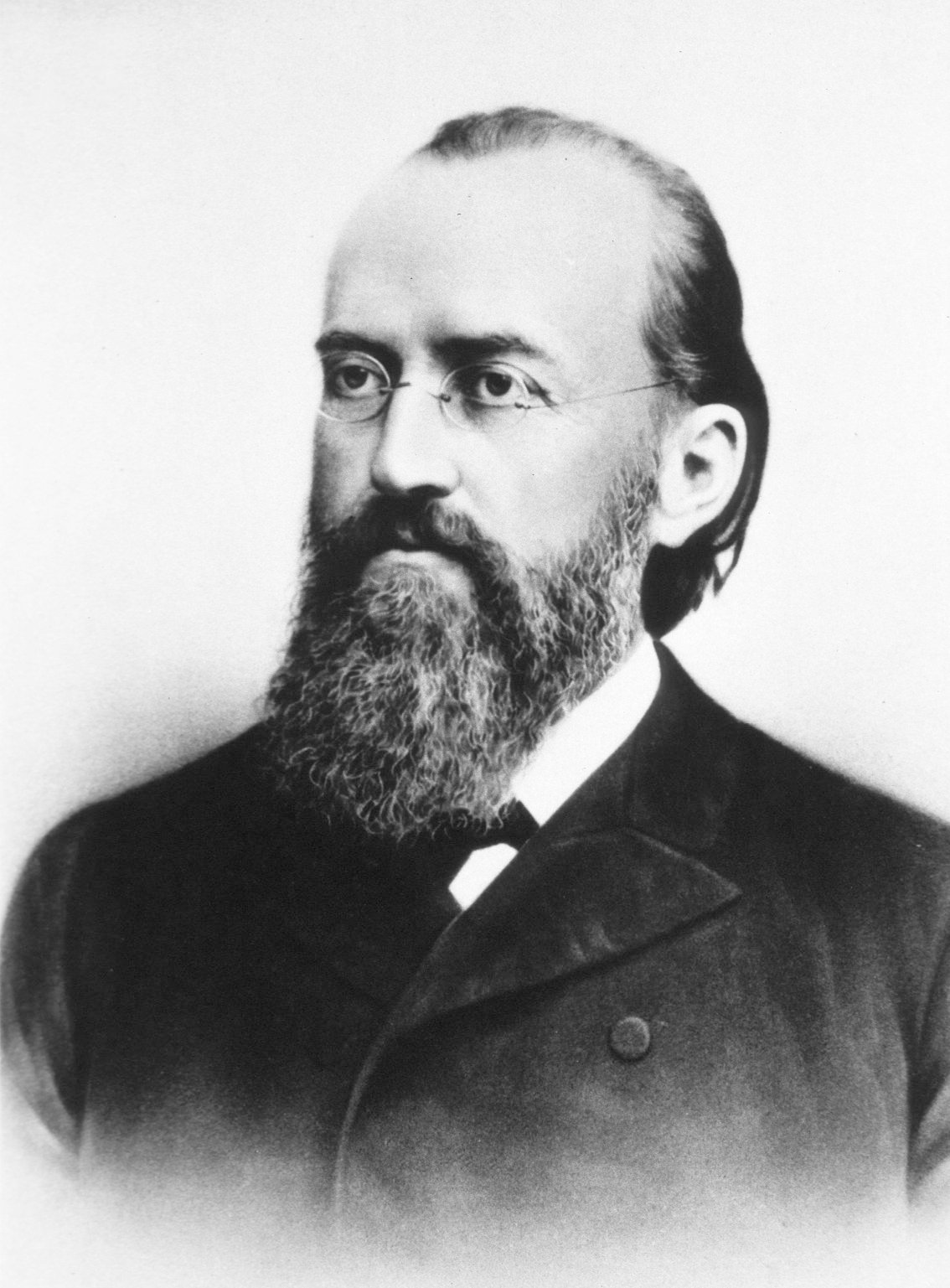
Karl Ewald Konstantin Hering (5 August 1834 – 26 January 1918) was a German physiologist who did much research in color vision, binocular perception, eye movements, and hyperacuity. He proposed opponent color theory in 1892.
Born in Alt-Gersdorf, Kingdom of Saxony, Hering studied at the University of Leipzig and became the first rector of the German Charles-Ferdinand University in Prague.
Hering was born in Alt-Gersdorf in Saxony, Germany. He probably grew up in a poor family, son of a Lutheran pastor. Hering attended gymnasium in Zittau and entered the university of Leipzig in 1853. There he studied philosophy, zoology and medicine. He completed an M.D. degree in 1860.
It is somewhat unclear how Hering trained to do research. At the time Johannes Peter Müller was perhaps the most famous physiologist in Germany. Hering seems to have applied for studying under his direction but was rejected,[citation needed] which might have contributed to his animosity towards Hermann von Helmholtz, Müller's protégé. However, in Leipzig, E. H. Weber and G. T. Fechner were conducting groundbreaking studies founding what would become the field of psychophysics. Although there is no evidence that Hering ever studied under their direction, in his later years he proudly acknowledged himself a "student of Fechner".
After graduating, Hering practiced as a physician in Leipzig. Despite having little time to do research and having even scarcer financial resources, he turned to binocular vision (using both eyes together) and the problem of the horopter (the points in space that project on anatomically identical points on the two retinas). There, he surprised the scientific community when he published, as a completely unknown scientist, his own mathematical derivation of the horopter independently from Hermann von Helmholtz, who was by then considered one of the best German scientists and mathematicians. Hering went as far as ridiculing Helmholtz's (unimportant) mathematical errors in his derivation of the horopter.
Hering was subsequently appointed professor of physiology at the military academy of Vienna until 1870. With better resources he conducted important studies in physiology, in particular on the cardiac and respiratory systems. In 1870, he succeeded Jan Evangelista Purkinje at the university of Prague where he remained for the next 25 years. There he became involved in fierce arguments between nationalistic Czechs who wanted the university taught in the language of the land, and a minority of German professors. Eventually a separate German university, Charles-Ferdinand University, was created in 1882 and Hering became its first rector.
In his late years, Hering returned to Germany, where he became professor at the university of Leipzig in 1895, aged 61. He retired in 1915 and died of tuberculosis three years later. He was an atheist.
Hering studied a broad range of subjects in vision, among them his outstanding studies on binocular vision. He derived, almost simultaneously with Helmholtz, the theoretical shape of the horopter. Despite identical results, Hering's derivation was far more modern and elegant, using recently developed projective geometry. Indeed, Helmholtz himself qualified Hering's approach as "very elegant, comprehensive and complete". Subsequently, Hering empirically estimated the shape of the horopter. Alongside with Helmholtz and Hillebrand, he noticed that the empirical horopter does not match the theoretical horopter, a phenomenon now named the Hering–Hillebrand deviation.
Hub AI
Ewald Hering AI simulator
(@Ewald Hering_simulator)
Ewald Hering
Karl Ewald Konstantin Hering (5 August 1834 – 26 January 1918) was a German physiologist who did much research in color vision, binocular perception, eye movements, and hyperacuity. He proposed opponent color theory in 1892.
Born in Alt-Gersdorf, Kingdom of Saxony, Hering studied at the University of Leipzig and became the first rector of the German Charles-Ferdinand University in Prague.
Hering was born in Alt-Gersdorf in Saxony, Germany. He probably grew up in a poor family, son of a Lutheran pastor. Hering attended gymnasium in Zittau and entered the university of Leipzig in 1853. There he studied philosophy, zoology and medicine. He completed an M.D. degree in 1860.
It is somewhat unclear how Hering trained to do research. At the time Johannes Peter Müller was perhaps the most famous physiologist in Germany. Hering seems to have applied for studying under his direction but was rejected,[citation needed] which might have contributed to his animosity towards Hermann von Helmholtz, Müller's protégé. However, in Leipzig, E. H. Weber and G. T. Fechner were conducting groundbreaking studies founding what would become the field of psychophysics. Although there is no evidence that Hering ever studied under their direction, in his later years he proudly acknowledged himself a "student of Fechner".
After graduating, Hering practiced as a physician in Leipzig. Despite having little time to do research and having even scarcer financial resources, he turned to binocular vision (using both eyes together) and the problem of the horopter (the points in space that project on anatomically identical points on the two retinas). There, he surprised the scientific community when he published, as a completely unknown scientist, his own mathematical derivation of the horopter independently from Hermann von Helmholtz, who was by then considered one of the best German scientists and mathematicians. Hering went as far as ridiculing Helmholtz's (unimportant) mathematical errors in his derivation of the horopter.
Hering was subsequently appointed professor of physiology at the military academy of Vienna until 1870. With better resources he conducted important studies in physiology, in particular on the cardiac and respiratory systems. In 1870, he succeeded Jan Evangelista Purkinje at the university of Prague where he remained for the next 25 years. There he became involved in fierce arguments between nationalistic Czechs who wanted the university taught in the language of the land, and a minority of German professors. Eventually a separate German university, Charles-Ferdinand University, was created in 1882 and Hering became its first rector.
In his late years, Hering returned to Germany, where he became professor at the university of Leipzig in 1895, aged 61. He retired in 1915 and died of tuberculosis three years later. He was an atheist.
Hering studied a broad range of subjects in vision, among them his outstanding studies on binocular vision. He derived, almost simultaneously with Helmholtz, the theoretical shape of the horopter. Despite identical results, Hering's derivation was far more modern and elegant, using recently developed projective geometry. Indeed, Helmholtz himself qualified Hering's approach as "very elegant, comprehensive and complete". Subsequently, Hering empirically estimated the shape of the horopter. Alongside with Helmholtz and Hillebrand, he noticed that the empirical horopter does not match the theoretical horopter, a phenomenon now named the Hering–Hillebrand deviation.
Recent media