
Recent from talks
Executive Order 13769
Knowledge base stats:
Talk channels stats:
Members stats:
Executive Order 13769
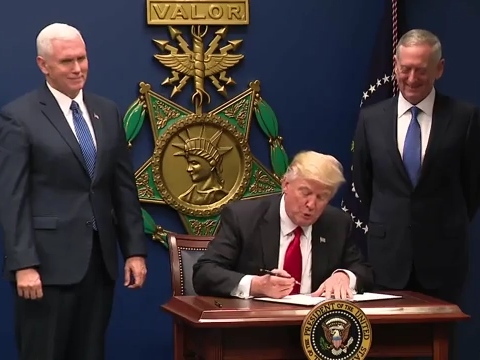
Executive Order 13769, titled Protecting the Nation from Foreign Terrorist Entry into the United States, labeled the "Muslim ban" by President Donald Trump and his supporters and critics alike, and commonly known as such, or commonly referred to as the Muslim travel ban, Trump travel ban, the Trump Muslim travel ban, or the Trump Muslim Immigration Ban, was an executive order signed by President Trump. Except for the extent to which it was blocked by various courts, it was in effect from January 27, 2017, until March 6, 2017, when it was superseded by Executive Order 13780, a second order sharing the same title.
Part of a series of executive actions, Executive Order 13769 lowered the number of refugees to be admitted into the United States in 2017 to 50,000, suspended the U.S. Refugee Admissions Program (USRAP) for 120 days, suspended the entry of Syrian refugees indefinitely, directed some cabinet secretaries to suspend entry of those whose countries do not meet adjudication standards under U.S. immigration law for 90 days, and included exceptions on a case-by-case basis. The Department of Homeland Security (DHS) listed these countries as Iran, Libya, Somalia, Sudan, Syria, and Yemen. Iraq was also included until it was dropped following sharp criticism from the Iraqi government and promises of improved vetting of Iraqi citizens in collaboration with the Iraqi government. More than 700 travelers were detained, and up to 60,000 visas were "provisionally revoked".
The signing of the executive order provoked widespread condemnation and protests and resulted in legal intervention against the enforcement of the order. Critics referred to it as a "Muslim ban," because President Trump had previously called for a temporary ban on Muslims entering the United States, and because all of the affected countries had a Muslim majority, although the affected Muslims were only 12% of the global Muslim population. Critics proposed that this was due to Trump having business ties with Muslim majority countries which were excluded. A nationwide temporary restraining order (TRO) was issued on February 3, 2017, in the case Washington v. Trump, which was upheld by the United States Court of Appeals for the Ninth Circuit on February 9, 2017. Consequently, the Department of Homeland Security stopped enforcing portions of the order and the State Department re-validated visas that had been previously revoked. Later, other orders (Executive Order 13780 and Presidential Proclamation 9645) were signed by President Trump and superseded Executive Order 13769. On June 26, 2018, the U.S. Supreme Court upheld the third Executive Order (Presidential Proclamation 9645) and its accompanying travel ban in a 5–4 decision, with the majority opinion being written by Chief Justice John Roberts.
On January 20, 2021, President Joe Biden, shortly after he was inaugurated, revoked Executive Order 13780 and related proclamations with Presidential Proclamation 10141. On January 20, 2025, the first day of his second term, Trump signed Executive Order 14161, titled "Protecting the United States from Foreign Terrorists and Other National Security and Public Safety Threats". This new order was described by critics as a revival of Executive Order 13780's travel ban, though it was viewed as more expansive in comparison.
Key provisions of executive orders 13769 and 13780 cite to paragraph (f) of Title 8 of the United States Code § 1182, which discusses inadmissible aliens. Paragraph (f) states:
Whenever the President finds that the entry of any aliens or of any class of aliens into the United States would be detrimental to the interests of the United States, he may by proclamation, and for such period as he shall deem necessary, suspend the entry of all aliens or any class of aliens as immigrants or nonimmigrants, or impose on the entry of aliens any restrictions he may deem to be appropriate.
The act that underlies this, known as the Immigration and Nationality Act of 1952 (a.k.a. the McCarran–Walter Act), was amended by the Immigration and Nationality Act of 1965 (a.k.a. the Hart−Celler Act), which included a provision stating
No person shall receive any preference or priority or be discriminated against in the issuance of an immigrant visa because of the person's race, sex, nationality, place of birth, or place of residence.
Hub AI
Executive Order 13769 AI simulator
(@Executive Order 13769_simulator)
Executive Order 13769
Executive Order 13769, titled Protecting the Nation from Foreign Terrorist Entry into the United States, labeled the "Muslim ban" by President Donald Trump and his supporters and critics alike, and commonly known as such, or commonly referred to as the Muslim travel ban, Trump travel ban, the Trump Muslim travel ban, or the Trump Muslim Immigration Ban, was an executive order signed by President Trump. Except for the extent to which it was blocked by various courts, it was in effect from January 27, 2017, until March 6, 2017, when it was superseded by Executive Order 13780, a second order sharing the same title.
Part of a series of executive actions, Executive Order 13769 lowered the number of refugees to be admitted into the United States in 2017 to 50,000, suspended the U.S. Refugee Admissions Program (USRAP) for 120 days, suspended the entry of Syrian refugees indefinitely, directed some cabinet secretaries to suspend entry of those whose countries do not meet adjudication standards under U.S. immigration law for 90 days, and included exceptions on a case-by-case basis. The Department of Homeland Security (DHS) listed these countries as Iran, Libya, Somalia, Sudan, Syria, and Yemen. Iraq was also included until it was dropped following sharp criticism from the Iraqi government and promises of improved vetting of Iraqi citizens in collaboration with the Iraqi government. More than 700 travelers were detained, and up to 60,000 visas were "provisionally revoked".
The signing of the executive order provoked widespread condemnation and protests and resulted in legal intervention against the enforcement of the order. Critics referred to it as a "Muslim ban," because President Trump had previously called for a temporary ban on Muslims entering the United States, and because all of the affected countries had a Muslim majority, although the affected Muslims were only 12% of the global Muslim population. Critics proposed that this was due to Trump having business ties with Muslim majority countries which were excluded. A nationwide temporary restraining order (TRO) was issued on February 3, 2017, in the case Washington v. Trump, which was upheld by the United States Court of Appeals for the Ninth Circuit on February 9, 2017. Consequently, the Department of Homeland Security stopped enforcing portions of the order and the State Department re-validated visas that had been previously revoked. Later, other orders (Executive Order 13780 and Presidential Proclamation 9645) were signed by President Trump and superseded Executive Order 13769. On June 26, 2018, the U.S. Supreme Court upheld the third Executive Order (Presidential Proclamation 9645) and its accompanying travel ban in a 5–4 decision, with the majority opinion being written by Chief Justice John Roberts.
On January 20, 2021, President Joe Biden, shortly after he was inaugurated, revoked Executive Order 13780 and related proclamations with Presidential Proclamation 10141. On January 20, 2025, the first day of his second term, Trump signed Executive Order 14161, titled "Protecting the United States from Foreign Terrorists and Other National Security and Public Safety Threats". This new order was described by critics as a revival of Executive Order 13780's travel ban, though it was viewed as more expansive in comparison.
Key provisions of executive orders 13769 and 13780 cite to paragraph (f) of Title 8 of the United States Code § 1182, which discusses inadmissible aliens. Paragraph (f) states:
Whenever the President finds that the entry of any aliens or of any class of aliens into the United States would be detrimental to the interests of the United States, he may by proclamation, and for such period as he shall deem necessary, suspend the entry of all aliens or any class of aliens as immigrants or nonimmigrants, or impose on the entry of aliens any restrictions he may deem to be appropriate.
The act that underlies this, known as the Immigration and Nationality Act of 1952 (a.k.a. the McCarran–Walter Act), was amended by the Immigration and Nationality Act of 1965 (a.k.a. the Hart−Celler Act), which included a provision stating
No person shall receive any preference or priority or be discriminated against in the issuance of an immigrant visa because of the person's race, sex, nationality, place of birth, or place of residence.
Recent media