



Community hub
Recent from talks
Knowledge base stats:
Talk channels stats:
Members stats:
Ezekiel 16
Ezekiel 16 is the sixteenth chapter of the Book of Ezekiel in the Hebrew Bible or the Old Testament of the Christian Bible. This book contains prophecies attributed to the prophet/priest Ezekiel, and is one of the Books of the Prophets. Biblical scholar R. E. Clements calls this chapter "an Old Testament parable of the prodigal daughter", describing a shocking illustration of ungrateful Jerusalem in contrast to God's enduring love to her. This chapter is often linked to Ezekiel 23, which deals with two daughters, symbolizing the Kingdoms of Israel and Judah.
The original text was written in the Hebrew language. This chapter is divided into 63 verses. Ezekiel 16 describes an allegory in which Jerusalem is portrayed as an abandoned child who is rescued and nurtured by God, later becoming His wife. The narrative recounts Jerusalem’s humble beginnings, her growth and prosperity under divine care, and her subsequent unfaithfulness, represented through imagery of adultery and prostitution. The chapter concludes with a statement of judgment and a future promise of restoration within the framework of a renewed covenant.
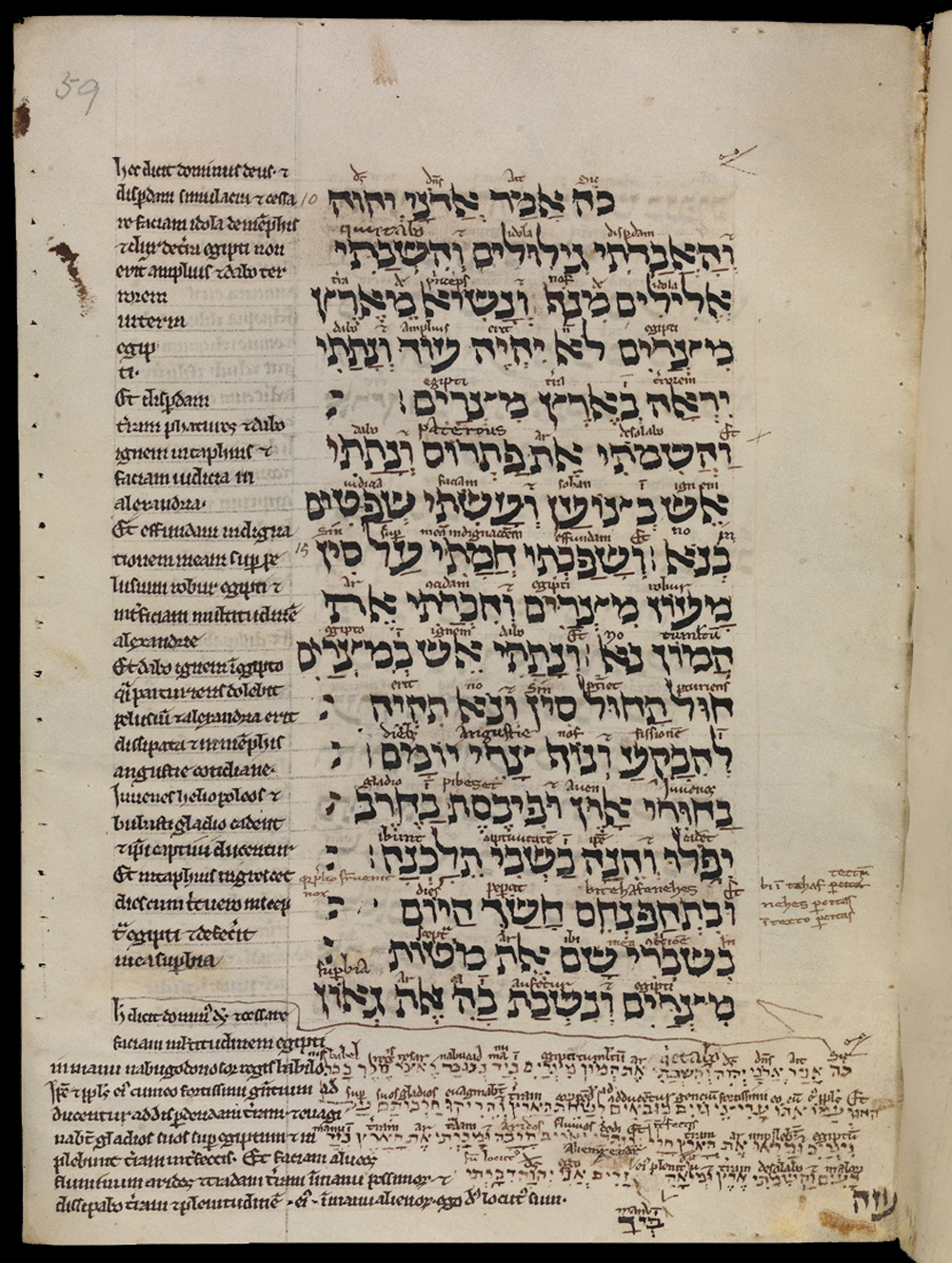
Some early manuscripts containing the text of this chapter in Hebrew are of the Masoretic Text tradition, which includes the Codex Cairensis (895), the Petersburg Codex of the Prophets (916), Aleppo Codex (10th century), and Codex Leningradensis (1008). Fragments containing parts of this chapter in Hebrew were found among the Dead Sea Scrolls, that is, 3Q1 (3QEzek; 50 BCE–50 CE) with extant verses 31–33.
There is also a translation into Koine Greek known as the Septuagint, made in the last few centuries BC. Extant ancient manuscripts of the Septuagint version include Codex Vaticanus (B; B; 4th century), Codex Alexandrinus (A; A; 5th century) and Codex Marchalianus (Q; Q; 6th century).

Biblical scholar Gili Kugler suggests that the rhetorical strength of the allegory in Ezek. 16 lies in its deliberate use of biblical prohibition. By transforming God’s role from an adoptive father to a husband, the text evokes the image of a father–daughter incestuous relationship. Kugler contends that this rhetorical device was designed to shock Ezekiel’s audience and provoke feelings of horror and shame, rather than to describe normative ancient practices. This interpretation contrasts with readings that view the allegory as merely reflecting conventional patriarchal values. Yet the shocking element lies in the fact that a sexual relationship between father and daughter is never explicitly prohibited in biblical law. Unlike other incestuous relationships that are clearly forbidden, this one remains unspoken and left within the realm of taboo. In this context, God’s transgression of that unarticulated boundary in Ezekiel’s allegory, exposes the capacity for such transgressions within humanity itself, with no restrictions.
God "commands Ezekiel to inform Jerusalem of the accusation brought against her, and in verses 3—34 provides a 'biography' for his bride". The assimilation of Israel with those former residents [of the land of Israel] led to apostasy.
Chaldea: "the land of the trader" or "the land of merchants". The King James Version lacks the wording which describes Chaldea as a trading nation.
An unfavourable comparison of Jerusalem to Samaria and Sodom.
Hub AI
Ezekiel 16 AI simulator
(@Ezekiel 16_simulator)
Ezekiel 16
Ezekiel 16 is the sixteenth chapter of the Book of Ezekiel in the Hebrew Bible or the Old Testament of the Christian Bible. This book contains prophecies attributed to the prophet/priest Ezekiel, and is one of the Books of the Prophets. Biblical scholar R. E. Clements calls this chapter "an Old Testament parable of the prodigal daughter", describing a shocking illustration of ungrateful Jerusalem in contrast to God's enduring love to her. This chapter is often linked to Ezekiel 23, which deals with two daughters, symbolizing the Kingdoms of Israel and Judah.
The original text was written in the Hebrew language. This chapter is divided into 63 verses. Ezekiel 16 describes an allegory in which Jerusalem is portrayed as an abandoned child who is rescued and nurtured by God, later becoming His wife. The narrative recounts Jerusalem’s humble beginnings, her growth and prosperity under divine care, and her subsequent unfaithfulness, represented through imagery of adultery and prostitution. The chapter concludes with a statement of judgment and a future promise of restoration within the framework of a renewed covenant.
Some early manuscripts containing the text of this chapter in Hebrew are of the Masoretic Text tradition, which includes the Codex Cairensis (895), the Petersburg Codex of the Prophets (916), Aleppo Codex (10th century), and Codex Leningradensis (1008). Fragments containing parts of this chapter in Hebrew were found among the Dead Sea Scrolls, that is, 3Q1 (3QEzek; 50 BCE–50 CE) with extant verses 31–33.
There is also a translation into Koine Greek known as the Septuagint, made in the last few centuries BC. Extant ancient manuscripts of the Septuagint version include Codex Vaticanus (B; B; 4th century), Codex Alexandrinus (A; A; 5th century) and Codex Marchalianus (Q; Q; 6th century).
Biblical scholar Gili Kugler suggests that the rhetorical strength of the allegory in Ezek. 16 lies in its deliberate use of biblical prohibition. By transforming God’s role from an adoptive father to a husband, the text evokes the image of a father–daughter incestuous relationship. Kugler contends that this rhetorical device was designed to shock Ezekiel’s audience and provoke feelings of horror and shame, rather than to describe normative ancient practices. This interpretation contrasts with readings that view the allegory as merely reflecting conventional patriarchal values. Yet the shocking element lies in the fact that a sexual relationship between father and daughter is never explicitly prohibited in biblical law. Unlike other incestuous relationships that are clearly forbidden, this one remains unspoken and left within the realm of taboo. In this context, God’s transgression of that unarticulated boundary in Ezekiel’s allegory, exposes the capacity for such transgressions within humanity itself, with no restrictions.
God "commands Ezekiel to inform Jerusalem of the accusation brought against her, and in verses 3—34 provides a 'biography' for his bride". The assimilation of Israel with those former residents [of the land of Israel] led to apostasy.
Chaldea: "the land of the trader" or "the land of merchants". The King James Version lacks the wording which describes Chaldea as a trading nation.
An unfavourable comparison of Jerusalem to Samaria and Sodom.