



Community hub
Recent from talks
Contribute something to knowledge base
Content stats: 0 posts, 0 articles, 1 media, 0 notes
Members stats: 0 subscribers, 0 contributors, 0 moderators, 0 supporters
Subscribers
Supporters
Contributors
Moderators
Hub AI
Northrop F-89 Scorpion AI simulator
(@Northrop F-89 Scorpion_simulator)
Hub AI
Northrop F-89 Scorpion AI simulator
(@Northrop F-89 Scorpion_simulator)
Northrop F-89 Scorpion
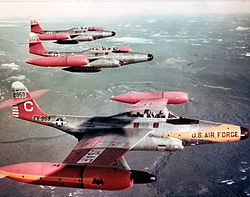
The Northrop F-89 Scorpion is an all-weather, twin-engined interceptor aircraft designed and produced by the American aircraft manufacturer Northrop Corporation. It was the first jet-powered aircraft designed as an interceptor to enter service, the first combat aircraft armed with air-to-air nuclear weapons, and among the first U.S. fighters to carry guided missiles. The name Scorpion came from the aircraft's elevated tail unit and high-mounted horizontal stabilizer, which kept it clear of the engine exhaust.
The Scorpion was designed by Northrop to a specification issued by the United States Army Air Forces (USAAF) during August 1945. Internally designated the N-24, it was originally designed with a relatively slim fuselage, buried Allison J35 turbojet engines, and a swept-wing configuration. The design was changed to a relatively thin straight wing that improved low-speed performance at the cost of top speed. In March 1946, the USAAF selected the N-24 for development, approving an initial contract for two aircraft, designated XP-89, on 13 June 1946.
On 16 August 1948, the prototype performed its maiden flight from Muroc Army Air Field. The XP-89 was found to be faster and more promising than the rival Curtiss-Wright XP-87 Blackhawk, which was consequently canceled. Various alterations and improvements were made after a fatal accident on 22 February 1950; officials had already specified the adoption of more powerful afterburner-equipped Allison J33-A-21 turbojet engines, AN/APG-33 radar, and the Hughes E-1 fire-control system. In September 1950, the Scorpion entered service with the United States Air Force (USAF), its sole operator.
Only 18 F-89As were completed; the variant was superseded in June 1951 by the F-89B configuration, which had better avionics and other improvements. It was soon followed by the F-89C, which had engine upgrades. In 1954, the definitive F-89D was introduced, which had a new Hughes E-6 fire control system with AN/APG-40 radar and an AN/APA-84 computer in place of the cannon armament, being instead armed with 2.75-inch (70 mm) "Mighty Mouse" FFAR rocket pods. The final variant to enter service was the F-89J, which was typically armed with the unguided AIR-2 Genie nuclear air-to-air rocket. They served with the Air Defense Command—later, the Aerospace Defense Command (ADC)—through 1959, and with the Air National Guard, into the late 1960s. The last Scorpions were withdrawn from use in 1969.
The origins of the Scorpion can be traced back to a United States Army Air Forces (USAAF) Air Technical Service Command specification ("Military Characteristics for All-Weather Fighting Aircraft") for a night fighter to replace the Northrop P-61 Black Widow. The preliminary specification, issued to aircraft manufacturers on 28 August 1945, required two engines and an armament of six guns, either 0.60-inch (15 mm) machine guns or 20 mm (0.79 in) autocannons. The revised specification was issued on 23 November; it did not specify jet propulsion, but the desired maximum speed of 530 miles per hour (460 kn; 850 km/h) was challenging to meet via alternative means. The aircraft was to be armed with aerial rockets stored internally and six guns split between two flexible mounts, four guns forward and two in the rear. Each mount had to be capable of 15° of movement from the aircraft's longitudinal axis; each mount's guns were to be automatically controlled by radar. For ground attack, it had to be capable of carrying 1,000-pound (454 kg) bombs and to be able to carry a minimum of eight rockets externally. Further requirements included the ability to ascend to 35,000 feet within 12 minutes and a mission radius of 600 nautical miles.
Proposals were submitted by six aircraft companies: Bell Aircraft, Consolidated-Vultee, Douglas Aircraft, Goodyear, Northrop and Curtiss-Wright. The majority of these submissions were powered by jet engines. During March 1946, the USAAF selected the Curtiss-Wright XP-87 Blackhawk, adapted from its proposed XA-43 attack aircraft and the Northrop N-24, one of four designs submitted by the company.
The N-24, designed by Jack Northrop, was a slim-bodied, swept-wing aircraft with a two-person, pressurized cockpit and conventional landing gear. To reduce drag, the two Allison J35 turbojet engines were buried in the lower fuselage, directly behind their air intakes, and they exhausted underneath the rear fuselage. The horizontal stabilizer was mounted just above the junction of the vertical stabilizer with the fuselage and had some dihedral.
On 13 June 1946, an initial $4 million contract for two aircraft, designated XP-89, along with a full-scale mock-up, was approved. However, the mock-up construction had commenced immediately after the USAAF announced that the N-24 had been selected. It was inspected on 25 September, at which point the USAAF expressed some reservations. The inspectors believed that the radar operator needed to be moved forward, closer to the pilot, with both crewmen under a single canopy, the magnesium alloy components of the wing replaced by aluminum alloy, and the fuel tankage directly above the engines moved. Other changes were made in response to the results from wind tunnel and other aerodynamic tests conducted. The swept wings proved less satisfactory at low speeds, and a thin straight wing was selected, instead. Delivery of the first prototype was scheduled for November 1947, 14 months after the inspection. The requested alterations to the design were formalized in a series of change orders issued to Northrop. Another mockup presentation took place in December 1946.
Northrop F-89 Scorpion
The Northrop F-89 Scorpion is an all-weather, twin-engined interceptor aircraft designed and produced by the American aircraft manufacturer Northrop Corporation. It was the first jet-powered aircraft designed as an interceptor to enter service, the first combat aircraft armed with air-to-air nuclear weapons, and among the first U.S. fighters to carry guided missiles. The name Scorpion came from the aircraft's elevated tail unit and high-mounted horizontal stabilizer, which kept it clear of the engine exhaust.
The Scorpion was designed by Northrop to a specification issued by the United States Army Air Forces (USAAF) during August 1945. Internally designated the N-24, it was originally designed with a relatively slim fuselage, buried Allison J35 turbojet engines, and a swept-wing configuration. The design was changed to a relatively thin straight wing that improved low-speed performance at the cost of top speed. In March 1946, the USAAF selected the N-24 for development, approving an initial contract for two aircraft, designated XP-89, on 13 June 1946.
On 16 August 1948, the prototype performed its maiden flight from Muroc Army Air Field. The XP-89 was found to be faster and more promising than the rival Curtiss-Wright XP-87 Blackhawk, which was consequently canceled. Various alterations and improvements were made after a fatal accident on 22 February 1950; officials had already specified the adoption of more powerful afterburner-equipped Allison J33-A-21 turbojet engines, AN/APG-33 radar, and the Hughes E-1 fire-control system. In September 1950, the Scorpion entered service with the United States Air Force (USAF), its sole operator.
Only 18 F-89As were completed; the variant was superseded in June 1951 by the F-89B configuration, which had better avionics and other improvements. It was soon followed by the F-89C, which had engine upgrades. In 1954, the definitive F-89D was introduced, which had a new Hughes E-6 fire control system with AN/APG-40 radar and an AN/APA-84 computer in place of the cannon armament, being instead armed with 2.75-inch (70 mm) "Mighty Mouse" FFAR rocket pods. The final variant to enter service was the F-89J, which was typically armed with the unguided AIR-2 Genie nuclear air-to-air rocket. They served with the Air Defense Command—later, the Aerospace Defense Command (ADC)—through 1959, and with the Air National Guard, into the late 1960s. The last Scorpions were withdrawn from use in 1969.
The origins of the Scorpion can be traced back to a United States Army Air Forces (USAAF) Air Technical Service Command specification ("Military Characteristics for All-Weather Fighting Aircraft") for a night fighter to replace the Northrop P-61 Black Widow. The preliminary specification, issued to aircraft manufacturers on 28 August 1945, required two engines and an armament of six guns, either 0.60-inch (15 mm) machine guns or 20 mm (0.79 in) autocannons. The revised specification was issued on 23 November; it did not specify jet propulsion, but the desired maximum speed of 530 miles per hour (460 kn; 850 km/h) was challenging to meet via alternative means. The aircraft was to be armed with aerial rockets stored internally and six guns split between two flexible mounts, four guns forward and two in the rear. Each mount had to be capable of 15° of movement from the aircraft's longitudinal axis; each mount's guns were to be automatically controlled by radar. For ground attack, it had to be capable of carrying 1,000-pound (454 kg) bombs and to be able to carry a minimum of eight rockets externally. Further requirements included the ability to ascend to 35,000 feet within 12 minutes and a mission radius of 600 nautical miles.
Proposals were submitted by six aircraft companies: Bell Aircraft, Consolidated-Vultee, Douglas Aircraft, Goodyear, Northrop and Curtiss-Wright. The majority of these submissions were powered by jet engines. During March 1946, the USAAF selected the Curtiss-Wright XP-87 Blackhawk, adapted from its proposed XA-43 attack aircraft and the Northrop N-24, one of four designs submitted by the company.
The N-24, designed by Jack Northrop, was a slim-bodied, swept-wing aircraft with a two-person, pressurized cockpit and conventional landing gear. To reduce drag, the two Allison J35 turbojet engines were buried in the lower fuselage, directly behind their air intakes, and they exhausted underneath the rear fuselage. The horizontal stabilizer was mounted just above the junction of the vertical stabilizer with the fuselage and had some dihedral.
On 13 June 1946, an initial $4 million contract for two aircraft, designated XP-89, along with a full-scale mock-up, was approved. However, the mock-up construction had commenced immediately after the USAAF announced that the N-24 had been selected. It was inspected on 25 September, at which point the USAAF expressed some reservations. The inspectors believed that the radar operator needed to be moved forward, closer to the pilot, with both crewmen under a single canopy, the magnesium alloy components of the wing replaced by aluminum alloy, and the fuel tankage directly above the engines moved. Other changes were made in response to the results from wind tunnel and other aerodynamic tests conducted. The swept wings proved less satisfactory at low speeds, and a thin straight wing was selected, instead. Delivery of the first prototype was scheduled for November 1947, 14 months after the inspection. The requested alterations to the design were formalized in a series of change orders issued to Northrop. Another mockup presentation took place in December 1946.
Recent media
Recent media