Hubbry Logo
Rocket launcherRocket launcherMain
Open search
Rocket launcher
Community hub
Rocket launcher
logo
8 pages, 0 posts
0 subscribers
Be the first to start a discussion here.
Rocket launcher
Rocket launcher
from Wikipedia
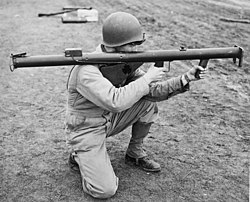
US soldier aims an M1 Bazooka during World War II

A rocket launcher is a weapon that launches an unguided, rocket-propelled projectile. The projectile contains at least one component of what is called a warhead, which is usually explosive.

The purpose of the projectile launched, the "rocket", depends on the situation. For example, there are rockets with warheads designed specifically to explode and destroy tough armor such as those of tanks (HEAT warheads). Rockets may contain a guidance system and an ability to steer towards targets, these guided rockets are called "missiles"; however this article will be focusing on the launchers of unguided rockets.

The launcher itself is usually a tube or multiple tubes containing the rockets and can be carried by a crew or be attached to a vehicle.

History

[edit]
Rocket carts from the Wubei Zhi
A depiction of a 'long serpent' rocket launcher from the Wubei Zhi
An Edo period wood block print showing samurai gunners firing bo-hiya with hiya-zutsu (fire arrow guns).

The earliest rocket launchers documented in imperial China consisted of arrows modified by the attachment of a rocket motor to the shaft a few inches behind the arrowhead. The rocket was propelled by the burning of the black powder in the motor; these should not be confused with early fire arrows, which were conventional arrows carrying small tubes of black powder as an incendiary that ignited only after the arrow hit its target. The rocket launchers were constructed of wood, basketry, and bamboo tubes.[1] The launchers divided the rockets with frames meant to keep them separated, and the launchers were capable of firing multiple rockets at once. Textual evidence and illustrations of various early rocket launchers are found in the 1510 edition of the Wujing Zongyao translated by Needham and others at Princeton University. (The original Wujing Zongyao was compiled between 1040 and 1044 and described the discovery of black powder but preceded the invention of the rocket. Partial copies of the original survived and Wujing Zongyao was republished in 1231 during the Southern Song dynasty, including military developments since the original 1044 publication. The British scientist, sinologist, historian Joseph Needham asserts that the 1510 edition is the most reliable in its faithfulness to the original and 1231 versions, since it was printed from blocks that were re-carved directly from tracings of the edition made in 1231 AD.) The 1510 Wujing Zongyao describes the "long serpent" rocket launcher, a rocket launcher constructed of wood and carried with a wheelbarrow, and the "hundred tiger" rocket launcher, a rocket launcher made of wood and capable of firing 320 rocket arrows.[2] The text also describes a portable rocket carrier consisting of a sling and a bamboo tube.[3]

Rocket launchers known as "wasp nest" launchers were used by the Ming dynasty in 1380 and in 1400 by Li Jinglong against Zhu Di.[4]

Rockets were introduced to the West during the Napoleonic Wars; the Congreve rocket was a British weapon devised by Sir William Congreve in 1804 after experiencing Indian rockets at the Siege of Seringapatam (1799). Congreve rockets were launched from an iron trough about 18 inches (46 centimetres) in length, called a chamber.[5] These chambers could be fixed to the ground for horizontal launching, secured to a folding copper tripod for high angle fire or mounted on frames on carts or the decks of warships.[6]

The collection of the royal armies includes man-portable rocket launchers that appear (based on lock designs) to date from the two decades after 1820.[7] These don't appear to have entered general use and no surviving documentation on them has been found.[7]

During the American Civil War, both the US and the Confederate militaries experimented upon and produced rocket launchers.[8] Confederate forces used Congreve rockets in limited uses due to its inaccuracies, while the US forces used Hale patent rocket launcher which fired seven to ten inch rockets with fin stabilizers at a range of 2,000 yards (6,000 ft).

World War II

[edit]
A World War II Katyusha rocket launcher, mounted on a ZiS-6 truck.

Pre-war research programmes into military rocket technology by many of the major powers led to the introduction of a number of rocket artillery systems with fixed or mobile launchers, often capable of firing a number of rockets in a single salvo. In the United Kingdom, solid fuel rockets were initially used in the anti-aircraft role; the 7-inch Unrotated Projectile was fired from single pedestal-mounted launchers on warships and a 3-inch version was used by shore based Z Batteries, for which multiple "projectors" were developed. Later developments of these weapons included the Land Mattress multiple launchers for surface-to-surface bombardment and the RP-3 air-to-ground rockets that were launched from rails fitted to fighter bomber aircraft. In Germany, the 15 cm Nebelwerfer 41 was an adaptation of a multiple barrelled smoke mortar for artillery rockets. The Soviet's Katyusha was a self-propelled system, being mounted on trucks, tanks and even trains. The United States Army deployed the tank mounted T34 Calliope system late in the war.[9]

Types

[edit]

Shoulder-fired

[edit]

The rocket launchers category includes shoulder-fired weapons, any weapon that fires a rocket-propelled projectile at a target yet is small enough to be carried by a single person and fired while held on one's shoulder. Depending on the country or region, people might use the terms "bazooka" or "RPG" as generalized terms to refer to such weapons, both of which are in fact specific types of rocket launchers. The Bazooka was an American anti-tank weapon which was in service from 1942 to 1957, while the RPG (most commonly the RPG-7) is a Soviet anti-tank weapon. There are also shoulder-fired rocket launchers that compose an overall weapon system, such as the man-portable anti-tank system FGM-148 Javelin, which has a guided anti-tank rocket.

A smaller variation is the gyrojet, a small arms rocket launcher with ammunition slightly larger than that of a .45-caliber pistol.

Recoilless rifles are sometimes confused with rocket launchers. A recoilless rifle launches its projectile using an explosive powder charge, not a rocket engine, though some such systems have sustainer rocket motors.

Rocket pod

[edit]
Su-20 aircraft with UB-32 rocket pods, each carrying thirty two S-5 rockets

A rocket pod is a launcher that contains several unguided rockets held in individual tubes, designed to be used by attack aircraft or attack helicopters for close air support. In many cases, rocket pods are streamlined to reduce aerodynamic drag. The first pods were developed immediately after World War II, as an improvement over the previous arrangement of firing rockets from rails, racks or tubes fixed under the wings of aircraft. Early examples of pod-launched rockets were the US Folding-Fin Aerial Rocket and the French SNEB.[10]

Large scale

[edit]

Larger-scale devices which serve to launch rockets include the multiple rocket launcher, a type of unguided rocket artillery system.

Tactics and uses

[edit]

A rocket launcher may be used for multiple purposes depending on what warhead is on the rocket to be launched.

Anti-tank

[edit]

The ancestral role of early modern rocket launchers is to destroy tanks. The warheads for destroying armor include high-explosive anti-tank (HEAT) warheads. Examples include the bazooka and the RPG-7 (if using a rocket designed to destroy tank armour, see the armoured fighting vehicle section of the vehicle armour article).

Anti-personnel

[edit]

Rocket launchers may also be used to target personnel. For example, the RPG-7V1, a variant of the RPG-7, can be loaded with a rocket with a OG-7M, a fragmentation warhead, or a rocket containing a thermobaric TBG-7V, along with the armour pierceing wahead-containing rockets compatible with this variant.

See also

[edit]

References

[edit]
[edit]
Revisions and contributorsEdit on WikipediaRead on Wikipedia
from Grokipedia
A rocket launcher is a device, most often employed as a , that launches unguided, rocket-propelled projectiles containing warheads to engage targets such as armored vehicles, fortifications, personnel, or . These projectiles are powered by rocket engines that provide self-propulsion, distinguishing them from gun-launched munitions, and are typically fired from shoulder-held tubes, vehicle-mounted racks, or fixed platforms for anti-tank, anti-personnel, or area suppression roles. Rocket launchers vary in scale, from portable infantry weapons like the —a reusable, shoulder-fired tube effective up to 1,600 feet against stationary targets—to multiple-launch systems capable of delivering saturating barrages over broader areas. The origins of rocket launchers date to the 13th century, when Chinese forces deployed "arrows of flying fire"—early solid-propellant launched from tubes—during the 1232 Siege of to repel Mongol invaders, marking the first recorded military use of such weapons. By the , European innovators like in refined tube-launched for improved accuracy, laying groundwork for modern designs. Significant military advancements emerged in the 20th century, particularly during ; the U.S. M1 , developed in 1941 by Leslie Skinner at and first deployed by British forces in , was a portable shoulder-fired launcher using shaped-charge to penetrate armor. Concurrently, the Soviet BM-13 Katyusha, pioneered in the late by engineers including Yu. A. Pobedonostsev and first used in ground combat on July 14, 1941, near , revolutionized area fire with its truck-mounted array of 16 electrically fired 132 mm , capable of a full salvo in 8-10 seconds and ranges up to 11 km. These WWII innovations influenced post-war designs, such as the introduced by the in 1961, which has seen over 9 million units produced globally and remains a staple in asymmetric conflicts due to its low cost, ease of use, and versatility against vehicles, bunkers, and low-flying . Today, rocket launchers encompass both unguided legacy systems and advanced guided variants integrated into precision strike capabilities, underscoring their enduring tactical importance in conventional and .

Overview

Definition and Principles

A rocket launcher is a device or system designed to launch unguided rockets, which are self-propelled munitions that utilize to deliver payloads at short ranges with high velocity. These systems can be man-portable, vehicle-mounted, or fixed, and the rockets themselves consist of a motor, , and , with propulsion achieved through the combustion of that expels gases rearward. The core operating principle of rocket in these systems is Newton's third law of motion, which states that for every action, there is an equal and opposite reaction. In a rocket launcher, the action is the high-pressure expulsion of hot gases from the rocket motor's nozzle, generated by burning solid or liquid ; this creates that propels the rocket forward in the opposite direction. The burns independently of external atmosphere, allowing operation in various environments. Once the is fully consumed—typically within seconds—the rocket coasts along a ballistic , an arc-shaped path determined by its initial , launch , and , with no further or course correction. The trajectory of an unguided rocket follows the physics of after burnout. Assuming level ground, negligible air resistance, and constant g9.8m/s2g \approx 9.8 \, \mathrm{m/s^2}, the horizontal range RR is approximated by the : R=v2sin(2θ)gR = \frac{v^2 \sin(2\theta)}{g} where vv is the initial (muzzle or burnout ), and θ\theta is the launch angle relative to the horizontal. This derives from the components of motion: the horizontal vx=vcosθv_x = v \cos \theta remains constant, while the vertical starts at vy=vsinθv_y = v \sin \theta and decreases due to . The TT to return to the launch height is T=2vsinθgT = \frac{2 v \sin \theta}{g}, obtained by solving y(t)=(vsinθ)t12gt2=0y(t) = (v \sin \theta) t - \frac{1}{2} g t^2 = 0 for t>0t > 0. Substituting into the horizontal displacement gives R=vxT=vcosθ2vsinθg=v2(2sinθcosθ)gR = v_x T = v \cos \theta \cdot \frac{2 v \sin \theta}{g} = \frac{v^2 (2 \sin \theta \cos \theta)}{g}. Using the double-angle identity sin(2θ)=2sinθcosθ\sin(2\theta) = 2 \sin \theta \cos \theta, the simplifies to the form above. Maximum range occurs at θ=45\theta = 45^\circ, where sin(2θ)=1\sin(2\theta) = 1. For typical velocities of 100–300 m/s in unguided rocket systems (e.g., initial booster velocities in man-portable launchers), this yields ranges from approximately 1 km at 100 m/s to 9 km at 300 m/s under ideal conditions; however, practical limitations like accuracy and design reduce effective ranges. Due to their unguided nature, rocket launchers are primarily used for area saturation tactics, delivering multiple projectiles to blanket a target zone rather than achieving precision strikes on single points. Typical operational ranges span 200–500 meters for man-portable systems like the against armored targets, extending to 5,000 meters or more for multiple systems like the Katyusha (BM-13), where salvos maximize coverage over larger areas. Rocket launchers are distinct from recoilless rifles primarily in their propulsion mechanisms. Recoilless rifles, such as the M40 106-mm, use an initial propellant charge within the barrel to accelerate the to high muzzle velocities (e.g., 1200 ft/s), after which the coasts unpowered along a ballistic , with managed by venting gases rearward through a . In contrast, rocket launchers employ a self-contained motor that ignites after the clears the launch tube, providing sustained during flight and enabling greater range and post-launch, as seen in systems like the RPG-29. Missile launchers differ from launchers in guidance capabilities. launchers fire unguided projectiles that rely on initial aim and follow a fixed ballistic arc after the rocket motor burns out, lacking in-flight correction. systems, however, incorporate guidance such as wire command, inertial navigation, or GPS, along with control surfaces for trajectory adjustments, allowing precision targeting even against moving objects. The following table summarizes key operational differences:
AspectRocket LauncherRecoilless RifleMissile Launcher
GuidanceNone (ballistic post-burn)None (ballistic throughout)Active (wire, inertial, GPS)
Propulsion DurationShort initial burn, then coastInitial barrel acceleration onlySustained or multi-stage with guidance
Reload TimeManual (man-portable: seconds to minutes)Manual (breech-loaded: similar)Often automated (vehicle-mounted: rapid)
Data derived from comparative analyses of systems like the RPG series, Carl Gustaf, and Javelin. The Bazooka (M1/M9), introduced in 1942, exemplifies an early true rocket launcher, using a shoulder-fired tube to launch a rocket-propelled shaped-charge warhead with stabilizing fins, achieving penetration of up to 100 mm of armor at ranges beyond hand-throwing capability—unlike earlier hand-thrown grenades, which lacked propulsion and were limited to short distances. Modern multiple launch rocket systems (MLRS), such as the M270, emphasize saturation fire over precision, delivering clusters of unguided rockets to blanket large areas and suppress enemy positions, whereas conventional artillery (e.g., 155-mm howitzers) prioritizes accurate, point-target strikes with adjustable shells. Under regimes, unguided rocket launchers are often classified as conventional munitions distinct from ballistic missiles. The (MTCR) regulates systems capable of delivering payloads over 300 km with precision guidance, excluding short-range unguided rockets like the Frog-7 (70 km range), which lack the trajectory and control features of treaty-covered ballistic missiles. The Intermediate-Range Nuclear Forces (INF) Treaty similarly focused on guided systems with ranges of 500–5,500 km, treating unguided rockets as non-prohibited equivalents.

History

Early Development

The earliest precursors to modern rocket launchers emerged in ancient , where —invented around the —was initially used for and pyrotechnic displays before being adapted for purposes. By the , Chinese engineers developed "fire arrows," unguided rockets attached to arrows or launched from tubes, which served as propulsion-enhanced projectiles in warfare. These systems marked the transition from recreational to solid-fuel rockets, providing incendiary or effects against enemies, as documented in historical accounts of battles against Mongol invaders in 1232. In the early , British inventor advanced rocket technology by designing more sophisticated unguided systems inspired by captured Indian rockets. Congreve's work began in 1804 at the Royal Arsenal in , where he experimented with metal-cased, solid-propellant rockets equipped with long wooden stabilizing sticks to address flight instability and improve range, achieving distances up to 3,000 yards in tests by 1806. These designs were intended for both naval and land applications, launched from frames or troughs, and represented a key evolution in addressing the inherent inaccuracy of early rockets through rudimentary stabilization. Congreve's rockets saw limited adoption during the , primarily by British forces in operations like the 1807 bombardment of and the 1814 siege of , where their psychological impact was notable despite poor accuracy compared to conventional . The weapons' unreliability—due to variable trajectories and wind sensitivity—restricted widespread use, though Congreve later patented a tail-mounted revolving fin design around 1823 to replace the cumbersome sticks and enhance . Pre-World War II advancements in the built on these foundations, with American physicist conducting pioneering experiments in the 1910s that shifted toward liquid propellants for greater control. Goddard received U.S. patents in 1914 for a liquid-fueled and a multi-stage rocket design, conducting static tests and the first liquid-propellant flight in 1926, though his work focused more on scientific rocketry than immediate military launchers. In the , development of solid-fuel rockets began in the under the Gas Dynamics Laboratory, leading to prototypes that informed the Katyusha system; early efforts by inventors like Nikolai Tikhomirov emphasized unguided artillery rockets with stabilizing fins to mitigate instability, setting the stage for multiple-launch configurations by the 1930s.

World War II

During , the introduced the M1 Bazooka in 1942, a man-portable anti-tank rocket launcher developed by Edward Uhl and Leslie Skinner as part of the Army's rocket research program. The weapon consisted of a 5-foot steel tube weighing 13 pounds, designed to fire 2.36-inch rockets with shaped-charge warheads that could penetrate up to 4 inches of armor, revolutionizing anti-tank capabilities by allowing soldiers to engage armored vehicles at ranges of about 300 yards. The Bazooka first saw combat during in in November 1942, where it proved effective against early-war German Panzers by targeting vulnerable spots like tracks and sides, though initial results were mixed due to untrained crews and unreliable rockets in humid conditions. By 1945, the U.S. Army had produced nearly 500,000 M1 and improved M9 variants, alongside millions of rockets, enabling widespread deployment across theaters like and the Pacific, where it excelled against lighter Japanese armor. On the Eastern Front, the fielded the BM-13 Katyusha system in 1941, mounted on trucks with 16 rails for 132mm M-13 fin-stabilized rockets, providing rapid area saturation fire over distances up to 8,500 meters. These unguided rockets, stabilized by folding fins for improved accuracy compared to earlier spin-stabilized designs, delivered high-explosive payloads in salvos lasting 7-10 seconds, creating devastating psychological and material effects on German forces. The Katyusha's impact was particularly notable at the in 1942-1943, where batteries of truck-launched 130mm rockets, nicknamed "Stalin's organs" by the Germans for their eerie whistling sound, inflicted heavy casualties and disrupted Axis positions with near-point-blank barrages during urban fighting. Over 10,000 BM-13 systems were produced by war's end, supporting Soviet counteroffensives through massed fire that could cover 400,000 square meters with 4.35 tons of explosives per battery salvo. Both systems highlighted wartime innovations in rocket technology but also revealed limitations. The Bazooka's shaped-charge warheads marked a shift toward focused armor penetration via the Munroe effect, concentrating explosive energy into a plasma jet, yet its backblast posed hazards, requiring a clear 10-20 meter rear area to avoid injuring the two-man crew or nearby allies. Similarly, the Katyusha's fin stabilization enhanced trajectory reliability, but its inaccuracy against pinpoint targets and vulnerability to after launches due to the telltale smoke trails limited its role to preparatory barrages rather than direct support. These weapons collectively transformed battlefield dynamics, empowering against armor and enabling area denial, though their effectiveness waned against late-war upgrades like sloped Panzer plating and improved German countermeasures.

Postwar Advancements

Following , rocket launcher technology advanced significantly during the era, with the developing the M20 Super in the early 1950s as an improved anti-tank weapon to counter evolving armored threats. This 3.5-inch (89 mm) recoilless launcher, which entered full-scale production in August 1950, featured enhanced shaped-charge warheads capable of penetrating up to 11 inches (280 mm) of armor, a substantial upgrade from its WWII predecessor, the M9 . Its design emphasized greater range and reliability, achieving effective distances of up to 1,100 yards (1,000 m), and it saw its first combat deployment during the in 1950. In parallel, the introduced the in 1961, a reusable shoulder-fired launcher that fired 40 mm PG-7V rockets with shaped-charge warheads capable of penetrating up to 260 mm of armor at effective ranges of 200–300 meters. With over 9 million units produced worldwide, the became a staple in squads for its simplicity, low cost, and versatility against armored vehicles, fortifications, and low-flying , influencing tactics. In parallel, the introduced the multiple rocket launcher system in the early , marking a leap in area saturation capabilities with its truck-mounted 122 mm rockets. The standard configuration featured a 40-tube launcher pod on a Ural-375D 6x6 , capable of delivering a full salvo of high-explosive fragmentation rockets over an area of 40,000 square meters in seconds, with an initial effective range of 20 km. This system addressed postwar demands for mobile, high-volume fire support, evolving from WWII-era Katyusha designs to provide more precise barrage patterns and rapid reload times of under 10 minutes. The in the 1960s further drove innovations in man-portable systems, exemplified by the U.S. adoption of the M72 Light Anti-tank Weapon (LAW) in early 1963 as the primary anti-armor tool. This disposable, 66 mm rocket launcher weighed just 5.5 pounds (2.5 kg) when loaded, offering a lightweight alternative to recoilless rifles with an effective range of 200 meters against armored vehicles and up to 1,000 meters against soft targets. Its one-shot design and construction improved portability and reliability in , where it was issued to riflemen for engaging North Vietnamese tanks and bunkers. By the , advancements in propellants and fire control systems extended operational ranges and accuracy for multiple rocket launchers, tackling challenges like limited standoff distances and imprecise targeting. Improved solid propellants, such as composite formulations, enabled systems like the to achieve ranges of 10-20 km with standard rockets, while upgrades like base-bleed units later pushed this to 30-40 km by reducing drag and enhancing stability. Simultaneously, the U.S. (MLRS), introduced in , incorporated electronic fire control systems with automated command, control, and communications (C3) integration, allowing for rapid targeting data input and salvo coordination across dispersed batteries. These developments prioritized reliability in contested environments, with the M270's fire control enabling "" tactics to evade . The 1991 demonstrated the impact of these evolutions, as U.S. M270 MLRS units conducted deep strikes against Iraqi positions, firing over 17,000 rockets in coordinated barrages that extended up to 30 km and demoralized enemy forces through overwhelming "" saturation. This operational success validated postwar emphases on range and mobility, with MLRS batteries achieving response times under 30 seconds from to launch. In the post-2000, rocket launchers have integrated precision guidance and lightweight materials to enhance versatility and reduce logistical burdens. The (APKWS) II, a laser-guided kit developed by , converts legacy unguided rockets into precision munitions with under 1 meter, deployable from and ground launchers for low-collateral engagements. Complementing this, advancements in composite materials like carbon fiber have lightened launcher designs by 40-50%, as seen in updated man-portable systems, improving soldier mobility without sacrificing structural integrity or range. These innovations reflect a shift toward networked, guided while building on foundations for greater reliability in asymmetric conflicts.

Design and Components

Propulsion Systems

Rocket launchers predominantly employ solid propellants due to their simplicity, reliability, and ease of storage compared to more complex alternatives. These solid fuels, such as double-base formulations consisting of and , allow for compact, ready-to-fire systems without the need for separate fuel and oxidizer handling. propellants, while offering potential advantages in performance, are rarely used in rocket launchers because of their inherent complexity, including requirements for pumps, tanks, and precise flow control, which complicate and increase vulnerability in tactical environments. A critical aspect of solid propellant engineering is controlling the , which dictates the profile over time, achieved primarily through the geometry of the grain. Grain shapes, such as cylindrical, star, or finocyl configurations, determine the burning surface area as the propellant regresses, enabling tailored acceleration curves for specific mission needs. The generated by the motor is governed by the equation T=m˙ve+(pepa)AeT = \dot{m} v_e + (p_e - p_a) A_e where TT is thrust, m˙\dot{m} is the mass flow rate of exhaust gases, vev_e is the exhaust velocity (typically 1500–2500 m/s for solid propellants in military applications), pep_e and pap_a are the exhaust and ambient pressures, respectively, and AeA_e is the nozzle exit area. This formulation highlights how efficient exhaust expulsion and pressure differentials contribute to overall propulsion efficiency. Modern military rocket motors often incorporate smokeless powders to minimize visible exhaust signatures, enhancing operational stealth by reducing the detectability of launch positions. In the 2020s, hybrid propulsion systems—combining with liquid oxidizers—have emerged as a promising development for launchers, offering improved safety, throttleability, and potential reusability through easier component replacement and reduced ignition risks. For example, in August 2025, Firehawk Aerospace demonstrated a tactical-ready 3D-printed hybrid for the U.S. Army, achieving a vertical ascent of over 18,000 feet with and . in these systems is commonly measured by (IspI_{sp}), which for solid-propellant military rockets ranges from 200 to 250 seconds, balancing with practical constraints like grain integrity and design.

Launch Mechanisms

Rocket launchers employ specialized hardware to initiate and direct the firing of rockets, distinct from the internal of the projectiles themselves. The primary components include launch tubes, which are typically to accommodate the unguided or fin-stabilized flight of rockets, in contrast to the rifled barrels used in conventional firearms to impart spin for stability. Firing mechanisms generally consist of mechanical firing pins or electrical igniters that strike a primer to activate the rocket's motor, ensuring reliable ignition upon trigger activation. Launch tubes vary by design to support different operational needs. Reloadable systems, such as the Soviet , feature an open-breech configuration that allows muzzle-loading of individual rockets, enabling rapid reloading in under 14 seconds for sustained fire. In contrast, disposable tubes like those in the U.S. integrate the launcher as a single-use outer and inner tube assembly, which extends for firing and is discarded after one shot, prioritizing portability and simplicity for use. These mechanisms often incorporate percussion-type strikers, where a hammer-driven impacts the rocket's primer to initiate propulsion. A critical consideration in launch operations is the backblast zone, created by the expulsion of high-pressure gases rearward from recoilless designs, posing a danger radius of approximately 10-20 meters to personnel and equipment. For instance, U.S. Army standards specify a 40-meter danger cone and 25-30 meter caution area for systems like the M72 series, requiring clear rear space before firing to prevent injury from blast and . Stabilization during launch is achieved through rails or pod assemblies; in multiple rocket systems like the M270 MLRS, spin rails within launch pods impart rotational stability to rockets via their fins, while pod containers securely hold and align six rockets for salvo fire. Safety features are integral to mitigate risks from and environmental factors. Recoilless venting systems direct exhaust gases rearward through the open breech, balancing forces to reduce operator , though this necessitates the aforementioned backblast clearance. In vehicle-mounted configurations, such as the MLRS, modern systems incorporate servo-assisted aiming via hydraulic turrets and electronic fire control for precise elevation and adjustments, along with voltage testers to prevent accidental ignition from static or electrical faults. These elements ensure operational reliability across man-portable and mounted platforms.

Types

Man-Portable Launchers

Man-portable rocket launchers are shoulder-fired or handheld systems designed for individual use, prioritizing lightweight construction and ease of deployment in dynamic combat environments. These weapons typically weigh under 10 kg to ensure mobility, allowing a single soldier to carry and operate them without assistance. For instance, the Soviet , introduced in 1961, has an unloaded weight of approximately 7 kg, while the Swedish , developed in the 1980s and entering service in 1987, weighs about 6.7 kg. Both exemplify the emphasis on portability, with the AT4's disposable design further reducing logistical burdens by eliminating the need for reloading equipment. Design features of these launchers include simple launch tubes paired with sighting systems for accurate targeting. The employs as standard but can be fitted with optical sights like the PGO-7, which provides 2.7x magnification for improved aiming at ranges up to 500 m. Reloadable systems such as the allow for rapid follow-up shots, with trained operators achieving reload times of 5-10 seconds by inserting a new grenade into the front-loading tube. In contrast, disposable launchers like the require no reloading, enabling immediate use but limiting the operator to a single shot per tube; its effective range reaches 300 m against point targets. These elements make man-portable launchers suitable for close-quarters engagements, where quick setup and firing are critical. Primarily employed in anti-tank roles, these systems deliver (HEAT) warheads to penetrate armored vehicles. The RPG-7's PG-7V series, for example, achieves effective ranges of up to 500 m against tanks. Adaptations for emerged in the post-1990s era, including tandem warheads like the RPG-7's PG-7VR, which uses a precursor charge to defeat explosive reactive armor before the main charge penetrates, enhancing lethality against modern protections in confined city environments. Despite their advantages, man-portable launchers have notable limitations that affect operational safety and effectiveness. The backblast from rocket ignition creates a hazardous zone behind the operator, spanning up to 30 m in a 90-degree sector and capable of causing severe or to nearby personnel. Additionally, unguided projectiles lead to reduced accuracy beyond 300 m due to ballistic drop and lack of stabilization, making them less reliable against distant or fast-moving targets.

Vehicle-Mounted Launchers

Vehicle-mounted rocket launchers are integrated systems designed to provide mobile from ground , , or helicopters, enhancing tactical flexibility in combat scenarios. These launchers allow for the deployment of rockets or missiles from stabilized platforms, enabling precise engagement of targets while the vehicle maintains mobility. Unlike man-portable systems, they leverage the host vehicle's power, sensors, and armor for improved operational effectiveness. A prominent example from the is the system mounted on Humvees (HMMWVs), which entered service in 1970 and was adapted for vehicular use to deliver wire-guided missiles against armored threats. The Improved Target Acquisition System (ITAS) variant, integrated on HMMWVs, features a single- or multi-tube pedestal mount for rapid targeting. This configuration supports engagements from ground vehicles, providing anti-armor capability with a reusable launcher and guidance set. In aerial applications, the Hydra 70 rocket system exemplifies vehicle-mounted launchers on helicopters and fixed-wing aircraft, with pods such as the LAU-61 and M261 accommodating 19 tubes, while the LAU-68 and LAU-131/A hold 7 tubes. These 2.75-inch unguided rockets are employed for close air support, as seen on the AH-64 Apache attack helicopter, which integrates Hydra 70 pods alongside advanced fire control systems for coordinated strikes. The Apache's setup allows for the launch of up to 76 rockets across four pods in support roles, with effective ranges reaching up to 8 kilometers depending on the motor variant. Design features of these emphasize integration with systems, including fire control computers that incorporate imagers, rangefinders, and target trackers for enhanced accuracy. Reloading often involves hydraulic-assisted mechanisms on ground or pod replacement on , allowing crews to sustain fire without dismounting. For instance, the TOW ITAS on Humvees uses digital fire control for day/night operations, while Hydra pods on helicopters like the enable seamless integration with the 's for real-time targeting. Key advantages include the capacity for rapid salvo fire, with rates of 10 to 20 rockets per minute, delivering concentrated effects on enemy positions. Additionally, mounting on provides through armored cabs and mobility, reducing exposure compared to exposed positions and allowing sustained operations in hostile environments.

Multiple Rocket Systems

Multiple rocket systems represent a class of heavy artillery platforms designed for delivering high-volume, saturating fire over large areas, typically employing salvos of unguided or guided rockets from multi-tube arrays to suppress enemy positions, fortifications, or troop concentrations. These systems evolved from earlier barrage launchers to incorporate modular pod designs that allow rapid reloading and enhanced mobility, often mounted on armored tracked chassis or heavy trucks for deployment in divisional artillery roles. Unlike single-launcher configurations, multiple rocket systems emphasize indirect fire capabilities, with launchers capable of firing dozens of rockets in seconds to achieve overwhelming effects across extended battlefields. A prominent example is the ' M270 Multiple Launch Rocket System (MLRS), developed in the 1980s and entering service with the U.S. Army in 1983, which features two six-tube pods for a total of 12 rockets in 227mm caliber. The M270, built on a tracked derived from the fighting vehicle, provides armored protection and high cross-country mobility, with a fire rate of 12 rockets in under 40 seconds. Its ammunition includes the Guided Multiple Launch Rocket System (GMLRS) variants, which integrate GPS-aided inertial navigation for precision strikes up to 70 kilometers, enabling pod-based loading where entire assemblies are ejected and replaced for quick turnaround. The lighter M142 HIMARS (High Mobility Artillery Rocket System), introduced in 2005, offers a wheeled alternative with a single six-tube pod on a 6x6 FMTV , providing similar GMLRS capabilities up to 150 km with extended-range variants while emphasizing rapid deployment and lower logistical footprint for lighter forces. The Russian , introduced in the late 1980s, exemplifies a truck-mounted counterpart with 12 launch tubes for 300mm rockets, achieving ranges of up to 90 kilometers and a full salvo in 38 seconds. Mounted on a MAZ-543 heavy , the Smerch prioritizes road mobility and logistical simplicity, with its rockets often employing cluster or high-explosive fragmentation warheads for area denial. Design features include automated fire control systems and optional inertial guidance for improved accuracy, though early variants relied primarily on ballistic trajectories for massed fire. In operational terms, these systems deliver immense salvo volumes; for instance, a single M270 firing dual-purpose improved conventional munitions (DPICM) rockets can disperse approximately 8,000 submunitions across an area of approximately 0.03 square kilometers, providing suppressive effects against armored and targets. During the , U.S. M270 units employed such barrages to neutralize Iraqi and command posts, contributing to rapid coalition advances by disrupting enemy counterfire capabilities. Post-2010 developments in multiple rocket systems have been influenced by international efforts to restrict cluster munitions, notably the 2008 , which prompted many operators to phase out submunition-dispersing warheads in favor of unitary high-explosive types for reduced . This shift, seen in upgrades like the M270A1's integration of GMLRS-ER (extended range) unitary warheads reaching 150 kilometers, emphasizes precision over area saturation while maintaining the core multi-tube architecture for sustained . has similarly pursued guided unitary options for the Smerch successor, the 9A52-4 Tornado-S, aligning with global trends toward compliant, lethal effects.

Ammunition and Warheads

Rocket Propellants

Rocket propellants for launchers have evolved from simple formulations in early designs to advanced composites in modern systems. Early rocket launchers, such as the M1 Bazooka developed during World War II, primarily utilized double-base propellants consisting of nitrocellulose and nitroglycerin, which provided improved propulsion over earlier black powder formulations but still had limitations in range and velocity due to energy density. In contrast, contemporary rocket propellants are typically solid composite types, incorporating high-energy materials like HMX (cyclotetramethylene-tetranitramine) embedded in polymer matrices such as hydroxyl-terminated polybutadiene (HTPB), enabling higher specific impulse and thrust for improved performance in anti-tank and other applications. These generally have a of 5 to 10 years under optimal conditions, after which degradation can compromise reliability. Storage requirements emphasize , typically between 10°C and 25°C, to minimize chemical breakdown and maintain structural integrity, as elevated temperatures accelerate aging and reduce ballistic consistency. A representative example is the PG-7VL round for the launcher, which employs a composite propellant charge weighing approximately 0.39 kg within a total round mass of 2.6 kg, delivering a of about 112 m/s. Safety concerns with propellants include the of spontaneous ignition if exposed to temperatures exceeding the auto-ignition threshold, often around 200–250°C depending on the , potentially leading to uncontrolled . Internationally, such is classified as explosives of Division 1.1D or 1.2D, indicating a projection or mass , which dictates strict packaging, labeling, and transport protocols to mitigate handling dangers.

Warhead Types

Rocket launcher warheads are the payloads designed to deliver destructive effects upon impact, varying by target type and operational environment. High- (HE) warheads primarily function through blast and fragmentation to engage personnel and light , dispersing metal fragments over a wide area to maximize casualties against soft targets. These warheads typically contain 0.5 to several kilograms of high , equivalent to comparable TNT yields, producing lethal radii of 10-20 meters depending on the charge size. Shaped-charge high-explosive anti-tank (HEAT) warheads employ the Munroe effect to focus explosive energy into a high-velocity metal jet, enabling penetration of armored vehicles. For instance, common man-portable rocket warheads achieve penetration equivalents of up to 500 mm of rolled homogeneous armor (RHA), sufficient against most light and medium tanks. Tandem warheads address countermeasures like explosive reactive armor (ERA) by incorporating two charges: a precursor to detonate the ERA and a follow-through charge for main armor defeat, restoring penetration effectiveness to 600-800 mm RHA in modern designs. Cluster submunitions, used in some pre-2008 rocket designs, disperse multiple bomblets to cover area targets with anti-personnel or anti-armor effects, though their use has declined following the 2008 Convention on Cluster Munitions. Thermobaric warheads, optimized for urban and confined spaces, generate a prolonged pressure wave by dispersing and igniting fuel-air mixtures, causing overpressure damage inside structures with yields equivalent to 1-5 kg TNT in portable variants like the Russian TBG-7V developed in the late 1980s. The TBG-7V, for example, is tailored for anti-personnel roles in buildings and bunkers, with a blast radius extending to 10 meters in enclosed environments. Larger rocket systems employ warheads up to 50 kg for broader area effects, but post-2010 developments in precision have integrated electronic timing and proximity sensors to minimize unintended detonations and in populated areas. These allow airburst or delayed modes, reducing fragmentation scatter by up to 50% compared to contact in urban scenarios.

Operational Use

Tactical Employment

Rocket launchers play essential roles in contemporary warfare, primarily serving as anti-armor weapons for forces and as substitutes for conventional in delivering . Man-portable systems enable dismounted troops to target armored vehicles, fortifications, and low-flying , allowing maneuver elements to exploit disruptions in enemy formations by suppressing or destroying threats at extended ranges. Multiple launch rocket systems (MLRS), such as the M270, provide support akin to , emphasizing area saturation to neutralize enemy positions, command nodes, and air defenses through high-volume barrages. Tactical employment of man-portable rocket launchers often involves configurations, where small teams position along anticipated enemy avenues of approach to launch surprise attacks on vehicles from concealed sites, maximizing the element of surprise and minimizing exposure. In contrast, MLRS tactics focus on coordinated salvos from dispersed launchers to overwhelm defenses, delivering dozens of rockets in seconds to saturate target areas and degrade enemy response capabilities before repositioning to avoid . U.S. for MLRS operations, as detailed in FM 3-09.60 from the early , marked a shift toward integrating these systems into broader plans, prioritizing mobility, rapid execution, and synchronization with joint assets for deep effects. Following 2015, tactical doctrines have increasingly incorporated unmanned aerial vehicles for targeting, enabling real-time reconnaissance and fire adjustment to counter dynamic threats in contested environments. As of 2025, advanced variants like the GMLRS-ER extend ranges to 150 km, improving precision in contested environments, particularly in support of Ukrainian operations against Russian forces. The effectiveness of rocket launchers is constrained by inherent inaccuracies, for example, tests have shown hit probabilities around 30-40% against area targets under optimal conditions, rendering them more suitable for suppressive roles than precision strikes. Countermeasures like explosive reactive armor () on armored vehicles mitigate threats from shaped-charge warheads by explosively disrupting the penetrating jet upon impact, often reducing lethality against protected targets.

Safety and Logistics

Safety protocols for rocket launchers prioritize operator training to mitigate hazards such as backblast, which generates high and debris in a rearward cone-shaped area. For systems like the M136 , training requires clearing a 100-meter backblast danger zone in a 90-degree fan behind the launcher during live-fire exercises, with the zone doubling in size below 0°C to account for increased gas expansion. Similarly, for the M72-series antiarmor weapons, operators must ensure a 40-meter backblast danger area is free of personnel and equipment. (PPE) is mandatory, including single hearing protection for noise levels exceeding 140 dB; the M72 rocket launcher produces approximately 180 dB at the operator's position, necessitating attenuating earplugs like the V51-R model, which provide 25-29 dB reduction. Additional PPE, such as helmets, , and , is required within 20 meters of firing positions for antitank rockets. Logistics for rocket launchers involve specialized transport and maintenance to ensure operational readiness. Ammunition resupply for multiple launch rocket systems (MLRS) relies on vehicles like the M985 Heavy Expanded Mobility Tactical Truck (HEMTT), which can carry four launch pods containing 48 unguided rockets or eight missiles, with trailers adding capacity for rapid reloading at forward points 800 meters from firing positions. Costs per round vary widely by type and guidance; basic unguided rockets for man-portable systems like the RPG-7 range from $100 to $500, while advanced guided MLRS rounds like the GMLRS cost approximately $168,000 each (as of 2020). Maintenance cycles follow Army standards under AR 750-1, including daily operator preventive maintenance checks and services (PMCS) for cleaning and inspection, quarterly unit-level repairs, and annual depot-level overhauls to verify structural integrity and propulsion systems. Demilitarization processes render rocket launchers and munitions unusable for combat, adhering to U.S. Department of Defense guidelines that employ methods such as cutting, crushing, shredding, , or burning components to prevent restoration. For cluster munition-equipped rockets, compliance with international agreements like the 2008 requires destruction of stockpiles by signatory states. In prolonged conflicts, supply vulnerabilities exacerbate logistical challenges; during the 2022 , Ukrainian forces nearly exhausted Soviet-era rocket ammunition stocks, becoming reliant on Western-supplied systems like HIMARS to sustain operations.

References

Add your contribution
Related Hubs
User Avatar
No comments yet.