


Community hub
Recent from talks
Contribute something
Nothing was collected or created yet.
Royal Aircraft Factory F.E.2
View on Wikipedia
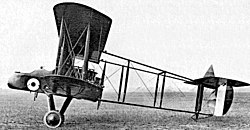
Between 1911 and 1914, the Royal Aircraft Factory used the F.E.2 ("Farman Experimental 2") designation for three different aircraft that shared only a common "Farman" pusher biplane layout.
Key Information


The third "F.E.2" type was operated as a day and night bomber and fighter by the Royal Flying Corps during the First World War. Along with the single-seat D.H.2 pusher biplane and the Nieuport 11, the F.E.2 was instrumental in ending the Fokker Scourge that had seen the German Air Service establish a measure of air superiority on the Western Front from the late summer of 1915 to the following spring.
Design and development
[edit]The Farman Experimental 2 designation refers to three distinct designs – all pushers based on the general layout employed by the French aircraft designers, the Farman Brothers – but otherwise completely different aircraft. This "re-use" of the F.E.2 designation has caused much confusion.
F.E.2 (1911)
[edit]
The first F.E.2 was designed by Geoffrey de Havilland at the Royal Aircraft Factory in 1911. Although it was claimed to be a rebuild of the F.E.1, a pusher biplane designed and built by de Havilland before he joined the Factory's staff, it was in fact an entirely new aircraft, with construction completed before the F.E.1 was wrecked in a crash in August 1911.[1] The new aircraft resembled the final form of the F.E.1, with no front elevator, but seated a crew of two in a wood and canvas nacelle, and was powered by a 50 hp (37 kW) Gnome rotary engine.[2]
It made its maiden flight on 18 August 1911, flown by de Havilland.[1] It was fitted with floats in April 1912, first flying in this form on 12 April 1912, but was underpowered and its engine was therefore replaced by a 70 hp (52 kW) Gnome, this allowed it to take off carrying a passenger while fitted with floats.[2] Later in the year the F.E.2, refitted with a landplane undercarriage, was modified to carry a Maxim machine gun on a flexible mount in the nose.[3]
F.E.2 (1913)
[edit].jpg)
The second F.E.2 was officially a rebuild of the first F.E.2, and may indeed have included some components from the earlier aircraft. It was, however, a totally new and much more modern design, larger and heavier than the 1911 aircraft, with the wingspan increased from 33 ft (10.06 m) to 42 ft (12.80 m) and a new, more streamlined nacelle. Loaded weight rose from 1,200 lb (545 kg) to 1,865 lb (848 kg). The new F.E.2 used the outer wings of the B.E.2a, with wing warping instead of ailerons for lateral control, and was powered by a 70 hp Renault engine.[4] It was destroyed when it spun into the ground from 500 ft (150 m) on 23 February 1914, probably because of insufficient fin area. The pilot, R. Kemp, survived the crash, but his passenger was killed.[5][6]
F.E.2 (1914)
[edit]Work started on another totally new design in mid-1914, the F.E.2a, specifically intended as a "fighter", or machine gun carrier – in the same class as the Vickers FB.5 "Gunbus".[7] Apart from the "Farman" layout it bore no direct relationship with either of the two earlier designs: the outer wing panels were identical with those of the B.E.2c. It was a two-seater with the observer in the nose of the nacelle and the pilot sitting above and behind. The observer was armed with a .303 in Lewis machine gun firing forward on a specially designed, "witches broomstick" mounting that gave it a wide field of fire. The first production order for 12 aircraft was placed "off the drawing board" (i.e. prior to first flight) shortly after the outbreak of the First World War.[8][9] By this time, the "pusher" configuration was aerodynamically obsolescent, but was retained to allow a clear forward field of fire.


The undercarriage of the "third" F.E.2 was particularly well designed – a small nose wheel prevented nose-overs when landing on soft ground, and the oleo type shock absorbers[a] were also appreciated by crews landing in rough, makeshift fields. In order to reduce weight and drag some of the production aircraft were fitted with a normal "V" type undercarriage. This was not universally popular and when a method was devised of removing the nose wheel in the field without disturbing the shock absorbers, this became the most common form of the F.E.2 undercarriage.[10] The "V" undercarriage remained standard for F.E.2 night bombers, as it permitted the carriage of a large bomb under the nacelle.
The first production batch consisted of 12 of the initial F.E.2a variant,[11] with a large air brake under the top centre section, and a Green E.6 engine. The first F.E.2a made its maiden flight on 26 January 1915, but was found to be underpowered, and was re-engined with a Beardmore 120 hp (89 kW) liquid-cooled inline engine, as were the other eleven aircraft.[12]
The F.E.2a was quickly followed by the main production model, the F.E.2b, again powered by a Beardmore, initially of 120 hp, although later F.E.2bs received the 160 hp (119 kW) model. The air brake of the "a" failed to deliver a worthwhile reduction in the landing run and was omitted to simplify production.[13] The type could also carry an external bomb load, and was routinely fitted with a standard air-photography camera. A total of 1,939 F.E.2bs were built,[14] only a few of them at the Royal Aircraft Factory, as most construction was by private British manufacturers such as G & J Weir, Boulton & Paul Ltd and Ransomes, Sims & Jefferies.
Early in the F.E.2b's career, a second Lewis gun was added in front of the pilot's cockpit, on a high telescopic mounting so that the pilot could fire forward, over his observer's head. In practice, this gun was appropriated by the observers, especially when they discovered that by climbing onto the rim of their cockpits they could fire backwards over the top wing – to some extent overcoming the notorious deficiency of pusher types in rear defence, although even this failed to cover a very large blind spot under the tail. The observer's perch was a precarious one, especially when firing the "rear gun", and he was liable to be thrown out of his cockpit, although his view was excellent in all directions except directly to the rear.

The arrangement was described by Frederick Libby, an American ace who served as an F.E.2b observer in 1916:
When you stood up to shoot, all of you from the knees up was exposed to the elements. There was no belt to hold you. Only your grip on the gun and the sides of the nacelle stood between you and eternity. Toward the front of the nacelle was a hollow steel rod with a swivel mount to which the gun was anchored. This gun covered a huge field of fire forward. Between the observer and the pilot a second gun was mounted, for firing over the F.E.2b's upper wing to protect the aircraft from rear attack ... Adjusting and shooting this gun required that you stand right up out of the nacelle with your feet on the nacelle coaming. You had nothing to worry about except being blown out of the aircraft by the blast of air or tossed out bodily if the pilot made a wrong move. There were no parachutes and no belts. No wonder they needed observers.[15]
The Royal Aircraft Factory was primarily a research establishment and other experiments were carried out using F.E.2bs, including the testing of a generator-powered searchlight attached between two .303 inch (7.7 mm) Lewis guns, apparently for night fighting duties.[6]
The F.E.2c was an experimental night fighter and bomber variant of the F.E.2b, the main change being the switching of the pilot's and observer's positions so that the pilot had the best view for night landings. Two were built in 1916, with the designation being re-used in 1918 for a similar night bomber version of the F.E.2b, which was used by 100 Squadron.[16] In the end, the observer-first layout was retained for the standard aircraft.

The final production model was the F.E.2d (386 built) which was powered by a Rolls-Royce Eagle engine with 250 hp (186 kW). While the more powerful engine made little difference in maximum speed, especially at low altitude, it did improve altitude performance, with an extra 10 mph at 5,000 ft.[14] The Rolls-Royce engine also improved payload, so that in addition to the two observer's guns, an additional one or two Lewis guns could be mounted to fire forward, operated by the pilot.
At least two F.E.2bs were fitted with 150 hp (110 kW) RAF 5 engines (a pusher version of the RAF 4 engine) in 1916 but no production followed.[17] The F.E.2h was an F.E.2 powered by a 230 hp (170 kW) Siddeley Puma. The prototype (A6545) was converted in February 1918 by Ransomes, Sims & Jefferies, in the hope of producing a night fighter with superior performance. When tested at Martlesham Heath, it proved to be little better than the F.E.2b. Despite this, three more aircraft were converted to F.E.2h standard, these being fitted with a six-pounder (57 mm) Davis gun, mounted to fire downwards for ground attack purposes.[18][19]
While the F.E.2d was replaced by the Bristol Fighter, the older F.E.2b proved an unexpected success as a light tactical night bomber, and remained a standard type in this role for the rest of the war. Its climb rate and ceiling were too poor for it to make a satisfactory night fighter.
Operational history
[edit]
The F.E.2a entered service in May 1915 with No. 6 Squadron RFC, which used the F.E.2 in conjunction with B.E.2s and a single Bristol Scout.[20][21] The first squadron to be equipped entirely with the F.E.2 was 20 Squadron, deploying to France on 23 January 1916.[11] At this stage it served as a fighter-reconnaissance aircraft – eventually about 2⁄3 of the F.E.2s were built as fighters (816) and 1⁄3 as bombers (395).[6] The F.E.2b and F.E.2d variants remained in day operations well into 1917, while the "b" continued as a standard night bomber until August 1918. At its peak, the F.E.2b equipped 16 RFC squadrons in France and six Home Defence squadrons in England.
On 18 June 1916, German flying ace Max Immelmann was killed in combat with F.E.2bs of No. 25 Squadron RFC. The squadron claimed the kill, but the German version of the encounter is either that Immelmann's Fokker Eindecker broke up after his synchroniser gear failed and he shot off his own propeller, or that he was hit by friendly fire from German anti-aircraft guns. In any case, by this time the F.E.2b was at least encountering the German monoplane fighters on more or less even terms and the so-called "Fokker scourge" had ended.[22]
By autumn 1916, the arrival of more modern German fighters such as the Albatros D.I and Halberstadt D.II meant that even the F.E.2d was outperformed and by April 1917, it had been withdrawn from offensive patrols. Despite its obsolescence in 1917, the F.E.2 was still well liked by its crews for its strength and good flight characteristics and it still occasionally proved a difficult opponent for even the best German aces. Rittmeister Baron von Richthofen was badly wounded in the head during combat with F.E.2d aircraft in June 1917 – the Red Baron, like most German pilots of the period, classed the F.E.2 as a "Vickers" type, confusing it with the earlier Vickers F.B.5.
In combat with single-seater fighters, the pilots of F.E.2b and F.E.2d fighters would form what was probably the first use of what later became known as a Lufbery circle (defensive circle).[23][b] In the case of the F.E.2, the intention was that the gunner of each aircraft could cover the blind spot under the tail of his neighbour and several gunners could fire on any enemy attacking the group. On occasion formations of F.E.2s fought their way back from far over the lines, while under heavy attack from German fighters, using this tactic.[25]
Although outclassed as a day fighter, the F.E.2 proved very suitable for use at night and was used as a night fighter in home defence squadrons on anti-Zeppelin patrols and as a light tactical night bomber. It was first used as a night bomber in November 1916, with the first specialist F.E.2b night bomber squadrons being formed in February 1917.[26] F.E.2bs were used as night bombers in eight bomber squadrons until the end of the First World War, with up to 860 being converted to, or built as bombers.[26] Service as a night fighter was less successful, owing to the type's poor climb and ceiling.[27]
F.E.2bs were experimentally fitted with flotation bags for operation over water and were also used to conduct anti-submarine patrols, operating from the Isle of Grain at the mouth of the Thames River.[6]
A total of 35 aircraft derived from the F.E.2 were sold to China in 1919 by Vickers as Vickers Instructional Machines (VIM), to be used as advanced trainers, having a redesigned nacelle fitted with dual controls and powered by a Rolls-Royce Eagle VIII engine.[28]
Fictional appearances
[edit]Derek Robinson's novel War Story is about the fictional Hornet Squadron flying the F.E.2b, and later the F.E.2d, giving an account of flying the fighter in the months leading up to the Battle of the Somme. Robert Radcliffe's novel Across the Blood-Red Skies is narrated by an F.E.2 pilot, and offers an insight into the skills required to fly the aeroplane. William Stanley's novel One Spring in Picardy is the story of a night-bomber FE2b squadron in France in the spring of 1918. Captain W.E. Johns' character Biggles starts his operational career in the fictional 169 Squadron, flying the F.E.2b.[29] Grif Hosker's five book series about Royal Flying Corps air combat in WWI: 1914, 1915–Fokker Scourge, 1916–Angels Over the Somme, 1917–Eagles Fall, and 1918–We Will Remember Them, vividly depict combat from an F.E.2. The protagonist, (a fictional character) Capt Bill Harsker, begins his flying career as an airman gunner in the front of a Vickers Gunbus and advances to become an ace pilot. By the 1917 book, the F.E.2 suffers badly at the hands of the more advanced German aircraft and Harsker converts to a Sopwith.
Survivors and replicas
[edit]
The Royal Air Force Museum London displays an F.E.2b. The wings and tail struts are replicas but the aircraft's nacelle and engine are original. The nacelle was made in 1918 by Richard Garrett & Sons, who were subcontracted to make the nacelles for Boulton & Paul Ltd, who assembled the complete aircraft. However, this nacelle was unfinished and never built into a complete aircraft. It was retained by Garretts until 1976 when it was passed to the RAF Museum. In 1986, the museum began a restoration project and commissioned the construction of replica wings and tail; a Beardmore engine was bought in New Zealand in 1992. The lengthy restoration was finally completed and the aircraft put on display in 2009.[30]
Two reproductions of the F.E.2b, one to full airworthiness standards and fitted with a genuine Beardmore engine, have been manufactured by The Vintage Aviator of New Zealand.[31]
Operators
[edit]
- Central Flying School AFC at Point Cook, Victoria – One aircraft only.


Royal Aircraft Factory F.E.2 aces
[edit]During its widespread service, 48 aces flew the FE2 and 20 observers also became aces.[citation needed]
F.E.2b pilot aces
F.E.2d pilot aces
F.E.2b observer aces
F.E.2d observer aces
Specifications (F.E.2b)
[edit]Data from Warplanes of the First World War: Fighters, Volume Two[32]
General characteristics
- Crew: 2
- Length: 32 ft 3 in (9.83 m)
- Wingspan: 47 ft 9 in (14.55 m)
- Height: 12 ft 8 in (3.86 m)
- Wing area: 494 sq ft (45.9 m2)
- Empty weight: 2,061 lb (935 kg)
- Gross weight: 3,037 lb (1,378 kg)
- Powerplant: 1 × Beardmore 6-cylinder water-cooled in-line piston engine, 160 hp (120 kW)
- Propellers: 4-bladed wooden fixed-pitch pusher propeller
Performance
- Maximum speed: 91.5 mph (147.3 km/h, 79.5 kn)
- Endurance: 3 hours
- Service ceiling: 11,000 ft (3,400 m)
- Time to altitude: 10,000 ft (3,048 m) in 39 minutes 44 seconds
- Wing loading: 6.15 lb/sq ft (30.0 kg/m2)
- Power/mass: 0.053 hp/lb (0.087 kW/kg)
Armament
- Guns: :* 1 or 2 × .303 in (7.7 mm) Lewis gun for observer (one mounted in front and one firing back over the top wing)
- 1 or 2 × .303 in (7.7 mm) Lewis gun sometimes mounted for the pilot's use in the F.E.2d
- Bombs:
- Up to 517 lb (235 kg) of bombs
See also
[edit]Related development
Aircraft of comparable role, configuration, and era
Related lists
References
[edit]Notes
[edit]- ^ These were strictly not "oleo struts" in the modern sense, but instead employed a combination of concentric helical springs and oil-dampers.
- ^ The term for this tactic is attributed to Major Raoul Lufbery, a French-American fighter pilot and flying ace, although he was not the first to employ it.[24]
Citations
[edit]- ^ a b Hare 1990, p. 189.
- ^ a b Jackson 1987, p. 35.
- ^ Hare 1990, p. 200.
- ^ Hare 1990, pp. 201–203.
- ^ Hare 1990, p.202.
- ^ a b c d Winchester 2004, p. 206.
- ^ Hare 1990, p. 204.
- ^ Bruce 1968, p. 36.
- ^ Raleigh 1922, pp. 249–250.
- ^ Hare 1990, pp. 208–209
- ^ a b Bruce 1952, p. 724.
- ^ Bruce 1968, p. 35.
- ^ Bruce 1968, p. 38.
- ^ a b Mason 1992, p. 13.
- ^ Guttman 2009, pp. 37–38.
- ^ Bruce 1968, p. 46.
- ^ Bruce 1982, p. 417.
- ^ Cole and Cheesman 1984, p. 373.
- ^ Bruce 1982, pp. 417–418.
- ^ Bruce 1982, p. 401.
- ^ Mason 1992, p. 12.
- ^ Guttman 2009, p. 28.
- ^ Bruce 1952, p. 725.
- ^ Lundstrom 2005, pp. 255–256, 353, 481.
- ^ Cheesman 1960, p. 44.
- ^ a b Mason 1994, p. 73.
- ^ Bruce 1968, pp. 42–43.
- ^ Andrews and Morgan 1988, p. 477.
- ^ Johns, W. E. Biggles Learns to Fly. London: Boys' Friend Library (Amalgamated Press), 1935.
- ^ Simpson, Andrew (2014). "INDIVIDUAL HISTORY ROYAL AIRCRAFT FACTORY F.E.2b 'A6526'" (PDF). RAF Museum. Retrieved 29 May 2015.
- ^ Morgan, Rhys. "Building the FE.2B." thevintageaviator.co.nz, 2009. Retrieved: 30 August 2009.
- ^ Bruce 1968, p. 44.
Bibliography
[edit]- Andrews C.F. and E.B. Morgan. Vickers Aircraft since 1908. London: Putnam, 1988. ISBN 0-85177-815-1.
- Bruce, J.M. "The F.E.2 Series: Historic Military Aircraft, No 3." Flight, 12 December 1952, pp. 724–728.
- Bruce, J.M. The Aeroplanes of the Royal Flying Corps (Military Wing). London: Putnam, 1982. ISBN 0-370-30084-X.
- Bruce, J.M. Warplanes of the First World War: Fighters, Volume Two. London: Macdonald & Co., 1968. ISBN 0-356-01473-8.
- Cheesman, E.F., ed. Fighter Aircraft of the 1914–1918 War. Letchworth, UK: Harleyford, 1960.
- Cole, Christopher and E. F. Cheesman. The Air Defence of Britain 1914–1918. London: Putnam, 1984. ISBN 0-370-30538-8.
- Guttman, Jon. Pusher Aces of World War 1 (Aircraft of the Aces). London: Osprey Publishing, 2009. ISBN 978-1-84603-417-6.
- Hare, Paul R. The Royal Aircraft Factory. London: Putnam, 1990. ISBN 0-85177-843-7.
- Jackson, A. J. De Havilland Aircraft since 1909. London: Putnam, 1987. ISBN 0-85177-802-X. .
- Mason, Francis K. The British Bomber Since 1914. London: Putnam Aeronautical Books, 1994. ISBN 0-85177-861-5.
- Mason, Francis K. The British Fighter Since 1912. Annapolis, Maryland: Naval Institute Press, 1992. ISBN 1-55750-082-7.
- Miller, James F.: "FE 2b/d vs Albatros Scouts - Western Front 1916-17 (Osprey Duel ; 55)". Oxford, UK: Osprey Publishing, 2014. ISBN 978-1-78096-325-9
- O'Gorman, Mervyn, "First Report on Aeroplane Research on Full-Sized Machines: Aeroplane F.E. 2", pp. 104–106 of Technical Report of the Advisory Committee for Aeronautics for the Year 1911–12, London: HMSO, 1919. Discusses the F.E.2 of 1911 created by "rebuilding" the F.E.1.
- O'Gorman, Mervyn, "The Design and Construction of Different Types of Aeroplanes: Gun-carrying Aeroplanes", p. 268 of Technical Report of the Advisory Committee for Aeronautics for the Year 1912–13, London: HMSO, 1919. Discusses the redesigned F.E.2 of 1913.
- Raleigh, Walter. The War In The Air: Being the Story of the Part played in the Great War by The Royal Air Force: Vol I. Oxford, UK: Clarendon Press, 1922.
- Taylor, John W.R. "F.E.2b". Combat Aircraft of the World from 1909 to the Present. New York: G.P. Putnam's Sons, 1969. ISBN 0-425-03633-2.
- Winchester, Jim. "Royal Aircraft Factory F.E.2." Biplanes, Triplanes and Seaplanes (Aviation Factfile). London: Grange Books plc, 2004. ISBN 1-84013-641-3.
External links
[edit]
- Vintage Aviator Co. (NZ) restoration
- Video links

Royal Aircraft Factory F.E.2
View on GrokipediaDevelopment
Initial concepts (1911)
The Royal Aircraft Factory was established in December 1909 at Farnborough, initially as the Army Balloon Factory under Superintendent Mervyn O'Gorman, with a mandate to conduct scientific research and experimentation in aeronautics for the British military.[4] By 1911, the facility had shifted focus toward powered aircraft design and testing, recruiting experts such as F.M. Green to apply rigorous engineering principles to aviation development.[4] The initial F.E.2, designated "Farman Experimental 2" to evoke the pusher biplane layouts pioneered by French designer Henri Farman, emerged in 1911 as an experimental two-bay pusher biplane intended primarily for reconnaissance duties.[5] This design derived from the earlier F.E.1 pusher biplane but retained the rear-mounted engine to afford the forward observer an unobstructed field of view, a configuration common in early military aircraft for aerial observation.[6][1] Key features of the 1911 prototype included a 50 hp Gnôme rotary engine, a wooden frame clad in fabric covering, and tandem open cockpits accommodating a crew of two—the pilot aft and the observer forward.[6] The aircraft achieved a top speed of approximately 47.5 mph, reflecting the limitations of its powerplant and conservative aerodynamics.[6] Initial flight testing began on 18 August 1911, with Geoffrey de Havilland at the controls, marking one of the factory's early efforts to validate indigenous designs.[6] De Havilland subsequently demonstrated the prototype's endurance on 6 December 1911 by completing a 100-mile round trip from Farnborough to Shrewton and back in about 2¾ hours, and on 23 December it reached 1,900 feet to secure a Royal Aero Club pilot's certificate.[6] However, evaluations revealed significant stability challenges, including pronounced tail-heaviness that demanded more than 50 pounds of lead ballast in the nose for balance, as well as chronic lateral imbalance causing the right wing to droop despite repeated rigging adjustments.[6] These handling deficiencies prompted the temporary shelving of the F.E.2 design in late 1911, redirecting resources to address more pressing aerodynamic and control issues in other projects.[6]Refinements and prototypes (1913)
In 1913, the Royal Aircraft Factory revived the F.E.2 project under the direction of Geoffrey de Havilland, who incorporated design lessons from the contemporary B.E.2 series to address stability and control issues observed in earlier experiments. The prototype was substantially redesigned as a three-bay pusher biplane, featuring a streamlined nacelle for reduced drag, new outer wing panels that extended the overall span, a raised tailplane mounted to the upper longerons, and a smaller rudder for better handling. Powered by a 70 hp air-cooled Renault V-8 engine driving a four-bladed propeller, this version marked a shift from the original 50 hp Gnôme rotary used in 1911.[6][7][1] Testing of the refined prototype, conducted primarily at Farnborough, demonstrated enhanced longitudinal stability after modifications to counter initial tail-heaviness, including the addition of lead ballast and a revised monoplane tail unit. While the pusher layout offered clear fields of fire for observers, it retained vulnerabilities such as propeller exposure to ground hazards and frontal impacts. Performance trials highlighted improved climb capability, with the aircraft reaching 1,900 ft during early evaluations, though handling remained sensitive in gusty conditions.[6][8] The 1913 F.E.2 played a key role in pre-war evaluation programs, including armament trials with a forward-firing Maxim machine gun mounted in the nacelle to assess defensive capabilities. These experiments, building on 1912 tests, underscored its potential for reconnaissance duties, leading to a decision to advance the design toward production for anticipated military needs. Although a fatal crash on 23 February 1914 during a dive test—attributed to insufficient directional stability from the lack of a fixed fin—temporarily halted progress, the prototype's data informed subsequent iterations.[6][1] Relative to the 1911 configuration, the 1913 refinements increased the wingspan from 33 ft to 42 ft and raised the all-up weight beyond 1,200 lb, enabling greater payload for fuel, crew, and equipment while maintaining a wing area of approximately 425 sq ft. These changes enhanced lift and versatility, directly influencing the later production F.E.2a variant developed in 1914, which had a span of 47 ft 9 in (14.55 m) and gross weight around 2,500 lb for improved operational range.[6][7]Wartime production and variants (1914–1918)
Upon the outbreak of World War I in August 1914, the Royal Aircraft Factory received an initial production order for 12 F.E.2a aircraft, placed directly from the drawing board to rapidly equip the Royal Flying Corps with fighting observation machines.[9] This marked the mobilization of the F.E.2 design for wartime needs, transitioning from pre-war experimentation to full-scale manufacturing. By the war's end in 1918, production had expanded dramatically to over 2,300 aircraft across multiple variants, primarily through subcontracting to civilian firms to meet surging demand.[2] The F.E.2a variant, introduced in early 1915, featured a 100 hp Green inline engine and was optimized for reconnaissance roles, with only 12 units produced at the Royal Aircraft Factory itself.[9][10] It was swiftly superseded by the F.E.2b in mid-1915, which adopted a more powerful 120 hp Beardmore inline-six engine—upgraded to 160 hp in later batches—for enhanced performance in both fighter and emerging night bomber applications.[11] The F.E.2b became the dominant model, with approximately 1,939 units built, including the experimental F.E.2c variant with switched crew positions and an additional forward-firing gun for night operations.[12][13] Production of the F.E.2b and F.E.2c was distributed among subcontractors like Boulton & Paul Ltd. in Norwich, G. & J. Weir Ltd. in Glasgow, Hewlett & Blonde Ltd. in Leagrave, Ruston, Proctor & Co. Ltd. in Lincoln, and the R. Fairey Aircraft Co. in Hayes, enabling rapid output despite the firms' limited prior aviation experience.[5] By 1916, the F.E.2d variant emerged as a refinement, incorporating a 250 hp Rolls-Royce Eagle VIII V-12 engine for superior speed and altitude, with 386 examples produced to address vulnerabilities against advancing enemy fighters.[9] Engine supply challenges plagued the program throughout, leading to hybrid configurations; for instance, some early F.E.2b airframes received the upright Green six-cylinder engine due to shortages of the preferred Beardmore units.[14] Standardization advanced by mid-1915, with most variants fitted with synchronized Vickers machine guns for the pilot and standardized bomb racks for the observer, facilitating interchangeable parts across the fleet.[15] Production peaked in 1916 but waned post-1916 as the F.E.2 series grew obsolete against synchronized single-seat fighters like the Fokker Eindecker, shifting resources to newer designs while existing stocks supported training and secondary roles through 1918.[2]Design
Airframe and configuration
The Royal Aircraft Factory F.E.2 was configured as an unequal-span staggered biplane with a pusher propeller layout, enabling clear fields of fire from the forward position without interference from the engine. This three-bay design featured a wingspan of 47 ft 9 in (14.55 m) and an overall length of 32 ft 3 in (9.83 m), with the central nacelle positioned between the wings and supported by twin tail booms extending rearward to carry the empennage, including twin rudders for directional control. The staggered arrangement provided improved pilot visibility and aerodynamic efficiency, while the pusher configuration housed the powerplant at the nacelle's rear.[10][16] The airframe utilized a box-girder fuselage constructed primarily from spruce and ash longerons for strength and lightness, with the wings built as fabric-covered wooden structures reinforced by internal wire bracing. The landing gear consisted of a cross-axle arrangement supported by V-struts attached to the fuselage lower longerons, incorporating forward skids to protect the propeller during ground operations and a fixed tail skid for stability. This wooden framework, typical of early wartime designs, allowed for straightforward production and repairs using readily available materials.[5][16] Crew accommodations were provided in tandem open cockpits within the nacelle, seating two personnel: the observer/gunner forward with an unobstructed 360-degree view for reconnaissance and defensive firing, and the pilot positioned aft, slightly elevated for control access. In specialized variants such as the F.E.2c, the seating was reversed to position the pilot forward, enhancing visibility for night landings. Escape provisions were limited.[9] Aerodynamically, the F.E.2 incorporated dihedral in the wings for inherent lateral stability and roll control, with ailerons primarily on the upper wing surfaces to assist in maneuvering. The high aspect ratio of the wings contributed to steady flight characteristics suited for reconnaissance, while the overall layout emphasized stability over agility. Bomber adaptations in variants like the F.E.2d included removable fittings in the lower fuselage for bomb carriage, facilitating role transitions without major structural changes.[10]Powerplant, performance, and armament
The powerplant of the Royal Aircraft Factory F.E.2 evolved significantly during its development to meet the demands of reconnaissance, fighter, and bomber roles. The initial F.E.2a variant was fitted with a 100 hp Green inline-six engine, providing basic propulsion for early trials.[11] This was later upgraded in some F.E.2a aircraft to a 120 hp Austro-Daimler inline-six produced under license by Beardmore.[9] The production F.E.2b, which became the most numerous model, primarily used the more reliable 120 hp Beardmore inline-six water-cooled engine, with later examples upgraded to 160 hp versions for improved output.[5] Fuel capacity stood at approximately 37 imperial gallons, enabling an endurance of around 3 hours for typical missions. These engines drove a two-bladed wooden propeller in a pusher configuration, mounted behind the crew nacelle. Performance characteristics of the F.E.2 reflected its multi-role design but highlighted growing obsolescence against faster opponents. The F.E.2b achieved a maximum speed of 80 mph (129 km/h) at sea level, with later 160 hp versions reaching up to 91 mph (146 km/h), and a cruising speed of 60–65 mph during operational patrols.[15][2] Its service ceiling reached 11,000 ft, while the rate of climb was approximately 400 ft per minute initially, allowing it to attain 10,000 ft in about 40 minutes.[3] By mid-1915, however, the aircraft's modest speed and climb proved vulnerable to single-seat tractor fighters equipped with synchronized machine guns, leading to high loss rates in dogfights as German Fokker types gained supremacy.[14] Later F.E.2d variants with a 250 hp Rolls-Royce Eagle VIII engine improved these figures slightly, with a top speed near 94 mph and a higher ceiling up to 17,500 ft, though maneuverability suffered due to added weight.[3] Armament progressed from basic defensive setups to more robust offensive and protective configurations as combat experience dictated. Early F.E.2a models in 1914 carried a single .303 in Lewis machine gun for the observer, mounted on a simple pintle for forward or rearward fire.[9] By 1916, F.E.2b aircraft typically featured dual Lewis guns for the observer—one forward-firing and one rearward—each with 500 rounds of ammunition, enhancing defensive coverage.[3] The pilot could add one or two fixed forward-firing .303 in Lewis guns, taking advantage of the pusher layout to avoid propeller interference without synchronization.[14] Bomb loads increased to a maximum of 517 lb (234 kg), including examples like one 112 lb high-explosive bomb under the fuselage combined with six to eight 20 lb Cooper fragmentation bombs racked beneath the wings and nacelle.[5][2] Defensive innovations focused on maximizing the observer's field of fire in the exposed forward position. Twin Lewis guns were often mounted on a Scarff ring—a rotating steel ring system with ball bearings—allowing 360-degree traversal for rear and side defense, a critical upgrade against flanking attacks.[5] Early experiments with interrupter gear for forward-firing guns proved unsuccessful due to the pusher configuration's unique airflow and mounting challenges, though the layout inherently permitted unsynchronized fire through the arc ahead of the propeller.[9] Operational limitations included susceptibility to ground fire damaging the unprotected rear propeller, which could shatter blades and cause catastrophic failure during low-level bombing.[9] Later models partially mitigated related vulnerabilities through relocated or shielded radiators, reducing exposure to small-arms fire in forward areas, though full armoring was not widely implemented.[17]Operational history
Early deployment and reconnaissance (1914–1915)
The F.E.2b variant marked the type's entry into operational service in May 1915, when it was first deployed to No. 6 Squadron of the Royal Flying Corps (RFC) on the Western Front in France.[1] The squadron, operating from Abeele airfield, incorporated the F.E.2 into its mixed fleet alongside B.E.2 and Bristol Scout aircraft, with initial deliveries enabling limited frontline use by late spring.[5] Although production had begun in early 1915, the type's rollout was gradual, reflecting wartime manufacturing constraints at the Royal Aircraft Factory and subcontracted builders.[10] In its early role, the F.E.2 conducted reconnaissance missions over the Western Front, focusing on aerial photography and artillery spotting to support ground operations.[18] These sorties typically covered ranges of around 50 miles, allowing crews to map enemy positions and trenches during key engagements in mid- to late 1915.[14] The aircraft's pusher configuration facilitated effective observer positioning in the forward cockpit, enabling unobstructed views for sketching maps or operating rudimentary cameras during flights. The F.E.2's stability at low speeds proved advantageous for these tasks, contributing vital intelligence on German dispositions that informed British Expeditionary Force adjustments. Early deployment brought significant challenges, including vulnerability to anti-aircraft ground fire due to the necessity of low-altitude flights for accurate observation.[19] In the first months, losses mounted from such fire. Crews adapted by integrating early aerial cameras, such as the handheld Type B models, to enhance photographic reconnaissance without prolonged exposure over targets. The absence of forward-firing armament exacerbated risks, leading to high casualty rates among deployed F.E.2s in 1915, primarily from ground defenses rather than aerial combat.[14] Despite these difficulties, the F.E.2 delivered key successes in intelligence gathering, particularly through flights over contested areas like the Ypres salient, where photographic evidence aided British artillery coordination and troop movements in the autumn offensives.[20] By late 1915, as German Fokker scouts introduced synchronized gunfire and began dominating daylight skies, the RFC shifted some F.E.2 reconnaissance to nighttime operations to evade enemy interceptors while maintaining the type's scouting utility.[21] Dozens of F.E.2b aircraft entered RFC service by the end of the year, underscoring the type's rapid—if perilous—integration into frontline reconnaissance.[22]Fighter and bomber roles (1916–1917)
By early 1916, the Royal Aircraft Factory F.E.2, affectionately nicknamed the "Fee" by its crews, had evolved from its reconnaissance origins into a versatile pusher fighter capable of engaging superior German single-seat scouts. Squadrons such as No. 20, No. 22, and No. 25 equipped with F.E.2bs conducted offensive patrols over the Western Front, employing formation tactics like the Lufbery circle—where aircraft flew in a protective, tight-turning ring—to allow gunners mutual coverage against attacks from the rear. This approach proved effective against early Albatros D.I and Halberstadt D.II fighters during the Somme offensive, where F.E.2bs from No. 25 Squadron claimed the downing of German ace Max Immelmann on 18 June 1916, a morale-boosting victory amid intense air battles.[1][23][24] The F.E.2's fighter role peaked in 1917 but faced mounting challenges from enhanced German Jasta units flying Albatros D.III scouts, which outmaneuvered the heavier pusher biplane. During the Arras Offensive and the associated "Bloody April" air campaign, F.E.2bs and F.E.2ds supported ground operations through line patrols and escorted bombing raids, though obsolescence led to heavy attrition as part of the RFC's overall 275 aircraft destroyed in April 1917. Defensive effectiveness relied on the observer-gunner, who often stood to fire a Lewis machine gun overhead and to the rear, providing a wide arc of fire that accounted for several enemy claims. However, increasing losses to Jasta formations highlighted vulnerabilities, with the type withdrawn from daylight offensive patrols by mid-1917.[25][24][26] In its bomber configuration, particularly the F.E.2b, the aircraft shifted toward light tactical and night operations by late 1916, serving as a precursor to strategic bombing with dedicated squadrons formed in February 1917. During the Somme campaign, F.E.2bs from units like No. 22 Squadron targeted German rail centers such as Cambrai and St. Sauveur, dropping bombs in escorted raids. Night raids intensified from November 1916, with up to eight bomber squadrons employing the F.E.2 for low-level strikes on enemy lines, carrying loads of up to 235 kilograms including one 230-pound bomb in single-seat configuration; these missions supported trench warfare by disrupting logistics, though poor climb rates limited their ceiling and exposure to anti-aircraft fire. The Royal Naval Air Service also employed F.E.2s for coastal reconnaissance and anti-submarine patrols during this period. By 1917, the type logged extensive combat hours in these roles, but escalating German fighter intercepts underscored the need for its transition to less contested night duties.[1][23][5]Later service and withdrawal (1918)
By 1918, the F.E.2 had been largely relegated from frontline combat roles to training and home defense duties, as more advanced fighters like the S.E.5a and Bristol F.2 Fighter assumed primary responsibilities on the Western Front.[1] Despite its obsolescence against newer German aircraft, limited numbers remained in secondary theaters, including reconnaissance and bombing operations in Palestine with units like No. 1 Squadron AFC and in Italy with squadrons supporting Allied advances.[2] The pusher biplane's sturdy construction and crew protection still made it a viable night bomber, with eight bomber squadrons employing the type as a standard night bomber until August 1918.[5] In the war's final months, F.E.2 squadrons contributed to the Hundred Days Offensive through night bombing sorties, targeting German infrastructure and supply lines.[1] These operations marked the aircraft's terminal frontline use, though it suffered heavy losses throughout the war from combat, accidents, and anti-aircraft fire, out of approximately 2,300 built.[27] The withdrawal process accelerated in mid-1918, as squadrons transitioned to superior types; No. 110 Squadron, the last dedicated F.E.2 day-bomber unit, re-equipped with the DH.9A in August 1918.[28] Post-war, surplus F.E.2s entered civilian markets for barnstorming and joyriding, while military evaluations underscored its outdated performance, including a maximum speed of 91 mph (147 km/h) that paled against 120 mph (193 km/h) German fighters like the Fokker D.VII.[1] Some airframes were exported for evaluation and training.[29] The F.E.2's training legacy extended into the early 1920s, serving as an observer instruction platform at the RAF College Cranwell until 1920, where its stable pusher configuration aided gunnery and reconnaissance drills before full retirement.[30]Operators and notable personnel
Military operators
The Royal Flying Corps (RFC) served as the primary operator of the F.E.2, receiving over 90 percent of production aircraft for reconnaissance, fighter, and bomber roles across multiple fronts. The type first entered operational service with No. 6 Squadron RFC in May 1915, alongside B.E.2s and Bristol Scouts, marking it as the first unit fully equipped with the design by late 1915.[31] Subsequent deployments included No. 20 Squadron, which arrived in France in January 1916 as the first entirely F.E.2-equipped unit; No. 23 Squadron, formed in September 1915 and posted to the Western Front in March 1916; No. 57 Squadron from 1916 to 1917; and No. 101 Squadron, established in July 1917 for night bombing duties.[32][33] At its height, the F.E.2 equipped 16 RFC squadrons in France and six Home Defence squadrons in England, with more than 20 squadrons overall utilizing the type, including night bomber units such as Nos. 58, 83, 100, 102, 148, and 149. Training establishments, including No. 25 Reserve Squadron, also employed the aircraft to build pilot proficiency in pusher configurations and observer duties.[1][5] The Royal Naval Air Service (RNAS) operated the F.E.2 from 1915 primarily for maritime reconnaissance and coastal patrols.[34][5] Following the integration of the RNAS into the newly formed Royal Air Force (RAF) on 1 April 1918, existing F.E.2 units transitioned under standardized handover protocols, preserving operational continuity; by this point, seven RAF squadrons continued night bombing roles, while four focused on training. The aircraft remained in limited service with occupation forces in Germany until March 1919.[35] Foreign operators included the Belgian Aviation Militaire, which incorporated F.E.2 variants into its fleet for operations in the Flanders region from 1917, the Australian Flying Corps (AFC), which trialed a single F.E.2b (serial A778) at its Central Flying School in Point Cook, Victoria, for training during 1917–1918, and the United States, which operated the type in limited roles.[36][37] Peak front-line strength across RFC squadrons reached approximately 200 aircraft in 1917, underscoring the type's central role in British air organization before its phased withdrawal.[1]Aces and key figures
The Royal Aircraft Factory F.E.2 served as a platform for numerous aces during the First World War, with 46 pilots and observers credited with aerial victories while flying the type. These individuals, primarily from the Royal Flying Corps, demonstrated the aircraft's effectiveness in both reconnaissance and fighter roles despite its pusher configuration and vulnerability to rear attacks. The F.E.2's armament, including forward-firing machine guns operated by the observer, allowed for defensive firepower that contributed to many successes, particularly during the 1916-1917 period when it helped counter the German Fokker Scourge.[3] Among the most prominent F.E.2 aces was Captain Francis Richard Cubbon, an English observer who achieved 21 victories, the highest tally for any F.E.2 crew member. Serving with No. 20 Squadron, Cubbon partnered with pilots such as Captain Frederick James Harry Thayre, with whom he shared 19 of those victories between April and June 1917; their teamwork downed multiple Albatros scouts in intense dogfights over the Western Front. Thayre himself tallied 19 confirmed kills in the F.E.2d, showcasing aggressive tactics that exploited the aircraft's observer position for effective gunnery. Other notable pilots included Lieutenant John Cowell with 15 victories and Lieutenant Harry George Ernest Luchford with 11, both emphasizing the F.E.2's role in squadron-level engagements.[3] Observer-gunners played a crucial role in F.E.2 successes, often credited independently for their marksmanship in repelling attacks. Sergeant James Tennant, an observer with No. 20 Squadron, scored seven victories in the summer of 1917, primarily assisting pilots like Luchford in downing Albatros D.IIIs during patrols near Lille. The first American ace of the war, Sergeant Frederick Libby, also flew as an observer in F.E.2s with No. 23 Squadron, achieving 10 victories before transitioning to single-seat fighters; his exploits highlighted the aircraft's accessibility for non-pilot crew in aerial combat. These observer contributions underscored the F.E.2's design, where the front-seated gunner could traverse a full 360 degrees with Lewis guns, enabling crews to claim over enemy aircraft in formation fights.[38][3] Key figures extended beyond combat aces to include the aircraft's designer and early testers. Geoffrey de Havilland, chief designer at the Royal Aircraft Factory, not only conceived the F.E.2 as a two-seat pusher for reconnaissance but also served as its primary test pilot, conducting initial flights of the prototype in 1911 and refining its configuration through 1914 trials at Farnborough. His innovations, such as the unequal-span wings and nacelle layout, directly enabled the type's wartime adaptability, though de Havilland focused on development rather than operational flying.[1] Notable exploits involving the F.E.2 included the disputed downing of German ace Max Immelmann on 18 June 1916. Lieutenant George Reynolds McCubbin, piloting an F.E.2b of No. 25 Squadron with observer Captain Stanley James Goble, engaged Immelmann's Fokker E.III over Lens, France; British records credit their fire with causing the fatal crash, marking a significant blow to early German air superiority, though German sources attributed it to anti-aircraft fire. Defensive tactics by F.E.2 crews, such as coordinated gunner fire to protect formations, saved numerous lives and downed foes during the Somme offensive.[39] Awards for F.E.2 personnel reflected extraordinary bravery under fire. Sergeant Thomas Mottershead of No. 20 Squadron earned the Victoria Cross posthumously for his actions on 7 January 1917, when he piloted a damaged F.E.2b back to base despite it being set ablaze by enemy bullets, preventing his observer's death and enabling a safe landing; he succumbed to burns five days later, becoming the only non-commissioned RFC airman to receive the VC during the war. Such recognitions highlighted the F.E.2 crews' resilience in high-risk missions.[40]Legacy
Survivors and replicas
No complete original Royal Aircraft Factory F.E.2 aircraft survive today. However, a reconstructed F.E.2b is on static display at the Royal Air Force Museum in London, incorporating an original unflown fuselage nacelle recovered from the former Royal Aircraft Factory site at Farnborough during the 1970s.[41] The nacelle was conserved and fitted with an original Beardmore 160 hp engine, while the wings, tail unit, and other components are modern replicas constructed to original specifications.[42] This reconstruction highlights the aircraft's pusher configuration and serves as an educational exhibit on early World War I aviation technology.[43] In New Zealand, The Vintage Aviator Ltd constructed a full-scale airworthy replica of an F.E.2b, completed in 2009 and marked as serial 6341 from No. 25 Squadron, Royal Flying Corps.[44] Powered by a genuine Beardmore 160 hp engine, this replica faithfully reproduces the original's two-seat pusher biplane layout and has been used for historical flight demonstrations and public education on World War I aerial operations.[45] The project utilized period-correct materials and techniques, emphasizing the F.E.2's role in reconnaissance and bombing missions.[39]Cultural depictions
The Royal Aircraft Factory F.E.2 has been depicted in various forms of media and artistic representations, often emphasizing its pusher configuration and roles in reconnaissance and early fighter engagements during World War I. In documentary films, the aircraft appears in reenactments and archival discussions of aerial warfare. The 2003 British documentary The First World War, narrated by Jonathan Lewis, features models and footage of the F.E.2b to illustrate its production of 1,939 units and contributions to the Royal Flying Corps' operations.[46][22] Similarly, the 1987 French documentary World War I (original title: La 1ère guerre mondiale - La Grande Guerre) includes representations of the F.E.2 alongside other early warplanes like the S.E.5 and Sopwith Camel to depict the evolution of air combat. The 1996 documentary Les avions de la première guerre mondiale 1914-1916, narrated by Alex Scott, also showcases the F.E.2 in sequences exploring the initial years of military aviation.[47] Scale model kits of the F.E.2 have been produced since the mid-20th century, appealing to enthusiasts of World War I aviation. In 1/72 scale, notable examples include the vacuform kit by Formaplane, which provides a detailed starting point for builders tackling the aircraft's distinctive twin-boom pusher design, and the 1995 injection-molded kit by Plum Blossom Design (kit number 20201), depicting the F.E.2b as a two-seat pusher fighter.[48] Larger options, such as Wingnut Wings' 1/32-scale F.E.2b "Late Version" kit released in 2015, offer high-fidelity parts including multiple armament configurations and engine options, enabling accurate recreations of its 1916–1917 service variants.[49] These kits often require conversions from related Royal Aircraft Factory types like the B.E.2c, highlighting the aircraft's shared design elements in modeling communities.[50] The F.E.2 features as a playable element in tabletop wargames focused on World War I dogfights. In Ares Games' Wings of Glory series, launched in 2012 as a successor to Wings of War, the F.E.2b is represented as a two-seater with variable firing arcs for its observer's machine guns, simulating historical scenarios such as Manfred von Richthofen's first victory against an F.E.2b on September 17, 1916.[51] Accessories like laser-cut acrylic bases for the F.E.2b's overwing Lewis gun mount enhance gameplay fidelity, allowing players to explore its defensive tactics against monoplanes.[52] Artistic depictions in aviation paintings frequently portray the F.E.2 in dramatic combat situations, underscoring the bravery of its crews. Ivan Berryman's Tribute to the Air Gunners (published by Cranston Fine Arts) shows a Royal Aircraft Establishment F.E.2 under attack by a Fokker E.III, emphasizing the exposed position of the forward-facing gunner amid early war skies.[53] Alex Hamilton's The Baron's First illustrates an F.E.2b crewed by Second Lieutenant Lionel Morris and Air Mechanic Stephen Rees as the target of Richthofen's inaugural kill near Cambrai in 1916, capturing the moment of vulnerability in the pusher's open cockpit.[54] Stephen Chard GAvA's Two Against One depicts an F.E.2b engaging German fighters despite its outdated design by 1917, with the composition highlighting the aircraft's stability and armament in a two-versus-one scenario.[55] Contemporary digital art, such as Piotr Forkasiewicz's rendering of an F.E.2 clashing with the Red Baron's aircraft, continues this tradition on platforms like ArtStation.[56] Modern interest in the F.E.2 persists through airworthy replicas demonstrated at aviation events. The Vintage Aviator Collection in New Zealand maintains the world's only flyable reproduction of the F.E.2b, completed in 2009, which performs in displays and flyovers to recreate its historical flight characteristics, including the pusher propeller's unique handling.[57] This replica, registered ZK-FEE, serves as a tangible link to the aircraft's legacy in public demonstrations.[58]Specifications and variants
Variant descriptions
The F.E.2a served as the initial production variant of the Royal Aircraft Factory F.E.2 series, designed primarily for early reconnaissance duties from 1914 to 1915. Powered by a 100 hp Green inline engine, it featured a two-seat pusher configuration with the observer positioned forward for a clear field of fire using a single Lewis machine gun, while the pilot sat behind. Only 12 examples were built at the Royal Aircraft Factory, marking it as a limited pre-production model featuring a large air-brake under the top center wing section, which was omitted in subsequent variants for mass production.[1][10][14] The F.E.2b emerged as the principal wartime variant, entering service in 1915 and remaining in production through 1918 for multirole applications including reconnaissance, fighter escort, and light bombing. Equipped with a 120 hp Beardmore inline engine (upgraded to 160 hp in later models), it adopted a simplified structure without the air-brake of the F.E.2a to facilitate mass production by subcontractors such as G. and J. Weir, Boulton and Paul, and Ransomes, Sims and Jefferies. Approximately 1,939 units were produced (including F.E.2c conversions), enabling enhanced armament with up to two Lewis guns for the observer and provisions for bombs, making it versatile across frontline operations.[1][35][2] Subsequent refinements led to the F.E.2c and F.E.2d variants in 1916, focusing on adaptations for night operations and performance improvements. The F.E.2c, limited to 2 prototypes, reversed the cockpit positions to place the pilot forward for better night visibility, serving as an experimental night fighter and bomber on the F.E.2b airframe with the Beardmore engine. The F.E.2d, produced in greater quantities (approximately 386 units), incorporated a more powerful 250 hp Rolls-Royce Eagle engine along with tweaks to radiators and controls for higher altitude capability, emphasizing night bombing roles while retaining the multirole flexibility. Combined, these late variants totaled around 388 units, primarily manufactured by the same subcontractors.[1][2][14] Experimental variants included the F.E.2e, a 1915 single-seat fighter trial that tested alternative engine configurations but was ultimately abandoned due to unresolved stability issues. Other minor experiments, such as the F.E.2f, F.E.2g, and F.E.2h, explored engine substitutions but saw no significant production. In total, the F.E.2 series production reached approximately 2,300 units across all variants, with production distributed among the Royal Aircraft Factory and key subcontractors to meet wartime demands.[1][59][2] These variants demonstrated progressive enhancements, with early models like the F.E.2a limited to basic reconnaissance at around 75 mph and 200 lb payload, evolving to the F.E.2d's improved speed of up to 80 mph and 500 lb bomb capacity, reflecting adaptations to escalating combat requirements.[1][7][14]General characteristics
The Royal Aircraft Factory F.E.2b accommodated a crew of two, consisting of a pilot and an observer/gunner.[15] Its overall length measured 32 ft 3 in (9.83 m), with a wingspan of 47 ft 9 in (14.55 m) and a height of 12 ft 8 in (3.86 m).[15] The wing area totaled 494 sq ft (45.9 m²).[15] The empty weight was 2,061 lb (935 kg), while the gross weight reached 3,037 lb (1,378 kg).[15]Powerplant
The F.E.2b was powered by a single Beardmore 120 hp inline water-cooled engine in its early production models, driving a wooden propeller with a diameter of approximately 9 ft 6 in.[15] Later variants upgraded to a 160 hp Beardmore engine for improved performance.[10]Performance
The maximum speed of the F.E.2b was 91 mph (147 km/h) at sea level with the 120 hp engine.[15] It had a range of 230 mi (370 km) and an endurance of 3 hours.[15] The service ceiling stood at 11,000 ft (3,353 m), with a climb rate enabling it to reach 5,000 ft (1,524 m) in 10 minutes.[15]Armament
Armament typically included 1 or 2 × .303 in (7.7 mm) Lewis machine guns for the observer on flexible mount(s), carrying up to 500 rounds of ammunition.[10][35] The aircraft could also carry up to 517 lb (235 kg) of bombs for bombing missions.[15]Avionics
The F.E.2b featured basic wireless equipment for reconnaissance duties but lacked advanced systems such as oxygen apparatus, limiting high-altitude operations.[15]References
- https://commons.wikimedia.org/wiki/Category:Flyable_replicas_of_aircraft