Hubbry Logo
PintlePintleMain
Open search
Pintle
Community hub
Pintle
logo
8 pages, 0 posts
0 subscribers
Be the first to start a discussion here.
Pintle
Pintle
from Wikipedia
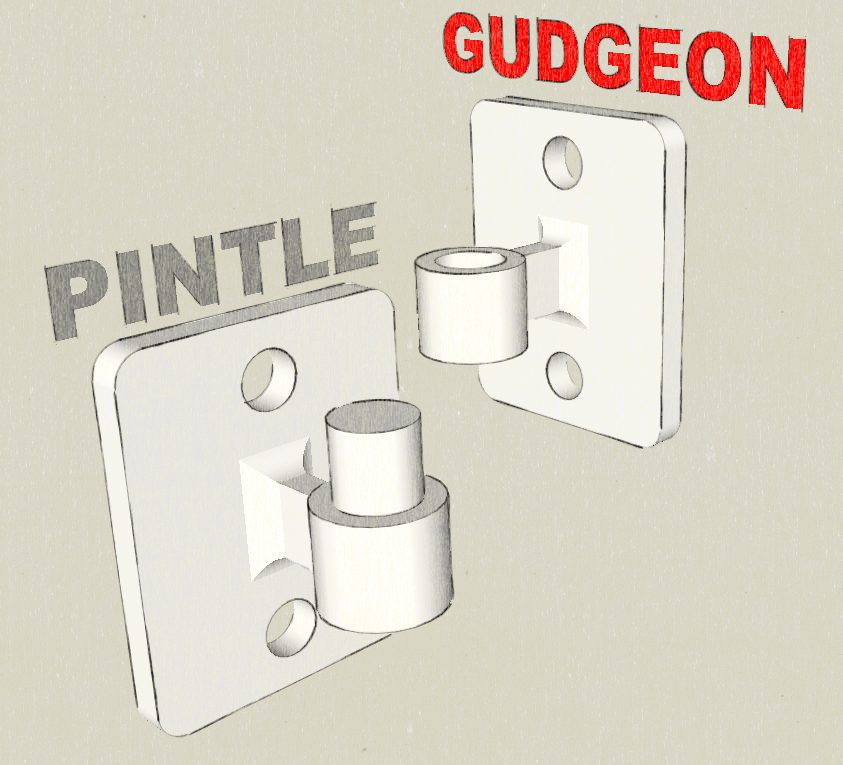
Image depicting a gudgeon with a pintle
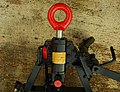
Several examples of pintles as part of door hinges

A pintle is a pin or bolt, usually inserted into a gudgeon, which is used as part of a pivot or hinge. Other applications include pintle and lunette ring for towing, and pintle pins securing casters in furniture.

Use

[edit]

Pintle/gudgeon sets have many applications, for example in sailing, to hold the rudder onto the boat; in transportation, in which a pincer-type device clamps through a lunette ring on the tongue of a trailer; and in controllable solid rocket motors, in which a plug moves into and out of the motor throat to control thrust.

In electrical cubicle manufacture, a pintle hinge is a hinge with fixed and moving parts. The hinge has a pin—the pintle—which can be both external and internal. The most common type consists of three parts, one part on the body of the cubicle, one part on the door, and the third being the pintle.

In transportation, a pintle hitch is a type of tow hitch that uses a tow ring configuration to secure to a hook or a ball combination for the purpose of towing an unpowered vehicle.[1][2]

As a weapon mount, a pintle mount is used with machine guns as the mounting hardware that mates the machine gun to a vehicle or tripod. Essentially, the pintle is a bracket with a cylindrical bottom and a cradle for the gun on top; the cylindrical bottom fits into a hole in the tripod while the cradle holds the gun.

In furniture, a pintle is usually fitted to a caster; the pintle is then inserted into a base, fixing the caster to that base.

In rocketry, a pintle injector uses a single-feed fuel injector rather than the hundreds of smaller holes used in a typical rocket engine.[3] This simplifies the engine, reducing cost and improving reliability, while surrendering some performance. Grumman used the pintle-based Rocketdyne RS-18 for the Ascent stage of the Apollo Lunar Module.[citation needed] TRW used this same injector for the Descent Propulsion System on Apollo's Lunar Module.[citation needed] Notable modern uses are in the Merlin engines developed by SpaceX[citation needed]

The forward-raked main gear struts on the Republic P-47 partly used "pintle angling" to allow them to clear the forward wingspar during retraction.

Pintle is also a common term used in the design of aircraft landing gears. It describes the attachment point between the landing gear structure and the aircraft structure. The pintle is the bolt around which the landing gear rotates when it is extended/retracted into/out of the aircraft. The pintle is a highly stressed component during landing manoeuvres and is often made from exotic metal alloys.[4] For World War II aircraft with sideways-retracting main gear units, carefully set-up "pintle angles" for such axes of rotation during retraction and extension allowed the maingear struts to be raked forward while fully extended for touchdown and better ground handling, while permitting retraction into rearwards-angled landing gear wells in their wings to usually clear the forward wing spar for stowing while in flight.[5]

[edit]

See also

[edit]

References

[edit]
Revisions and contributorsEdit on WikipediaRead on Wikipedia
from Grokipedia
A pintle is a pin or bolt, typically inserted into a , that serves as a pivot or in mechanical assemblies, allowing rotational movement between connected parts. This simple yet robust component has been integral to engineering designs for centuries, deriving its name from "pintel," akin to Old English terms for a pin, reflecting its fundamental role in fastening and articulation. In practical applications, pintles are widely used in heavy-duty systems, where a pintle hook—a hook-shaped device mounted on a vehicle—connects to a lunette ring on a trailer, providing a secure, flexible capable of handling loads up to 30,000 pounds or more, commonly in , agricultural, and industrial contexts. They also feature in as the vertical pin supporting a ship's , enabling steering through precise pivoting. Beyond these, pintles appear in as components of pintle chains, which are steel chains with open barrels designed for high-stress environments like , feeding systems, and elevators, preventing seizures under load. A particularly advanced application is the in systems, where a movable central pintle controls flow and mixing in bipropellant rocket engines, offering advantages in throttling, stability, and efficiency; this design originated in mid-1950s experiments at NASA's and was notably employed in the Apollo Lunar Module's descent engine. In diesel engines, pintle-type fuel nozzles use a plunger-like pintle to shape injection rates, improving control and reducing emissions in high-pressure systems. These varied uses underscore the pintle's versatility across scales, from small hinges to spacecraft thrusters, emphasizing its enduring importance in mechanical and .

Etymology and Definition

Etymology

The term "pintle" derives from the word pintel, which originally referred to the , likely as a form related to Germanic roots denoting a protrusion or peg. This anatomical meaning persisted into as pintil or pyntel, maintaining its vulgar connotation for male genitalia. By the late , the word had evolved to describe a mechanical component, specifically a projecting pin or bolt upon which something pivots or turns, drawing an from the of the original sense. The earliest recorded uses in this technical context appear in English texts around this period, marking the shift from bodily to engineering terminology. In 16th- and 17th-century , "pintle" became established for such pivot elements, reflecting broader linguistic adaptations in technical descriptions of hinges, rudders, and machinery, while the anatomical usage faded in formal writing.

Definition and Basic Principles

A pintle is a cylindrical pin or bolt designed to serve as a pivot point in mechanical assemblies, enabling movement around a fixed axis. This component is typically inserted into a corresponding socket or bearing to facilitate hinging or swiveling actions, commonly found in applications requiring reliable articulation under load. As established in its , in engineering contexts, it specifically denotes a robust, load-bearing element that supports unidirectional or bidirectional rotation. The fundamental operating principles of a pintle revolve around its ability to withstand mechanical stresses while permitting controlled motion. It bears loads primarily through shear and tensile forces, where the pin resists deformation along its cross-section and elongation under axial pull. resistance during is managed via frictional contact with the mating surface or through to minimize and energy loss, ensuring smooth operation over repeated cycles. The load-bearing capacity is limited by the material's yield strength, with often occurring due to excessive exceeding the allowable threshold. A key metric for assessing pintle performance is the maximum shear stress, calculated as τ=FA\tau = \frac{F}{A}, where τ\tau is the , FF is the applied force, and AA is the cross-sectional area of the pintle. This equation provides a foundational estimate of the pintle's strength, assuming uniform stress distribution and neglecting dynamic factors like . In practice, safety factors are applied to this value to account for real-world variables, ensuring the component's reliability in service. Pintles are distinct from similar components such as , which function as the socket or female counterpart that receives the pintle, forming a complete pivot pair. While the pintle provides the rotational axis, the gudgeon offers alignment and support, preventing lateral displacement during operation. This complementary relationship underscores the pintle's role as the active pivoting element rather than a passive .

Historical Development

Ancient and Medieval Origins

The earliest documented uses of pintle-like mechanisms trace back to from the First Dynasty (c. 3100–2900 BCE), where they formed part of systems in temple and monumental architecture. Egyptian doors typically consisted of a single leaf with protrusions at the top and bottom edges that fitted into sockets in the doorframe, allowing the door to pivot—effectively a rudimentary pintle and setup. These pivots were often wooden pins for everyday use, though later examples incorporated for greater durability, as seen in a dating to c. 760–650 BCE inscribed with a king's name. In Roman engineering, pintles evolved into more refined components integral to architectural and military applications, as detailed in ' De Architectura (c. 30–15 BCE). described door construction using scarpi cardinales—vertical hinge stiles one-twelfth the height of the aperture, supporting smooth rotation. These mechanisms were employed in gates for aqueducts to control water flow. Medieval advancements saw pintles become widespread in fortifications from the 11th to 15th centuries, particularly in doors and drawbridges, where iron variants provided enhanced durability against wear and attack. Strap hinges, looped over L-shaped iron pintles fixed into stone or wood jambs, supported heavy oak doors reinforced with iron bands. Drawbridges similarly relied on large iron pintles or pivots at the threshold to raise and lower the structure via chains or counterweights. In medieval , pintles supported rudders on ships like cogs from the , enabling effective steering in European maritime expansion.

Modern Evolution

During the , pintle technology underwent significant standardization to support the growing demands of steam-powered machinery. Innovations in pivot mechanisms, such as those patented by in 1781 for converting linear steam motion into rotary power, facilitated more efficient engine designs without infringing on existing crank patents; these included sun-and-planet gear systems relying on precise pintle-like pivots to transmit motion from the engine's beam to mill wheels or flywheels. By the mid-19th century, as steam engines proliferated in factories and locomotives, standardized pintle components emerged to ensure interchangeability, reducing manufacturing costs and enabling of reliable pivoting joints in textile machinery and pumping systems. In the , military applications drove further evolution, particularly with the development of mounting systems for machine guns during . The British , introduced in 1912 and widely used from 1914, used tripod mounts like the Mk. IV, allowing pivoting for 360-degree traversal and elevation adjustments under combat conditions. This adaptation proved critical in , where such mounts enabled gunners to pivot weapons swiftly against advancing infantry or . Early modern carriages from the also incorporated pintle-like pivots for elevation, evolving into standardized gun mounts by the . Post-World War II, pintle technology advanced through material innovations and international for civilian uses, notably in automotive towing. Drawing from wartime pintle hitches that connected military vehicles to trailers, post-1945 designs integrated lightweight alloys like high-strength and aluminum to withstand heavier loads in commercial trucking and recreational vehicles, improving durability and reducing corrosion. By the , as global trade expanded, organizations like formalized dimensions for pintle hooks, such as SAE J634, ensuring compatibility between towing vehicles and trailers up to 30 tons in agricultural and industrial applications. Recent advancements up to 2025 have leveraged additive manufacturing for lightweight pivot components in , yielding substantial weight and material savings. enables complex, topology-optimized designs using or composites, as seen in drone projects where printed structural elements like brackets reduced weight by up to 67% and material usage by 80% compared to traditional parts, enhancing efficiency without compromising strength.

Design and Components

Structural Features

The pintle consists of a cylindrical shaft with defined head and tail ends, frequently featuring a near the head to distribute loads evenly during operation and prevent excessive wear on mating components. This enables the pintle to serve as a robust , supporting rotational movement while maintaining structural integrity under applied forces. Lengths vary widely depending on the application, such as hinges or heavy-duty assemblies. Pintles are available in various configurations to suit diverse mechanical needs, including fixed designs for stable, non-articulating connections and swivel variants that permit multi-axis movement for enhanced flexibility in dynamic environments. Attachment options often incorporate ring or elements at the tail end, facilitating secure engagement with complementary eyes or loops on the connected structure. Assembly involves inserting the pintle's shaft into a matching socket or eye, where it aligns along a common axis to enable pivoting; retention is achieved through cotter pins passed through drilled holes at the tail end or, in permanent installations, via welds to resist disassembly under or load. Fit tolerances ensure precise clearance between the shaft and socket, minimizing play while allowing free . In a text-based cross-section representation, the pintle appears as a central cylindrical shaft defining the axis of , flanked by the head and on one end and the on the other; bearing surfaces form at the shaft-socket interface, providing distributed contact to support without binding.

Materials and Variations

Pintles are commonly constructed from for general-purpose applications, offering a tensile strength typically ranging from 400 to 500 MPa, which provides a balance of strength and cost-effectiveness. variants are preferred in environments requiring resistance, such as outdoor or humid settings, due to their content that forms a protective layer against . In marine applications, is widely used for its low-friction properties and inherent resistance to , facilitating smooth pivoting with minimal wear. Pintles exhibit variations in design to suit diverse functional needs, including solid constructions for maximum load-bearing capacity and hollow types that reduce weight while maintaining structural integrity in towing components. They can also be categorized as lubricated models, which incorporate bushings for oil or grease retention to minimize friction, or dry types relying on self-lubricating materials like embedded for maintenance-free operation. Sizes are often standardized using ASTM A108 specifications for cold-finished carbon and bars, ensuring consistent dimensions and quality across manufacturing. Adaptations for specific environments include heat-treated alloys for high-stress applications. Modern lightweight variants employ composites, such as those in bushings, to achieve reduced mass without compromising durability in marine contexts. In heavy-duty scenarios, Grade 8 steel pintles provide exceptional tensile strength of 150,000 psi, enabling reliable performance under extreme loads.

Applications

In Hinges and Pivots

In hinges and pivots, a pintle serves as the male component—a cylindrical pin—that inserts into a corresponding female socket or gudgeon, enabling rotational movement while primarily supporting vertical shear loads in static pivot applications such as doors and gates. This configuration distributes the weight of the door or gate directly to the supporting structure, with heavy-duty pintle hinges capable of handling up to 500 pounds per hinge in architectural settings, often requiring multiple hinges for larger installations to ensure stability. Architectural applications frequently incorporate pintle hinges in residential and historic structures, particularly for heavy swing doors and where durability and ease of removal are essential. For instance, 19th-century doors in American buildings commonly utilized strap-style pintle hinges with pintle diameters around 1/2 to 5/8 inches to accommodate the substantial weight of timber panels, providing robust support in rural environments exposed to weather and frequent use. These designs, often forged from , remain popular in restoration projects for their aesthetic integration with traditional while maintaining functional reliability. Proper maintenance is crucial for pintle hinges in high-traffic areas to mitigate from and environmental factors. Regular with grease or silicone-based products applied to the pintle pin and socket every 3 to 6 months prevents binding and , extending operational life; in demanding residential or architectural settings, full replacement may be necessary every 5 to 7 years for hinges subjected to intensive daily cycles. A specialized variant, the offset pintle hinge, enhances functionality in gate installations by positioning the pivot point away from the post or frame, allowing for wider swing clearance and full 180-degree without interference from adjacent structures. This offset, typically 2 to 3 inches, is particularly useful in residential or entryways where space constraints limit standard pivot alignment, as seen in modern adaptations of traditional gate hardware.

In Towing and Vehicles

In towing applications, pintle hitches employ a robust ring-and-hook system, typically featuring a ring on the trailer that engages with a pivoting on the , enabling articulating connections that accommodate 360-degree horizontal rotation and up to ±90-degree vertical articulation for enhanced maneuverability over varied . This design excels in heavy-duty scenarios where flexibility is critical, such as off-road or environments, by minimizing binding that could occur with less versatile couplings. Pintle hitches are widely used in and commercial vehicles for trailers with substantial loads. In the U.S. , they have been standard on trucks like the M939 series 5-ton vehicles, introduced in 1982, to facilitate reliable transport of equipment and supplies in demanding conditions. Commercial semi-trucks and heavy-duty rigs also incorporate pintle hitches for applications in , , and , supporting gross trailer weights up to 40,000 pounds. These capacities make them suitable for hauling large trailers without compromising stability under high stress. Interoperability and safety are governed by established standards, including specifications for pintle hitches that ensure compatibility across allied vehicles and equipment. In the United States, (DOT) regulations under 49 CFR § 393.70 mandate the use of safety chains or devices with pintle hitches, which must connect the towed and towing vehicles independently of the hitch itself to prevent detachment in case of failure. These requirements emphasize secure attachment points equidistant from the hitch to maintain control during . A key advantage of lunette ring pintles in off-road towing is their ability to reduce jerking motions compared to ball hitches, thanks to the greater articulation that absorbs shocks and vibrations from uneven surfaces more effectively. This forgiving design enhances trailer stability and driver control in rugged applications, such as operations or construction sites. Materials like high-strength , often with corrosion-resistant coatings, contribute to the durability of these hitches under repeated heavy use.

In Weaponry and Mounts

Pintle mounts have been integral to military weaponry since , enabling flexible rotational mounting for s on vehicles. A prominent example is the M2 .50-caliber mounted on jeeps used by U.S. units, where the pintle allowed for a full 360-degree traverse and elevation adjustments to engage targets in any direction during and combat operations. This design facilitated rapid aiming without dismounting the weapon, enhancing mobility and defensive capabilities in fluid battlefield scenarios. During the in the , pintle mounts played a critical role in door gun configurations, particularly on the UH-1 Huey, where they supported M60 machine guns for . These mounts allowed gunners to swivel weapons freely from the open doors, providing covering fire for troop insertions, extractions, and perimeter defense against ground threats, often under intense enemy contact. The pintle's pivot mechanism ensured quick orientation toward incoming fire, contributing to the survival of aircrews and ground forces in missions. In terms of , pintle mounts in weaponry incorporate quick-detach mechanisms to enable rapid field swaps of firearms, minimizing downtime during engagements. These systems often include vibration-damping features, such as resilient isolators, to counteract and vehicle motion, thereby preserving aiming accuracy over sustained firing. Such engineering ensures stable platforms for heavy machine guns like the , where even minor oscillations could degrade precision at range. Modern applications build on these principles with remote weapon stations, exemplified by the introduced in the 2000s. CROWS employs electric-driven pintle-like mounts for stabilized 360-degree traversal and elevation from -20 to +60 degrees, allowing operators inside armored vehicles to engage targets remotely while reducing exposure to enemy fire. This evolution provides superior stability compared to traditional manual pintles, integrating sensors for on-the-move accuracy in contemporary conflicts.

In Marine and Anchoring Systems

In stockless anchors, such as the Hall design, the pintle functions as the pivot pin connecting the flukes to the shank, enabling the flukes to rotate freely and self-right upon contact with the for optimal embedding. This mechanism enhances holding power in various bottom conditions by allowing the anchor to adjust its orientation without a fixed stock, a feature refined in conventional stockless anchors widely used in commercial shipping. In ship rudders, pintles serve as the primary hinge pins, mating with gudgeons on the rudder stock to support the rudder's weight and transmit forces while accommodating dynamic loads from flow and vessel motion. For large vessels, these pintles are engineered to bear substantial axial loads, typically up to 100 tons or more, depending on ship size and rudder dimensions, with diameters calculated based on bearing forces to ensure structural integrity under operational stresses. standards require pintles to be constructed from forged or cast carbon-manganese steel with a minimum yield strength of 200 N/mm², featuring tapered designs (ratios of 1:8 to 1:20) for secure assembly and liners at least 8 mm thick to minimize wear. Marine pintles incorporate adaptations for saltwater environments, including the attachment of sacrificial s—typically zinc or aluminum—to protect against by acting as the in an , thereby preserving the pintle's integrity. These anodes must comply with type approval procedures to ensure effective over the vessel's service life, often combined with coatings on exposed surfaces. In mooring systems, pintles are integrated into buoys to facilitate rotational freedom, preventing twisting and of mooring lines as vessels or currents shift direction, thus maintaining secure and tangle-free connections. This design is particularly vital in permanent or semi-permanent s, where the pintle's pivoting action absorbs torsional stresses without compromising the overall system's stability.

In Power Transmission

Pintles are essential components in pintle chains, which are rugged chains featuring protruding barrel-shaped pins (pintles) that connect links, allowing flexibility and strength in high-load environments. These chains are commonly used in , conveyor systems, agricultural equipment, and elevators, where they withstand abrasion, shock loads, and temperatures up to 400°F without seizing.

In Rocket Propulsion

In , pintle injectors utilize a central pintle—a movable rod or post—to control the flow and mixing of propellants in bipropellant rocket engines. This design, developed in the mid-1950s at NASA's , enables throttling, deep throttling, and stable combustion, and was used in the Descent Engine for precise control during lunar landings.

In Diesel Engines

Pintle-type injectors in diesel engines feature a plunger-like pintle at the tip that meters and atomizes spray, shaping the injection pattern to optimize and reduce emissions. These nozzles operate under high pressures (up to 2,000 bar) and are prevalent in automotive and industrial diesel systems for improved economy and lower particulate matter output.

Advantages and Limitations

Benefits in Engineering

Pintles provide significant benefits through their inherent simplicity, featuring a minimal part count that primarily involves a robust pin and socket configuration. This design reduces assembly complexity and time compared to more intricate bearing systems, such as roller or ball bearings, which require multiple components like races, separators, and seals. In structural applications like lock and dam gates, pintle assemblies enable straightforward field installation via bolting and press-fitting, enhancing serviceability and lowering maintenance demands over the structure's lifespan. The versatility of pintles stems from their ability to accommodate multi-axis rotational movement, making them well-suited for handling irregular or dynamic loads in mechanical systems. This adaptability allows pintles to function effectively in environments requiring both pivotal and slight oscillatory freedom, outperforming rigid fixed joints in scenarios with non-uniform stress distribution. Pintles also excel in cost-effectiveness, with manufacturing processes that leverage basic or techniques, resulting in lower production costs than more complex bearings due to reduced material and needs. In terms of durability, pintles have demonstrated exceptional resilience in extreme conditions. Self-lubricating variants further extend in terrestrial applications like marine anchoring and hydraulic gates, resisting and without frequent interventions.

Drawbacks and Alternatives

Pintle mechanisms exhibit high in unlubricated states, leading to notable loss through sliding contact between the pin and socket, particularly during rotational movements. This can destabilize operations in dynamic applications, such as towing or pivoting systems, where insufficient may exacerbate instability under varying loads. In high-speed rotations, pintles are prone to accelerated wear due to the direct metal-on-metal contact, resulting in a reduced of approximately 5-10 years under heavy use conditions. This wear is compounded by environmental factors like dust or moisture, which further degrade the pivot surfaces over time. Maintenance represents a significant drawback for pintles, as they necessitate periodic greasing to mitigate and prevent premature failure, in contrast to self-lubricating alternatives that require minimal intervention. Neglecting this can lead to squeaking, misalignment, and increased operational noise, such as rattling in configurations. Pintles are generally unsuitable for precision optics applications owing to inherent backlash from the loose pin fit, which can compromise alignment accuracy. Alternatives to pintles include ball bearings, which enable smoother via rolling elements that substantially reduce compared to sliding pintle contacts and extend in moderate-load scenarios. Trunnions serve as another option for fixed-axis pivoting needs, offering enhanced rigidity for heavy loads but with limited rotational freedom. These alternatives are selected for applications where reduced maintenance or higher precision outweighs the pintle's in heavy-duty, low-speed uses.

References

Add your contribution
Related Hubs
User Avatar
No comments yet.