


Community hub
Recent from talks
Contribute something
Nothing was collected or created yet.
FOIL method
View on Wikipedia | This article needs additional citations for verification. (April 2016) |
In elementary algebra, FOIL is a mnemonic for the standard method of multiplying two binomials[1]—hence the method may be referred to as the FOIL method. The word FOIL is an acronym for the four terms of the product:
Key Information


- First ("first" terms of each binomial are multiplied together)
- Outer ("outside" terms are multiplied—that is, the first term of the first binomial and the second term of the second)
- Inner ("inside" terms are multiplied—second term of the first binomial and first term of the second)
- Last ("last" terms of each binomial are multiplied)
The general form is

Note that a is both a "first" term and an "outer" term; b is both a "last" and "inner" term, and so forth. The order of the four terms in the sum is not important and need not match the order of the letters in the word FOIL.
History
[edit]The FOIL method is a special case of a more general method for multiplying algebraic expressions using the distributive law. The word FOIL was originally intended solely as a mnemonic for high-school students learning algebra. The term appears in William Betz's 1929 text Algebra for Today, where he states:[2]
... first terms, outer terms, inner terms, last terms. (The rule stated above may also be remembered by the word FOIL, suggested by the first letters of the words first, outer, inner, last.)
William Betz was active in the movement to reform mathematics in the United States at that time, had written many texts on elementary mathematics topics and had "devoted his life to the improvement of mathematics education".[3]
Many students and educators in the US now use the word "FOIL" as a verb meaning "to expand the product of two binomials".[4]
Examples
[edit]The method is most commonly used to multiply linear binomials. For example,
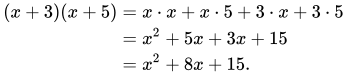
If either binomial involves subtraction, the corresponding terms must be negated. For example,

The distributive law
[edit]The FOIL method is equivalent to a two-step process involving the distributive law:[5]

In the first step, the (c + d) is distributed over the addition in first binomial. In the second step, the distributive law is used to simplify each of the two terms. Note that this process involves a total of three applications of the distributive property. In contrast to the FOIL method, the method using distributivity can be applied easily to products with more terms such as trinomials and higher.
Reverse FOIL
[edit]The FOIL rule converts a product of two binomials into a sum of four (or fewer, if like terms are then combined) monomials.[6] The reverse process is called factoring or factorization. In particular, if the proof above is read in reverse it illustrates the technique called factoring by grouping.
Table as an alternative to FOIL
[edit]A visual memory tool can replace the FOIL mnemonic for a pair of polynomials with any number of terms. Make a table with the terms of the first polynomial on the left edge and the terms of the second on the top edge, then fill in the table with products of multiplication. The table equivalent to the FOIL rule looks like this:
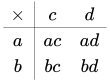
In the case that these are polynomials, (ax + b)(cx + d), the terms of a given degree are found by adding along the antidiagonals:
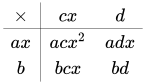
so

To multiply (a + b + c)(w + x + y + z), the table would be as follows:
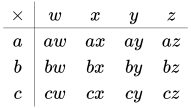
The sum of the table entries is the product of the polynomials. Thus:

Similarly, to multiply (ax2 + bx + c)(dx3 + ex2 + fx + g), one writes the same table:
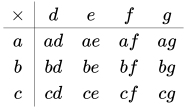
and sums along antidiagonals:

Generalizations
[edit]The FOIL rule cannot be directly applied to expanding products with more than two multiplicands or multiplicands with more than two summands. However, applying the associative law and recursive foiling allows one to expand such products. For instance:
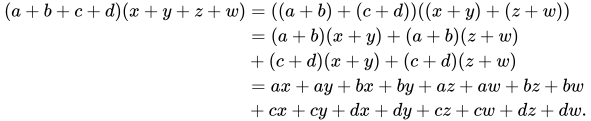
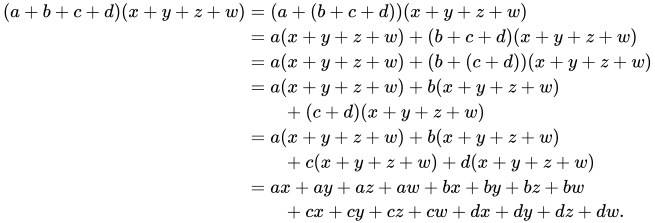
Alternate methods based on distributing forgo the use of the FOIL rule, but may be easier to remember and apply. For example:
See also
[edit]References
[edit]- ^ "Simplifying using the FOIL Method Lessons". 19 September 2013. Retrieved 10 May 2018.
- ^ Betz, William (1929), Algebra for Today (vol. 1), Ginn and Company, p. 291.
- ^ W. D. R. (November 1937), "Review of Algebra for Today : First Year", The Mathematics Teacher, 30 (7), National Council for the Teaching of Mathematics: 348.
- ^ McCrea, Emma (2019-05-01). Making Every Maths Lesson Count: Six principles to support great maths teaching (Making Every Lesson Count series). Crown House Publishing Ltd. ISBN 978-1-78583-421-9.
- ^ Khare, Apoorva; Lachowska, Anna (2015). Beautiful, Simple, Exact, Crazy: Mathematics in the Real World. Yale University Press. p. 3. ISBN 978-0-300-19089-2.
This is sometimes called the "FOIL" method – essentially, it is simply the distributive law applied twice
. - ^ Kirkland, Carla C.; Cleveland, Chan (2020-01-29). Praxis Core For Dummies with Online Practice Tests. John Wiley & Sons. p. 78. ISBN 978-1-119-62047-1.
...reverse FOIL can take you in the opposite direction from one expression to two-term expressions times each other. It's a form of factoring.
Further reading
[edit]- Steege, Ray; Bailey, Kerry (1997). Schaum's Outline of Theory and Problems of Intermediate Algebra. Schaum's Outline Series. New York: McGraw–Hill. ISBN 978-0-07-060839-9.
FOIL method
View on Grokipediawhere First gives , Outer gives , Inner gives , and Last gives .[2] This method simplifies the process of polynomial expansion and is particularly useful for recognizing patterns like the difference of squares, .[3] While effective for binomials, the FOIL method is limited to two-term factors and is often introduced as a precursor to more general polynomial multiplication techniques, such as the distributive property for trinomials or higher-degree expressions.[1] It serves as an educational tool to build foundational skills in intermediate algebra, emphasizing the importance of all cross-products in expansion.[4]
Fundamentals
Definition and Acronym
The FOIL method is a mnemonic device used in elementary algebra to facilitate the multiplication of two binomials by systematically applying the distributive property.[5] It provides a structured order for multiplying the terms within the binomials, ensuring all cross-products are accounted for without omission.[6] The acronym FOIL stands for First, Outer, Inner, and Last, referring to the specific pairs of terms to be multiplied in sequence. The First terms are the leading coefficients or constants of each binomial. The Outer terms consist of the first term of the initial binomial and the second term of the subsequent binomial. The Inner terms involve the second term of the initial binomial and the first term of the subsequent binomial. The Last terms are the trailing coefficients or constants of each binomial.[7][8] In general form, the multiplication of two binomials and using FOIL yields , where the terms are generated in the order of First (), Outer (), Inner (), and Last ().[6] This approach relies on repeated applications of the distributive property but simplifies the process through its memorable sequence.[5]Purpose in Algebra
The FOIL method serves as a pedagogical tool in algebra education primarily to simplify the multiplication of two binomials for beginners by emphasizing pattern recognition rather than relying solely on rote application of the distributive property.[9] It introduces students to a structured sequence—recalling the acronym for First, Outer, Inner, and Last terms—which helps them systematically pair and compute products, fostering an initial grasp of how terms combine in polynomial expressions.[9] Among its benefits, FOIL aids student memory by providing a memorable mnemonic that reduces errors in term pairing, particularly for novices who might otherwise overlook cross-products.[9] This approach promotes a basic understanding of polynomial structure, enabling learners to visualize the expansion as a predictable pattern rather than an arbitrary calculation, which can build confidence in early algebra coursework.[10] When taught with teacher modeling and practice, it supports retention of the multiplication process, making it an effective scaffold for students with learning difficulties.[9] However, FOIL has notable limitations as a teaching strategy, as it is applicable only to the multiplication of two binomials and does not extend to trinomials or higher-degree polynomials without additional methods.[10] This specificity can encourage over-reliance on the mnemonic, potentially hindering students' comprehension of the underlying distributive property and leading to confusion or incorrect applications in more complex scenarios.[10] In comparison to full expansion via repeated distribution, FOIL functions as a targeted shortcut exclusively for binomial pairs, underscoring its role in curricula as an introductory device rather than a comprehensive technique for all polynomial multiplications.[10]Mathematical Basis
Distributive Property
The distributive property, also known as the distributive law, states that for all real numbers , , and , multiplication distributes over addition such that .[11] This property holds symmetrically as well, with .[12] The property extends naturally to the product of two binomials by applying the distributive law twice: first distributing the sum over , yielding , and then distributing each term further to obtain .[13] The distributive law has roots in pre-20th-century mathematics, where it was recognized by Ancient Greek mathematicians in their geometric and algebraic treatments of numbers, though not always explicitly stated; it was formally named in the early 19th century by François-Joseph Servois.[14] In the axiomatic framework of real numbers, the distributive property is a fundamental axiom of the field structure, postulated without proof to ensure consistency in arithmetic operations.[12] A simple verification can be seen in its role within the field axioms, where it follows from the construction of the reals as a complete ordered field, confirming that multiplication interacts compatibly with addition for all elements.[11] The FOIL method leverages this property by systematically applying distributivity four times—once for each term in the second binomial distributed across each term in the first—to expand the product of two binomials, with the acronym serving as a mnemonic to organize these applications.[13]Derivation from Expansion
The FOIL method arises directly from the application of the distributive property to the multiplication of two binomials, providing a systematic way to expand expressions of the form . To derive it, begin by distributing each term of the first binomial across the entire second binomial: first, ; then, . Combining these yields the full expansion , which includes all four possible products without duplication or omission.[1][3] This expansion maps precisely to the FOIL acronym, where "First" refers to the product of the leading terms (), "Outer" to the product of the first term of the first binomial and the second term of the second binomial (), "Inner" to the product of the second term of the first binomial and the first term of the second binomial (), and "Last" to the product of the trailing terms (). The FOIL order ensures that these terms are generated in a structured sequence that mirrors the geometric or visual pairing of terms when the binomials are written horizontally, covering every cross-multiplication exactly once.[1][3] To verify, consider the specific example . Applying FOIL step-by-step: First, ; Outer, ; Inner, ; Last, . Adding these gives , which simplifies by combining like terms to . This matches the direct expansion using the distributive property: .[1][3] The FOIL order works effectively because it promotes systematic coverage of all term pairs, reducing errors in manual calculation and facilitating the natural grouping of like terms (such as the outer and inner products, which are often similar and can be combined early). This derivation underscores that FOIL is not a separate rule but a mnemonic aid for the distributive property, ensuring completeness in binomial products.[1][3]Usage and Examples
Basic Applications
The FOIL method finds basic application in multiplying two binomials consisting of numerical terms, providing a straightforward way to expand the product systematically. Consider the example of multiplying (2 + 3) and (4 + 5). Applying FOIL yields: First terms give , outer terms give , inner terms give , and last terms give . Summing these products results in .[1] For binomials involving variables, the FOIL method similarly expands expressions while requiring attention to like terms. For instance, multiplying (x + 1) and (x + 2) proceeds as follows: First: , outer: , inner: , last: . Combining the like terms gives the final expansion .[1] Users of the FOIL method often encounter errors such as mis-pairing the outer and inner terms, which can lead to incorrect products, or neglecting to combine like terms, resulting in overly complex expressions.[15] Another frequent mistake involves mishandling signs during multiplication.[15] To verify accuracy, perform the multiplication by altering the order of binomials or applying the distributive property directly, ensuring the result matches due to the commutative nature of multiplication.[4]Step-by-Step Process
The FOIL method provides a structured procedure for multiplying two binomials of the form , where , , , and are constants. This approach ensures that each term in the first binomial is distributed to each term in the second, resulting in four distinct products that are then simplified by combining like terms.[1][4] The process begins with Step 1: Multiply the First terms, which involves multiplying the leading term of the first binomial by the leading term of the second: . This produces the quadratic term in the expanded form. Next, in Step 2: Multiply the Outer terms, the leading term of the first binomial is multiplied by the constant term of the second: . This generates one of the linear cross terms.[1][4] Step 3: Multiply the Inner terms follows, where the constant term of the first binomial is multiplied by the leading term of the second: . This yields the other linear cross term, which will later combine with the outer product. Finally, Step 4: Multiply the Last terms multiplies the constant terms of both binomials: , producing the constant term in the result. At this stage, all four products——should be written out explicitly before proceeding.[1][4] To complete the expansion, combine like terms, particularly the middle terms: , yielding the simplified trinomial . This step leverages the commutative property of addition to merge identical variable expressions.[1][4] For practical application, students are advised to write the binomials either vertically or horizontally to maintain clarity and prevent errors in term pairing, such as aligning them side-by-side for horizontal FOIL or stacking them like traditional multiplication for vertical organization.[16][17]Extensions and Alternatives
Reverse FOIL for Factoring
The reverse FOIL method applies the FOIL multiplication process in reverse to factor quadratic trinomials of the form into a product of two binomials, typically , where and are integers satisfying specific conditions derived from the original FOIL expansion.[18] This technique leverages the structure of binomial multiplication by identifying factors that reconstruct the trinomial when expanded forward.[19] In the adapted acronym for reverse FOIL, the focus shifts to finding two numbers that correspond to the "Last" terms' product (multiplying to ) and the combined "Outer" and "Inner" terms' sum (adding to ), while the "First" terms are usually 1 for monic quadratics (leading coefficient of 1).[19] The process begins by listing factor pairs of and checking which pair sums to , accounting for signs: if , the numbers have the same sign as ; if , they have opposite signs.[18] Once identified, the binomials are formed, and verification occurs by applying standard FOIL multiplication to ensure the product matches the original trinomial.[19] For example, to factor , identify two numbers that multiply to 6 (the constant term) and add to 5 (the linear coefficient): the pair 2 and 3 satisfies this, as and .[19] Thus, the factorization is . Verifying with FOIL: First: ; Outer: ; Inner: ; Last: ; combining yields , confirming the result.[19] This method works best for monic quadratics with integer coefficients, where factor pairs of are straightforward integers, but it is limited for non-monic cases (leading coefficient not 1) or when and lack integer factors that sum appropriately, requiring alternative techniques like the AC method.[19] It does not apply universally to all quadratics, particularly those with irrational or non-integer solutions.[18]Table Method Comparison
The table method, also known as the box method or area model, serves as a visual alternative to the FOIL method for multiplying binomials by organizing the terms into a grid that illustrates the distributive property.[20] To set up the table, draw a 2x2 grid where the terms of the first binomial are placed along the top row (as column headers) and the terms of the second binomial along the left column (as row headers). Each cell in the grid is then filled with the product of the corresponding row and column terms.[20][21] For example, to multiply , the table is constructed as follows:| 4 | ||
|---|---|---|
| 3 | 12 |