Hubbry Logo
Fabian BuschFabian BuschMain
Open search
Fabian Busch
Community hub
Fabian Busch
logo
8 pages, 0 posts
0 subscribers
Be the first to start a discussion here.
Fabian Busch
Fabian Busch
from Wikipedia

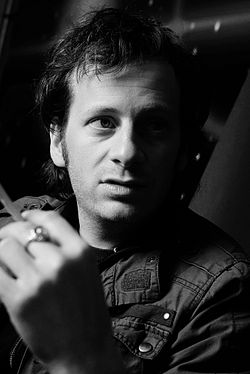
Fabian Busch (born 1 October 1975) is a German actor.[1] He has appeared in more than sixty films since 1993.[2] Among his best-known films is the film satire Look Who's Back, in which he plays a moviemaker who befriends Adolf Hitler. He also had supporting roles in Downfall (2004) as Obersturmbannführer Stehr and in The Reader (2008) as Kate Winslet's defense attorney. In addition to acting, Busch also directed and wrote the screenplay for the 2009 short film Edgar.

Key Information

Selected filmography

[edit]
Films
Year Title Role Notes
1993 Inge, April und Mai [de]
1995 Under the Milky Way [de] Tom
1996 Kinder ohne Gnade Dennis TV film
1997 Gone Wrong [de] Jojo
1998 23 David
2000 England! [it] Tom
Cold Is the Evening Breeze Felix
Dogma 2000 - Unter Freunden Stefan
2003 Ein Schiff wird kommen Leo
Learning to Lie Helmut
2004 Vakuum Mick
Farland Jakob
Downfall Obersturmbannführer Stehr
SommerHundeSöhne Frank
2007 Video Kings [de] Flo
Sunny
2008 My Mother's Tears [de] Alex, today
The Charlemagne Code [de] Justus TV film
Finnischer Tango Rudolph
Waiting for Angelina [de] Olaf
The Reader Hanna's Defence Council
2010 Spear of Destiny [de] Justus TV film
2011 Gegengerade [de] Arne
2012 The Hunt for the Amber Room [de] Justus TV film
Abseitsfalle Podolski
2014 A Blind Hero: The Love of Otto Weidt [de] Chaim Horn TV film
Fiddlesticks [de] Otto
2015 Look Who's Back Fabian Sawatzki
Vorstadtrocker
2016 Sex & Crime [de] Theo
TV series
Year Title Role Notes
2011 Der Kriminalist Jens Knappmeyer 1 episode
2017 Fargo Jakob Ungerleider Episode "The Law of Vacant Places"

References

[edit]
[edit]
Revisions and contributorsEdit on WikipediaRead on Wikipedia
from Grokipedia
Fabian Busch (born 1 October 1975) is a German and director. Born in , , Busch entered the acting profession early, appearing as an extra in theater at age 13 and securing his first professional role by 15 without formal training. Since 1993, he has amassed over 60 credits in film and television, often portraying complex characters in historical dramas and satires. Among his most recognized performances are supporting roles in Der Untergang (2004), which depicted Hitler's final days, and the satirical (2015), where he appeared in a modern reimagining of Hitler's return. Busch has also directed projects and continues to work in German cinema and television, including recent appearances in series like Fargo season 3.

Early life

Upbringing in

Fabian Busch was born on 1 October 1975 in , within the German Democratic Republic (GDR). His parents were professional dancers engaged in variety and theater performances, which immersed the family in the environment. Busch's father later transitioned to working as a stage designer, further embedding the household in theatrical circles. Much of Busch's early childhood unfolded amid the cultural and political constraints of the GDR, where access to Western media and travel was restricted, though his parents' professions provided proximity to state-supported arts institutions in . Theaters served as a familiar backdrop, fostering an early familiarity with performance spaces and routines, even as the regime emphasized in cultural output. By the late 1980s, as political upheavals led to the fall of the in November 1989—when Busch was 14—the city's division began to dissolve, marking the end of his formative years under GDR rule. This period of transition exposed him to reunified Germany's evolving opportunities, though specific personal impacts from these events remain undocumented in available accounts.

Initial steps into acting

Busch's entry into acting was influenced by his family's involvement in the ; his parents were variety dancers, with his father later working as a stage designer, providing early exposure to theater environments. At age 13, around 1988, he began appearing as an extra (Komparse) in theatrical productions, marking his initial on-stage experience without formal training. In 1992, at age 16, Busch responded to a advertisement for a casting call, securing his first cinema lead role in the film Inge, April und Mai, directed by Wolfgang Kohlhaase. This opportunity arose shortly after , as a young East Berliner navigating the West German-dominated in the early . The role represented an organic breakthrough without prior agency representation or structured acting education, relying instead on self-initiated auditions. By age 18 in 1993, Busch obtained his first dedicated engagement, leading to signing with a talent agency that facilitated subsequent television and cinema roles. This progression from unpaid extras to contracted work underscored a rapid, luck-driven ascent typical of early post-Wall East German talents entering a competitive market.

Acting career

Debut and 1990s roles

Busch debuted in film at age 18 with a minor role as a Canadian in the 1993 drama Inge, April und Mai, directed by Wolfgang Kohlhaase and Gabriele Denecke, marking his entry into acting without formal training. His breakthrough in the came with the leading role of Marcus, a rebellious teenager drawing inspiration from West German terrorists, in Andreas Dresen's 1997 Raus aus der Haut. Co-starring Susanne Bormann as Anna, the production examined youth alienation and radicalization in unified , earning acclaim for its raw portrayal of adolescent turmoil. Busch followed this with the supporting role of , a entangled in and personal downfall, in Hans-Christian Schmid's 1998 thriller 23, based on the true events surrounding Karl Koch's 1980s intrusions into and systems. Playing opposite August Diehl's Koch, Busch's performance highlighted the addictive perils of early cyberculture, solidifying his presence in critically regarded German independent cinema. Throughout the decade, Busch accumulated television credits, including appearances in the crime series Sperling, which helped build his profile in broadcast drama before transitioning to more prominent features in the .

2000s breakthrough and key films

Busch's breakthrough in the came with supporting roles in major German productions that garnered international attention. In 2004, he portrayed Stehr, an officer, in Oliver Hirschbiegel's Der Untergang (Downfall), depicting the final days of in his Berlin bunker; the character ends by committing suicide amid the Soviet advance. The film premiered on September 8, 2004, at the and achieved widespread acclaim, earning a nomination for the Academy Award for Best Film. Earlier in the decade, Busch appeared in Andreas Veiel's Liegen lernen (2003), playing Helmut, a role in a drama exploring post-unification German youth struggles. He also starred as Frank in the comedy SommerHundeSöhne (2004), directed by Andreas Prochaska, which follows a group's chaotic summer adventures. These roles built on his television work, expanding his presence in feature films. By the late , Busch secured a part in the internationally produced (2008), directed by , where he played the defense attorney for the character portrayed by during a war crimes trial. The film, adapted from Bernhard Schlink's novel, premiered at the 61st on February 5, 2009, and won the Oscar for Best Actress for Winslet on February 22, 2009. Busch's performance contributed to the film's exploration of guilt and post-war , further solidifying his reputation in historical dramas.

2010s onward: Versatility and international exposure

In the 2010s, Busch showcased versatility across genres, including adventure, satire, and crime drama. He portrayed Justus, a historian entangled in a quest for the Holy Lance, in the German adventure film Spear of Destiny (2010), directed by Florian Baxmeyer. In 2015, he took the leading role of Fabian Sawatzki, a jaded television producer who discovers and exploits Adolf Hitler's apparent reappearance in modern Germany, in the satirical comedy Look Who's Back, adapted from Timur Vermes' novel and directed by David Wnendt; the film earned critical praise for its sharp commentary on media and politics, grossing over €20 million in Germany and achieving international distribution. Busch also appeared in the crime thriller Sex & Crime (2016), playing a detective investigating a series of murders tied to online deception. His international exposure grew through English-language projects, notably a guest role as Jakob Ungerleider, a German associate in a criminal scheme, in the third season premiere of the anthology series Fargo ("," 2017), produced by and set in Midwestern America. This appearance in the Emmy-winning American production highlighted his adaptability to non-German contexts. Into the , Busch continued diversifying with the role of Dr. , a crisis negotiator, in the The Conference (2022), which satirized climate summits and reached global audiences via streaming. These roles underscored his range from comedic leads to supporting dramatic parts in both domestic and cross-border media.

Directing work

Early directorial efforts

Busch made his directorial debut with the Edgar in 2009, which he also wrote. The 12-minute comedy-drama follows Edgar (played by Wilfried Dziallas), a retired widower with two years after his wife's , as he seeks purposeful employment by wandering the city and approaching a for a job. Rejected due to his age, he inadvertently shoplifts an item, leading to a court-mandated role at the store that restores his sense of direction and ends on an uplifting note. Produced by KONTRASTFILM in with Tidi von Tiedemann, the film featured cinematography by Bernd Löhr, editing by Sabine Brose, and music by Julian Tyrasa, alongside supporting cast including , Horst Günter Marx, and . Edgar premiered in the Leopards of Tomorrow section at the 2009 Locarno Film Festival, where it received a special mention from the jury. It earned a Certificate of Exceptional Merit from Germany's FILMBEWERTUNGSSTELLE and screened at the 2010 Tribeca Film Festival for its North American debut, highlighting Busch's initial foray into directing as a shift from his established acting career toward exploring themes of isolation and redemption in everyday settings. No prior directorial projects are documented, marking this as his earliest credited effort behind the camera.

Notable projects and collaborations

Busch made his directorial debut with the 2009 Edgar, for which he also wrote the . The film centers on a retired widower with and seeking purpose after his wife's death, wandering the city in search of meaningful engagement. Starring Wilfried Dziallas in the title role alongside , , and Horst Günter Marx, it explores themes of isolation in old age. Key collaborations included cinematographer Bernd Löhr, who handled the visual storytelling, and producers Tidi von Tiedemann and Dirk Wellbrock, who supported the production. received the Jury Prize at the 2009 Locarno Festival's Pardi di Domani section, highlighting its reception among international selectors. No further feature-length directorial projects by Busch have been documented as of 2025.

Reception and influence

Critical assessments

Fabian Busch has been praised by German film critics for his reliability as a , particularly in supporting roles that require portraying sympathetic, figures with nuance and authenticity. In reviews of television films like Spurlos in (2020), Busch's performance as Bruno Bassmann, a former boat builder turned househusband thrust into crisis, was highlighted as an "excellent casting" for roles demanding emotional depth and personal growth beyond initial expectations. Similarly, outlets such as Prisma have described him as a "hervorragender Charakterdarsteller" capable of infusing offered roles with vitality, drawing comparisons to actors like while noting his strength in grounded, relatable portrayals rather than high-drama leads. Critics have occasionally noted Busch's persistent image as the "sympathisch-naive" type, a persona he has worked to evolve beyond the "eternal youth" archetype of his earlier career, allowing for broader range in mature roles. In Learning to Lie (2003), reviewers appreciated his solid contribution to the ensemble, though the role itself was seen as undemanding, aligning with his reputation for dependable rather than transformative performances. His work in satirical contexts, such as the TV producer in Look Who's Back (2015), has been characterized as fittingly naive amid broader ensemble dynamics, supporting the film's comedic critique without overshadowing leads. However, not all assessments are unqualified praise; in the crime drama Sanft schläft der Tod (2017), Busch's portrayal drew criticism for relying on exaggerated physicality—such as widened eyes and vocal outbursts—deemed "hausbackenste" (the most simplistic) approach to conveying intensity, prioritizing overt expression over subtlety. Regarding his directorial debut, the Edgar (2009), feedback emphasized its concise storytelling and emotional resonance, marking an effective early effort in shifting from acting to behind-the-camera work, though it remains less scrutinized than his on-screen output. Overall, Busch's reception underscores a consistent mid-tier status in German cinema and television, valued for versatility in ensemble pieces but seldom elevated to auteur-level acclaim.

Cultural impact through roles

Busch's portrayal of Fabian Sawatzki, a opportunistic in the 2015 satirical film Look Who's Back (Er ist wieder da), exemplifies media complicity in elevating extremist figures for profit and ratings. Sawatzki encounters the reemerged and transforms him into a media sensation, mirroring real-world dynamics of that prioritize viewership over scrutiny. This role contributed to the film's broader cultural resonance, sparking debates on the of and the press's role in , particularly as European far-right movements gained traction post-2015. The film's innovative blend of scripted narrative and public reactions—filmed during a month-long tour across with actor as Hitler—amplified these themes, with Busch's character serving as the conduit for Hitler's viral ascent. Analysts have drawn parallels to contemporary events, including the U.S. presidential election, arguing the depiction presciently warned of how media amplification can normalize demagoguery. Busch himself expressed limited expectations for altering entrenched views, stating in a 2016 that the film would not sway committed right-wing audiences but aimed to foster awareness among others. In contrast, Busch's minor supporting roles, such as Obersturmbannführer Stehr in Downfall (2004), reinforced depictions of Nazi bureaucracy in the regime's collapse but exerted negligible distinct cultural influence beyond the film's established legacy of historical dramatization. Similarly, his appearance as the defense attorney in The Reader (2008) trial scenes contributed to explorations of post-war accountability without generating standalone cultural discourse. Overall, Busch's impact remains tied predominantly to Look Who's Back, where his everyman antagonist underscored causal links between media incentives and societal vulnerabilities to authoritarian appeals.

References

Add your contribution
Related Hubs
User Avatar
No comments yet.