Recent from talks
Contribute something to knowledge base
Content stats: 0 posts, 0 articles, 1 media, 0 notes
Members stats: 0 subscribers, 0 contributors, 0 moderators, 0 supporters
Subscribers
Supporters
Contributors
Moderators
Hub AI
Fabio Cannavaro AI simulator
(@Fabio Cannavaro_simulator)
Hub AI
Fabio Cannavaro AI simulator
(@Fabio Cannavaro_simulator)
Fabio Cannavaro
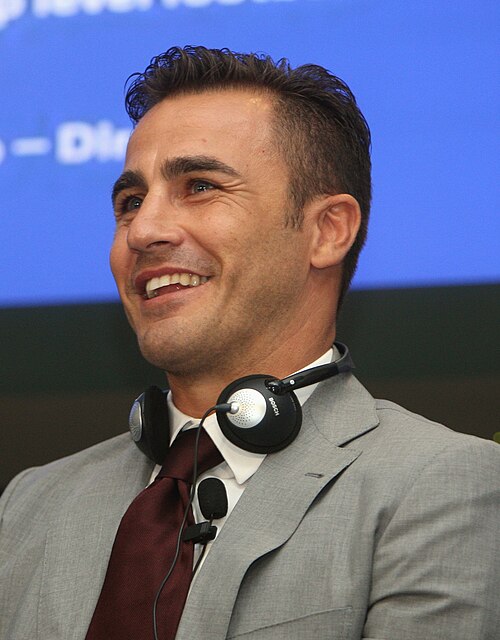
Fabio Cannavaro Ufficiale OMRI (Italian pronunciation: [ˈfaːbjo kannaˈvaːro]; born 13 September 1973) is an Italian professional football coach and former player who is the head coach of the Uzbekistan national team. He is regarded as one of the greatest defenders of all time.
A centre-back, he spent the majority of his career in Italy. He started his career at Napoli before spending seven years at Parma, with whom he won two Coppa Italia titles, the 1999 Supercoppa Italiana, and the 1999 UEFA Cup. After spells at Inter Milan and Juventus, he transferred (along with manager Fabio Capello) from Juventus to Real Madrid in 2006, with whom he won consecutive La Liga titles in 2007 and 2008. He returned to Juventus for one season in 2009–10 and retired from football in 2011 after a stint at Al-Ahli.
Cannavaro was part of the Italy team which won consecutive UEFA European Under-21 Championships in 1994 and 1996. After earning his first senior cap in 1997, he helped his national team to the final of UEFA Euro 2000, being named in the team of the tournament, and became captain in 2002, following Paolo Maldini's retirement.
Cannavaro led Italy to victory in the 2006 FIFA World Cup in Germany and was given the nickname "Il Muro di Berlino" ("The Berlin Wall") by the Italian supporters due to his defensive performances, which saw Italy keep five clean sheets and concede only two goals, neither of which were in open play. He was awarded the Silver Ball after being named the tournament's second-best player. He was named the 2006 FIFA World Player of the Year, making him the only defender in history to have won the award. He also won the Ballon d'Or award in 2006 which made him the only defender to win the award in a decade and only the third of all time after Franz Beckenbauer and Matthias Sammer.
In 2009, Cannavaro overtook Maldini as the most-capped player in the country's history. He retired from international football on 25 June 2010 following Italy's failure to qualify for the knockout stages of the 2010 World Cup, having amassed 136 caps and 2 goals for the senior national team. In total, he represented Italy at four World Cups, two UEFA European Championships, the 1996 Summer Olympics and the 2009 FIFA Confederations Cup. He is currently Italy's second all-time appearance holder, behind Gianluigi Buffon, as well as Italy's most capped defender.
Since his retirement, Cannavaro has coached club teams in the Middle East and China. He was briefly appointed as manager of the China national team in 2019. He was the head coach of Serie B club Benevento in the 2022–23 season, and in April 2024, he became head coach of Serie A club Udinese, successfully leading the club clear of the relegation zone. In December 2024, he was announced as the manager of Croatian club Dinamo Zagreb.
Fabio Cannavaro was born in Naples to Gelsomina Costanzo and Pasquale Cannavaro. His mother worked as a maid, while his father was a bank clerk. His father also played football for provincial side Giugliano. He has an elder sister named Renata and a younger brother named Paolo, also a professional footballer.
As a youngster, Cannavaro played for a team from Bagnoli before being quickly spotted by the scouts of Napoli, his hometown and favourite childhood team. Cannavaro initially served as the club's ball boy and would often watch his idols Diego Maradona and Ciro Ferrara play. He later joined the club's youth team, initially playing as a midfielder like his idol Marco Tardelli, before the team's youth coach switched him to the role of centre-back. He gained a reputation when, in a training session at Napoli, the young Fabio produced a strong sliding challenge on Maradona, who was then the undisputed star of the club, to dispossess him. The rough challenge angered teammates and staff at Napoli. However, Maradona himself defended the promising player and encouraged him to play the way he wanted, and reportedly congratulated Cannavaro by giving him his boots as a souvenir after the training session.
Fabio Cannavaro
Fabio Cannavaro Ufficiale OMRI (Italian pronunciation: [ˈfaːbjo kannaˈvaːro]; born 13 September 1973) is an Italian professional football coach and former player who is the head coach of the Uzbekistan national team. He is regarded as one of the greatest defenders of all time.
A centre-back, he spent the majority of his career in Italy. He started his career at Napoli before spending seven years at Parma, with whom he won two Coppa Italia titles, the 1999 Supercoppa Italiana, and the 1999 UEFA Cup. After spells at Inter Milan and Juventus, he transferred (along with manager Fabio Capello) from Juventus to Real Madrid in 2006, with whom he won consecutive La Liga titles in 2007 and 2008. He returned to Juventus for one season in 2009–10 and retired from football in 2011 after a stint at Al-Ahli.
Cannavaro was part of the Italy team which won consecutive UEFA European Under-21 Championships in 1994 and 1996. After earning his first senior cap in 1997, he helped his national team to the final of UEFA Euro 2000, being named in the team of the tournament, and became captain in 2002, following Paolo Maldini's retirement.
Cannavaro led Italy to victory in the 2006 FIFA World Cup in Germany and was given the nickname "Il Muro di Berlino" ("The Berlin Wall") by the Italian supporters due to his defensive performances, which saw Italy keep five clean sheets and concede only two goals, neither of which were in open play. He was awarded the Silver Ball after being named the tournament's second-best player. He was named the 2006 FIFA World Player of the Year, making him the only defender in history to have won the award. He also won the Ballon d'Or award in 2006 which made him the only defender to win the award in a decade and only the third of all time after Franz Beckenbauer and Matthias Sammer.
In 2009, Cannavaro overtook Maldini as the most-capped player in the country's history. He retired from international football on 25 June 2010 following Italy's failure to qualify for the knockout stages of the 2010 World Cup, having amassed 136 caps and 2 goals for the senior national team. In total, he represented Italy at four World Cups, two UEFA European Championships, the 1996 Summer Olympics and the 2009 FIFA Confederations Cup. He is currently Italy's second all-time appearance holder, behind Gianluigi Buffon, as well as Italy's most capped defender.
Since his retirement, Cannavaro has coached club teams in the Middle East and China. He was briefly appointed as manager of the China national team in 2019. He was the head coach of Serie B club Benevento in the 2022–23 season, and in April 2024, he became head coach of Serie A club Udinese, successfully leading the club clear of the relegation zone. In December 2024, he was announced as the manager of Croatian club Dinamo Zagreb.
Fabio Cannavaro was born in Naples to Gelsomina Costanzo and Pasquale Cannavaro. His mother worked as a maid, while his father was a bank clerk. His father also played football for provincial side Giugliano. He has an elder sister named Renata and a younger brother named Paolo, also a professional footballer.
As a youngster, Cannavaro played for a team from Bagnoli before being quickly spotted by the scouts of Napoli, his hometown and favourite childhood team. Cannavaro initially served as the club's ball boy and would often watch his idols Diego Maradona and Ciro Ferrara play. He later joined the club's youth team, initially playing as a midfielder like his idol Marco Tardelli, before the team's youth coach switched him to the role of centre-back. He gained a reputation when, in a training session at Napoli, the young Fabio produced a strong sliding challenge on Maradona, who was then the undisputed star of the club, to dispossess him. The rough challenge angered teammates and staff at Napoli. However, Maradona himself defended the promising player and encouraged him to play the way he wanted, and reportedly congratulated Cannavaro by giving him his boots as a souvenir after the training session.