
Recent from talks
Factor XI
Knowledge base stats:
Talk channels stats:
Members stats:
Factor XI
Factor XI, or plasma thromboplastin antecedent, is the zymogen form of factor XIa, one of the enzymes involved in coagulation. Like many other coagulation factors, it is a serine protease. In humans, factor XI is encoded by F11 gene.
Factor XI (FXI) is produced by the liver and circulates as a homo-dimer in its inactive form. The plasma half-life of FXI is approximately 52 hours. The zymogen factor is activated into factor XIa by factor XIIa (FXIIa), thrombin, and FXIa itself; due to its activation by FXIIa, FXI is a member of the "contact pathway" (which includes HMWK, prekallikrein, factor XII, factor XI, and factor IX).
Factor XIa activates factor IX by selectively cleaving arg-ala and arg-val peptide bonds. Factor IXa, in turn, forms a complex with Factor VIIIa (FIXa-FVIIIa) and activates factor X.
Physiological inhibitors of factor XIa include protein Z-dependent protease inhibitor (ZPI, a member of the serine protease inhibitor/serpin class of proteins), which is independent of protein Z (its action on factor X, however, is protein Z-dependent, hence its name).
Although synthesized as a single polypeptide chain, FXI circulates as a homodimer. Every chain has a relative molecular mass of approximately 80000. Typical plasma concentrations of FXI are 5 μg/mL, corresponding to a plasma concentration (of FXI dimers) of approximately 30 nM. The FXI gene is 23kb in length, has 15 exons, and is found on chromosome 4q32-35.
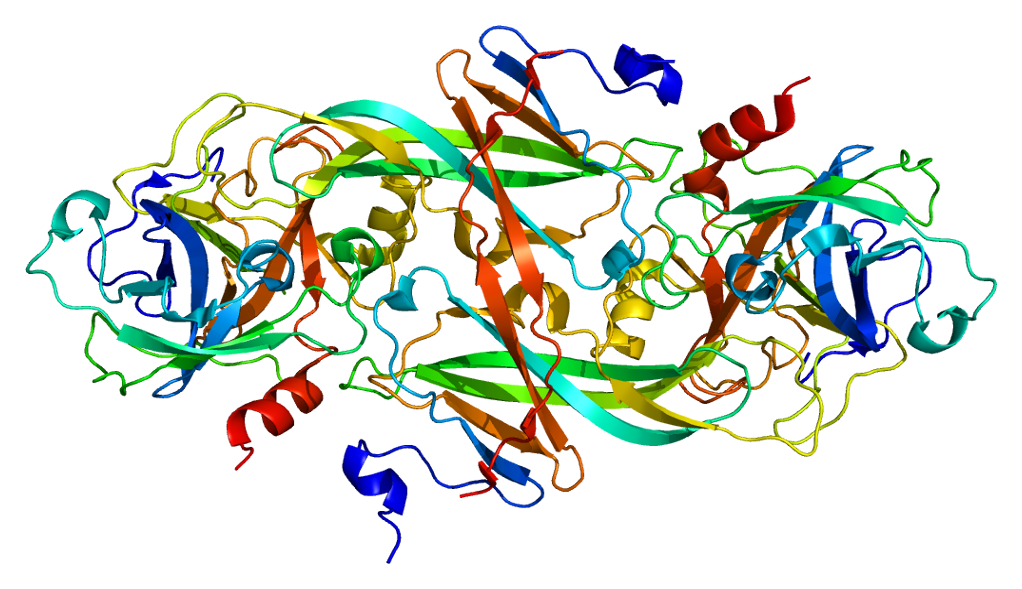
Factor XI consists of four apple domains, that create a disk-like platform around the base of a fifth, catalytic serine protease domain. One contains a binding site for thrombin, another for high molecular weight kininogen, a third one for factor IX, heparin and glycoprotein Ib and the fourth is implicated in forming the factor XI homodimer, including a cysteine residue that creates a disulfide bond.
In the homodimer, the apple domains create two disk-like platforms connected together at an angle, with the catalytic domains sticking out at each side of the dimer.
Activation by thrombin or factor XIIa is achieved by cleavage of Arg369-Ile370 peptide bonds on both subunits of the dimer. This results in a partial detachment of the catalytic domain from the disk-like apple domains, still linked to the fourth domain with a disulfide bond, but now farther from the third domain. This is thought that this exposes the factor IX binding site of the third apple domain, allowing factor XI's protease activity on it.
Hub AI
Factor XI AI simulator
(@Factor XI_simulator)
Factor XI
Factor XI, or plasma thromboplastin antecedent, is the zymogen form of factor XIa, one of the enzymes involved in coagulation. Like many other coagulation factors, it is a serine protease. In humans, factor XI is encoded by F11 gene.
Factor XI (FXI) is produced by the liver and circulates as a homo-dimer in its inactive form. The plasma half-life of FXI is approximately 52 hours. The zymogen factor is activated into factor XIa by factor XIIa (FXIIa), thrombin, and FXIa itself; due to its activation by FXIIa, FXI is a member of the "contact pathway" (which includes HMWK, prekallikrein, factor XII, factor XI, and factor IX).
Factor XIa activates factor IX by selectively cleaving arg-ala and arg-val peptide bonds. Factor IXa, in turn, forms a complex with Factor VIIIa (FIXa-FVIIIa) and activates factor X.
Physiological inhibitors of factor XIa include protein Z-dependent protease inhibitor (ZPI, a member of the serine protease inhibitor/serpin class of proteins), which is independent of protein Z (its action on factor X, however, is protein Z-dependent, hence its name).
Although synthesized as a single polypeptide chain, FXI circulates as a homodimer. Every chain has a relative molecular mass of approximately 80000. Typical plasma concentrations of FXI are 5 μg/mL, corresponding to a plasma concentration (of FXI dimers) of approximately 30 nM. The FXI gene is 23kb in length, has 15 exons, and is found on chromosome 4q32-35.
Factor XI consists of four apple domains, that create a disk-like platform around the base of a fifth, catalytic serine protease domain. One contains a binding site for thrombin, another for high molecular weight kininogen, a third one for factor IX, heparin and glycoprotein Ib and the fourth is implicated in forming the factor XI homodimer, including a cysteine residue that creates a disulfide bond.
In the homodimer, the apple domains create two disk-like platforms connected together at an angle, with the catalytic domains sticking out at each side of the dimer.
Activation by thrombin or factor XIIa is achieved by cleavage of Arg369-Ile370 peptide bonds on both subunits of the dimer. This results in a partial detachment of the catalytic domain from the disk-like apple domains, still linked to the fourth domain with a disulfide bond, but now farther from the third domain. This is thought that this exposes the factor IX binding site of the third apple domain, allowing factor XI's protease activity on it.
Recent media