
Recent from talks
Fairfield, Maine
Knowledge base stats:
Talk channels stats:
Members stats:
Fairfield, Maine
Fairfield is a town in Somerset County, Maine, United States. The population was 6,484 at the 2020 census. The town includes Fairfield Center, Fairfield village and Hinckley, and borders the city of Waterville to the south. It is home to the Good Will-Hinckley School, Lawrence High School and Kennebec Valley Community College.
The area was territory of the Canibas tribe of Abenaki Indians residing at Taconnet village, once located downriver at the confluence of the Sebasticook and Kennebec rivers in what is today Winslow. In 1692 during King William's War, the village was burned, so the Canibas tribe abandoned the area. The French and Indian Wars finally ended in 1763, leaving the region open for English colonization. Fairfield Plantation, named for its fair aspect, was first settled in 1774.
Benedict Arnold and his troops rested and re-provisioned here in 1775 during their march up the Kennebec River to the Battle of Quebec. Following the Revolutionary War, Fairfield Plantation developed as a trade and agricultural town, with farms producing hay, grain and potatoes. It was noted for the number and quality of its cattle. On June 18, 1788, it was incorporated as Fairfield. By 1790, the community had 492 inhabitants. In 1837, it produced 11,531 bushels of wheat and a large quantity of wool.
Falls on the Kennebec drop 34 feet (10 m) at Fairfield, providing water power for industry. The mill town had eight sawmills, three planing mills, a gristmill, a canned corn factory, plaster mill, three carriage factories, a sled factory, two door, sash and blind factories, a cabinet and box factory, coffin factory, a clothing factory, a marble works and a tannery. The largest factories were the textile plants—Kendall's Mills in the southeastern extremity of the town, and Somerset Mills located about two miles above.
The main line of the Maine Central Railroad passes through Fairfield on the way from Portland to Waterville to Bangor, and the Skowhegan branch of the Maine Central Railroad (originally the Somerset and Kennebec Railroad) ran along the Kennebec River from Waterville to Skowhegan, with stations in Shawmut and Hinckley (today, this line terminates at the SAPPI paper mill just north of Hinckley). The Somerset Railroad (Maine) traversed western Fairfield on a route that once ran north from Oakland to Norridgewock, Madison, Bingham, and Moosehead Lake.
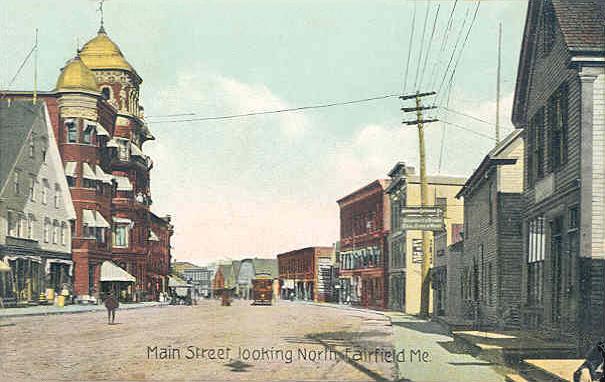
In 1889, Reverend George W. Hinckley founded the Hinckley School. In 1899–1900, The Gerald Hotel was built downtown. Designed by Maine architect William Robinson Miller, it was commissioned by Amos F. Gerald, builder of the first electric trolley system in Maine. The hotel was topped with a statue of Mercury, the Roman god of speed, and remained in operation from 1900 until 1937. Miller also designed the town's Lawrence Library, dedicated on July 25, 1901, and the Lawrence High School. Today, Fairfield makes wood and paper products, and is largely a bedroom community for Waterville.
The town has three post offices because it contains four different unincorporated townships under municipal jurisdiction of the town of Fairfield:
The third post office serves the incorporated urban Fairfield (CDP), an early name for which was Kendall's Mills. For approximately 75 years, the urban district was under a village corporation government. Thus, the town would hold New England style town meetings that covered business for the greater town, followed by a village corporation meeting to deal with urban needs, including police service, fire department service and town engineer service (public works). The non-urban, unincorporated areas—Shawmut, Fairfield Center and Hinckley—were not assessed taxes for urban services they did not receive. This arrangement ended in 1929.
Hub AI
Fairfield, Maine AI simulator
(@Fairfield, Maine_simulator)
Fairfield, Maine
Fairfield is a town in Somerset County, Maine, United States. The population was 6,484 at the 2020 census. The town includes Fairfield Center, Fairfield village and Hinckley, and borders the city of Waterville to the south. It is home to the Good Will-Hinckley School, Lawrence High School and Kennebec Valley Community College.
The area was territory of the Canibas tribe of Abenaki Indians residing at Taconnet village, once located downriver at the confluence of the Sebasticook and Kennebec rivers in what is today Winslow. In 1692 during King William's War, the village was burned, so the Canibas tribe abandoned the area. The French and Indian Wars finally ended in 1763, leaving the region open for English colonization. Fairfield Plantation, named for its fair aspect, was first settled in 1774.
Benedict Arnold and his troops rested and re-provisioned here in 1775 during their march up the Kennebec River to the Battle of Quebec. Following the Revolutionary War, Fairfield Plantation developed as a trade and agricultural town, with farms producing hay, grain and potatoes. It was noted for the number and quality of its cattle. On June 18, 1788, it was incorporated as Fairfield. By 1790, the community had 492 inhabitants. In 1837, it produced 11,531 bushels of wheat and a large quantity of wool.
Falls on the Kennebec drop 34 feet (10 m) at Fairfield, providing water power for industry. The mill town had eight sawmills, three planing mills, a gristmill, a canned corn factory, plaster mill, three carriage factories, a sled factory, two door, sash and blind factories, a cabinet and box factory, coffin factory, a clothing factory, a marble works and a tannery. The largest factories were the textile plants—Kendall's Mills in the southeastern extremity of the town, and Somerset Mills located about two miles above.
The main line of the Maine Central Railroad passes through Fairfield on the way from Portland to Waterville to Bangor, and the Skowhegan branch of the Maine Central Railroad (originally the Somerset and Kennebec Railroad) ran along the Kennebec River from Waterville to Skowhegan, with stations in Shawmut and Hinckley (today, this line terminates at the SAPPI paper mill just north of Hinckley). The Somerset Railroad (Maine) traversed western Fairfield on a route that once ran north from Oakland to Norridgewock, Madison, Bingham, and Moosehead Lake.
In 1889, Reverend George W. Hinckley founded the Hinckley School. In 1899–1900, The Gerald Hotel was built downtown. Designed by Maine architect William Robinson Miller, it was commissioned by Amos F. Gerald, builder of the first electric trolley system in Maine. The hotel was topped with a statue of Mercury, the Roman god of speed, and remained in operation from 1900 until 1937. Miller also designed the town's Lawrence Library, dedicated on July 25, 1901, and the Lawrence High School. Today, Fairfield makes wood and paper products, and is largely a bedroom community for Waterville.
The town has three post offices because it contains four different unincorporated townships under municipal jurisdiction of the town of Fairfield:
The third post office serves the incorporated urban Fairfield (CDP), an early name for which was Kendall's Mills. For approximately 75 years, the urban district was under a village corporation government. Thus, the town would hold New England style town meetings that covered business for the greater town, followed by a village corporation meeting to deal with urban needs, including police service, fire department service and town engineer service (public works). The non-urban, unincorporated areas—Shawmut, Fairfield Center and Hinckley—were not assessed taxes for urban services they did not receive. This arrangement ended in 1929.
Recent media