
Recent from talks
Fairlight CMI
Knowledge base stats:
Talk channels stats:
Members stats:
Fairlight CMI
The Fairlight CMI (short for Computer Musical Instrument) is a digital synthesizer, music sampler, and digital audio workstation introduced in 1979 by Fairlight. It was based on a commercial licence of the Qasar M8 developed by Tony Furse of Creative Strategies in Sydney, Australia. It was one of the earliest electronic music workstations with an embedded sampler and is credited for coining the term sampling in music. It rose to prominence in the early 1980s and competed with the Synclavier from New England Digital.
In the 1970s, Kim Ryrie, then a teenager, had an idea to develop a build-it-yourself analogue synthesizer, the ETI 4600, for the magazine he founded, Electronics Today International (ETI). Ryrie was frustrated by the limited number of sounds that the synthesizer could make. After his classmate, Peter Vogel, graduated from high school and had a brief stint at university in 1975, Ryrie asked Vogel whether he would be interested in making "the world's greatest synthesizer" based on the recently announced microprocessor. He recalled: "We had long been interested in computers – I built my first computer when I was about 12 – and it was obvious to me that combining digital technology with music synthesis was the way to go."
In December 1975, Ryrie and Vogel formed a home business to manufacture digital synthesizers. They named the business Fairlight after the hydrofoil ferry passing before Ryrie's grandmother's home in Sydney Harbour. The two planned to design a digital synthesizer that could create sounds reminiscent of acoustic instruments (physical modelling synthesis). They initially planned to make an analogue synthesizer that was digitally controlled, as the competing Moog synthesizer was difficult to control.
By 1978, Vogel and Ryrie were making "interesting" but unrealistic sounds. Hoping to learn how to synthesize an instrument by studying the harmonics of real instruments, Vogel recorded about a second of a piano piece from a radio broadcast. He discovered that by playing the recording back at different pitches, it sounded much more realistic than a synthesized piano sound. He recalled in 2005:
It sounded remarkably like a piano, a real piano. This had never been done before ... By today's standards it was a pretty awful piano sound, but at the time it was a million times more like a piano than anything any synthesizer had churned out. So I rapidly realised that we didn't have to bother with all the synthesis stuff. Just take the sounds, whack them in the memory and away you go.
Vogel and Ryrie coined the term sampling to describe this process. With the Fairlight CMI, they could now produce endless sounds, but control was limited to attack, sustain, decay and vibrato. According to Ryrie, "We regarded using recorded real-life sounds as a compromise – as cheating – and we didn't feel particularly proud of it." They continued to work on the design while creating office computers for Remington Office Machines, which Ryrie described as "a horrendous exercise, but we sold 120 of them".
In addition to the keyboard, processing, computer graphics and interactive pen borrowed from Furse's synthesizer, the pair added a QWERTY keyboard, and a large 1×1.5×3-foot box stored the sampling, processing and ADC/DAC hardware and the 8-inch floppy disk. The biggest problem was largely considered to be the small 16 kB sample memory. To accommodate sample lengths from approximately a quarter of a second to an entire second, a low variable sample rate between 24 kHz and 8 kHz was used. The low sample rate introduced aliasing; however, Vogel felt that the low quality of the sounds gave them their own character.
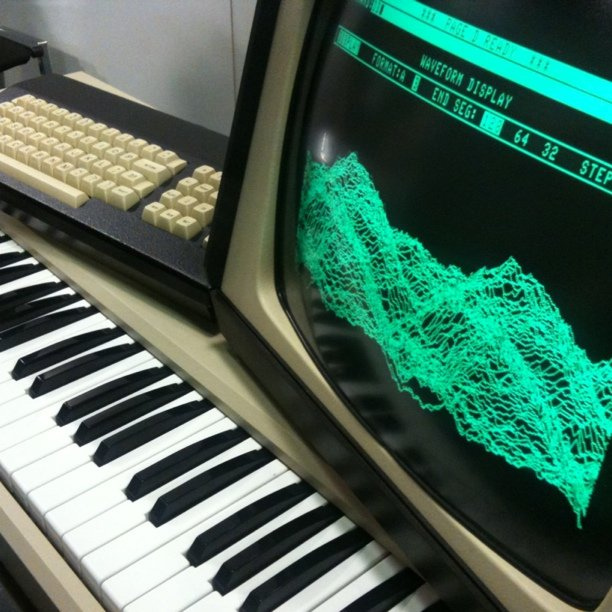
The Music Composition Language feature was criticised as being too difficult for practical use. Other primitive aspects included its limited amount of RAM (208 kilobytes) and its green-and-black graphics. Nonetheless, the CMI garnered significant attention from Australian distributors and consumers for being able to emulate sounds of acoustic instruments, as well as for its light pen and three-dimensional sound visualisation. Still, Vogel was unsure whether there would be enough interest in the product. The CMI's ability to emulate real instruments made some refer to it as an "orchestra-in-a-box", and each unit came with 8-inch, 500-kilobyte floppy disks that each stored 22 samples of orchestral instruments. The Fairlight CMI also garnered publicity in the science industry, being featured on the BBC science and technology series Tomorrow's World. The Musicians' Union described it as a "lethal threat" to its members.
Hub AI
Fairlight CMI AI simulator
(@Fairlight CMI_simulator)
Fairlight CMI
The Fairlight CMI (short for Computer Musical Instrument) is a digital synthesizer, music sampler, and digital audio workstation introduced in 1979 by Fairlight. It was based on a commercial licence of the Qasar M8 developed by Tony Furse of Creative Strategies in Sydney, Australia. It was one of the earliest electronic music workstations with an embedded sampler and is credited for coining the term sampling in music. It rose to prominence in the early 1980s and competed with the Synclavier from New England Digital.
In the 1970s, Kim Ryrie, then a teenager, had an idea to develop a build-it-yourself analogue synthesizer, the ETI 4600, for the magazine he founded, Electronics Today International (ETI). Ryrie was frustrated by the limited number of sounds that the synthesizer could make. After his classmate, Peter Vogel, graduated from high school and had a brief stint at university in 1975, Ryrie asked Vogel whether he would be interested in making "the world's greatest synthesizer" based on the recently announced microprocessor. He recalled: "We had long been interested in computers – I built my first computer when I was about 12 – and it was obvious to me that combining digital technology with music synthesis was the way to go."
In December 1975, Ryrie and Vogel formed a home business to manufacture digital synthesizers. They named the business Fairlight after the hydrofoil ferry passing before Ryrie's grandmother's home in Sydney Harbour. The two planned to design a digital synthesizer that could create sounds reminiscent of acoustic instruments (physical modelling synthesis). They initially planned to make an analogue synthesizer that was digitally controlled, as the competing Moog synthesizer was difficult to control.
By 1978, Vogel and Ryrie were making "interesting" but unrealistic sounds. Hoping to learn how to synthesize an instrument by studying the harmonics of real instruments, Vogel recorded about a second of a piano piece from a radio broadcast. He discovered that by playing the recording back at different pitches, it sounded much more realistic than a synthesized piano sound. He recalled in 2005:
It sounded remarkably like a piano, a real piano. This had never been done before ... By today's standards it was a pretty awful piano sound, but at the time it was a million times more like a piano than anything any synthesizer had churned out. So I rapidly realised that we didn't have to bother with all the synthesis stuff. Just take the sounds, whack them in the memory and away you go.
Vogel and Ryrie coined the term sampling to describe this process. With the Fairlight CMI, they could now produce endless sounds, but control was limited to attack, sustain, decay and vibrato. According to Ryrie, "We regarded using recorded real-life sounds as a compromise – as cheating – and we didn't feel particularly proud of it." They continued to work on the design while creating office computers for Remington Office Machines, which Ryrie described as "a horrendous exercise, but we sold 120 of them".
In addition to the keyboard, processing, computer graphics and interactive pen borrowed from Furse's synthesizer, the pair added a QWERTY keyboard, and a large 1×1.5×3-foot box stored the sampling, processing and ADC/DAC hardware and the 8-inch floppy disk. The biggest problem was largely considered to be the small 16 kB sample memory. To accommodate sample lengths from approximately a quarter of a second to an entire second, a low variable sample rate between 24 kHz and 8 kHz was used. The low sample rate introduced aliasing; however, Vogel felt that the low quality of the sounds gave them their own character.
The Music Composition Language feature was criticised as being too difficult for practical use. Other primitive aspects included its limited amount of RAM (208 kilobytes) and its green-and-black graphics. Nonetheless, the CMI garnered significant attention from Australian distributors and consumers for being able to emulate sounds of acoustic instruments, as well as for its light pen and three-dimensional sound visualisation. Still, Vogel was unsure whether there would be enough interest in the product. The CMI's ability to emulate real instruments made some refer to it as an "orchestra-in-a-box", and each unit came with 8-inch, 500-kilobyte floppy disks that each stored 22 samples of orchestral instruments. The Fairlight CMI also garnered publicity in the science industry, being featured on the BBC science and technology series Tomorrow's World. The Musicians' Union described it as a "lethal threat" to its members.
Recent media