



Community hub
Recent from talks
Contribute something
Nothing was collected or created yet.
Falling and rising factorials
View on Wikipedia
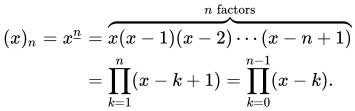
In mathematics, the falling factorial (sometimes called the descending factorial,[1] falling sequential product, or lower factorial) is defined as the polynomial
The rising factorial (sometimes called the Pochhammer function, Pochhammer polynomial, ascending factorial,[1] rising sequential product, or upper factorial) is defined as
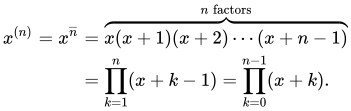
The value of each is taken to be 1 (an empty product) when . These symbols are collectively called factorial powers.[2]

The Pochhammer symbol, introduced by Leo August Pochhammer, is the notation , where n is a non-negative integer. It may represent either the rising or the falling factorial, with different articles and authors using different conventions. Pochhammer himself actually used with yet another meaning, namely to denote the binomial coefficient .[3]


In this article, the symbol is used to represent the falling factorial, and the symbol is used for the rising factorial. These conventions are used in combinatorics,[4] although Knuth's underline and overline notations and are increasingly popular.[2][5] In the theory of special functions (in particular the hypergeometric function) and in the standard reference work Abramowitz and Stegun, the Pochhammer symbol is used to represent the rising factorial.[6][7]


When is a positive integer, gives the number of n-permutations (sequences of distinct elements) from an x-element set, or equivalently the number of injective functions from a set of size to a set of size . The rising factorial gives the number of partitions of an -element set into ordered sequences (possibly empty).[a]


Examples and combinatorial interpretation
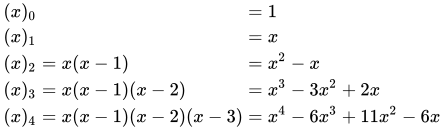
[edit]The first few falling factorials are as follows:
The first few rising factorials are as follows:
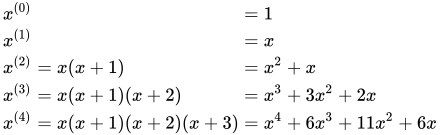
The coefficients that appear in the expansions are Stirling numbers of the first kind (see below).
When the variable is a positive integer, the number is equal to the number of n-permutations from a set of x items, that is, the number of ways of choosing an ordered list of length n consisting of distinct elements drawn from a collection of size . For example, is the number of different podiums—assignments of gold, silver, and bronze medals—possible in an eight-person race. On the other hand, is "the number of ways to arrange flags on flagpoles",[8] where all flags must be used and each flagpole can have any number of flags. Equivalently, this is the number of ways to partition a set of size (the flags) into distinguishable parts (the poles), with a linear order on the elements assigned to each part (the order of the flags on a given pole).

Properties
[edit]The rising and falling factorials are simply related to one another:

Falling and rising factorials of integers are directly related to the ordinary factorial:
_{n}&={\frac {m!}{(m-n)!}},\\[6pt]m^{(n)}&={\frac {(m+n-1)!}{(m-1)!}}.\end{aligned}}}](https://wikimedia.org/api/rest_v1/media/math/render/svg/1abe42997ccb9ab9503b8ab2289e912124ea6708)
Rising factorials of half integers are directly related to the double factorial:
![{\displaystyle {\begin{aligned}\left[{\frac {1}{2}}\right]^{(n)}={\frac {(2n-1)!!}{2^{n}}},\quad \left[{\frac {2m+1}{2}}\right]^{(n)}={\frac {(2(n+m)-1)!!}{2^{n}(2m-1)!!}}.\end{aligned}}}](https://wikimedia.org/api/rest_v1/media/math/render/svg/7c8c2067922006bca5c132e731eb2734a57b130b)
The falling and rising factorials can be used to express a binomial coefficient:
![{\displaystyle {\begin{aligned}{\frac {(x)_{n}}{n!}}&={\binom {x}{n}},\\[6pt]{\frac {x^{(n)}}{n!}}&={\binom {x+n-1}{n}}.\end{aligned}}}](https://wikimedia.org/api/rest_v1/media/math/render/svg/f7abd360da2887a175116b5e10804c2e4bcd44c7)
Thus many identities on binomial coefficients carry over to the falling and rising factorials.
The rising and falling factorials are well defined in any unital ring, and therefore can be taken to be, for example, a complex number, including negative integers, or a polynomial with complex coefficients, or any complex-valued function.
Real numbers and negative n
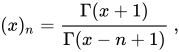
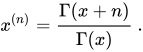
[edit]The falling factorial can be extended to real values of using the gamma function provided and are real numbers that are not negative integers: and so can the rising factorial:

Calculus
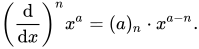
[edit]Falling factorials appear in multiple differentiation of simple power functions:
The rising factorial is also integral to the definition of the hypergeometric function: The hypergeometric function is defined for by the power series provided that . Note, however, that the hypergeometric function literature typically uses the notation for rising factorials.


Connection coefficients and identities
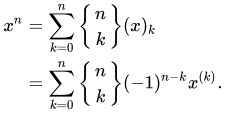
[edit]Falling and rising factorials are closely related to Stirling numbers. Indeed, expanding the product reveals Stirling numbers of the first kind
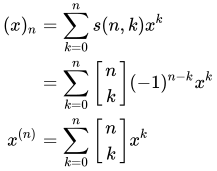
And the inverse relations uses Stirling numbers of the second kind
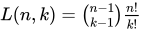
The falling and rising factorials are related to one another through the Lah numbers :[9]

Since the falling factorials are a basis for the polynomial ring, one can express the product of two of them as a linear combination of falling factorials:[10]

The coefficients are called connection coefficients, and have a combinatorial interpretation as the number of ways to identify (or "glue together") k elements each from a set of size m and a set of size n.

There is also a connection formula for the ratio of two rising factorials given by

Additionally, we can expand generalized exponent laws and negative rising and falling powers through the following identities:[11](p 52)
![{\displaystyle {\begin{aligned}(x)_{m+n}&=(x)_{m}(x-m)_{n}=(x)_{n}(x-n)_{m}\\[6pt]x^{(m+n)}&=x^{(m)}(x+m)^{(n)}=x^{(n)}(x+n)^{(m)}\\[6pt]x^{(-n)}&={\frac {\Gamma (x-n)}{\Gamma (x)}}={\frac {(x-n-1)!}{(x-1)!}}={\frac {1}{(x-n)^{(n)}}}={\frac {1}{(x-1)_{n}}}={\frac {1}{(x-1)(x-2)\cdots (x-n)}}\\[6pt](x)_{-n}&={\frac {\Gamma (x+1)}{\Gamma (x+n+1)}}={\frac {x!}{(x+n)!}}={\frac {1}{(x+n)_{n}}}={\frac {1}{(x+1)^{(n)}}}={\frac {1}{(x+1)(x+2)\cdots (x+n)}}\end{aligned}}}](https://wikimedia.org/api/rest_v1/media/math/render/svg/bd3efcab373ab20c11ed840a79a942066bda8e4c)
Finally, duplication and multiplication formulas for the falling and rising factorials provide the next relations:
![{\displaystyle {\begin{aligned}(x)_{k+mn}&=x^{(k)}m^{mn}\prod _{j=0}^{m-1}\left({\frac {x-k-j}{m}}\right)_{n}\,,&{\text{for }}m&\in \mathbb {N} \\[6pt]x^{(k+mn)}&=x^{(k)}m^{mn}\prod _{j=0}^{m-1}\left({\frac {x+k+j}{m}}\right)^{(n)},&{\text{for }}m&\in \mathbb {N} \\[6pt](ax+b)^{(n)}&=x^{n}\prod _{j=0}^{n-1}\left(a+{\frac {b+j}{x}}\right),&{\text{for }}x&\in \mathbb {Z} ^{+}\\[6pt](2x)^{(2n)}&=2^{2n}x^{(n)}\left(x+{\frac {1}{2}}\right)^{(n)}.\end{aligned}}}](https://wikimedia.org/api/rest_v1/media/math/render/svg/47fee6455aa4324bfb34466e431e9c1dc43c009b)
Relation to umbral calculus
[edit]The falling factorial occurs in a formula which represents polynomials using the forward difference operator which in form is an exact analogue to Taylor's theorem: Compare the series expansion from umbral calculus


with the corresponding series from differential calculus
![{\displaystyle \qquad f(t)=\sum _{n=0}^{\infty }\ {\frac {1}{\ n!}}\left[{\frac {\ \operatorname {d} }{\operatorname {d} x}}\right]^{n}f(x)\ {\bigg \vert }_{x=0}\ t^{n}~.}](https://wikimedia.org/api/rest_v1/media/math/render/svg/183fa5cf1a525f77e67bfd5f59c36138eae38b9a)
In this formula and in many other places, the falling factorial in the calculus of finite differences plays the role of in differential calculus. For another example, note the similarity of to


A corresponding relation holds for the rising factorial and the backward difference operator.
The study of analogies of this type is known as umbral calculus. A general theory covering such relations, including the falling and rising factorial functions, is given by the theory of polynomial sequences of binomial type and Sheffer sequences. Falling and rising factorials are Sheffer sequences of binomial type, as shown by the relations:
^{(n)}&=\sum _{j=0}^{n}\ {\binom {n}{j}}\ a^{(n-j)}\ b^{(j)}\ \end{aligned}}\ }](https://wikimedia.org/api/rest_v1/media/math/render/svg/42e5a2a613b566ecbd86750b41d92fe9a5a8ae63)
where the coefficients are the same as those in the binomial theorem.
Similarly, the generating function of Pochhammer polynomials then amounts to the umbral exponential,

since

Alternative notations
[edit]An alternative notation for the rising factorial

and for the falling factorial

goes back to A. Capelli (1893) and L. Toscano (1939), respectively.[2] Graham, Knuth, and Patashnik[11](pp 47, 48) propose to pronounce these expressions as "x to the m rising" and "x to the m falling", respectively.
An alternative notation for the rising factorial is the less common When is used to denote the rising factorial, the notation is typically used for the ordinary falling factorial, to avoid confusion.[3]


Generalizations
[edit]The Pochhammer symbol has a generalized version called the generalized Pochhammer symbol, used in multivariate analysis. There is also a q-analogue, the q-Pochhammer symbol.
For any fixed arithmetic function and symbolic parameters x, t, related generalized factorial products of the form

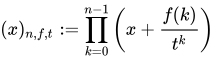
may be studied from the point of view of the classes of generalized Stirling numbers of the first kind defined by the following coefficients of the powers of x in the expansions of (x)n,f,t and then by the next corresponding triangular recurrence relation:
![{\displaystyle {\begin{aligned}\left[{\begin{matrix}n\\k\end{matrix}}\right]_{f,t}&=\left[x^{k-1}\right](x)_{n,f,t}\\&=f(n-1)t^{1-n}\left[{\begin{matrix}n-1\\k\end{matrix}}\right]_{f,t}+\left[{\begin{matrix}n-1\\k-1\end{matrix}}\right]_{f,t}+\delta _{n,0}\delta _{k,0}.\end{aligned}}}](https://wikimedia.org/api/rest_v1/media/math/render/svg/57404d462daa4b98d900770ab2a24c0823d0ded4)
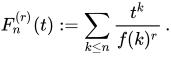
These coefficients satisfy a number of analogous properties to those for the Stirling numbers of the first kind as well as recurrence relations and functional equations related to the f-harmonic numbers,[12]
See also
[edit]References
[edit]- ^ Here the parts are distinct; for example, when x = n = 2, the (2)(2) = 6 partitions are , , , , , and , where − denotes an empty part.


- ^ a b Steffensen, J.F. (17 March 2006). Interpolation (2nd ed.). Dover Publications. p. 8. ISBN 0-486-45009-0. — A reprint of the 1950 edition by Chelsea Publishing.
- ^ a b c Knuth, D.E. The Art of Computer Programming. Vol. 1 (3rd ed.). p. 50.
- ^ a b Knuth, D.E. (1992). "Two notes on notation". American Mathematical Monthly. 99 (5): 403–422. arXiv:math/9205211. doi:10.2307/2325085. JSTOR 2325085. S2CID 119584305. The remark about the Pochhammer symbol is on page 414.
- ^ Olver, P.J. (1999). Classical Invariant Theory. Cambridge University Press. p. 101. ISBN 0-521-55821-2. MR 1694364.
- ^ Harris; Hirst; Mossinghoff (2008). Combinatorics and Graph Theory. Springer. ch. 2. ISBN 978-0-387-79710-6.
- ^ Abramowitz, Milton; Stegun, Irene A., eds. (December 1972) [June 1964]. Handbook of Mathematical Functions with Formulas, Graphs, and Mathematical Tables. National Bureau of Standards Applied Mathematics Series. Vol. 55. Washington, DC: United States Department of Commerce. p. 256 eqn. 6.1.22. LCCN 64-60036.
- ^ Slater, Lucy J. (1966). Generalized Hypergeometric Functions. Cambridge University Press. Appendix I. MR 0201688. — Gives a useful list of formulas for manipulating the rising factorial in (x)n notation.
- ^ Feller, William. An Introduction to Probability Theory and Its Applications. Vol. 1. Ch. 2.
- ^ "Introduction to the factorials and binomials". Wolfram Functions Site.
- ^ Rosas, Mercedes H. (2002). "Specializations of MacMahon symmetric functions and the polynomial algebra". Discrete Math. 246 (1–3): 285–293. doi:10.1016/S0012-365X(01)00263-1. hdl:11441/41678.
- ^ a b Graham, Ronald L.; Knuth, Donald E. & Patashnik, Oren (1988). Concrete Mathematics. Reading, MA: Addison-Wesley. pp. 47, 48, 52. ISBN 0-201-14236-8.
- ^ Schmidt, Maxie D. (2018). "Combinatorial identities for generalized Stirling numbers expanding f-factorial functions and the f-harmonic numbers". Journal of Integer Sequences. 21 (2) 18.2.7. arXiv:1611.04708v2. MR 3779776.
External links
[edit]Falling and rising factorials
View on GrokipediaDefinitions and Notation
Falling Factorial
The falling factorial, denoted , is a polynomial in of degree defined for any real or complex number and non-negative integer .[1] It extends the concept of the ordinary factorial from positive integers to broader domains and appears frequently in combinatorics, algebra, and analysis.[6] For , the falling factorial is given by the product formula which consists of successive terms decreasing by 1 starting from .[1] For , the empty product convention yields .[1] This definition aligns with the notation introduced in seminal works on discrete mathematics, where the falling factorial serves as a basis for polynomial interpolation and finite differences.[7] When is a positive integer with , the falling factorial simplifies to the permutation formula representing the number of ways to arrange distinct items from available ones, though here it is presented purely as an algebraic reduction.[8] This special case connects directly to the ordinary factorial , which is recovered when as .[8] The falling factorial also admits a recursive definition: for , with the base case .[9] This recurrence facilitates computational evaluation and proofs involving the function.[9] As a counterpart, the rising factorial employs a product of increasing terms, providing a dual perspective in related mathematical contexts.[1]Rising Factorial
The rising factorial, denoted and also known as the Pochhammer symbol , generalizes the factorial to real or complex arguments and nonnegative integers . It is defined by the ascending product formula for , with the base case .[10] This construction emphasizes an increasing sequence of terms, in contrast to the falling factorial's decreasing sequence. When is a positive integer, the rising factorial reduces to a ratio of factorials: This equivalence follows directly from the product form, as the terms through form the upper portion of the expanded factorial after canceling the lower terms up to .[10] The rising factorial admits a recursive definition: with , which mirrors the iterative multiplication in the product formula.[10] For analytic extension beyond integers, the rising factorial connects to the gamma function: valid when is not a non-positive integer to avoid poles in the gamma function.[10] This relation, introduced by Leo August Pochhammer in the context of hypergeometric functions, enables evaluation for non-integer and underpins its role in special functions and series expansions.Relation Between Falling and Rising
The falling factorial and the rising factorial are interconnected through identities that shift the argument or incorporate a sign change, allowing one to be expressed directly in terms of the other. A primary relation is given by the argument shift identity which equates the product for the rising factorial to the falling factorial starting at the raised base . The converse follows immediately as reflecting the reverse ordering of factors in the products. Another fundamental link involves negation, with the identity derived from expanding both sides and observing the sign pattern in the factors of the falling factorial at .[1] This relation facilitates analytic continuations and handles cases with negative or complex arguments. Both factorials feature prominently in generalized binomial expansions, where the falling factorial underlies the series for with , while the rising factorial appears in , linking them through argument adjustments like replacing with and shifting . The Pochhammer symbol , standard for the rising factorial since its introduction by Leo August Pochhammer in studies of hypergeometric series, contrasts with falling factorial notation in contemporary texts, though earlier literature occasionally reversed these conventions.[3]Combinatorial Interpretations
Basic Examples
The falling factorial and rising factorial are defined as products of consecutive terms, with the falling form decreasing from and the rising form increasing from .[11][1][2] For integer values, consider and : while These computations follow directly from the product definitions.[11] For non-integer arguments, the definitions extend naturally. For example, with and , The rising factorial in this case is .[11] When , both the falling and rising factorials equal 1 for any , as they represent the empty product.[11][1] The following table provides further computations for small integer values of and :| (falling) | (rising) | ||
|---|---|---|---|
| 0 | 1 | 0 | 0 |
| 0 | 2 | 0 | 0 |
| 0 | 3 | 0 | 0 |
| 1 | 1 | 1 | 1 |
| 1 | 2 | 0 | 2 |
| 1 | 3 | 0 | 6 |
| 2 | 1 | 2 | 2 |
| 2 | 2 | 2 | 6 |
| 2 | 3 | 0 | 24 |
| 3 | 1 | 3 | 3 |
| 3 | 2 | 6 | 12 |
| 3 | 3 | 6 | 60 |