


Community hub
Recent from talks
Contribute something
Nothing was collected or created yet.
Lah number
View on Wikipedia

In mathematics, the (signed and unsigned) Lah numbers are coefficients expressing rising factorials in terms of falling factorials and vice versa. They were discovered by Ivo Lah in 1954.[1][2] Explicitly, the unsigned Lah numbers are given by the formula involving the binomial coefficient


for , and the signed Lah numbers are related to them by .


Signed Lah numbers are only of historical interest as it's how they were defined in Lah's seminal paper, but their sign pattern (, instead of as used for signed Stirling numbers) make them of little to no use in formulas of mathematical interest.


Unsigned Lah numbers have an interesting meaning in combinatorics: they count the number of ways a set of elements can be partitioned into nonempty linearly ordered subsets.[3] Lah numbers are related to Stirling numbers.[4]


For , the Lah number is equal to the factorial in the interpretation above, the only partition of into 1 set can have its set ordered in 6 ways: is equal to 6, because there are six partitions of into two ordered parts: is always 1 because the only way to partition into non-empty subsets results in subsets of size 1, that can only be permuted in one way. In the more recent literature,[5][6] Karamata–Knuth style notation has taken over. Lah numbers are now often written as







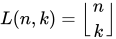
Table of values
[edit]Below is a table of values for the Lah numbers:
k n
|
0 | 1 | 2 | 3 | 4 | 5 | 6 | 7 | 8 | 9 | 10 |
|---|---|---|---|---|---|---|---|---|---|---|---|
| 0 | 1 | ||||||||||
| 1 | 0 | 1 | |||||||||
| 2 | 0 | 2 | 1 | ||||||||
| 3 | 0 | 6 | 6 | 1 | |||||||
| 4 | 0 | 24 | 36 | 12 | 1 | ||||||
| 5 | 0 | 120 | 240 | 120 | 20 | 1 | |||||
| 6 | 0 | 720 | 1800 | 1200 | 300 | 30 | 1 | ||||
| 7 | 0 | 5040 | 15120 | 12600 | 4200 | 630 | 42 | 1 | |||
| 8 | 0 | 40320 | 141120 | 141120 | 58800 | 11760 | 1176 | 56 | 1 | ||
| 9 | 0 | 362880 | 1451520 | 1693440 | 846720 | 211680 | 28224 | 2016 | 72 | 1 | |
| 10 | 0 | 3628800 | 16329600 | 21772800 | 12700800 | 3810240 | 635040 | 60480 | 3240 | 90 | 1 |

Rising and falling factorials
[edit]Let represent the rising factorial and let represent the falling factorial . The Lah numbers are the coefficients that express each of these families of polynomials in terms of the other. Explicitly,andFor example,and




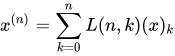
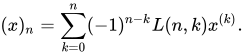


where the coefficients 6, 6, and 1 are exactly the Lah numbers , , and .


Identities and relations
[edit]The Lah numbers satisfy a variety of identities and relations.
In Karamata–Knuth notation for Stirling numberswhere are the unsigned Stirling numbers of the first kind and are the Stirling numbers of the second kind.
![{\displaystyle L(n,k)=\sum _{j=k}^{n}\left[{n \atop j}\right]\left\{{j \atop k}\right\}}](https://wikimedia.org/api/rest_v1/media/math/render/svg/7d59f53de532d895866b5ef0424c63e46e957cbd)
![{\textstyle \left[{n \atop j}\right]}](https://wikimedia.org/api/rest_v1/media/math/render/svg/177354d52550d6bd54bef4a364e17ca22d3410d4)



- , for .


Recurrence relations
[edit]The Lah numbers satisfy the recurrence relationswhere , the Kronecker delta, and for all .



Exponential generating function
[edit]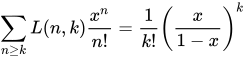
Derivative of exp(1/x)
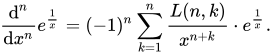
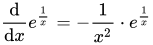
[edit]The n-th derivative of the function can be expressed with the Lah numbers, as follows[7]For example,



Link to Laguerre polynomials
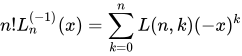
[edit]Generalized Laguerre polynomials are linked to Lah numbers upon setting This formula is the default Laguerre polynomial in Umbral calculus convention.[8]


Practical application
[edit]In recent years, Lah numbers have been used in steganography for hiding data in images. Compared to alternatives such as DCT, DFT and DWT, it has lower complexity of calculation——of their integer coefficients.[9][10] The Lah and Laguerre transforms naturally arise in the perturbative description of the chromatic dispersion.[11][12] In Lah-Laguerre optics, such an approach tremendously speeds up optimization problems.

See also
[edit]References
[edit]- ^ Lah, Ivo (1954). "A new kind of numbers and its application in the actuarial mathematics". Boletim do Instituto dos Actuários Portugueses. 9: 7–15.
- ^ John Riordan, Introduction to Combinatorial Analysis, Princeton University Press (1958, reissue 1980) ISBN 978-0-691-02365-6 (reprinted again in 2002 by Dover Publications).
- ^ Petkovsek, Marko; Pisanski, Tomaz (Fall 2007). "Combinatorial Interpretation of Unsigned Stirling and Lah Numbers". Pi Mu Epsilon Journal. 12 (7): 417–424. JSTOR 24340704.
- ^ Comtet, Louis (1974). Advanced Combinatorics. Dordrecht, Holland: Reidel. p. 156. ISBN 9789027703804.
- ^ Shattuck, Mark (2014). "Generalized r-Lah numbers". arXiv:1412.8721 [math.CO].
- ^ Nyul, Gábor; Rácz, Gabriella (2015-10-06). "The r-Lah numbers". Discrete Mathematics. Seventh Czech-Slovak International Symposium on Graph Theory, Combinatorics, Algorithms and Applications, Košice 2013. 338 (10): 1660–1666. doi:10.1016/j.disc.2014.03.029. hdl:2437/213886. ISSN 0012-365X.
- ^ Daboul, Siad; Mangaldan, Jan; Spivey, Michael Z.; Taylor, Peter J. (2013). "The Lah Numbers and the nth Derivative of ". Mathematics Magazine. 86 (1): 39–47. doi:10.4169/math.mag.86.1.039. JSTOR 10.4169/math.mag.86.1.039. S2CID 123113404.
- ^ Rota, Gian-Carlo; Kahaner, D; Odlyzko, A (1973-06-01). "On the foundations of combinatorial theory. VIII. Finite operator calculus". Journal of Mathematical Analysis and Applications. 42 (3): 684–760. doi:10.1016/0022-247X(73)90172-8. ISSN 0022-247X.
- ^ Ghosal, Sudipta Kr; Mukhopadhyay, Souradeep; Hossain, Sabbir; Sarkar, Ram (2020). "Application of Lah Transform for Security and Privacy of Data through Information Hiding in Telecommunication". Transactions on Emerging Telecommunications Technologies. 32 (2) e3984. doi:10.1002/ett.3984. S2CID 225866797.
- ^ "Image Steganography-using-Lah-Transform". MathWorks. 5 June 2020.
- ^ Popmintchev, Dimitar; Wang, Siyang; Xiaoshi, Zhang; Stoev, Ventzislav; Popmintchev, Tenio (2022-10-24). "Analytical Lah-Laguerre optical formalism for perturbative chromatic dispersion". Optics Express. 30 (22): 40779–40808. Bibcode:2022OExpr..3040779P. doi:10.1364/OE.457139. PMID 36299007.
- ^ Popmintchev, Dimitar; Wang, Siyang; Xiaoshi, Zhang; Stoev, Ventzislav; Popmintchev, Tenio (2020-08-30). "Theory of the Chromatic Dispersion, Revisited". arXiv:2011.00066 [physics.optics].

External links
[edit]- The signed and unsigned Lah numbers are respectively (sequence A008297 in the OEIS) and (sequence A105278 in the OEIS)
Classes of natural numbers | |||||||||||||||||||||||||
|---|---|---|---|---|---|---|---|---|---|---|---|---|---|---|---|---|---|---|---|---|---|---|---|---|---|
| |||||||||||||||||||||||||
| |||||||||||||||||||||||||
| |||||||||||||||||||||||||
| |||||||||||||||||||||||||
| |||||||||||||||||||||||||
| |||||||||||||||||||||||||
| |||||||||||||||||||||||||
| |||||||||||||||||||||||||
| |||||||||||||||||||||||||
| |||||||||||||||||||||||||
