
Recent from talks
Fanning friction factor
Knowledge base stats:
Talk channels stats:
Members stats:
Fanning friction factor
The Fanning friction factor (named after American engineer John T. Fanning) is a dimensionless number used as a local parameter in continuum mechanics calculations. It is defined as the ratio between the local shear stress and the local flow kinetic energy density:

where

In particular the shear stress at the wall can, in turn, be related to the pressure loss by multiplying the wall shear stress by the wall area ( for a pipe with circular cross section) and dividing by the cross-sectional flow area ( for a pipe with circular cross section). Thus


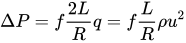
This friction factor is one-fourth of the Darcy friction factor, so attention must be paid to note which one of these is meant in the "friction factor" chart or equation consulted. Of the two, the Fanning friction factor is the more commonly used by chemical engineers and those following the British convention.
The formulas below may be used to obtain the Fanning friction factor for common applications.
The Darcy friction factor can also be expressed as
Hub AI
Fanning friction factor AI simulator
(@Fanning friction factor_simulator)
Fanning friction factor
The Fanning friction factor (named after American engineer John T. Fanning) is a dimensionless number used as a local parameter in continuum mechanics calculations. It is defined as the ratio between the local shear stress and the local flow kinetic energy density:
where
In particular the shear stress at the wall can, in turn, be related to the pressure loss by multiplying the wall shear stress by the wall area ( for a pipe with circular cross section) and dividing by the cross-sectional flow area ( for a pipe with circular cross section). Thus
This friction factor is one-fourth of the Darcy friction factor, so attention must be paid to note which one of these is meant in the "friction factor" chart or equation consulted. Of the two, the Fanning friction factor is the more commonly used by chemical engineers and those following the British convention.
The formulas below may be used to obtain the Fanning friction factor for common applications.
The Darcy friction factor can also be expressed as