



Community hub
Recent from talks
Contribute something
Nothing was collected or created yet.
Darcy–Weisbach equation
View on Wikipedia | This article needs editing to comply with Wikipedia's Manual of Style. In particular, it has problems with MOS:FORMULA - avoid mixing <math>...</math> and {{math}} in the same expression. (July 2025) |
| Part of a series on |
| Continuum mechanics |
|---|

In fluid dynamics, the Darcy–Weisbach equation is an empirical equation that relates the head loss, or pressure loss, due to viscous shear forces along a given length of pipe to the average velocity of the fluid flow for an incompressible fluid. The equation is named after Henry Darcy and Julius Weisbach. Currently, there is no formula more accurate or universally applicable than the Darcy-Weisbach supplemented by the Moody diagram or Colebrook equation.[1]
The Darcy–Weisbach equation contains a dimensionless friction factor, known as the Darcy friction factor. This is also variously called the Darcy–Weisbach friction factor, friction factor, resistance coefficient, or flow coefficient.[a]
Historical background
[edit]The Darcy-Weisbach equation, combined with the Moody chart for calculating head losses in pipes, is traditionally attributed to Henry Darcy, Julius Weisbach, and Lewis Ferry Moody. However, the development of these formulas and charts also involved other scientists and engineers over its historical development. Generally, the Bernoulli's equation would provide the head losses but in terms of quantities not known a priori, such as pressure. Therefore, empirical relationships were sought to correlate the head loss with quantities like pipe diameter and fluid velocity.[3]
Julius Weisbach was certainly not the first to introduce a formula correlating the length and diameter of a pipe to the square of the fluid velocity. Antoine Chézy (1718-1798), in fact, had published a formula in 1770 that, although referring to open channels (i.e., not under pressure), was formally identical to the one Weisbach would later introduce, provided it was reformulated in terms of the hydraulic radius. However, Chézy's formula was lost until 1800, when Gaspard de Prony (a former student of his) published an account describing his results. It is likely that Weisbach was aware of Chézy's formula through Prony's publications.[4]
Weisbach's formula was proposed in 1845 in the form we still use today:
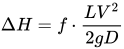
where:
- : head loss.
- : length of the pipe.
- : diameter of the pipe.
- : velocity of the fluid.
- : acceleration due to gravity.


However, the friction factor f was expressed by Weisbach through the following empirical formula:
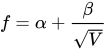
with and depending on the diameter and the type of pipe wall.[5] Weisbach's work was published in the United States in 1848 and soon became well known there. In contrast, it did not initially gain much traction in France, where Prony equation, which had a polynomial form in terms of velocity (often approximated by the square of the velocity), continued to be used. Beyond the historical developments, Weisbach's formula had the objective merit of adhering to dimensional analysis, resulting in a dimensionless friction factor f. The complexity of f, dependent on the mechanics of the boundary layer and the flow regime (laminar, transitional, or turbulent), tended to obscure its dependence on the quantities in Weisbach's formula, leading many researchers to derive irrational and dimensionally inconsistent empirical formulas.[6] It was understood not long after Weisbach's work that the friction factor f depended on the flow regime and was independent of the Reynolds number (and thus the velocity) only in the case of rough pipes in a fully turbulent flow regime (Prandtl-von Kármán equation).[7]


Pressure-loss equation
[edit]In a cylindrical pipe of uniform diameter D, flowing full, the pressure loss due to viscous effects Δp is proportional to length L and can be characterized by the Darcy–Weisbach equation:[8]
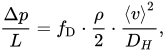
where the pressure loss per unit length Δp/L (SI units: Pa/m) is a function of:
- , the density of the fluid (kg/m3);
- , the hydraulic diameter of the pipe (for a pipe of circular section, this equals D; otherwise DH = 4A/P for a pipe of cross-sectional area A and perimeter P) (m);
- , the mean flow velocity, experimentally measured as the volumetric flow rate Q per unit cross-sectional wetted area (m/s);
- , the Darcy friction factor (also called flow coefficient λ[9][10]).


For laminar flow in a circular pipe of diameter , the friction factor is inversely proportional to the Reynolds number alone (fD = 64/Re) which itself can be expressed in terms of easily measured or published physical quantities (see section below). Making this substitution the Darcy–Weisbach equation is rewritten as

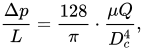
where
- μ is the dynamic viscosity of the fluid (Pa·s = N·s/m2 = kg/(m·s));
- Q is the volumetric flow rate, used here to measure flow instead of mean velocity according to Q = π/4Dc2<v> (m3/s).
Note that this laminar form of Darcy–Weisbach is equivalent to the Hagen–Poiseuille equation, which is analytically derived from the Navier–Stokes equations.
Head-loss formula
[edit]The head loss Δh (or hf) expresses the pressure loss due to friction in terms of the equivalent height of a column of the working fluid, so the pressure drop is
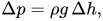
where:
- Δh = The head loss due to pipe friction over the given length of pipe (SI units: m);[b]
- g = The local acceleration due to gravity (m/s2).
It is useful to present head loss per length of pipe (dimensionless):
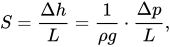
where L is the pipe length (m).
Therefore, the Darcy–Weisbach equation can also be written in terms of head loss:[11]
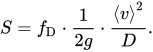
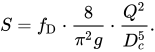
In terms of volumetric flow
[edit]The relationship between mean flow velocity and volumetric flow rate Q is

where:
- Q = The volumetric flow (m3/s),
- A = The cross-sectional wetted area (m2).
In a full-flowing, circular pipe of diameter ,
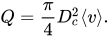
Then the Darcy–Weisbach equation in terms of Q is
Shear-stress form
[edit]The mean wall shear stress τ in a pipe or open channel is expressed in terms of the Darcy–Weisbach friction factor as[12]
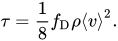
The wall shear stress has the SI unit of pascals (Pa).
Darcy friction factor
[edit]
The friction factor fD is not a constant: it depends on such things as the characteristics of the pipe (diameter D and roughness height ε), the characteristics of the fluid (its kinematic viscosity ν [nu]), and the velocity of the fluid flow ⟨v⟩. It has been measured to high accuracy within certain flow regimes and may be evaluated by the use of various empirical relations, or it may be read from published charts. These charts are often referred to as Moody diagrams, after L. F. Moody, and hence the factor itself is sometimes erroneously called the Moody friction factor. It is also sometimes called the Blasius friction factor, after the approximate formula he proposed.
Figure 1 shows the value of fD as measured by experimenters for many different fluids, over a wide range of Reynolds numbers, and for pipes of various roughness heights. There are three broad regimes of fluid flow encountered in these data: laminar, critical, and turbulent.
Laminar regime
[edit]For laminar (smooth) flows, it is a consequence of Poiseuille's law (which stems from an exact classical solution for the fluid flow) that

where Re is the Reynolds number

and where μ is the viscosity of the fluid and

is known as the kinematic viscosity. In this expression for Reynolds number, the characteristic length D is taken to be the hydraulic diameter of the pipe, which, for a cylindrical pipe flowing full, equals the inside diameter. In Figures 1 and 2 of friction factor versus Reynolds number, the regime Re < 2000 demonstrates laminar flow; the friction factor is well represented by the above equation.[c]
In effect, the friction loss in the laminar regime is more accurately characterized as being proportional to flow velocity, rather than proportional to the square of that velocity: one could regard the Darcy–Weisbach equation as not truly applicable in the laminar flow regime.
In laminar flow, friction loss arises from the transfer of momentum from the fluid in the center of the flow to the pipe wall via the viscosity of the fluid; no vortices are present in the flow. Note that the friction loss is insensitive to the pipe roughness height ε: the flow velocity in the neighborhood of the pipe wall is zero.
Critical regime
[edit]For Reynolds numbers in the range 2000 < Re < 4000, the flow is unsteady (varies grossly with time) and varies from one section of the pipe to another (is not "fully developed"). The flow involves the incipient formation of vortices; it is not well understood.
Turbulent regime
[edit]
For Reynolds number greater than 4000, the flow is turbulent; the resistance to flow follows the Darcy–Weisbach equation: it is proportional to the square of the mean flow velocity. Over a domain of many orders of magnitude of Re (4000 < Re < 108), the friction factor varies less than one order of magnitude (0.006 < fD < 0.06). Within the turbulent flow regime, the nature of the flow can be further divided into a regime where the pipe wall is effectively smooth, and one where its roughness height is salient.
Smooth-pipe regime
[edit]When the pipe surface is smooth (the "smooth pipe" curve in Figure 2), the friction factor's variation with Re can be modeled by the Kármán–Prandtl resistance equation for turbulent flow in smooth pipes[9] with the parameters suitably adjusted

The numbers 1.930 and 0.537 are phenomenological; these specific values provide a fairly good fit to the data.[13] The product Re√fD (called the "friction Reynolds number") can be considered, like the Reynolds number, to be a (dimensionless) parameter of the flow: at fixed values of Re√fD, the friction factor is also fixed.
In the Kármán–Prandtl resistance equation, fD can be expressed in closed form as an analytic function of Re through the use of the Lambert W function:

In this flow regime, many small vortices are responsible for the transfer of momentum between the bulk of the fluid to the pipe wall. As the friction Reynolds number Re√fD increases, the profile of the fluid velocity approaches the wall asymptotically, thereby transferring more momentum to the pipe wall, as modeled in Blasius boundary layer theory.
Rough-pipe regime
[edit]When the pipe surface's roughness height ε is significant (typically at high Reynolds number), the friction factor departs from the smooth pipe curve, ultimately approaching an asymptotic value ("rough pipe" regime). In this regime, the resistance to flow varies according to the square of the mean flow velocity and is insensitive to Reynolds number. Here, it is useful to employ yet another dimensionless parameter of the flow, the roughness Reynolds number[14]
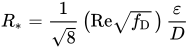
where the roughness height ε is scaled to the pipe diameter D.
.svg)
It is illustrative to plot the roughness function B:[17]

Figure 3 shows B versus R∗ for the rough pipe data of Nikuradse,[14] Shockling,[18] and Langelandsvik.[19]
In this view, the data at different roughness ratio ε/D fall together when plotted against R∗, demonstrating scaling in the variable R∗. The following features are present:
- When ε = 0, then R∗ is identically zero: flow is always in the smooth pipe regime. The data for these points lie to the left extreme of the abscissa and are not within the frame of the graph.
- When R∗ < 5, the data lie on the line B(R∗) = R∗; flow is in the smooth pipe regime.
- When R∗ > 100, the data asymptotically approach a horizontal line; they are independent of Re, fD, and ε/D.
- The intermediate range of 5 < R∗ < 100 constitutes a transition from one behavior to the other. The data depart from the line B(R∗) = R∗ very slowly, reach a maximum near R∗ = 10, then fall to a constant value.
Afzal's fit to these data in the transition from smooth pipe flow to rough pipe flow employs an exponential expression in R∗ that ensures proper behavior for 1 < R∗ < 50 (the transition from the smooth pipe regime to the rough pipe regime):[15][20][21]

and

This function shares the same values for its term in common with the Kármán–Prandtl resistance equation, plus one parameter 0.305 or 0.34 to fit the asymptotic behavior for R∗ → ∞ along with one further parameter, 11, to govern the transition from smooth to rough flow. It is exhibited in Figure 3.
The friction factor for another analogous roughness becomes
:

and
:

This function shares the same values for its term in common with the Kármán–Prandtl resistance equation, plus one parameter 0.305 or 0.34 to fit the asymptotic behavior for R∗ → ∞ along with one further parameter, 26, to govern the transition from smooth to rough flow.
The Colebrook–White relation[16] fits the friction factor with a function of the form

This relation has the correct behavior at extreme values of R∗, as shown by the labeled curve in Figure 3: when R∗ is small, it is consistent with smooth pipe flow, when large, it is consistent with rough pipe flow. However its performance in the transitional domain overestimates the friction factor by a substantial margin.[18] Colebrook acknowledges the discrepancy with Nikuradze's data but argues that his relation is consistent with the measurements on commercial pipes. Indeed, such pipes are very different from those carefully prepared by Nikuradse: their surfaces are characterized by many different roughness heights and random spatial distribution of roughness points, while those of Nikuradse have surfaces with uniform roughness height, with the points extremely closely packed.
Calculating the friction factor from its parametrization
[edit]For turbulent flow, methods for finding the friction factor fD include using a diagram, such as the Moody chart, or solving equations such as the Colebrook–White equation (upon which the Moody chart is based), or the Swamee–Jain equation. While the Colebrook–White relation is, in the general case, an iterative method, the Swamee–Jain equation allows fD to be found directly for full flow in a circular pipe.[11]
Direct calculation when friction loss S is known
[edit]In typical engineering applications, there will be a set of given or known quantities. The acceleration of gravity g and the kinematic viscosity of the fluid ν are known, as are the diameter of the pipe D and its roughness height ε. If as well the head loss per unit length S is a known quantity, then the friction factor fD can be calculated directly from the chosen fitting function. Solving the Darcy–Weisbach equation for √fD,
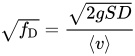
we can now express Re√fD:

Expressing the roughness Reynolds number R∗,
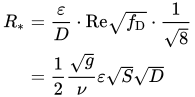
we have the two parameters needed to substitute into the Colebrook–White relation, or any other function, for the friction factor fD, the flow velocity ⟨v⟩, and the volumetric flow rate Q.
Confusion with the Fanning friction factor
[edit]The Darcy–Weisbach friction factor fD is 4 times larger than the Fanning friction factor f, so attention must be paid to note which one of these is meant in any "friction factor" chart or equation being used. Of the two, the Darcy–Weisbach factor fD is more commonly used by civil and mechanical engineers, and the Fanning factor f by chemical engineers, but care should be taken to identify the correct factor regardless of the source of the chart or formula.
Note that

Most charts or tables indicate the type of friction factor, or at least provide the formula for the friction factor with laminar flow. If the formula for laminar flow is f = 16/Re, it is the Fanning factor f, and if the formula for laminar flow is fD = 64/Re, it is the Darcy–Weisbach factor fD.
Which friction factor is plotted in a Moody diagram may be determined by inspection if the publisher did not include the formula described above:
- Observe the value of the friction factor for laminar flow at a Reynolds number of 1000.
- If the value of the friction factor is 0.064, then the Darcy friction factor is plotted in the Moody diagram. Note that the nonzero digits in 0.064 are the numerator in the formula for the laminar Darcy friction factor: fD = 64/Re.
- If the value of the friction factor is 0.016, then the Fanning friction factor is plotted in the Moody diagram. Note that the nonzero digits in 0.016 are the numerator in the formula for the laminar Fanning friction factor: f = 16/Re.
The procedure above is similar for any available Reynolds number that is an integer power of ten. It is not necessary to remember the value 1000 for this procedure—only that an integer power of ten is of interest for this purpose.
History
[edit]Historically this equation arose as a variant on the Prony equation; this variant was developed by Henry Darcy of France, and further refined into the form used today by Julius Weisbach of Saxony in 1845. Initially, data on the variation of fD with velocity was lacking, so the Darcy–Weisbach equation was outperformed at first by the empirical Prony equation in many cases. In later years it was eschewed in many special-case situations in favor of a variety of empirical equations valid only for certain flow regimes, notably the Hazen–Williams equation or the Manning equation, most of which were significantly easier to use in calculations. However, since the advent of the calculator, ease of calculation is no longer a major issue, and so the Darcy–Weisbach equation's generality has made it the preferred one.[22]
Derivation by dimensional analysis
[edit]Away from the ends of the pipe, the characteristics of the flow are independent of the position along the pipe. The key quantities are then the pressure drop along the pipe per unit length, Δp/L, and the volumetric flow rate. The flow rate can be converted to a mean flow velocity V by dividing by the wetted area of the flow (which equals the cross-sectional area of the pipe if the pipe is full of fluid).
Pressure has dimensions of energy per unit volume, therefore the pressure drop between two points must be proportional to the dynamic pressure q. We also know that pressure must be proportional to the length of the pipe between the two points L as the pressure drop per unit length is a constant. To turn the relationship into a proportionality coefficient of dimensionless quantity, we can divide by the hydraulic diameter of the pipe, D, which is also constant along the pipe. Therefore,
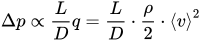
The proportionality coefficient is the dimensionless "Darcy friction factor" or "flow coefficient". This dimensionless coefficient will be a combination of geometric factors such as π, the Reynolds number and (outside the laminar regime) the relative roughness of the pipe (the ratio of the roughness height to the hydraulic diameter).
Note that the dynamic pressure is not the kinetic energy of the fluid per unit volume,[citation needed] for the following reasons. Even in the case of laminar flow, where all the flow lines are parallel to the length of the pipe, the velocity of the fluid on the inner surface of the pipe is zero due to viscosity, and the velocity in the center of the pipe must therefore be larger than the average velocity obtained by dividing the volumetric flow rate by the wet area. The average kinetic energy then involves the root mean-square velocity, which always exceeds the mean velocity. In the case of turbulent flow, the fluid acquires random velocity components in all directions, including perpendicular to the length of the pipe, and thus turbulence contributes to the kinetic energy per unit volume but not to the average lengthwise velocity of the fluid.
Practical application
[edit]In a hydraulic engineering application, it is typical for the volumetric flow Q within a pipe (that is, its productivity) and the head loss per unit length S (the concomitant power consumption) to be the critical important factors. The practical consequence is that, for a fixed volumetric flow rate Q, head loss S decreases with the inverse fifth power of the pipe diameter, D. Doubling the diameter of a pipe of a given schedule (say, ANSI schedule 40) roughly doubles the amount of material required per unit length and thus its installed cost. Meanwhile, the head loss is decreased by a factor of 32 (about a 97% reduction). Thus the energy consumed in moving a given volumetric flow of the fluid is cut down dramatically for a modest increase in capital cost.
Advantages
[edit]The Darcy-Weisbach's accuracy and universal applicability makes it the ideal formula for flow in pipes. The advantages of the equation are as follows:[1]
- It is based on fundamentals.
- It is dimensionally consistent.
- It is useful for any fluid, including oil, gas, brine, and sludges.
- It can be derived analytically in the laminar flow region.
- It is useful in the transition region between laminar flow and fully developed turbulent flow.
- The friction factor variation is well documented.
See also
[edit]Notes
[edit]- ^ The value of the Darcy friction factor is four times that of the Fanning friction factor, with which it should not be confused.[2]
- ^ This is related to the piezometric head along the pipe.
- ^ The data exhibit, however, a systematic departure of up to 50% from the theoretical Hagen–Poiseuille equation in the region of Re > 500 up to the onset of critical flow.
- ^ In its originally published form,

References
[edit]- ^ a b Jones, Garr M., ed. (2006). Pumping station design (3rd ed.). Burlington, MA: Butterworth-Heinemann. p. 3.5. ISBN 978-0-08-094106-6. OCLC 144609617.
- ^ Manning, Francis S.; Thompson, Richard E. (1991). Oilfield Processing of Petroleum. Vol. 1: Natural Gas. PennWell Books. p. 293. ISBN 0-87814-343-2.
- ^ Brown 2002, p. 35-36
- ^ Brown 2002, p. 36-37
- ^ Brown 2002, p. 35-36
- ^ Brown 2002, p. 37
- ^ Brown 2002, p. 39
- ^ Howell, Glen (1970-02-01). "3.9.2". Aerospace Fluid Component Designers' Handbook. Vol. I. Redondo Beach CA: TRW Systems Group. p. 87, equation 3.9.2.1e. Archived from the original on October 20, 2020 – via Defense Technical Information Center.
- ^ a b Rouse, H. (1946). Elementary Mechanics of Fluids. John Wiley & Sons.
- ^ Incopera, Frank P.; Dewitt, David P. (2002). Fundamentals of Heat and Mass Transfer (5th ed.). John Wiley & Sons. p. 470 paragraph 3.
- ^ a b Crowe, Clayton T.; Elger, Donald F.; Robertson, John A. (2005). Engineering Fluid Mechanics (8th ed.). John Wiley & Sons. p. 379; Eq. 10:23, 10:24, paragraph 4.
- ^ Chaudhry, M. H. (2013). Applied Hydraulic Transients (3rd ed.). Springer. p. 45. ISBN 978-1-4614-8538-4.
- ^ McKeon, B. J.; Zagarola, M. V; Smits, A. J. (2005). "A new friction factor relationship for fully developed pipe flow" (PDF). Journal of Fluid Mechanics. 538. Cambridge University Press: 429–443. Bibcode:2005JFM...538..429M. doi:10.1017/S0022112005005501. S2CID 15642454. Retrieved 25 June 2016.
- ^ a b Nikuradse, J. (1933). "Strömungsgesetze in rauen Rohren" (PDF). V. D. I. Forschungsheft. 361. Berlin: 1–22. In translation, NACA TM 1292. The data are available in digital form[permanent dead link].
- ^ a b Afzal, Noor (2007). "Friction Factor Directly From Transitional Roughness in a Turbulent Pipe Flow". Journal of Fluids Engineering. 129 (10). ASME: 1255–1267. doi:10.1115/1.2776961.
- ^ a b Colebrook, C. F. (February 1939). "Turbulent flow in pipes, with particular reference to the transition region between smooth and rough pipe laws". Journal of the Institution of Civil Engineers. London. doi:10.1680/ijoti.1939.14509.
- ^ Schlichting, H. (1955). Boundary Layer Theory. McGraw-Hill.
- ^ a b Shockling, M. A.; Allen, J. J.; Smits, A. J. (2006). "Roughness effects in turbulent pipe flow". Journal of Fluid Mechanics. 564: 267–285. Bibcode:2006JFM...564..267S. doi:10.1017/S0022112006001467. S2CID 120958504.
- ^ Langelandsvik, L. I.; Kunkel, G. J.; Smits, A. J. (2008). "Flow in a commercial steel pipe" (PDF). Journal of Fluid Mechanics. 595. Cambridge University Press: 323–339. Bibcode:2008JFM...595..323L. doi:10.1017/S0022112007009305. S2CID 59433444. Archived from the original (PDF) on 16 August 2016. Retrieved 25 June 2016.
- ^ Afzal, Noor (2011). "Erratum: Friction factor directly from transitional roughness in a turbulent pipe flow". Journal of Fluids Engineering. 133 (10). ASME: 107001. doi:10.1115/1.4004961.
- ^ Afzal, Noor; Seena, Abu; Bushra, A. (2013). "Turbulent flow in a machine honed rough pipe for large Reynolds numbers: General roughness scaling laws". Journal of Hydro-environment Research. 7 (1). Elsevier: 81–90. Bibcode:2013JHER....7...81A. doi:10.1016/j.jher.2011.08.002.
- ^ Brown, G. O. (2003). "The History of the Darcy-Weisbach Equation for Pipe Flow Resistance". In Rogers, J. R.; Fredrich, A. J. (eds.). Environmental and Water Resources History. American Society of Civil Engineers. pp. 34–43. doi:10.1061/40650(2003)4. ISBN 978-0-7844-0650-2.

18. Afzal, Noor (2013) "Roughness effects of commercial steel pipe in turbulent flow: Universal scaling". Canadian Journal of Civil Engineering 40, 188-193.
Further reading
[edit]- De Nevers (1970). Fluid Mechanics. Addison–Wesley. ISBN 0-201-01497-1.
- Shah, R. K.; London, A. L. (1978). "Laminar Flow Forced Convection in Ducts". Supplement 1 to Advances in Heat Transfer. New York: Academic.
- Rohsenhow, W. M.; Hartnett, J. P.; Ganić, E. N. (1985). Handbook of Heat Transfer Fundamentals (2nd ed.). McGraw–Hill Book Company. ISBN 0-07-053554-X.
- Glenn O. Brown (2002). "The History of the Darcy-Weisbach Equation for Pipe Flow Resistance". researchgate.net.
External links
[edit]- The History of the Darcy–Weisbach Equation Archived 2011-07-20 at the Wayback Machine
- Darcy–Weisbach equation calculator
- Pipe pressure drop calculator Archived 2019-07-13 at the Wayback Machine for single phase flows.
- Pipe pressure drop calculator for two phase flows. Archived 2019-07-13 at the Wayback Machine
- Open source pipe pressure drop calculator.
- Web application with pressure drop calculations for pipes and ducts
- ThermoTurb – A web application for thermal and turbulent flow analysis
Darcy–Weisbach equation
View on GrokipediaEquation Formulation
Pressure Drop Form
The pressure drop form of the Darcy–Weisbach equation quantifies the frictional pressure loss in fluid flow through pipes, serving as a fundamental tool in engineering designs for pipelines, HVAC systems, and process industries. It applies specifically to incompressible, steady flows where viscous effects dominate energy dissipation along straight pipe sections. The equation is derived from dimensional analysis and empirical correlations, capturing the balance between inertial and frictional forces in the momentum equation. The core formulation is where represents the pressure drop along the pipe length, measured in pascals (Pa); is the dimensionless Darcy friction factor, which encapsulates wall roughness and flow regime effects; is the pipe length in meters (m); is the pipe's hydraulic diameter in meters (m); is the fluid density in kilograms per cubic meter (kg/m³); and is the average cross-sectional flow velocity in meters per second (m/s).[7][8] This equation assumes steady-state conditions, incompressible fluid behavior (constant density), fully developed flow profiles (negligible entrance effects), and geometry where the hydraulic diameter D is used, with Newtonian fluid properties. These assumptions hold well for many liquid transport applications but may require modifications for non-circular ducts or compressible gases. To illustrate, consider water ( kg/m³) flowing through a horizontal steel pipe of length m and diameter m at an average velocity m/s, with a friction factor typical for smooth pipes in turbulent flow. The term , and Pa. Thus, Pa (or 40 kPa), indicating the required pump pressure to overcome friction over this segment.[7][8] The friction factor directly scales the pressure drop, as ; for instance, increasing to 0.04 due to surface corrosion would double to 80 kPa, underscoring the need for material selection and maintenance to minimize energy costs in long pipelines. This form is especially relevant in pressure-driven systems like chemical processing, where it informs compressor sizing and efficiency.Head Loss Form
The head loss form of the Darcy–Weisbach equation quantifies the reduction in hydraulic head due to frictional forces in pipe flow, providing a measure of energy dissipation in terms of length units, which is essential for energy balance calculations in gravitational systems. This formulation arises directly from the pressure drop expression by converting pressure loss to equivalent head loss via the relation , where is the pressure drop, is the fluid density, and is the gravitational acceleration (approximately 9.81 m/s²). Substituting the pressure drop yields the head loss equation: Here, is the frictional head loss (m), is the dimensionless friction factor, is the pipe length (m), is the hydraulic diameter (m), and is the mean flow velocity (m/s).[7][9] In fluid mechanics, this head loss term integrates into Bernoulli's equation as the frictional energy dissipation component, accounting for irreversible losses in the total mechanical energy balance along a streamline: The terms represent elevation head, making the head loss form particularly applicable to vertical pipe networks or siphons, where potential energy variations due to height differences influence overall flow dynamics.[10] Consider a water supply line transporting fluid from a reservoir at 50 m elevation to a lower outlet over 1000 m of 0.2 m diameter pipe, with a mean velocity of 2 m/s and friction factor of 0.02. The frictional head loss is m, reducing the effective elevation head available for delivery pressure or further losses.[3][7]Volumetric Flow Rate Form
The volumetric flow rate form of the Darcy–Weisbach equation expresses the capacity of a pipe, denoted as , in terms of parameters such as pipe diameter , length , friction factor , and head loss , facilitating calculations for system throughput and sizing. In general, , where is the cross-sectional area and with the hydraulic diameter. For circular pipes, where and is the diameter (which equals the hydraulic diameter), this yields . Simplifying further, this becomes An equivalent pressure drop form uses , resulting in . These forms are particularly useful for estimating pipe capacity under specified losses, as derived in standard fluid mechanics analyses.[11] In pipe design, the volumetric flow rate form enables iteration to determine the required diameter for a target and allowable , since depends on Reynolds number and relative roughness, necessitating trial-and-error or numerical methods for precision. For initial estimates, a constant (e.g., based on anticipated flow regime) is often assumed, allowing approximate sizing before refinement. This approach is common in engineering practice for optimizing pipe dimensions to balance cost and hydraulic performance.[12] A practical application occurs in irrigation systems, where pipes must be sized to deliver a specified flow rate while limiting head loss to available pump capacity. For instance, consider designing a PVC pipe of length 200 m to carry m³/s of water with a maximum allowable m and assuming for turbulent flow in smooth pipe; rearranging the equation iteratively yields m, ensuring efficient water distribution without excessive energy use. Such calculations guide selection of commercial pipe sizes in agricultural networks.Physical Basis
Shear Velocity Interpretation
The wall shear stress in steady, fully developed pipe flow arises from the frictional resistance at the pipe wall and can be derived through a momentum balance on a cylindrical fluid element of length and diameter . The net pressure force acting on the upstream and downstream faces, , balances the shear force exerted by the wall over the lateral surface, , yielding . Substituting the Darcy–Weisbach pressure drop expression , where is the friction factor, is fluid density, and is the average velocity, results in .[13] This shear stress relates directly to the shear velocity (or friction velocity) , a characteristic velocity scale that normalizes near-wall flow dynamics. In turbulent boundary layers along the pipe wall, governs the law-of-the-wall velocity profile, where the mean velocity varies logarithmically with distance from the wall in the overlap region, facilitating the scaling of turbulence production and dissipation near the surface.[14] Physically, the friction captured by the Darcy–Weisbach equation represents the continuous transfer of momentum from the faster-moving bulk fluid to the stationary pipe wall, mediated by viscous diffusion in laminar regimes and enhanced by turbulent eddies in turbulent regimes. This momentum flux slows the core flow, converting kinetic energy into heat through irreversible deformation at the wall.[15] Qualitatively, scales linearly with in laminar flow due to dominant molecular viscosity, whereas in turbulent flow, it scales quadratically with owing to intensified mixing and eddy-induced transport.[16] In biomedical applications, the Darcy–Weisbach framework provides an analog for estimating wall shear stress in blood vessels modeled as rigid pipes, aiding studies of endothelial cell response and atherosclerosis risk. For a typical left anterior descending coronary artery with diameter mm, mean blood velocity m/s, density kg/m³, and viscosity Pa·s (yielding Reynolds number Re and laminar friction factor ), the wall shear stress is Pa, aligning with physiological values that influence vascular remodeling.[17][18]Energy Dissipation Mechanism
The Darcy–Weisbach equation quantifies irreversible energy loss in pipe flow arising from viscous friction between the fluid and the pipe wall, as well as within the fluid itself. This loss manifests as a pressure drop along the pipe length, reducing the available mechanical energy for downstream processes. From the mechanical energy balance for steady, incompressible flow, the rate of energy dissipation, or power loss , equals the product of the volumetric flow rate and the pressure drop , such that . Substituting the Darcy–Weisbach expression for , where is the friction factor, the pipe length, the diameter, the fluid density, and the average velocity, yields , since . This formulation highlights how dissipation scales with flow velocity cubed, emphasizing the significant impact of higher speeds on energy requirements in piping systems.[7][19] This frictional dissipation complies with the second law of thermodynamics by irreversibly converting mechanical energy—comprising kinetic and pressure components—into internal thermal energy through viscous effects. The process generates entropy, as the ordered motion of the fluid degrades into random molecular motion, manifesting as a slight temperature increase in the fluid under adiabatic conditions. In practical terms, this thermal generation is typically negligible for low-viscosity fluids like water at moderate velocities but becomes more pronounced in high-viscosity or high-speed flows, underscoring the thermodynamic inefficiency of frictional processes in fluid transport.[20][21] Microscopically, the dissipation originates from viscous shearing forces within the fluid, driven by velocity gradients across the pipe cross-section. In the Navier-Stokes framework, the local dissipation rate per unit volume is in cylindrical coordinates for axial velocity and radial coordinate , with as the dynamic viscosity; this term represents the irreversible work done by shear stresses on fluid elements. Integrating this over the pipe volume provides the total dissipation rate, which aligns with the macroscopic power loss from the Darcy–Weisbach equation. The gradients are steepest near the wall boundary layer, where no-slip conditions create high shear, while the core flow contributes less; in turbulent regimes, eddy viscosity enhances this effect across the profile.[21][22] In a representative water pumping system conveying 0.01 m³/s through a 100 m long, 0.1 m diameter steel pipe with and m/s, the frictional head loss equates to approximately 1.7 m, necessitating additional pump input equivalent to 3% of the total system head if the required delivery head is 50 m. This elevates the pump's energy consumption, potentially reducing overall system efficiency from 80% to around 77% when accounting for the extra power to overcome friction. Such losses illustrate the practical imperative of minimizing pipe length and roughness to optimize energy use in industrial applications. The equation addresses only major losses from distributed wall friction along straight pipe sections and excludes minor losses from localized disturbances like valves or elbows, which require separate empirical coefficients for accurate system analysis.[7]Friction Factor
Definition and Dimensions
The Darcy friction factor, denoted as , is a dimensionless parameter that quantifies the frictional losses in fluid flow through pipes and ducts within the Darcy–Weisbach equation. It is precisely defined by rearranging the pressure drop form of the equation as where is the pipe diameter, is the pressure loss over a length , is the fluid density, and is the mean flow velocity.[23] This formulation arises directly from the standard Darcy–Weisbach relation .[24] Physically, the friction factor represents the ratio of the average wall shear stress to the dynamic pressure , scaled by a factor of 4, such that . This interpretation underscores its dimensionless character, as the units of pressure drop, density, velocity, and lengths cancel out completely, yielding a pure scalar value independent of the system of units employed. Unlike earlier hydraulic coefficients such as the Hazen-Williams , which carry units and limit applicability, the Darcy friction factor's unitless nature facilitates universal use in dimensional analysis and model scaling across engineering disciplines.[23] The term originates from Henry Darcy's mid-19th-century experiments on water flow in pipes, which established the foundational relationship for friction losses; in contrast, the Fanning friction factor , commonly used in chemical engineering, was later tabulated by John Thomas Fanning in 1876 based on Darcy's data.[25] A schematic representation of as a function of the Reynolds number Re (where , with as dynamic viscosity) illustrates its dependence on flow inertia and viscosity, generally decreasing with increasing Re before stabilizing in turbulent conditions, though specific trends are addressed in subsequent sections.[26]Laminar Flow Regime
In the laminar flow regime, the friction factor for the Darcy–Weisbach equation is given by the exact analytical expression , where is the Reynolds number defined as , with denoting fluid density, the average flow velocity, the pipe diameter, and the dynamic viscosity of the fluid.[27][28] This formula arises from the Hagen–Poiseuille law, which describes steady, fully developed laminar flow in a straight circular pipe under the assumptions of incompressible Newtonian fluid, no-slip boundary conditions at the wall, and negligible entrance effects. The derivation begins with the Navier–Stokes equations simplified for axial flow symmetry, yielding a parabolic velocity profile , where is the pipe radius, is the pressure drop over length , and is the radial distance from the centerline. Integrating this profile gives the average velocity , or equivalently . Substituting into the Darcy–Weisbach equation and solving for produces , confirming the viscous-dominated nature of the pressure loss.[29][28] The expression is valid for Reynolds numbers to , corresponding to fully developed flow in smooth, circular pipes where inertial forces remain subordinate to viscous forces, ensuring stable, layered streamlines.[30][31] Beyond this range, near the critical Reynolds number of approximately , small disturbances can amplify, leading to flow instability and transition to turbulence.[30] As a representative example, consider the flow of a viscous fluid similar to oil (density , viscosity ) through a smooth small-diameter tube of length and diameter at a mass flow rate of . The average velocity is , yielding , confirming laminar conditions. The friction factor is then , and the pressure drop is (or about ).[32]Turbulent Flow Regime
In the turbulent flow regime, which predominates for Reynolds numbers greater than approximately 4000, the Darcy friction factor decreases as the Reynolds number increases, reflecting the reduced relative influence of viscous forces amid dominant inertial effects and eddy formation. This decrease is further modulated by the relative roughness , where is the average height of surface protrusions and is the pipe diameter; higher relative roughness tends to elevate and slow the rate of decrease with . These behaviors arise from the chaotic nature of turbulent flow, where momentum transfer occurs primarily through turbulent eddies rather than molecular viscosity alone, leading to higher overall shear stresses at the wall compared to laminar conditions.[33][34] The transition to fully turbulent flow is preceded by an unstable transitional zone typically spanning Reynolds numbers from 2300 to 4000, where flow patterns intermittently switch between laminar and turbulent states, resulting in unpredictable and variable friction factors that are often approximated using average values for engineering purposes. This instability stems from the amplification of small disturbances in the flow, making precise predictions challenging without detailed measurements. In contrast to the laminar regime, where , the turbulent zone marks the onset of significantly higher energy dissipation due to enhanced mixing.[30][35] The empirical foundation for understanding friction in the turbulent regime derives from pioneering experiments conducted by Johann Nikuradse in 1933, who systematically varied pipe roughness using uniform sand grains and measured pressure drops across a wide range of Reynolds numbers, revealing the interplay between flow instability, roughness, and velocity profiles. These studies demonstrated that turbulent friction is not solely viscosity-dependent but critically influenced by surface irregularities that disrupt the boundary layer. Overall, when plotted logarithmically against , follows a gradual logarithmic decline in the turbulent regime, forming the basis for subsequent correlations and charts.[33][36] For practical illustration, in the flow of water through large smooth pipes at high Reynolds numbers (e.g., ), the friction factor typically assumes values around 0.012, corresponding to minimal roughness effects and efficient energy transport over long distances.[37]Smooth Pipe Approximation
In the smooth pipe approximation for turbulent flow, surface roughness is considered negligible relative to the boundary layer thickness, such that the friction factor depends solely on the Reynolds number . This regime applies to clean, polished conduits like glass or drawn tubing, where the relative roughness , allowing the wall shear stress to be governed primarily by viscous sublayer and turbulent mixing effects without protrusion influences.[38] An early empirical correlation for this approximation was developed by Heinrich Blasius based on experimental data for turbulent flows in smooth pipes. The Blasius formula provides an explicit expression for the friction factor: valid for . This power-law relation captures the decreasing trend of with increasing , reflecting reduced relative influence of viscosity in higher-speed flows.[39] A more theoretically grounded and wider-ranging correlation stems from Ludwig Prandtl's universal law of the wall, which integrates the logarithmic velocity profile across the pipe radius to relate bulk flow parameters to wall shear. The resulting implicit equation for smooth pipes is: applicable over a broader turbulent range, typically up to , and offering improved accuracy at higher Reynolds numbers compared to the Blasius formula. This relation arises from matching the log-law region to the pipe centerline velocity, providing a semi-empirical bridge between boundary layer theory and global pipe resistance.[40] The physical basis for both correlations lies in the logarithmic law of the wall for the mean velocity profile in the turbulent boundary layer, where near-wall turbulence is modeled using Prandtl's mixing-length hypothesis. In the inertial sublayer, the velocity scales as , with (von Kármán constant) and ; integrating this profile yields the centerline velocity and thus the friction factor via the bulk velocity definition. This log-law assumption holds when the viscous sublayer dominates roughness effects, ensuring momentum transfer is controlled by turbulent eddies rather than surface geometry.[41] These approximations assume idealized smoothness () and break down at extremely high Reynolds numbers, where wake components or superpipe effects alter the profile beyond the pure log-law regime, leading to deviations in predicted . For instance, in airflow through polished aluminum tubing at (corresponding to air at 20°C, velocity of approximately 15 m/s, and diameter of 0.05 m), the Blasius formula yields , indicating a pressure drop of approximately 60 Pa per meter of pipe length using the Darcy–Weisbach equation.[36]Rough Pipe Approximation
In the fully rough turbulent flow regime, the friction factor in the Darcy–Weisbach equation depends exclusively on the relative roughness , where is the absolute roughness of the pipe inner surface and is the pipe diameter, rendering independent of the Reynolds number.[36] This regime prevails when surface protrusions fully disrupt the viscous sublayer, such that flow resistance arises primarily from geometric form drag rather than viscous shear.[42] The relative roughness quantifies the scale of surface irregularities relative to the pipe size; typical absolute roughness values include mm for commercial steel pipes and up to 3.0 mm for rough concrete.[43][44] In this limit, roughness elements generate persistent eddies and wakes that maintain a fixed structure within the turbulent flow, independent of fluid viscosity or flow speed.[42] The von Kármán equation provides an explicit approximation for the friction factor in fully rough conditions, applicable when : This relation, derived from universal velocity profile considerations in rough-wall turbulence, yields a constant value for a given .[45] For instance, in a concrete pipe with gravel-induced roughness where mm and m (), the equation gives , illustrating the elevated friction typical of such textured surfaces.[44]Calculation Techniques
The Moody chart provides a graphical method for determining the Darcy friction factor in turbulent pipe flow, plotting on a logarithmic scale against the Reynolds number for various values of relative roughness . To use the chart, one locates the intersection of the value (on the horizontal axis) and the curve (parameterized lines), then reads the corresponding from the vertical axis; this approach is effective for and spans both smooth and rough regimes, though interpolation may be required for precision.[46][47] For numerical determination, the Colebrook–White equation offers an implicit relation for in the transitional and fully rough turbulent regimes: This equation requires iterative solution, typically starting with an initial guess from the Moody chart or a laminar approximation and converging via methods like Newton-Raphson within a few iterations for engineering accuracy.[48] Explicit approximations simplify computation; the Swamee–Jain equation provides a direct formula for valid over a wide range of from to and from to : This approximation introduces errors typically below 1% compared to the Colebrook–White solution, making it suitable for hand calculations or preliminary design.[49] In cases where the friction head loss per unit length is known from measurements or specifications, the friction factor can be computed directly from the Darcy–Weisbach equation as , where is the mean velocity; this rearranges the standard head loss formula and assumes steady, fully developed flow.[7] For complex geometries or non-circular ducts beyond simple pipe approximations, modern computational fluid dynamics (CFD) software employs numerical solvers to compute or equivalent losses; as of 2025, AI-optimized solvers, such as those integrating machine learning for mesh adaptation and turbulence modeling, have become common, reducing simulation times by up to 50% in pipe network analyses.[50]Derivation Methods
Dimensional Analysis
The dimensional analysis for the Darcy–Weisbach equation employs the Buckingham π theorem to establish the functional relationship governing frictional losses in steady, incompressible pipe flow, independent of specific experimental measurements. The primary variables influencing the pressure drop ΔP across a pipe length L are the fluid density ρ, mean flow velocity V, pipe diameter D, dynamic viscosity μ, and absolute roughness ε of the pipe wall. These variables have dimensions in mass [M], length [L], and time [T]: ΔP ([M L^{-1} T^{-2}]), ρ ([M L^{-3}]), V ([L T^{-1}]), D ([L]), μ ([M L^{-1} T^{-1}]), and ε ([L]). With 6 variables and 3 fundamental dimensions, the theorem predicts 3 dimensionless π groups.[51] Selecting repeating variables ρ, V, and D (which collectively include all dimensions and represent inertial, viscous, and geometric scales), the dimensionless groups are formed as follows: the Reynolds number Re = ρ V D / μ, capturing the ratio of inertial to viscous forces; the relative roughness ε / D, representing surface effects; and the pipe aspect ratio L / D. The pressure drop is nondimensionalized as ΔP / (ρ V² / 2), yielding the relation where f is an unknown function. This form implies that the friction factor, defined as f_D = (D / L) [ΔP / (ρ V² / 2)], depends solely on Re, ε / D for fully developed flow over long pipes (where L / D appears explicitly in the Darcy–Weisbach equation). The analysis assumes isothermal, incompressible flow with negligible entrance and exit effects, focusing on fully developed conditions.[51][52] A key limitation of this approach is that it provides only the structural form of the equation, not the explicit functional dependence of f on Re or ε / D, which requires empirical correlations derived from experiments. For instance, in the context of head loss h_f = ΔP / (ρ g), the analysis extends analogously, assuming gravitational effects via g ([L T^{-2}]) as an additional variable if needed, resulting in This dimensionless head loss coefficient aligns directly with the Darcy–Weisbach form h_f = f_D (L / D) (V² / (2g)), where f_D is the Darcy friction factor.[53]Momentum Balance Approach
The momentum balance approach to deriving the Darcy–Weisbach equation begins with applying the steady-state linear momentum equation to a control volume representing a section of pipe flow. Consider a horizontal pipe segment of length and diameter , with cross-sectional area . The net axial force due to pressure difference acts over the area , while the opposing wall shear stress acts over the wetted surface area . For steady, fully developed flow with constant velocity , the momentum flux terms cancel, yielding the force balance . Substituting simplifies to .[22] To relate this shear stress to energy dissipation, the mechanical energy equation for incompressible pipe flow is employed, accounting for frictional losses. The differential form along the pipe axis is , where is the wetted perimeter. For horizontal flow with negligible elevation change and constant velocity, this reduces to . Integrating over length gives the pressure drop , consistent with the momentum result. In terms of head loss , the integrated form is .[54][55] The friction factor is defined to nondimensionalize the wall shear stress as , linking the balances to the full equation. Substituting from the momentum balance into this definition and then into the head loss expression yields the Darcy–Weisbach equation: , or equivalently in pressure form . This approach highlights the physical origin of the equation in shear-induced drag.[55] Key assumptions include steady, incompressible flow, fully developed conditions with uniform velocity profile (or bulk average ), and constant wall shear stress around the perimeter. The derivation assumes negligible entrance effects and gravity for horizontal pipes but extends generally via the full energy equation. For non-circular ducts, the approach generalizes using the hydraulic diameter , replacing in the equations to maintain the form.[22][54] This method applies to annular flows, common in double-pipe heat exchangers, by defining where and are outer and inner diameters. The resulting equation predicts frictional losses accurately for such geometries, supporting compact designs in advanced thermal systems as of 2025.[56]Historical Development
Early Contributions
In the early 19th century, around 1804, French engineer Gaspard de Prony advanced the understanding of hydraulic losses through systematic experiments on flow in open channels and pipes, proposing an empirical formula for head loss that incorporated both linear and quadratic terms in velocity: , where and were empirically determined coefficients reflecting viscous and turbulent effects, respectively.[57] These studies provided early quantitative insights into friction resistance, influencing subsequent hydraulic engineering amid the Industrial Revolution's demand for efficient water conveyance to support urban growth and industrial processes like textile manufacturing and steam power.[58] In the 1840s and 1850s, Henry Darcy, as chief engineer for Dijon's public works starting in 1840, conducted pioneering experiments on water flow through sand filters and pipes to optimize municipal water supply systems strained by rapid industrialization and population expansion.[59] His pipe flow investigations revealed that head loss was proportional to the square of the flow velocity () in turbulent regimes, marking a key empirical observation that distinguished turbulent from laminar losses, while his sand filter experiments demonstrated linear dependence for porous media flow.[57] Building on such empirical foundations, German engineer Julius Weisbach formalized the velocity-head concept in 1845 within his treatise on hydrostatics and hydrodynamics, expressing frictional head loss as , introducing the dimensionless friction factor to account for pipe material and roughness.[25] This dimensionally homogeneous form emphasized energy dissipation in terms of kinetic energy, aligning with Bernoulli's principles and facilitating practical calculations for pipe networks. Darcy's seminal 1857 publication, Recherches expérimentales relatives au mouvement de l'eau dans les tuyaux, compiled extensive tabular data from his pipe flow tests across various diameters, materials (e.g., lead, iron, wood), and velocities, confirming the quadratic velocity dependence and providing coefficients for loss estimation that refined Prony's approach for real-world applications.[60] These contributions, driven by the era's urgent needs for reliable water distribution in industrializing Europe, established the groundwork for the unified Darcy–Weisbach equation developed shortly thereafter.Formulation and Refinements
The Darcy–Weisbach equation emerged from the work of German hydraulic engineer Julius Weisbach in 1845, with French engineer Henry Darcy's experimental work in 1857–1858 providing empirical validation and extensive data for the friction factor . Darcy's experiments on water flow in pipes confirmed the form of the head loss relation, marking a shift from dimensionally inconsistent earlier models to a more standardized approach applicable across flow regimes. This solidified the equation's role in engineering practice, emphasizing 's dependence on flow conditions rather than fixed empirical constants.[59] In the early 20th century, Johann Nikuradse conducted pioneering experiments in the 1930s to quantify the effects of surface roughness on turbulent pipe flow, using pipes artificially roughened with glued sand grains of controlled sizes. His 1933 study demonstrated that the relative roughness, defined as the ratio of roughness height ε to pipe diameter D (ε/D), significantly influences the friction coefficient in the fully rough regime, where viscous effects become negligible. These results provided a foundational dataset for distinguishing smooth and rough pipe behaviors, enabling more accurate predictions of head losses in real-world conduits with varying wall textures. Nikuradse's work bridged theoretical boundary layer concepts with practical measurements, influencing subsequent refinements to the equation. Building on Nikuradse's data, Lewis F. Moody developed a graphical representation in 1944 to facilitate engineering calculations of the friction coefficient . Moody's chart correlates with the Reynolds number and relative roughness ε/D, compiling experimental results from multiple sources into a single, non-dimensional plot that covers laminar, transitional, and turbulent regimes. This tool simplified the application of the Darcy–Weisbach equation by allowing direct visual interpolation, reducing reliance on iterative computations and promoting widespread adoption in pipeline design. Moody's contribution addressed the equation's empirical limitations by integrating diverse datasets into a cohesive framework. In 1939, C. F. Colebrook proposed an implicit equation to approximate for transitional and rough turbulent flows, combining logarithmic terms for smooth and rough contributions based on Nikuradse's experiments. This formulation, often solved iteratively, captures the transition from smooth-wall dominance at lower roughness to fully rough behavior, enhancing the equation's precision without requiring graphical aids. Colebrook's work refined the Darcy–Weisbach framework by providing a semi-empirical relation that balances accuracy and computational feasibility. In the 2020s, direct numerical simulations (DNS) have validated and extended the Darcy–Weisbach equation to microscale flows, confirming the friction coefficient's behavior in microchannels where continuum assumptions hold but wall effects amplify. High-fidelity DNS studies up to Reynolds numbers of 10,000 have reproduced classical trends in pipe-like geometries, including transitional microflows, with errors below 1% compared to empirical correlations, thus supporting the equation's applicability in miniaturized hydraulic systems like lab-on-a-chip devices. Additionally, AI-enhanced models using physics-informed neural networks have improved predictions of for non-Newtonian fluids, learning viscosity variations from microscale data to extend the equation beyond Newtonian assumptions, achieving up to 30% better accuracy in complex rheological scenarios such as blood or polymer flows in pipes. These advancements leverage machine learning to handle non-linear effects, offering real-time refinements for engineering applications.[61][62]Practical Applications
Pipeline Design
In the design of long-distance pipelines for transporting fluids such as oil or natural gas, the Darcy-Weisbach equation plays a central role in determining the optimal pipe diameter to achieve a specified volumetric flow rate , given the pipeline length and an allowable pressure drop . Engineers typically employ an iterative approach, starting with an initial diameter estimate and refining it based on the flow rate form of the equation, which relates to velocity, cross-sectional area, friction factor, and hydraulic parameters, until the computed aligns with operational limits like pump capacity or maximum allowable pressure. This process ensures efficient steady-state transport while minimizing energy losses due to friction.[63][7] Economic optimization further refines this design by balancing capital costs, which increase with larger diameters due to material and installation expenses, against operating costs driven by pumping power requirements that rise with higher friction losses in smaller pipes. Models based on the Darcy-Weisbach equation derive an optimal diameter by minimizing the total annualized cost, often assuming complete turbulence where the friction factor depends primarily on relative roughness, and incorporating factors like energy prices and pipeline lifespan for a net present value analysis. Such approaches have been shown to yield diameters that reduce overall project costs by 10-20% compared to rule-of-thumb selections.[64][65] A notable case study is the Trans-Alaska Pipeline System (TAPS), an 800-mile (1,287 km) conduit designed in the 1970s to carry up to 2 million barrels per day of crude oil from Prudhoe Bay to Valdez. The Darcy-Weisbach equation was used to select a friction factor of approximately 0.02-0.025 for the 48-inch (1.22 m) diameter steel pipes, accounting for the non-Newtonian properties of waxy crude oil with density around 900 kg/m³ and viscosity of 5-10 cP at operating temperatures. Subsequent applications of drag-reducing polymers reduced the effective friction factor by up to 50%, enabling a 30% increase in flow rate without additional pressure drop, demonstrating the equation's adaptability for enhancing throughput in real-world operations.[66][67] For multiphase flows involving gas-liquid mixtures, such as in oil-gas transport, the Darcy-Weisbach equation is extended by defining an effective friction factor that incorporates phase interactions, holdup, and flow regime (e.g., slug or annular flow), often using correlations like Beggs-Brill to adjust the single-phase for two-phase pressure gradients. This effective can be 1.5-3 times higher than single-phase values due to interfacial shear, guiding diameter selection to maintain stable flow and avoid excessive holdup. In recent developments as of 2025, the equation has been applied to supercritical CO₂ transport pipelines for carbon capture and storage, where dense-phase properties (density ~700 kg/m³ at 100-150 bar) necessitate modified calculations via Colebrook-White iterations to optimize diameters of 16-24 inches for flows up to 1 Mt/year over 100-500 km distances.[68][69][70] Simulation software facilitates these designs by integrating the Darcy-Weisbach equation for accurate predictions. EPANET, developed by the U.S. Environmental Protection Agency, supports extended-period simulations of pressurized pipe networks, optionally using the Darcy-Weisbach formula to compute friction losses based on user-specified roughness and flow regimes, aiding in diameter iteration for water and similar fluid pipelines. Similarly, PIPE-FLO software models complex piping systems by applying the equation to calculate pressure drops, flows, and pump requirements across single- or multiphase scenarios, enabling rapid economic assessments and scenario testing for oil and gas infrastructure.[71][72][73]Hydraulic Systems
In closed-loop hydraulic systems, such as those found in heating, ventilation, and air conditioning (HVAC) setups or industrial fluid circuits, the Darcy–Weisbach equation facilitates system analysis by quantifying total head loss as the cumulative sum of major frictional losses in straight pipe segments and minor losses from components like elbows, valves, and expansions. This total head loss represents the energy required to overcome resistance throughout the loop, enabling engineers to construct the system curve—which plots head loss against flow rate—and match it to the pump's performance curve for selecting an appropriately sized pump that operates at the desired efficiency point.[7][37] Minor losses in these multi-component systems are integrated into the Darcy–Weisbach framework by expressing them as an equivalent pipe length, given by the formulawhere is the dimensionless loss coefficient specific to the fitting (e.g., 0.9 for a standard elbow), is the pipe diameter, and is the Darcy friction factor, which accounts for both pipe roughness and flow regime. This approach simplifies calculations by treating minor losses as additional straight-pipe friction over , allowing the total effective length to be substituted directly into the head loss equation for iterative system balancing.[74][11] A representative application occurs in the cooling water loop of a power plant, where the Darcy–Weisbach equation is used to model head losses across branched piping networks supplying condensers and heat exchangers; here, the friction factor is iterated for each branch to converge on flow distributions, incorporating varying velocities and roughness values to predict total pump requirements accurately under steady-state conditions. In scenarios involving pulsatile flow from reciprocating pumps in industrial hydraulic circuits, the equation is adjusted by employing a time-averaged friction factor, computed over the pulsation cycle, to approximate mean head losses while accounting for transient velocity variations that influence the Reynolds number and thus .[75][76] By 2025, Industry 4.0 integrations in hydraulic systems feature smart sensors—such as pressure, flow, and vibration detectors embedded in piping—that enable real-time monitoring and dynamic estimation of the friction factor , facilitating predictive adjustments to mitigate unexpected losses and optimize energy use in automated industrial loops. The friction factor in these applications reflects pipe roughness relative to diameter, as determined from empirical correlations like the Colebrook equation.[77][78]