
Recent from talks
Far Eastern University
Knowledge base stats:
Talk channels stats:
Members stats:
Far Eastern University
Far Eastern University (Filipino: Pamantasan ng Malayong Silanganan), also referred to by its acronym FEU, is a private research non-sectarian university in Manila, Philippines. Created by the merger of Far Eastern College and Institute of Accounts, Business and Finance, FEU became a university in 1934 during the term of its first president, Dr. Nicanor B. Reyes, Sr.
The first accountancy school for Filipinos, the university has expanded its course offerings to the arts and sciences, architecture, fine arts, education, engineering, computer studies, graduate studies, tourism and hotel management, law, nursing, and medicine. FEU has eight campuses located in Metro Manila, Cavite, Rizal, and Pampanga. It offers programs from elementary, secondary, tertiary, to graduate school.
FEU Manila comprises several institutes that offer specific programs. The accountancy program, along with its other undergraduate programs, have received the highest Level IV accreditation from the Philippine Association of Colleges and Universities Commission on Accreditation (PACUCOA). The Commission on Higher Education (CHED) has also granted it as a Center of Development in Business Administration and a Center of Excellence for Teacher Education.
The university was founded in November 1933 when the Far Eastern College School of Accounts, Commerce & Finance along Arlequi Street, Quiapo, Manila in 1919 and the Institute of Accounts, Business and Finance (IABF) merged. Far Eastern College, founded in 1919 by Vicente F. Fabella (the first Filipino CPA), Nicanor Maronilla-Seva, Francisco Africa, Pedro Cortez, and Salvador Unson, had been a liberal arts college in Arlegui St., Quiapo; while the IABF had been established (originally under the name Institute of Accountancy) by Dr. Francisco T. Dalupan, Sr. and Dr. Nicanor B. Reyes, Sr., then head of the Department of Economics at the University of the Philippines, with a number of other prominent educators in 1928.
From the initial 117 students, population grew to 11,000 just before the war. IABF had been originally predominately used by night students, and the new university, which was supported by the tuition provided by its students rather than government grants, soon demonstrated that a private university was financially sustainable in the Philippines. FEU is the 6th oldest university in the Philippines and the 4th oldest private, nonsectarian university in the country based on its extant university charter.
In the early 1930s, FEU was housed in a converted tobacco factory (La Oriente Fabrica de Tabacos y Compania; boundary of Quiapo and Sampaloc district lots) already present on the 4 hectares (9.9 acres) property lot owned by Sulucan Hill Subdivision. Due to the widening of the street that became Quezon Blvd (formerly El Dorano Street)., the original building designed and built by Pablo S. Antonio, Sr., National Artist for Architecture, was demolished and had to be rebuilt on a bigger scale on what is the present campus of FEU.
In 1934, the first four institutes, Accounts, Business and Finance (IABF), Arts and Sciences (IAS), Law (IL), and Education (IE) were founded. Two years later, the Institute of Technology (FIT) was also established.
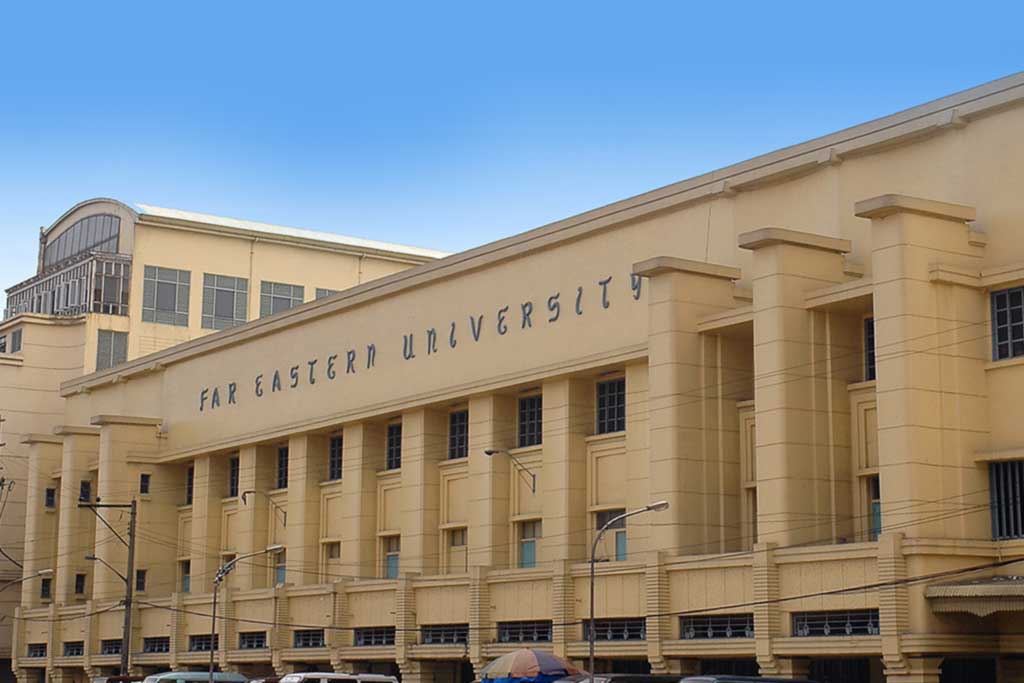
Dr. Nicanor B. Reyes, Sr., as the founding president of the university, spent his early years establishing the courses and programs for FEU. For the campus, he commissioned Ar. Pablo S. Antonio, Sr.(son-in-law of the founder) to construct the main building - NRH and several structures for the university. In 1940, the Nicanor B. Reyes Sr. Hall, which would later house the main library at third level and Institute of Accounts, Business and Finance, opened. Two other buildings by Antonio, the Girl's High School Building and Boy's High School Building followed. Enrollment had blown with approximately 10,000 registered students and an international student population of 400. Former Philippine President Manuel L. Quezon hailed and called FEU "the best non-sectarian institution in the country."
Hub AI
Far Eastern University AI simulator
(@Far Eastern University_simulator)
Far Eastern University
Far Eastern University (Filipino: Pamantasan ng Malayong Silanganan), also referred to by its acronym FEU, is a private research non-sectarian university in Manila, Philippines. Created by the merger of Far Eastern College and Institute of Accounts, Business and Finance, FEU became a university in 1934 during the term of its first president, Dr. Nicanor B. Reyes, Sr.
The first accountancy school for Filipinos, the university has expanded its course offerings to the arts and sciences, architecture, fine arts, education, engineering, computer studies, graduate studies, tourism and hotel management, law, nursing, and medicine. FEU has eight campuses located in Metro Manila, Cavite, Rizal, and Pampanga. It offers programs from elementary, secondary, tertiary, to graduate school.
FEU Manila comprises several institutes that offer specific programs. The accountancy program, along with its other undergraduate programs, have received the highest Level IV accreditation from the Philippine Association of Colleges and Universities Commission on Accreditation (PACUCOA). The Commission on Higher Education (CHED) has also granted it as a Center of Development in Business Administration and a Center of Excellence for Teacher Education.
The university was founded in November 1933 when the Far Eastern College School of Accounts, Commerce & Finance along Arlequi Street, Quiapo, Manila in 1919 and the Institute of Accounts, Business and Finance (IABF) merged. Far Eastern College, founded in 1919 by Vicente F. Fabella (the first Filipino CPA), Nicanor Maronilla-Seva, Francisco Africa, Pedro Cortez, and Salvador Unson, had been a liberal arts college in Arlegui St., Quiapo; while the IABF had been established (originally under the name Institute of Accountancy) by Dr. Francisco T. Dalupan, Sr. and Dr. Nicanor B. Reyes, Sr., then head of the Department of Economics at the University of the Philippines, with a number of other prominent educators in 1928.
From the initial 117 students, population grew to 11,000 just before the war. IABF had been originally predominately used by night students, and the new university, which was supported by the tuition provided by its students rather than government grants, soon demonstrated that a private university was financially sustainable in the Philippines. FEU is the 6th oldest university in the Philippines and the 4th oldest private, nonsectarian university in the country based on its extant university charter.
In the early 1930s, FEU was housed in a converted tobacco factory (La Oriente Fabrica de Tabacos y Compania; boundary of Quiapo and Sampaloc district lots) already present on the 4 hectares (9.9 acres) property lot owned by Sulucan Hill Subdivision. Due to the widening of the street that became Quezon Blvd (formerly El Dorano Street)., the original building designed and built by Pablo S. Antonio, Sr., National Artist for Architecture, was demolished and had to be rebuilt on a bigger scale on what is the present campus of FEU.
In 1934, the first four institutes, Accounts, Business and Finance (IABF), Arts and Sciences (IAS), Law (IL), and Education (IE) were founded. Two years later, the Institute of Technology (FIT) was also established.
Dr. Nicanor B. Reyes, Sr., as the founding president of the university, spent his early years establishing the courses and programs for FEU. For the campus, he commissioned Ar. Pablo S. Antonio, Sr.(son-in-law of the founder) to construct the main building - NRH and several structures for the university. In 1940, the Nicanor B. Reyes Sr. Hall, which would later house the main library at third level and Institute of Accounts, Business and Finance, opened. Two other buildings by Antonio, the Girl's High School Building and Boy's High School Building followed. Enrollment had blown with approximately 10,000 registered students and an international student population of 400. Former Philippine President Manuel L. Quezon hailed and called FEU "the best non-sectarian institution in the country."
Recent media