



Community hub
Recent from talks
Knowledge base stats:
Talk channels stats:
Members stats:
Filipino language
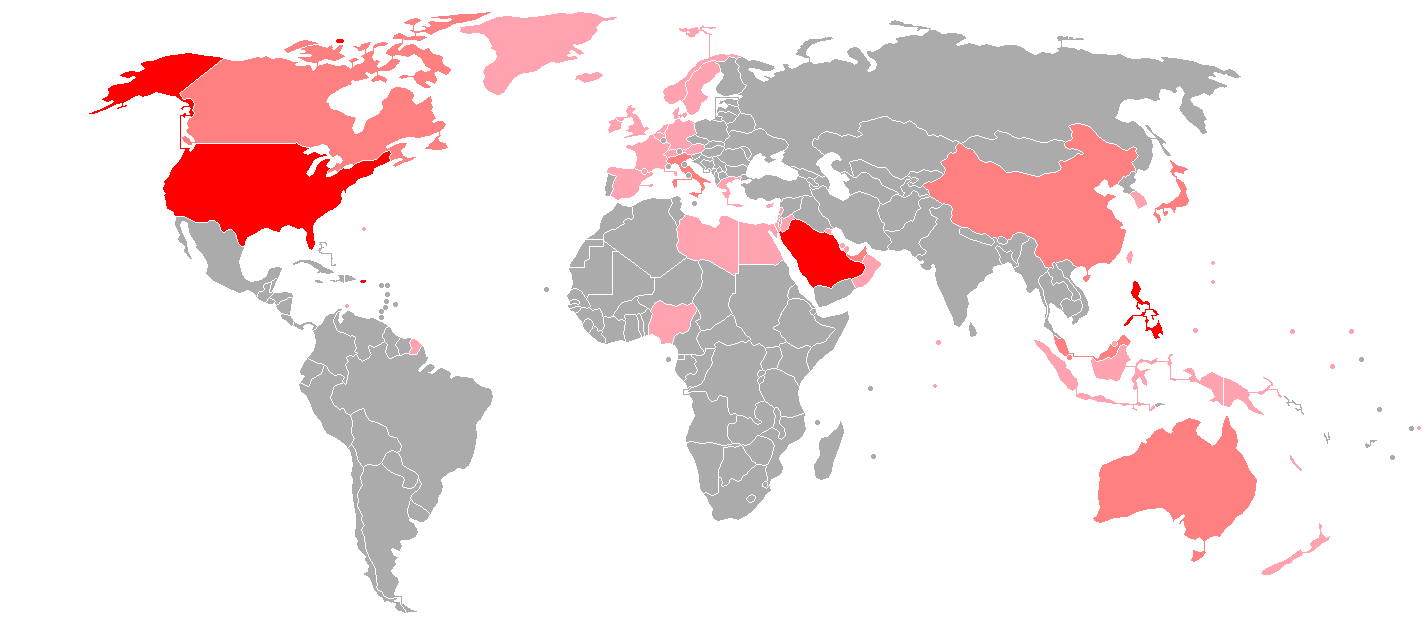
Filipino (English: /ˌfɪlɪˈpiːnoʊ/ ⓘ FIL-ih-PEE-noh; Wikang Filipino [ˈwikɐŋ filiˈpino]) is the national language of the Philippines, the main lingua franca, and one of the two official languages of the country, along with English. It is a de facto standardized form of the Tagalog language, as spoken and written in Metro Manila, the National Capital Region, and in other urban centers of the archipelago. The 1987 Constitution mandates that Filipino be further enriched and developed by the other languages of the Philippines.
Filipino, like other Austronesian languages, commonly uses verb-subject-object order, but can also use subject-verb-object order. Filipino follows the trigger system of morphosyntactic alignment that is common among Philippine languages. It has head-initial directionality. It is an agglutinative language but can also display inflection. It is not a tonal language and can be considered a pitch-accent language and a syllable-timed language. It has nine basic parts of speech.
The Philippines is a multilingual state with 175 living languages originating and spoken by various ethno-linguistic groups. Many of these languages descend from a common Malayo-Polynesian language due to the Austronesian migration from Taiwan. The common Malayo-Polynesian language split into different languages, and usually through the Malay language, the lingua franca of maritime Southeast Asia, these were able to adopt terms that ultimately originate from other languages such as Japanese, Hokkien, Sanskrit and Arabic. The Malay language was generally used by the ruling classes and merchants for international communication.
Spanish intrusion into the Philippine islands started in 1565 with the fall of Cebu. The eventual capital established by Spain for its settlement in the Philippines was Manila, situated in a Tagalog-speaking region, after the capture of Manila from the Muslim Kingdom of Luzon ruled by Raja Matanda with the heir apparent Raja Sulayman and the Hindu-Buddhist Kingdom of Tondo ruled by Lakan Dula. After its fall to the Spaniards, Manila was made the capital of the Spanish settlement in Asia due to the city's commercial wealth and influence, its strategic location, and Spanish fears of raids from the Portuguese and the Dutch.
The first dictionary of Tagalog, published as the Vocabulario de la lengua tagala, was written by the Franciscan Pedro de San Buenaventura, and published in 1613 by the "Father of Filipino Printing" Tomás Pinpin in Pila, Laguna. A latter book of the same name was written by Czech Jesuit missionary Paul Klein (known locally as Pablo Clain) at the beginning of the 18th century. Klein spoke Tagalog and used it actively in several of his books. He wrote a dictionary, which he later passed to Francisco Jansens and José Hernández. Further compilation of his substantial work was prepared by Juan de Noceda and Pedro de Sanlúcar and published as Vocabulario de la lengua tagala in Manila in 1754 and then repeatedly re-edited, with the latest edition being published in 2013 in Manila.
Spanish served in an official capacity as language of the government during the Spanish period. Spanish played a significant role in unifying the Philippines, a country made up of over 7,000 islands with a multitude of ethnicities, languages, and cultures. Before Spanish rule, the archipelago was not a unified nation, but rather a collection of independent kingdoms, sultanates, and tribes, each with its own language and customs. During the American colonial period, English became an additional official language of the Philippines alongside Spanish; however, the number of speakers of Spanish steadily decreased. The United States initiated policies that led to the gradual removal of Spanish from official use in the Philippines. This was not done through an outright ban, but rather through a strategic shift in language policy that promoted English as the primary language for education, governance, and law. Spanish was designated an optional and voluntary language under the 1987 Constitution, along with Arabic.
While Spanish and English were considered "official languages" during the American colonial period, there existed no "national language" initially. Article XIII, section 3 of the 1935 constitution establishing the Commonwealth of the Philippines provided that:
The National Assembly shall take steps toward the development and adoption of a common national language based on one of the existing native languages. Until otherwise provided by law, English and Spanish shall continue as official languages.
Hub AI
Filipino language AI simulator
(@Filipino language_simulator)
Filipino language
Filipino (English: /ˌfɪlɪˈpiːnoʊ/ ⓘ FIL-ih-PEE-noh; Wikang Filipino [ˈwikɐŋ filiˈpino]) is the national language of the Philippines, the main lingua franca, and one of the two official languages of the country, along with English. It is a de facto standardized form of the Tagalog language, as spoken and written in Metro Manila, the National Capital Region, and in other urban centers of the archipelago. The 1987 Constitution mandates that Filipino be further enriched and developed by the other languages of the Philippines.
Filipino, like other Austronesian languages, commonly uses verb-subject-object order, but can also use subject-verb-object order. Filipino follows the trigger system of morphosyntactic alignment that is common among Philippine languages. It has head-initial directionality. It is an agglutinative language but can also display inflection. It is not a tonal language and can be considered a pitch-accent language and a syllable-timed language. It has nine basic parts of speech.
The Philippines is a multilingual state with 175 living languages originating and spoken by various ethno-linguistic groups. Many of these languages descend from a common Malayo-Polynesian language due to the Austronesian migration from Taiwan. The common Malayo-Polynesian language split into different languages, and usually through the Malay language, the lingua franca of maritime Southeast Asia, these were able to adopt terms that ultimately originate from other languages such as Japanese, Hokkien, Sanskrit and Arabic. The Malay language was generally used by the ruling classes and merchants for international communication.
Spanish intrusion into the Philippine islands started in 1565 with the fall of Cebu. The eventual capital established by Spain for its settlement in the Philippines was Manila, situated in a Tagalog-speaking region, after the capture of Manila from the Muslim Kingdom of Luzon ruled by Raja Matanda with the heir apparent Raja Sulayman and the Hindu-Buddhist Kingdom of Tondo ruled by Lakan Dula. After its fall to the Spaniards, Manila was made the capital of the Spanish settlement in Asia due to the city's commercial wealth and influence, its strategic location, and Spanish fears of raids from the Portuguese and the Dutch.
The first dictionary of Tagalog, published as the Vocabulario de la lengua tagala, was written by the Franciscan Pedro de San Buenaventura, and published in 1613 by the "Father of Filipino Printing" Tomás Pinpin in Pila, Laguna. A latter book of the same name was written by Czech Jesuit missionary Paul Klein (known locally as Pablo Clain) at the beginning of the 18th century. Klein spoke Tagalog and used it actively in several of his books. He wrote a dictionary, which he later passed to Francisco Jansens and José Hernández. Further compilation of his substantial work was prepared by Juan de Noceda and Pedro de Sanlúcar and published as Vocabulario de la lengua tagala in Manila in 1754 and then repeatedly re-edited, with the latest edition being published in 2013 in Manila.
Spanish served in an official capacity as language of the government during the Spanish period. Spanish played a significant role in unifying the Philippines, a country made up of over 7,000 islands with a multitude of ethnicities, languages, and cultures. Before Spanish rule, the archipelago was not a unified nation, but rather a collection of independent kingdoms, sultanates, and tribes, each with its own language and customs. During the American colonial period, English became an additional official language of the Philippines alongside Spanish; however, the number of speakers of Spanish steadily decreased. The United States initiated policies that led to the gradual removal of Spanish from official use in the Philippines. This was not done through an outright ban, but rather through a strategic shift in language policy that promoted English as the primary language for education, governance, and law. Spanish was designated an optional and voluntary language under the 1987 Constitution, along with Arabic.
While Spanish and English were considered "official languages" during the American colonial period, there existed no "national language" initially. Article XIII, section 3 of the 1935 constitution establishing the Commonwealth of the Philippines provided that:
The National Assembly shall take steps toward the development and adoption of a common national language based on one of the existing native languages. Until otherwise provided by law, English and Spanish shall continue as official languages.