Hubbry Logo
Far pointFar pointMain
Open search
Far point
Community hub
Far point
logo
7 pages, 0 posts
0 subscribers
Be the first to start a discussion here.
Far point
Far point
from Wikipedia

In visual perception, the far point is the farthest point at which an object can be placed (along the optical axis of the eye) for its image to be focused on the retina within the eye's accommodation. It is sometimes described as the farthest point from the eye at which images are clear. The other limit of eye's accommodation is the near point.

For an unaccommodated emmetropic eye, the far point is at infinity, but for the sake of practicality, infinity is considered to be 6 m (20 ft) because the accommodation change from 6 m to infinity is negligible. See visual acuity or Snellen chart for details about 6/6 (m) or 20/20 (ft) vision.

For an unaccommodated myopic eye, the far point is closer than 6 m. It depends upon the refractive error of the person's eye.

For an unaccommodated hypermetropic eye, incident light must be converging before entering the eye so as to focus on the retina. In this case (the hypermetropic eye) the focus point is behind the retina in virtual space, rather than on the retina screen.

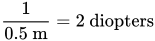
Sometimes far point is given in diopters, the inverse of the distance in meters (see Simple myopia). For example, an individual who can see clearly out to 50 cm would have a far point of .
Vision correction

[edit]

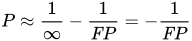
A corrective lens can be used to correct myopia by imaging an object at infinity onto a virtual image at the patient's far point. According to the thin lens formula the required optical power P is

,[1]

where FP is the distance to the patient's far point. P is negative, because a diverging lens is required.

This calculation can be improved by taking into account the distance between the spectacle lens and the human eye, which is usually about 1.5 cm:

.

For example, if a person has FP = 30 cm, then the optical power needed is P = −3.51 diopters where one diopter is the reciprocal of one meter.

References

[edit]
Revisions and contributorsEdit on WikipediaRead on Wikipedia
from Grokipedia
The far point of the eye is defined as the maximum distance from the eye at which an object can be clearly focused on the without accommodation, typically at optical for an emmetropic (normal) eye. In refractive errors such as (nearsightedness), the far point is finite and closer than , meaning distant objects appear blurred because light rays converge in front of the . Conversely, in hyperopia (), the far point is a virtual point located behind the eye when relaxed, requiring accommodation to focus distant objects on the , which can strain the eye over time. This concept is fundamental in and for assessing and prescribing corrective lenses, where the lens power is calculated to shift the far point to for optimal . The far point contrasts with the , the closest distance for clear focus, and together they define the eye's accommodative range, which diminishes with age due to .

Fundamentals

Definition

The far point of the eye is defined as the maximum distance from the eye at which an object can be clearly focused on the without the use of accommodation, corresponding to the state where the is fully relaxed and the crystalline lens is in its least convex form. In this unaccommodated condition, parallel rays of light originating from optical are ideally focused precisely on the in an emmetropic eye, placing the far point at . Accommodation, the process by which the eye adjusts the lens curvature to focus on nearer objects, is not engaged at this point. The position of the far point is typically quantified in diopters (D), a unit representing the reciprocal of the distance in meters from the eye; for instance, a far point at 6 meters corresponds to -1/6 D or approximately -0.17 D, indicating a myopic where a diverging lens of -0.17 D is required for correction. This measurement reflects the of the needed to shift the far point to infinity for clear without accommodation. A basic ray diagram illustrates this concept: parallel rays from a distant object at the far point enter the eye and, after refraction by the cornea and relaxed lens, converge to a single point on the retina, forming a sharp image without divergence or additional bending.

Optical basis

The far point of the eye represents the location from which light rays, in the absence of accommodation, are focused precisely on the retina, governed by the principles of geometric optics applied to the eye's refractive system. In the simplified thin lens model of the eye, the refractive apparatus—approximated as a single lens—obeys the lens equation 1f=1v1u\frac{1}{f} = \frac{1}{v} - \frac{1}{u}, where ff is the focal length of the eye's effective lens, uu is the object distance (corresponding to the far point), and vv is the fixed image distance to the retina, approximately 17 mm (effective from the second principal plane). This equation determines the position of the far point uu based on the eye's focal properties, ensuring that incoming rays from that distance converge on the retina without additional lens adjustment. A key concept in ophthalmic is vergence, which quantifies the convergence or of rays as the reciprocal of the to their point of focus, expressed in diopters () where dd is in meters: P=1dP = \frac{1}{d}. For the relaxed emmetropic eye, the far point lies at optical , yielding a vergence of 0 , as parallel rays from distant objects are focused directly on the . In this state, the incident vergence UU at the eye plus the eye's total power FF equals the emergent vergence VV at the : V=U+FV = U + F, with U=0U = 0 for . The eye's total refractive power arises primarily from its anterior components: the contributes approximately 43 , while the crystalline lens in its relaxed state adds about 20 , yielding an overall power of roughly 60 in the emmetropic eye. This power is complemented by the eye's axial length of approximately 24 mm, which fixes the relative to the principal planes of the refractive . Deviations in this balance, known as ametropia, shift the far point; the dd to the far point can be calculated as d=1Peye60 Dd = \frac{1}{P_\text{eye} - 60~\text{D}}, where PeyeP_\text{eye} is the effective power of the ametropic eye, reflecting how excess or deficit power alters the required incident vergence for focus. For instance, if Peye=62P_\text{eye} = 62 , d=0.5d = 0.5 m, positioning the far point 50 cm in front of the eye.

Normal Vision

Emmetropia

refers to the refractive condition of the eye in which there is no significant error in focusing power, allowing parallel rays of light from distant objects to converge precisely on the when the eye is in its relaxed state. In this ideal optical setup, the far point—the farthest distance at which an object can be clearly focused without accommodation—lies at optical . This configuration ensures that incoming parallel light rays, as from a very distant source, form a sharp image on the without the need for muscular effort to adjust the lens. The balance achieving arises from the precise matching of the eye's axial and its total refractive power. In a typical emmetropic eye, the axial measures approximately 24 mm, while the combined refractive power of the and crystalline lens totals about 60 diopters (D), with the contributing roughly two-thirds of this power. This equilibrium ensures that the posterior focal point of the eye's optical system aligns exactly with the , preventing blurred distance vision. Deviations in either parameter, such as a slightly longer or shorter axial , would shift the far point and introduce . Under emmetropic conditions, individuals can achieve normal , such as 20/20 vision, for distant objects without any corrective lenses, as the far point's vergence is 0 D, corresponding to rays from . This vergence value reflects the absence of any required diverging or converging adjustment for parallel incident . The far point concept thus serves as a key diagnostic reference in , confirming the eye's ability to handle infinite-distance viewing sharply. In emmetropic eyes, the far point remains stably at infinity throughout adulthood, unaffected by typical age-related changes in lens flexibility, such as the development of , which primarily impairs near focusing rather than distant clarity. This lifelong stability underscores emmetropia's role as the benchmark for normal refractive health.

Accommodation and far point

In emmetropic eyes, the far point is situated at optical when the ciliary muscle is fully relaxed, providing the baseline for clear distance vision without any accommodative effort. Accommodation enables the eye to shift focus inward from this far point to nearer objects by dynamically increasing the total of the eye, primarily through changes in the crystalline lens. This process is essential for maintaining sharp retinal images across a range of viewing distances in normal vision. The accommodation mechanism begins with the contraction of the ciliary muscles, which relaxes the tension in the zonular fibers attached to the lens equator. This allows the elastic lens capsule to mold the lens into a thicker, more spherical shape, thereby increasing its refractive power from approximately 20 diopters in the relaxed state to up to 33 diopters during maximum effort in youth. As a result, parallel rays from the far point converge precisely on the without adjustment, while rays from closer objects—carrying positive vergence—are compensated by this enhanced lens power to achieve the same focal outcome. The amplitude of accommodation represents the maximum dioptric change the lens can undergo, typically ranging from 10 to 15 diopters in young adults, which permits clear vision from the far point to a conventional of about 25 cm. In the relaxed state, the far point defines the optical reference; accommodation then actively increases the eye's converging power to draw this reference plane forward, ensuring nearer stimuli are focused sharply. This adjustment is finite, however, and diminishes gradually with age due to reduced flexibility and lens elasticity. Physiological constraints further define the precision around the far point, including a of approximately 0.5 diopters, which arises from the interplay of diameter—typically 3 to 5 mm in normal lighting—and the tolerable size of the . Within this narrow range, slight defocus remains imperceptible, providing a buffer for minor variations in object without requiring active accommodation.

Refractive Errors

Myopia

In , the far point is the maximum from the eye at which an object can be clearly focused on the without accommodation, and it is located at a finite in front of the eye rather than at optical . For instance, in an eye with -0.5 diopters of , the far point is approximately 2 meters away, meaning objects beyond this distance appear blurred unless the eye accommodates or correction is applied./University_Physics_III_-Optics_and_Modern_Physics(OpenStax)/02%3A_Geometric_Optics_and_Image_Formation/2.06%3A_The_Eye) This finite far point arises because parallel rays from distant objects converge to a focal point anterior to the , requiring the eye's optical system to handle incoming rays with negative vergence at the far point to achieve sharp imagery. The primary causes of this shifted far point in include an excessive axial length of the eyeball or increased refractive power of its components. A normal adult eye has an axial length of approximately 23-24 ; when this exceeds 24 , the elongation shifts the retinal plane behind the focal point, resulting in axial . Alternatively, refractive occurs when the total refractive power surpasses the normal range of about 60 diopters, often due to a steeper corneal or higher lens , causing to focus prematurely in front of the . These structural mismatches lead to the negative vergence characteristic of the myopic far point. Myopia is classified into types based on these etiologies, with simple myopia typically referring to mild axial elongation (often under -6 diopters) that develops during childhood or without underlying . In contrast, refractive myopia stems from alterations in the or lens power, independent of axial length changes, and is less common than the axial form. The distance to the far point can be calculated as d=1myopia in dioptersd = \frac{1}{|\text{myopia in diopters}|} in meters, providing a direct quantitative link between the refractive error magnitude and the effective viewing range./University_Physics_III_-Optics_and_Modern_Physics(OpenStax)/02%3A_Geometric_Optics_and_Image_Formation/2.06%3A_The_Eye) The primary symptoms stem from this restricted far point, manifesting as blurred vision for distant objects and limiting unaided clear viewing to closer ranges. Individuals may struggle to read road signs or recognize faces from afar, prompting behaviors like squinting to temporarily sharpen focus. This distance vision impairment can lead to eye strain and headaches during prolonged attempts to view remote targets, underscoring the far point's role in defining the practical boundaries of uncorrected myopic sight.

Hyperopia

In hyperopia, the far point of the eye is a virtual point located behind the eye, meaning that when the eye is fully relaxed, parallel rays from distant objects converge to a focus behind the rather than on it. This positioning requires the eye to exert accommodative effort even for viewing objects at to bring the image onto the . For instance, in a case of +2 diopters (D) of hyperopia, the far point lies approximately 50 cm behind the eye, as the distance is the reciprocal of the magnitude. The primary causes of hyperopia involve structural factors that reduce the eye's overall converging power, necessitating additional positive vergence from incoming light rays to achieve focus on the . A shorter , typically less than 24 compared to the emmetropic average of about 23-24 , is the most common , as it positions the too close to the refractive elements. Alternatively, reduced refractive power of the or lens—such as a total ocular power below 60 D, often due to corneal flattening—can contribute, with each 1 increase in leading to roughly 6 D of hyperopia. Hyperopia is classified into latent and manifest components, distinguished by the eye's accommodative response, which can the true position of the far point in younger individuals. Latent hyperopia represents the portion compensated by tonic accommodation, remaining undetected without cycloplegic agents, while manifest hyperopia is the measurable error under non-cycloplegic conditions; the total is their sum. In uncorrected young eyes, accommodation often fully or partially overcomes the refractive , shifting the apparent far point toward infinity, but the inherent uncorrected far point remains at a distance of 1/D behind the eye, where D is the hyperopic . The effects of hyperopia include ocular strain during distance vision tasks, as even minimal accommodation for far points leads to asthenopic symptoms like and headaches without necessarily blurring distant objects. Additionally, the sustained accommodative demand can trigger accommodative convergence issues, such as , particularly in children with uncorrected hyperopia exceeding +3.50 D, where the convergence response overdrives alignment. Accommodation plays a compensatory by dynamically adjusting the far point forward, though this mechanism diminishes with age, unmasking the full error.

Clinical Applications

Measurement techniques

Measurement of the far point in clinical settings relies on both subjective and objective techniques to assess refractive errors and determine the point of clearest without accommodative effort. Subjective methods involve feedback to refine the far point position, while methods use instrumentation to directly evaluate the eye's . These approaches are essential for accurate , particularly in distinguishing from or hyperopia. Subjective methods primarily utilize the fogging technique combined with distance visual acuity charts, such as the , to locate the far point. In the fogging technique, the examiner starts with an objective estimate of and adds plus lenses (e.g., +0.75 D) to overcorrect the eye, blurring vision by 2-3 lines on the chart to relax accommodation and shift the far point forward. The plus power is then gradually reduced in 0.25 D increments until the patient reports maximum clarity at distance (e.g., 20/20 or better), indicating the far point has been aligned for emmetropic vision. This method ensures the far point is determined under controlled accommodative relaxation, typically using a phoropter to trial lenses during the process. The phoropter allows rapid lens changes and alignment for binocular testing at a standard distance of 6 meters. Objective methods provide independent verification of the far point without relying on patient responses. Retinoscopy neutralizes the light reflex from the observed through a retinoscope, where the far point is identified as the plane where rays converge or diverge relative to ; "with" motion indicates the far point behind the retinoscope (hyperopia), "against" motion places it between (myopia), and neutrality aligns it at the peephole (). Autorefractors automate this by measuring the vergence of the relaxed eye using infrared light and , detecting where parallel rays from infinity focus relative to the to quantify the far point's displacement. These devices output spherical and cylindrical powers that correspond to the far point location, often serving as a starting point for subjective refinement. Distinguishing non-cycloplegic from cycloplegic approaches is crucial, especially for hyperopes where latent accommodation can mask the true far point. Non-cycloplegic methods, such as standard or autorefraction, are performed without drugs and may overestimate or underestimate hyperopia due to unintended accommodative effort, shifting the apparent far point closer. Cycloplegic employs agents like 1% atropine drops (applied for up to 3 days) to paralyze the , fully relaxing accommodation and revealing the unmasked far point in hyperopes by preventing compensatory focusing. This is the gold standard for accurate far point assessment in children and young adults with potential accommodative reserves. Once is measured, the far point distance can be calculated as the reciprocal of the spherical power required for (in diopters, yielding meters), providing a quantitative metric for the eye's distant focus plane. For instance, a -2.00 D correction implies a far point at 0.50 meters without lenses. Instrumentation like the phoropter facilitates this by integrating trial lenses for both subjective and objective evaluations, ensuring precise far point determination in .

Vision correction strategies

Vision correction strategies leverage the concept of the far point to restore clear distance vision by aligning the eye's focal plane with infinity for emmetropia-like function. In myopic eyes, where the far point lies in front of the retina, corrective measures diverge incoming light to shift this point to optical infinity. Conversely, in hyperopic eyes, with the far point behind the retina, strategies add convergence to achieve the same adjustment. These approaches encompass optical aids and surgical interventions tailored to the refractive error's magnitude. Spectacle lenses provide the foundational correction by placing the lens's secondary focal point at the eye's . For , concave minus lenses diverge parallel rays from distant objects, effectively moving the far point to ; for instance, a -3 diopter (D) lens corrects a far point at 33 cm (1/0.33 m), allowing relaxed focus on without accommodation. In hyperopia, convex plus lenses converge rays to compensate for insufficient ocular power, shifting the posterior far point forward to and enabling clear . Contact lenses operate on similar principles of far point neutralization but require adjustments for —the gap between the lens and —to maintain equivalent power. Unlike spectacles, which typically sit 12 mm from the , contacts rest directly on the surface, necessitating less minus power for (e.g., a -12 D spectacle prescription converts to approximately -10.5 D for contacts) and more plus power for hyperopia to align the focal point precisely with the far point. This closer positioning minimizes distortions like minification in high and ensures the lens's power effectivity matches the eye's refractive needs without altering convergence demands. Refractive surgery, such as , permanently adjusts the far point by reshaping the to modify its refractive power. In , laser ablation flattens the central , reducing converging power and relocating the far point to for emmetropic distance vision. For hyperopia, the procedure steepens the to increase convergence, similarly positioning the far point at . For severe refractive errors unsuitable for corneal procedures, (IOL) implants add corrective power anterior to the natural lens, neutralizing the far point displacement without removing ocular tissue; these are particularly effective for high or hyperopia exceeding ±6 D. In , where age-related lens inflexibility limits accommodation but may coexist with refractive errors, multifocal corrections integrate far point adjustment for with a near add for close tasks. Multifocal IOLs or lenses feature zonal designs that split light into multiple foci, such as +2.5 D to +4 D adds superimposed on correction, enabling simultaneous far and near vision without the minification associated with single-vision plus adds alone. This approach preserves spectacle independence across distances while avoiding excessive magnification or distortion.

References

Add your contribution
Related Hubs
User Avatar
No comments yet.